

Kun Two: the southwestern Earth palace of the nine
Content version · · Sources & references
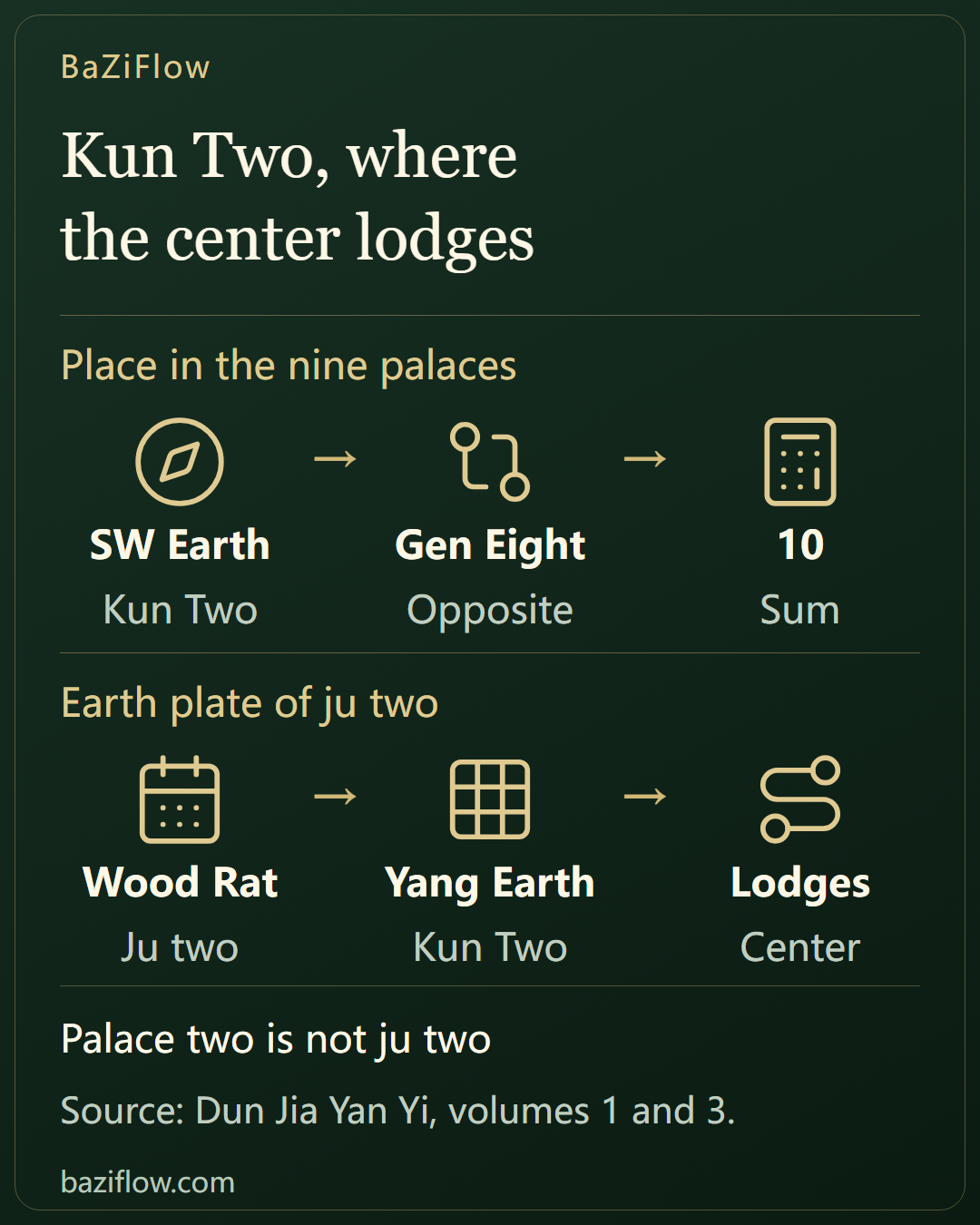
Kun Two is the southwest box of the nine palaces: number 2, trigram Kun, Earth. Two examples from Dun Jia Yan Yi show how palace two, ju two and the lodged center differ.
The short version8 min read
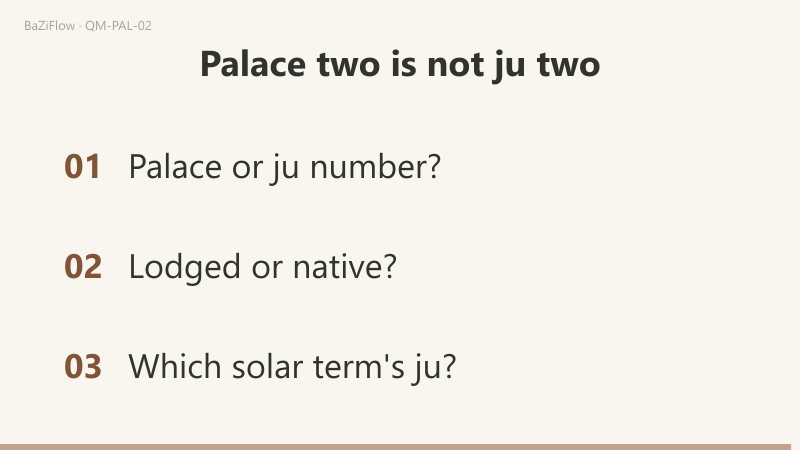
A "two" on a Qimen chart can mean two things: Kun Two, the southwest box with Luoshu number 2, the Kun trigram and Earth, or the ju number two, which only says where the Yang Wood Rat count begins. Dun Jia Yan Yi also lodges what falls in the center here.
- Kun Two sits at the upper right of a south-up grid, opposite Gen Eight; Dun Jia Yan Yi gives Kun Start of Autumn, End of Heat and White Dew, the second group of Yin-mode terms.
- The Dun Jia Yan Yi example for the middle ju of Grain Buds is Yang-mode ju 2 and starts Yang Wood Rat at the Kun palace. It also gives the upper ju starting at the center and the lower ju at Gen Eight, so each ju number equals its starting palace.
- The book writes "Yang Wood Horse, Yin Metal in the center, lodged in Kun" and "Yang Wood Dragon, five, is lodged in Kun Two": contents of the center are placed in Kun Two when they need a position, so this box sometimes takes in lodged material.
Read first
Southwest, Earth, Kun, two: the box of "earth"
Kun Two (坤二) takes the southwest corner of the nine palaces: number 2, trigram Kun, element Earth.
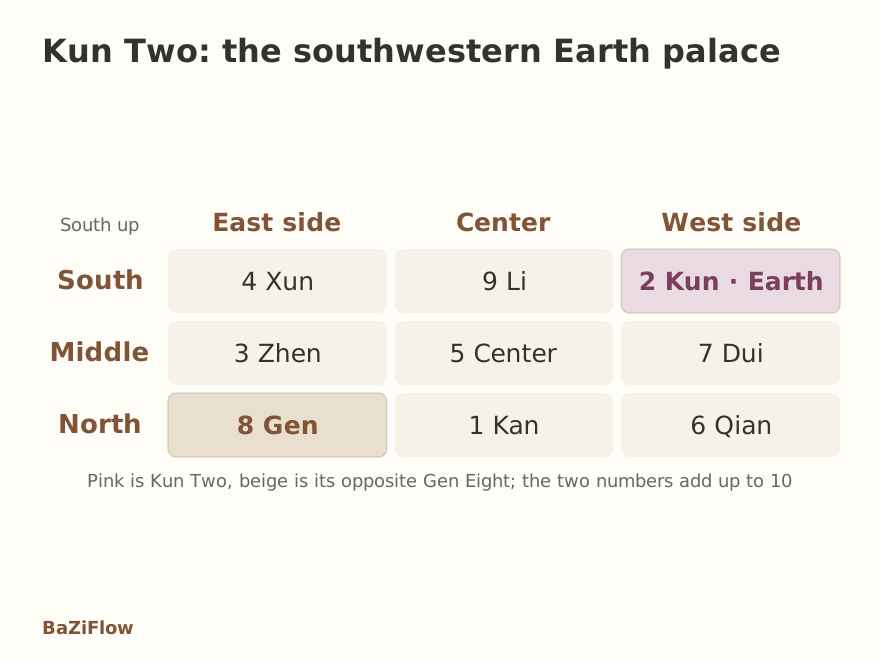
Nine-palace base grid with south at the top and east on the left. Directions and elements follow the usual assignments, the numbers are Luoshu numbers. Pink marks Kun Two and beige its opposite, Gen Eight.
With south drawn at the top, the southwest falls in the upper right, so Kun Two sits at the right end of the top row. Its opposite number is Gen Eight, at the lower left, and 2 + 8 = 10. The Shuo Gua (说卦), chapter 5, says of Kun:
Kun is the earth, the one in which all things are nourished; hence "serve in Kun".
"Earth" and "nourishing" say the same thing as the element Earth, and that is the layer of the trigram a Qimen chart draws on for the Kun palace. The third volume of Dun Jia Yan Yi (遁甲演义) also hands the terms of the year out among the trigrams, and Kun receives Start of Autumn, End of Heat and White Dew. The same passage makes the twelve terms after the Summer Solstice the Yin mode; counting along, Summer Solstice, Minor Heat and Major Heat belong to Li, and Kun comes next, so the terms of Kun are second within the Yin mode.
Middle ju of Grain Buds: Yang-mode ju 2 starts Yang Wood Rat at the Kun palace
An example in the third volume, dated the twelfth day of the fourth month of the twenty-fifth year of Wanli (a Yang Water Monkey (壬申) day, Yang Fire Horse hour), shows clearly how a ju lands on a palace:
On this Yang Water Monkey day at the noon hour it is exactly the middle ju of Grain Buds, Yang mode two, starting Yang Wood Rat at the Kun palace, the Three Wonders laid out backward and the Six Instruments forward. ... Yang Wood Rat, Yang Earth, is in Kun; Yang Wood Dog, Yin Earth, in Zhen; Yang Wood Monkey, Yang Metal, in Xun; Yang Wood Horse, Yin Metal, in the center, lodged in Kun; Yang Wood Dragon, Yang Water, in Qian; Yang Wood Tiger, Yin Water, in Dui.
The first "two" in the sentence is the ju number and the "Kun palace" that follows is the starting point: ju two means Yang Wood Rat with Yang Earth is laid out from the Kun Two palace. The same example gives the other two ju of Grain Buds: the upper ju starts at the center and the lower ju at Gen Eight. The three ju numbers, 5, 2 and 8, equal their starting palace numbers.
Enlarge diagram · scroll sideways to read
The picture shows the earth plate only, meaning where the nine stem symbols (the Three Wonders and the Six Instruments) land. No stars, gates or spirits are in it. The Six Instruments run forward from Kun Two, and the Three Wonders run backward in the order Yin Fire, Yang Fire, Yin Wood, which matches the book's "Yin Wood at Kan, Yang Fire at Li, Yin Fire at Gen". The split between heaven plate and earth plate is taken up in Three Wonders and Six Instruments.
Why the Yin Metal in the center is written "lodged in Kun"
On the earth plate above, the fifth palace holds Yin Metal, yet the book writes "Yang Wood Horse, Yin Metal in the center, lodged in Kun": the Yin Metal sits in the center and, when it needs a position, is lodged in Kun. The hourly example for the first Yang-mode ju, in volume 1, is written the same way. The Yang Wood Dragon cycle head is at the fifth, Tian Qin is the duty star, the Death Gate the duty gate, and the book notes "Yang Wood Dragon, five, is lodged in Kun Two".
Enlarge diagram · scroll sideways to read
For Kun Two this makes it the landing place of the center. There are only eight gates, so the center has no gate to hold, and when the book needs a place for what belongs to the center it writes that it is lodged in Kun Two. The duty gate of the Yang Wood Dragon cycle in ju 1 is the Death Gate, which is the home gate of Kun Two, so both places agree. The reason the book gives for lodging in Kun is one sentence, left for Center Five to read.
The same Yang Wood Dog cycle: Kun Two in Yang-mode ju 1, Gen Eight in Yin-mode ju 9
The home star of Kun Two is Tian Rui and its home gate is the Death Gate (see the home-position table). In volume 1's hourly examples the Yang Wood Dog cycle of the first Yang-mode ju falls exactly here, whereas in the ninth Yin-mode ju it lands elsewhere.
Enlarge diagram · scroll sideways to read
The box called Kun Two stays the same, and what enters it changes with the ju. The Yang Wood Dog cycle of Yang-mode ju 1 brings Tian Rui and the Death Gate, while in Yin-mode ju 9 it falls in Gen Eight and brings the home star Tian Ren and the Life Gate of Gen Eight. So when you see "the Yang Wood Dog cycle", first ask "in which ju", because only then do you know which palace it falls in and what it carries. "Death Gate" is a gate name whose home happens to be Kun Two; the book merely records it as the duty gate of this cycle.
Four things stacked in one box
Looking back, the two words "Kun Two" can touch four different kinds of information on a chart at once:
Enlarge diagram · scroll sideways to read
When you take notes, writing these four apart is far safer than writing only "Kun Two": the position is fixed, the setup varies with the ju, the home is an address in a list, and the lodged part depends on the method used.
Two small exercises
On the earth plate of Yang-mode ju 2, in which palace is Yin Metal?
It is laid in the fifth palace, which the book writes as "in the center, lodged in Kun", so it takes the Kun Two position when it needs a place.
What ju number is the lower ju of Grain Buds, and where does it start Yang Wood Rat?
The book writes "the lower ju, eight, starts Yang Wood Rat at Gen": ju eight, starting at Gen Eight. The upper ju five and the middle ju two work the same way, each ju number equal to its starting palace.
Next, read the neighboring Zhen Three palace for another example in which the ju number decides the starting point.
Questions readers ask next
Is the two in "ju two" the same two as in "Kun Two"?
The numeral is the same but it points to different things. The two in Kun Two is the palace number, fixed in the southwest corner. The two in ju two is the ju number, saying from which palace Yang Wood Rat with Yang Earth is laid out. In the Grain Buds example the middle ju is two and starts in Kun Two, but the same book gives upper ju five and lower ju eight, which start elsewhere.
The Death Gate has its home in Kun Two; does that make the palace unlucky?
It should not be read that way. The Death Gate is simply the name of one of the eight gates, and its home position happens to be Kun Two. In the Yang-mode ju 1 example the Yang Wood Dog cycle merely lists it as the duty gate. A gate name does not announce death, and the palace takes on no verdict from it.
When the center is "lodged" in Kun Two, does the chart gain an extra box?
No. Lodging only gives the contents of the center a place to stand, and the grid still has nine boxes. In this site's experimental chart Tian Qin shares the palace with Tian Rui while keeping its own star name. How other methods write it must be read from their own notes.
Was this article helpful?
Sources & references
Continue reading
Kan One: the Northern Water Palace Where the Daily Rest Gate Starts ↗
Zhen Three: the Eastern Wood Palace, Checked Against the "Flying Bird" Example ↗