

Red Phoenix: counting from Rabbit to the year
Content version · · Sources & references
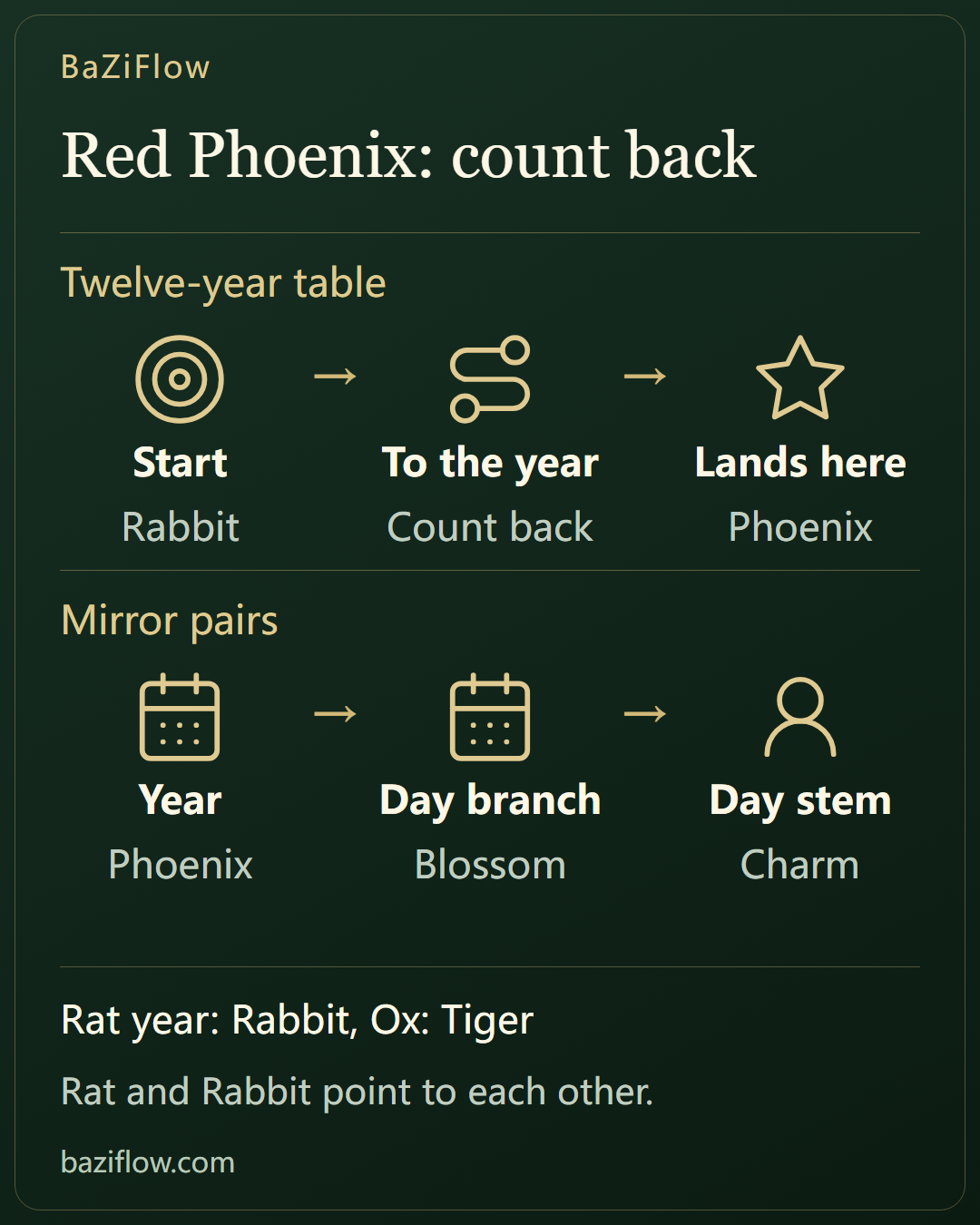
Red Phoenix starts from the year branch, counted back from Rabbit. A twelve-year table, the Ziwei verse, three other things of this name and a comparison with Peach Blossom and Red Charm set it apart.
The short version6 min read
Red Phoenix is counted from Rabbit: put the Rat there, count backward along the twelve branches until you reach the birth-year branch, and the branch where you stop is Red Phoenix; then search the four pillars for it.
- The start is fixed at Rabbit and the direction is backward: Rat year Rabbit, Ox year Tiger, Tiger year Ox, down to Pig year at Dragon. Each step forward in the year branch moves Red Phoenix one place back.
- The twelve year branches point at one another in pairs, Rat-Rabbit, Ox-Tiger, Dragon-Pig, Snake-Dog, Horse-Rooster, Goat-Monkey, like a mirror whose line runs between Ox and Tiger and between Goat and Monkey; each pair is one Yang and one Yin.
- The old books hold three other things of the same name: a pattern in juan 5, a phrase in the same juan, and a season table in juan 36 of the Xieji Bianfang Shu. Red Phoenix, Peach Blossom and Red Charm start from year branch, day branch and day stem.
Read first
Symbolic Stars in BaZi: Check the Reference and Rule Before the Meaning ↗
From Rabbit, counting back to the year branch
Red Phoenix (红鸾) has a one-line rule: start at Rabbit for the Rat, count backward to the branch of the birth year.
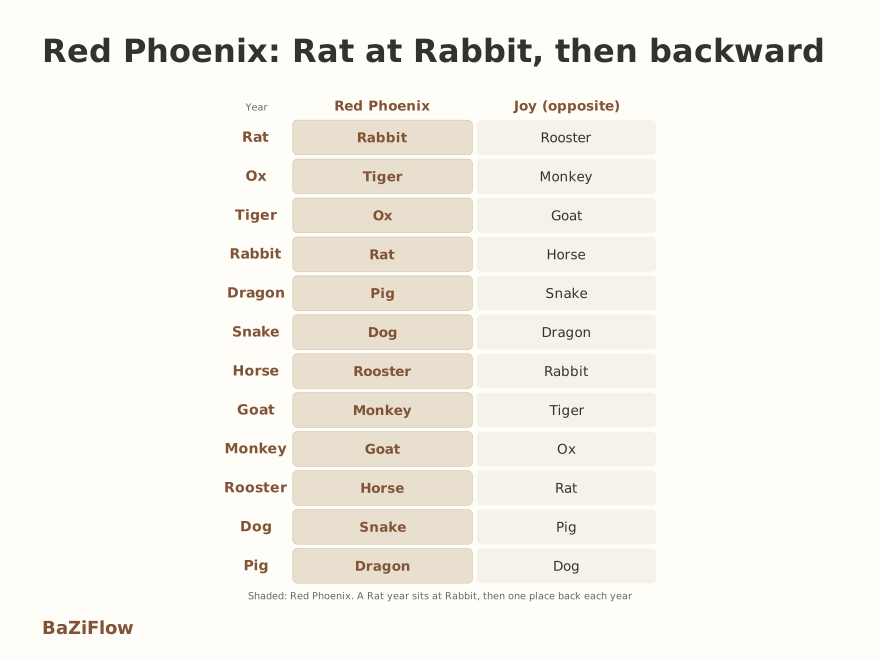
Comparison table: the Red Phoenix column follows the site engine's rule, checked year by year; the Heavenly Joy column is the branch opposite it, six places further on. Red Phoenix starts at Rabbit for the Rat and counts backward.
The Ziwei Doushu Quanshu (紫微斗数全书) states the rule as a rhyme in its juan 2, and the rhyme opens with these three lines:
From Rabbit start the Rat and count backward; count to the branch of the year of birth; where it stops, that palace is where Red Phoenix sits.
"The branch of the year of birth" is the year branch. Put Rat at Rabbit, Ox at Tiger, Tiger at Ox, Rabbit at Rat, Dragon at Pig, and keep walking back: a Rat year has Red Phoenix at Rabbit, an Ox year at Tiger, a Tiger year at Ox, a Rabbit year at Rat, a Dragon year at Pig, until a Pig year lands at Dragon. The last column of the table is the Heavenly Joy across from it, see Heavenly Joy.
Twelve years, six mirrored pairs
Link the twelve year branches in the table and the pointing turns out to be mutual: a Rat year has Red Phoenix at Rabbit, and a Rabbit year's Red Phoenix comes back to Rat; Ox and Tiger, Dragon and Pig, Snake and Dog, Horse and Rooster, Goat and Monkey form pairs too.
Enlarge diagram · scroll sideways to read
It is a mirror whose line passes between Ox and Tiger and between Goat and Monkey, and every year branch lands at its reflection. Each pair joins one Yang branch to one Yin branch, so a year pillar never lands on its own Red Phoenix; hits show up only on the month, day or hour pillar.
Three other things the old books call by this name
The name Red Phoenix turns up in more than one place in the old books, with different look-ups and uses:
Three places, three different things
"Red Phoenix Heavenly Seal" is a Eating God pattern
Juan 5 gives it for a Yang Fire day meeting Wu Xu or a Yin Metal day meeting Gui Chou, pillars of the Eating God; it has nothing to do with the year branch, and the site does not look for it.
"Sure to bring a red-phoenix omen"
In the verses on the wife star in juans 5 and 12, a Luck Pillar or year that meets the wealth group "is sure to bring a red-phoenix omen"; here Red Phoenix stands for happy news, not a table.
Rat in spring, Rooster in summer, Horse in autumn, Rabbit in winter
Juan 36 takes another "proper Red Phoenix" table by season for choosing wedding days and remarks that "the Heavenly Joy of spring and summer is the Red Phoenix of autumn and winter". The compilers criticize the whole scheme in the same entry.
Three things, three ways of starting: the site's Red Phoenix is counted the same way as in the Ziwei verse, started from the birth-year branch, with no season and no Eating God.
Three stars of romance, three different bases
Red Phoenix, Peach Blossom and Red Charm are often discussed together as romance stars, but their bases are quite different. Compare them on one chart:
Enlarge diagram · scroll sideways to read
The three hit on different pillars because each starts from a different character. When they show up together, tell which star comes from which base; Peach Blossom is in Peach Blossom and Red Charm in Red Charm.
Two sample charts, and the age condition in the book
Look each up with the site's engine:
Enlarge diagram · scroll sideways to read
In the first chart Dragon shows up on the day and hour pillars and each is recorded; the second has a single hit. The Monkey year runs from Rabbit back eight places to Goat, so reading it off the table is safer than counting by hand.
Even the compilers of the almanac said that Red Phoenix and Heavenly Joy are what fate-calculators use and are "of no great importance" for choosing days, in a note in juan 35 of the Xieji Bianfang Shu. The second half of the Ziwei verse attaches an age condition:
Young, marriage and happy events are marvelous... before thirty a lucky star, after fifty not suitable.
The book ties Red Phoenix to age, and the site's table has no such step. The site describes it as "a place for romance and happy events, bringing attraction and chances in relationships, a chance is not stability", a modern summary in which "attraction" cannot be found in these passages; the source is still to be checked.
Questions readers ask next
Is "Red Phoenix stirs this year" about the star the site shows?
It is a different matter. The site's Red Phoenix looks only at the birth-year branch, and its place is fixed; it does not change with the passing years. The verse's "branch of the year of birth" is also the birth year. Where the star falls in each later year is another use, which this table does not cover.
How does Red Phoenix differ from Peach Blossom?
The base differs: Red Phoenix starts from the year branch and counts backward from Rabbit, while Peach Blossom starts from the day branch and takes the place after the Growth of its Three Harmony group. In one chart both can appear, or only one, and neither depends on the other.
The book says "a lucky star before thirty". Does the site count that way?
No. The site's table only says where Red Phoenix falls, whether it appears among the four branches and on which pillar; it has no age step. The age condition is the verse's own wording, and reading it means going back to the book's setting.
Was this article helpful?
Sources & references
Continue reading
Heavenly Joy (天喜): The Branch Opposite Red Phoenix, and Other Tables of That Name ↗