

Horn: the Horn month and the year start
Content version · · Sources & references
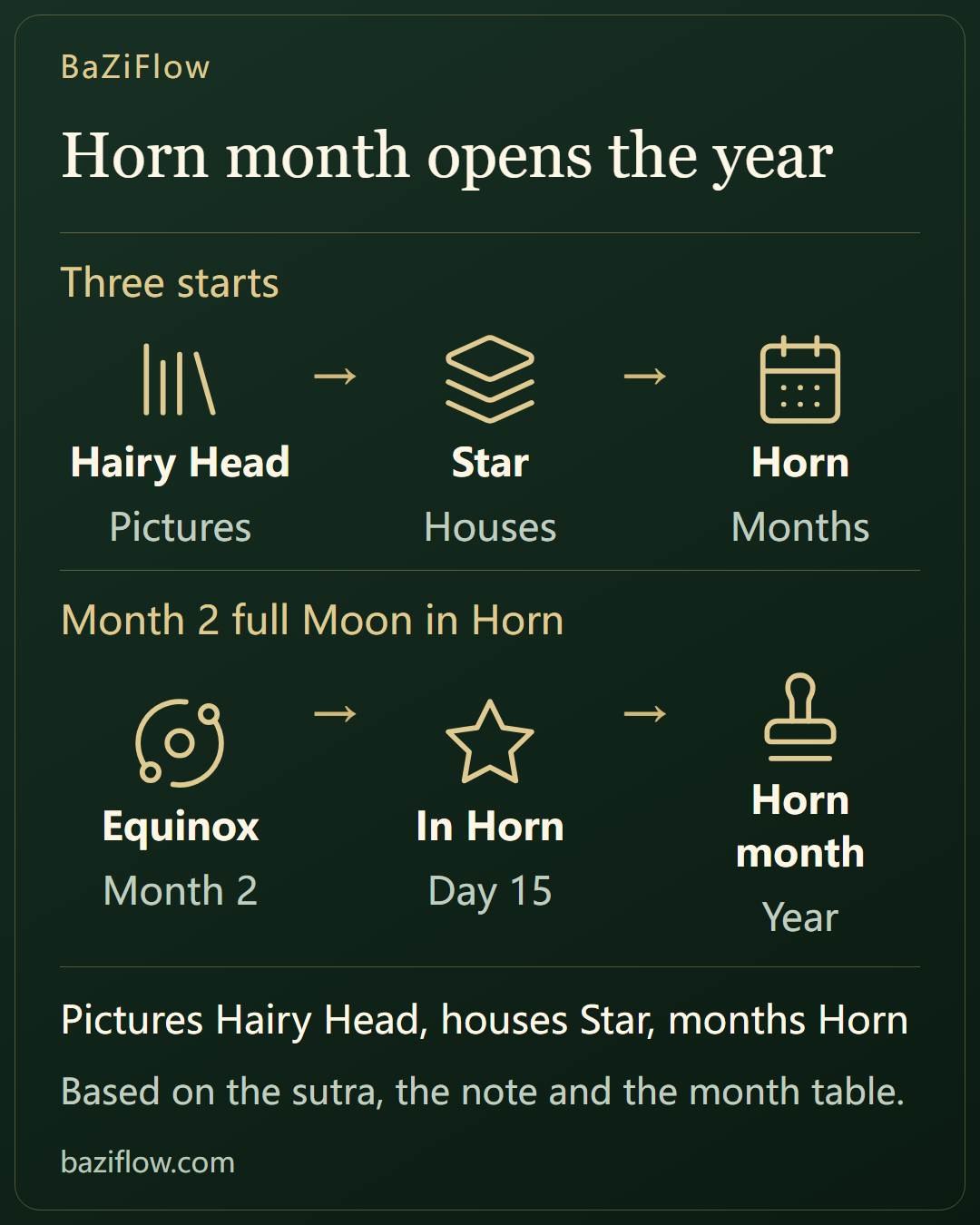
Horn (角) is position 12 on the site’s 27-mansion ring. The several starting points in the sutra, the second month as the start of the year, the two-star picture that agrees with the note, and its old-calendar days.
The short version6 min read
Horn (角) is position 12 on the site’s 27-mansion ring, between Chariot and Neck. The Sukuyō Sutra names its months after the mansion holding the full Moon, and the Horn month opens the year.
- The one sutra has several “firsts”: the pictures start at Hairy Head, the house table at Star, the month names and the year at Horn; Chinese practice with 28 mansions also counts from Horn.
- Jingfeng’s note says Tang took the Tiger-branch month as the start of the year and the western countries the Rabbit-branch month; the sutra text itself says the new Moon of month 2 at the equinox is made the origin by Brahma, and its full Moon falls in Horn.
- The picture gives Horn two stars shaped like a long banner and the note also says two. In the site’s month table, which follows Japan’s old calendar (new moon by Tokyo time), month 8 begins at Horn and day 15 of month 2 is Horn, which is April 2 in 2026.
Read first
What is Sukuyō astrology? How a birth mansion is found ↗
Sukuyō 27 mansions vs the 28 lunar mansions: what is the difference? ↗
Position 12 on the ring, and one book with several “firsts”
In the Sukuyō Sutra the year opens with the second month, which is named for the mansion of its full moon: the Horn month. On the site’s ring Horn (角) sits twelfth, after Chariot (轸) and before Neck (亢).
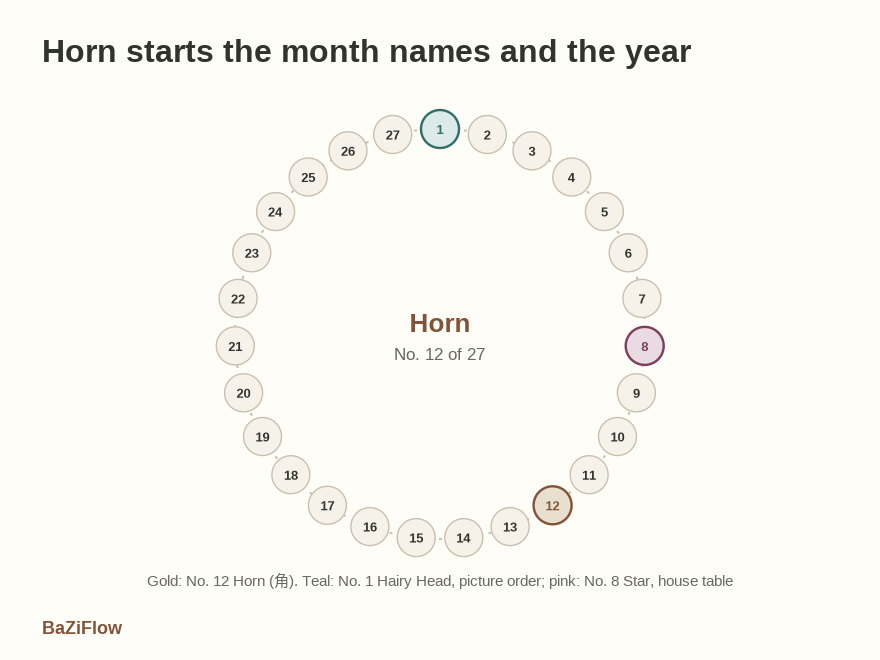
Gold Horn starts the month names and the year; teal Hairy Head starts the picture order, and pink Star starts the house table.
Gold is Horn. Teal is Hairy Head (昴), position 1 on the ring, and pink is Star (星), the mansion that opens the house table. In the one Sukuyō Sutra (宿曜经), “start counting from which mansion” has more than one answer:
Enlarge diagram · scroll sideways to read
The second month at the equinox: the Horn month starts the year
When the year begins in the sutra differs from Tang habit. Jingfeng set the two side by side in the passage on month names:
Great Tang takes the Tiger-branch month as the start of the year; India (天竺) takes the Rabbit-branch month as the head of the year.
The Tiger-branch month (建寅) is month 1 of the Tang calendar and the Rabbit-branch month (建卯) is month 2, so the sutra’s year-start comes one month after Tang’s month 1. The sutra gives a reason why month 2 is the one:
On the new Moon of the second month, at the spring equinox, the luminary then stood in the Bond mansion. The way was even and shadows true, the midday air mild, all things beginning to flourish and grow. Brahma was glad and made it the origin of the year.
Around the equinox day and night are equal and things begin to grow, so Brahma (梵天) took that month as the origin. The full Moon of this month falls in Horn, so the month is named the Horn month; day 15 of month 2 on the site’s month table is also Horn.
Enlarge diagram · scroll sideways to read
Two stars shaped like a long banner, two in the note too
The picture entry for Horn, in the chapter that draws every mansion, begins:
Horn has two stars, shaped like a long banner. It is the god Seshili (瑟室利).
A “banner” (幢) here is a long banner raised on a pole, and the sutra uses it to picture two stars one above the other. Jingfeng’s note then supplies the Chinese view: Horn has two stars, is in charge of the gate of heaven, and belongs to the east. Both numbers are two.
Enlarge diagram · scroll sideways to read
Among the seven mansions from Star to Root only Horn and Root have text and note agreeing (ten do across all 27; the numbers for the seven side by side are in Extended Net). In the house table Horn’s four feet divide evenly, two at the end of the Maiden house and two at the start of the Scales house; the passage in fascicle 2 that lists mansion days by house puts Horn in the Scales house (“take the Horn and Neck days”).
First of month 8, full moon of month 2: Horn in the old calendar
On the site’s month table Horn is the first-day mansion of old-calendar month 8, so day 1 of month 8 is Horn, and after a full lap of 27 steps day 28 is Horn again. Month by month the days run like this:
Enlarge diagram · scroll sideways to read
Day 15 of month 2 matches the Horn month above: month 2 begins at Legs (奎), and 14 steps reach Horn. Converted to the Gregorian calendar, old-calendar month 2, day 15 of 2026 is April 2, and the site’s table gives Horn that day.
From month 2 to month 8 the first-day mansion moves on 14 places in all (2, 2, 2, 2, 3, 3), so month 8 also starts at Horn, on the same mansion as the day-15 full Moon of month 2. In 2026 old-calendar month 7 has only 29 days, so the day after Wings is already the first of month 8 (September 11), which is Horn, and the Chariot between them gets no day; see Chariot for the details.
Before it is Chariot and after it Neck; for keeping month names, month tables and birth mansions apart, see Sukuyō and birth mansions.
Questions readers ask next
Why is Horn often called “the first mansion”?
In the customary order of the 28 Chinese mansions the seven of the Azure Dragon of the east come first and Horn heads them. The site’s ring follows the sutra’s picture order and starts at Hairy Head instead. The two “firsts” come from different orderings, and the sutra’s month names are a third start, again at Horn.
Is the second month really the start of the year in the sutra?
Two layers: Jingfeng’s note says Tang took the Tiger-branch month for the start of the year and the western countries the Rabbit-branch month, while the sutra text itself makes the new Moon of month 2 at the spring equinox the origin. So the month names run from the Horn month. That explains the month names; it does not move today’s old-calendar new year to month 2.
Day 15 of month 2 and day 1 of month 8 are both Horn. Is that a coincidence?
It is a result of how the month-start table is built. Month 2 starts at Legs, and 14 steps take you to Horn. From month 2 to month 8 the first-day mansion shifts 14 places in total, so month 8 also starts at Horn. The structure of the table makes the two coincide.
Was this article helpful?
Sources & references
Continue reading
Chariot (轸): A Hand of Five Stars, a Stray Heading, and a Skipped Day in 2026 ↗
Neck (亢): One-Star Fire Pearl, Three Runs of Nine from Neck, and a Leap Month ↗