

The square (90°): conditions and orbs
Content version · · Sources & references
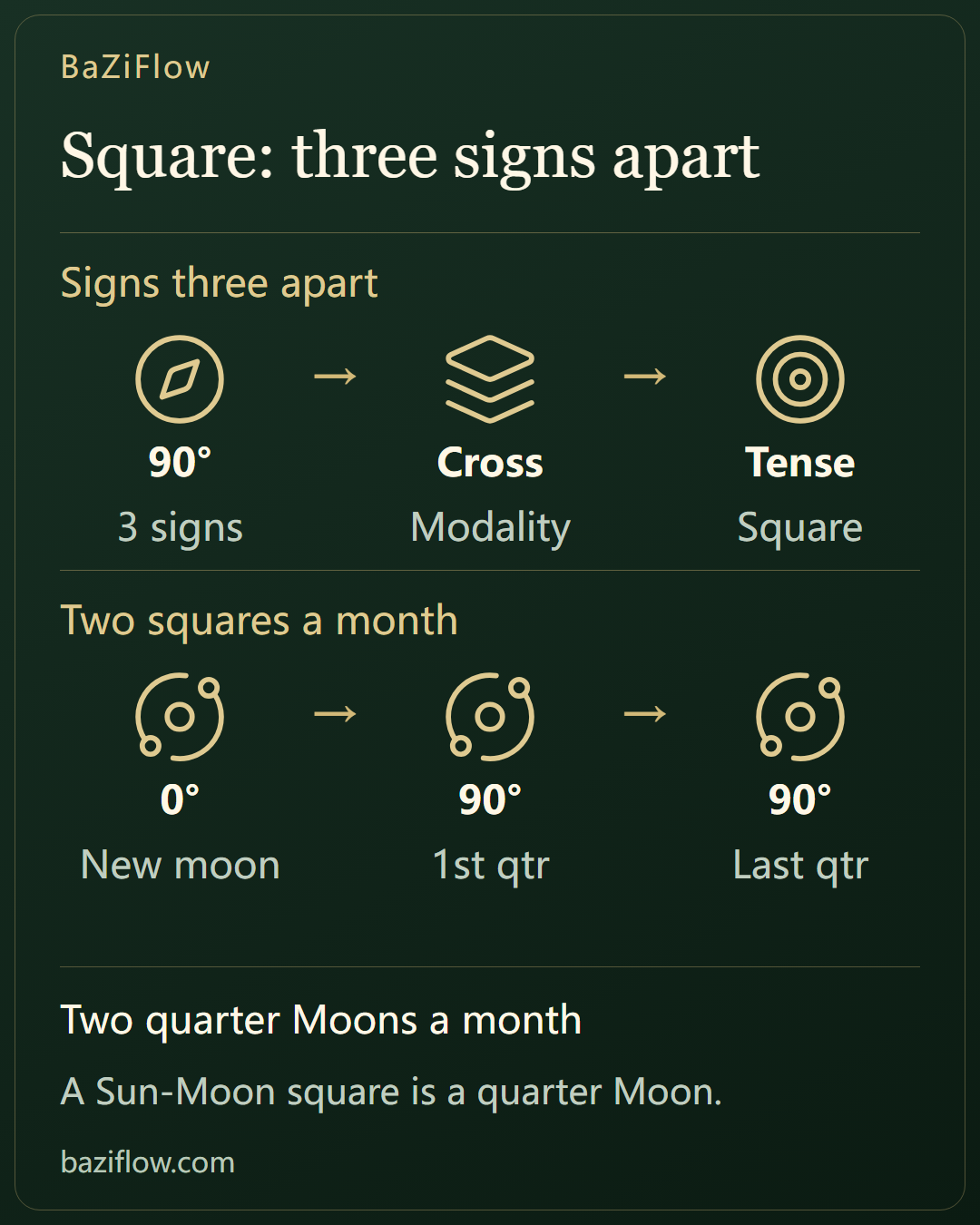
The square is a longitude gap near 90°, three signs apart for Ptolemy. From three crosses of signs to the quarter Moon, four squares on November 17, 2026, why the Ascendant and Midheaven get no line, and why orbs differ.
The short version7 min read
The square is two longitudes about 90° apart, three signs away, with an orb of 8° when the Sun or Moon takes part and 6° otherwise. The Sun and Moon square each other exactly twice a month, at the first and last quarter.
- Two signs three apart always share a modality, differ in element and have opposite polarity: Aries, Cancer, Libra and Capricorn form the cardinal cross, and fixed and mutable have one each.
- At 11:48 UTC on November 17, 2026 the Sun and Moon stood exactly 90° apart, Scorpio and Aquarius. That day Jupiter and Mars also squared the Sun, and all four lines ran between fixed signs.
- The longitude gap between the Ascendant and Midheaven varies with latitude, swinging between about 25° and 155° in a single day at 64° north, so the site draws no aspect between those two points; each can still square a planet.
Read first
Aspects and orbs in astrology: how to calculate the angle between two planets ↗
Three signs apart always make a cross: the starts of the seasons stand 90° apart
In plain words first: the square is a quarter of the circle, three signs. Ptolemy writes it as "exactly one right angle, three signs, ninety degrees" and calls it, like the opposition, "discordant", because it joins signs that differ in nature and in sex.
The signs alternate in polarity, and three is an odd number, so the two ends are always one yang and one yin. The site's sign table adds that two signs three apart share a modality and differ in element. Start at Aries and jump three signs at a time: Cancer, Libra, Capricorn, then back to Aries, and all four are cardinal signs.
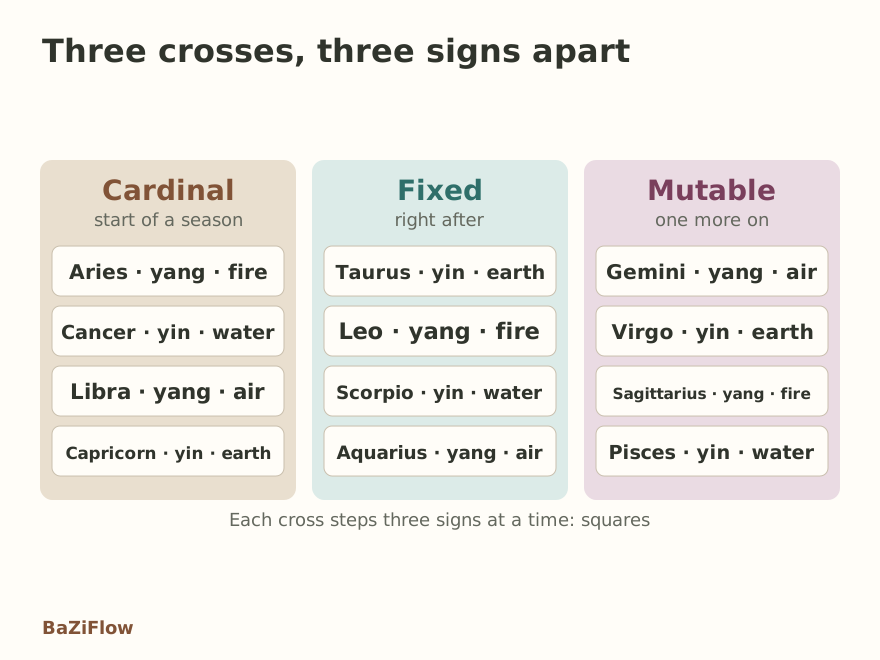
Polarity, element and modality come from the site sign table; each cross takes every third sign in order, and neighbors in a cross are in square.
Those four are also the starts of the seasons: Aries the spring equinox, Cancer the summer solstice, Libra the autumn equinox and Capricorn the winter solstice. Ptolemy (Book I chapter 11, XIV in Ashmand) calls them the equinoctial and tropical signs. The four right after them are the fixed signs, and the four after those he calls bicorporeal, which are the mutable signs. Each set of four is a cross of its own.
First and last quarter: the commonest square between two bodies
The Sun-Moon angle runs a full circle each month: 0° at the new moon, 90° at the first quarter, 180° at the full moon, and then the angle is 90° again with the Moon on the other side of the Sun, the last quarter. So in a month the Sun and Moon form exactly two squares, one opposition and one conjunction.
Enlarge diagram · scroll sideways to read
In every row the Sun and Moon have the same degree and minute and differ only in sign. At the first quarter of October 18 the Sun was in Libra and the Moon in Capricorn, one cardinal sign against another, exactly the cross of the first section; the first quarter of November 17 fell in Scorpio and Aquarius, both fixed.
In Book I (chapter VIII in Ashmand) Ptolemy cuts the Moon's round at its four quarters: from first appearing to the first quarter chiefly moisture, then to the full moon heat, to the last quarter dryness and from there to disappearing cold. Book II chapter XIII, on the weather, asks the reader to watch the Sun and Moon at the "intermediate quarters" as well as at new and full moon. Those assignments are the book's own; here they only show that the ancients already drew a line at 90°.
The site's window for a Sun-Moon square is 82°–98°. The November 17, 2026 one opened at 18:29 UTC on the 16th and closed at 04:50 UTC on the 18th, about a day and a half.
November 17, 2026: four squares in one day's sky
Now a whole sky. At 12:00 UTC that day the Sun was at 25°08′ Scorpio, the Moon at 25°14′ Aquarius, Jupiter at 25°59′ Leo, Mars at 26°26′ Leo, Mercury at 6°17′ Scorpio and Pluto at 3°18′ Aquarius. Among these positions the engine finds four squares:
Enlarge diagram · scroll sideways to read
The first three involve the Sun, so their limit is 8°; Mercury and Pluto are two planets with a limit of 6°. The site calls a deviation within 2° strong, 2°–4° medium and over 4° loose, with tightness 0.99, 0.90, 0.84 and 0.50: three strong and one medium. All four lines join fixed signs, Scorpio, Aquarius and Leo, three corners of the fixed cross.
Why the Ascendant and Midheaven get no square
Traditionally the four angles stand a quadrant apart. When Ptolemy lists the starting places for prorogation (Book III, chapter XII in Ashmand), he makes the thirty degrees in quartile to the Ascendant the tenth house at the Midheaven. Measured in longitude, though, the Ascendant and Midheaven are not always 90° apart.
The site engine sampled every 15 minutes through October 28, 2026. On the equator the gap between the two points stays between 85.1° and 94.9°; at 31.2° N it runs from 71.9° to 108.1°, at 51.5° N from 54.2° to 125.8°, and at 64° N from 25.3° to 154.7°. The higher the latitude, the wider the swing.
Enlarge diagram · scroll sideways to read
Orbs are not written one way: seven numbers in Ashmand's footnote
In Book I chapter XXVII, on application and separation, Ashmand adds a translator's footnote (not Ptolemy's text): "trifling distances" are said to mean the two stars being "within each other's orbs", and it lists seven: Saturn 10°, Jupiter 12°, Mars 7°30′, the Sun 17°, Venus 8°, Mercury 7°30′ and the Moon 12°30′.
Enlarge diagram · scroll sideways to read
The footnote does not say how two bodies' orbs combine into one limit, so using it on a real pair means adding a rule first, and no day's sky is judged with it here. The site chose a simpler rule: 8° for the Sun and Moon, 6° for the rest, taking the wider end. Software differs too: the TimePassages support article "Why Don't I See Certain Aspects in My Chart?" lists fixed default orbs for each chart type and says users cannot adjust them.
Three terms
- Modality
- Cardinal, fixed, mutable, in a round of three along the zodiac; two signs three apart share one.
- Tightness
- 1 minus (deviation ÷ limit), between 0 and 1; within 2° is called strong, 2°–4° medium and over 4° loose.
- Applying, separating
- The site's marker: the deviation from an exact 90° an hour later is smaller for applying and larger for separating, which matches the traditional test.
Along the table, the row before is the sextile (60°) and the next is the trine (120°); for how several lines join into a whole, see how aspect patterns fit back into the whole chart.
Questions readers ask next
Why does the Sun square the Moon twice a month?
The Sun-Moon angle runs a full circle every month and passes 90° and then 270°, which is 90° the other way round. The first is the first quarter and the second the last quarter, as on October 18, November 1 and November 17, 2026.
How long does a Sun-Moon square last?
The window is 82°–98° and the Moon gains about twelve degrees a day on the Sun, so it lasts a day and a half or so. The November 17, 2026 square opened at 18:29 UTC on the 16th and closed at 04:50 UTC on the 18th.
Are the two bodies of a square always in signs of one kind?
If you count signs, three apart, yes. If you measure degrees, not necessarily: a few degrees off 90° the two bodies can sit in signs of different modality, and the site still accepts the square while the gap stays inside the limit.
Was this article helpful?
Sources & references
Continue reading
The Sextile (60°): A Third of a Half-Circle, Checked on Three Real 2026 Readings ↗
The Trine (120°): Four Triangles of Signs and Windows That Last a Day or a Year ↗
Conjunction, opposition and square aspects: measure the angle before judging good or bad ↗