

Three cards, three distinct jobs
Content version · · Sources & references
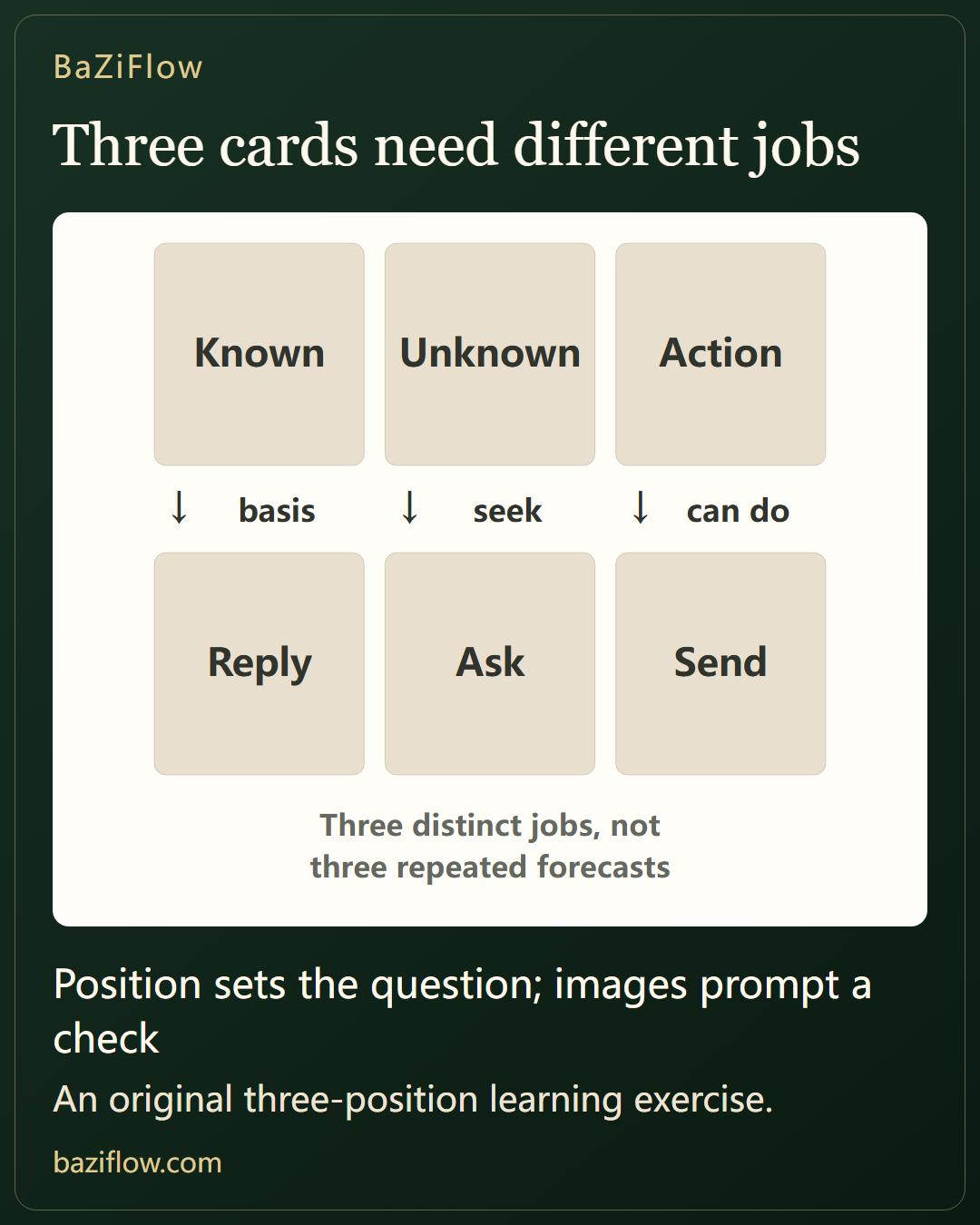
Design a small spread around known conditions, missing information and a possible action. A repair-event example shows why positions need to be defined before the cards and checked against external evidence.
The short version7 min read
A three-card exercise can separate known conditions, missing information and one possible action. Position defines the question before the image prompts an observation. The same gathering scene can therefore lead to three different checks rather than three forecasts of success.
- Write each position as a complete question before drawing; three cards do not intrinsically mean past, present and future.
- When an image moves to another position, its task changes. Rewrite the relevant question instead of transferring the entire previous interpretation.
- Explain how the contributions connect while preserving the difference between a confirmed condition, an information gap and an action you can take.
Read first
Frame a tarot question that leaves room for evidence ↗
Compare two formats before asking which one is better
A community repair group is choosing between a drop-in afternoon and booked appointments. A symmetrical row of three cards can make these options look equally defined even when they are not: the first needs capacity to handle an unknown queue, while the second needs someone to manage bookings. The missing information differs.
Before involving cards, list the room offer, confirmed volunteers and available equipment. Then choose what the three positions are for. This article uses known conditions, missing information and one action within your control. It is an original teaching design, not a recovered ancient spread or a claim that three cards make a choice more accurate.
The exercise can be completed without cards. If images are used, their role is to prompt attention to the plan. They do not tell you how many people will arrive or which volunteers have agreed.
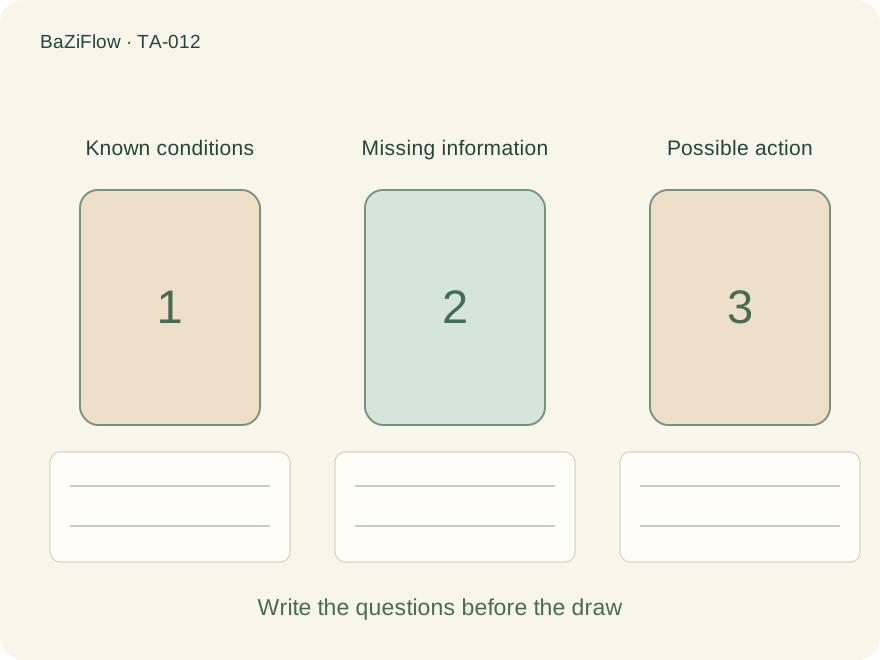
Original BaZiFlow three-position diagram: define a question and retain observations for each slot.
Define what each position is allowed to establish
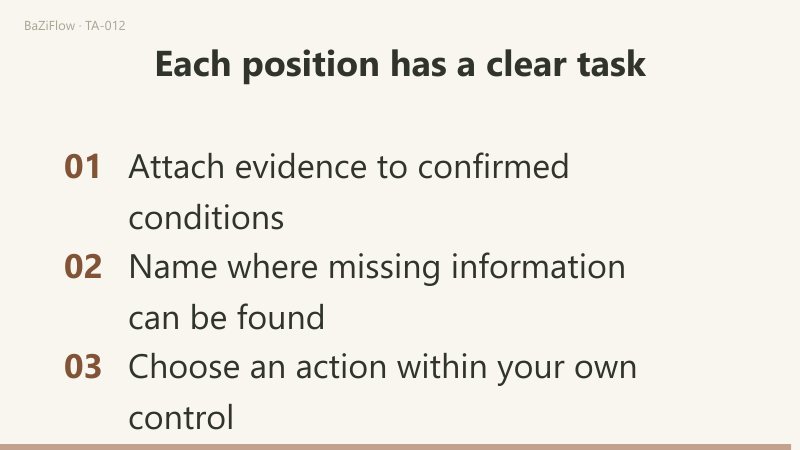
The first position does not create facts. If a lively image appears, it does not establish that volunteers have accepted. Record confirmed arrangements from actual messages or records, and use the image only to prompt a check of what you may have overlooked. A fact cannot become “known” merely because its story fits the card.
The second position asks what still needs checking. It is not a box for hidden truths that the cards supposedly reveal. If the equipment list is incomplete, ask the people who can supply it. The third asks for an action you can take, such as compiling a request or arranging a follow-up, rather than guaranteeing that other people will agree.
| Position | Repair-session question | Relevant evidence |
|---|---|---|
| Known conditions | What has actually been confirmed? | Room offer and written arrangements |
| Missing information | Which resources or people remain unconfirmed? | Volunteer replies and equipment details |
| Possible action | What can I complete next? | My time, responsibilities and available means |
Write the full questions before drawing. The same image can prompt different discussion in different positions because its assigned task changes. For example, a card showing people gathered together can prompt a check of who has replied in the known position, and of who has not in the missing position. Renaming a position after an awkward card appears is a different matter. If the second position cannot be interpreted usefully, preserve that gap instead of moving it to a new role called “the past”.
If the original questions turn out to be unsuitable, close the exercise with that observation and begin a separately recorded version. A change of design can be reasonable; concealing the change makes the record harder to understand.
Same gathering image
Known
- Prompt
- Who has confirmed?
- Evidence
- Replies received
Unknown
- Prompt
- Who has not replied?
- Evidence
- Outstanding replies
Action
- Prompt
- Whom can I remind?
- Evidence
- My contact list
Past, present and future is one choice, not the definition
Three cards do not intrinsically encode three points on a timeline. A time-based arrangement can organise a narrative, but a future label does not confer predictive authority. Even a past position must distinguish documented events from later symbolic interpretation. An endlessly adjustable future period makes an apparent fit especially difficult to assess.
Waite's historical Celtic layout assigns different roles to its positions, while the following section of his book uses another arrangement and procedure. These are examples of methods with stated rules. The three-position exercise here is not a compressed version claimed to be printed in either section. Its provenance is the present teaching design.
For a comparison exercise, another possible set of questions is “conditions required by option A”, “conditions required by option B”, and “information still needed to compare them”. The last card is not a judge. If one option has a different cost, time requirement or dependency, those asymmetries need to be examined in the real plan rather than erased by a symmetrical layout.
Time
- Past / present / future
- One topic, different periods
Task
- Known / missing / action
- One point, different jobs
Build the relationship after inspecting the separate contributions
At each position, record one specific image detail, a tentative application, and a question that real information can answer. Only then attempt a relationship across the three. In the repair-session example, a confirmed room plus an incomplete equipment list may suggest sending a precise equipment request. The action follows from the practical gap, not from treating a card as an instruction with authority over the organisers. For image description, begin with single-card practice.
When the proposed interpretations conflict, check whose situation each statement concerns and which time period it uses. One may be describing a wish while another has been reported as a confirmed condition. Or a card may simply not support the application being attempted. Adding a fourth card immediately can conceal that basic confusion rather than resolve it.
A coherent account does not need to accommodate every possible outcome. “Some things will be easy and others difficult” contributes little unless it identifies the particular conditions being discussed. A precise unresolved question can be a better result than a smooth paragraph.
For a complete constructed example, deliberately choose the Three of Wands, Four of Wands and Eight of Pentacles. The repair session has room permission; access details remain unchecked.
In the known position, the Three shows a figure looking toward ships. Its outward gaze prompts “Which external arrangements are confirmed?” The room offer answers that question; it does not confirm every volunteer. In the missing position, the Four’s garland hung from the wands, the two figures holding nosegays and the bridge to a manor house can prompt questions about arrival and reception. Ask how visitors will enter and gather. Access and reception are checks to make, not facts discovered in the image.
In the action position, the Eight shows a craftsperson working on a coin, with others arranged nearby. Apply this item-by-item making to a notice draft: fill in time, access and booking details, leaving unconfirmed access visibly pending. The connection is confirmed contact, missing arrival details, then a concrete preparation task. If access is settled but equipment is unknown, the same making cue should instead inform an equipment checklist. The three images do distinct work without guaranteeing attendance.
The action addresses a gap; the cards are not a total score
The choice is still yours when the third position is filled
Keep the title of the exercise, position definitions, order, orientation, individual observations and final practical check in the same record. Later volunteer confirmations belong in a later entry. Do not insert them into the original known-conditions field as if they were available at the time.
If the event is postponed or cancelled, keep the note. It may show that an assumption was never verified, or that the exercise did not address an important dependency. Removing inconvenient records leaves a distorted picture of what the practice actually contributed.
Before moving to the Celtic Cross, make sure three positions can retain distinct jobs without drifting. More positions increase the relationships you must track. They do not automatically supply missing facts, and a three-card exercise that identifies one concrete information gap can be a complete and useful learning result.
Original roles
Retain the three questions written before drawing.
New information
Date later replies separately rather than adding them to the original known conditions.
Next exercise
Define positions for the new question rather than forcing the old conclusion to fit.
Questions readers ask next
Must three cards represent past, present and future?
No. A timeline is one possible design; conditions, missing information and action provide another. Define the jobs and relevant periods before drawing so that the positions do not change in response to the images.
Why can one image prompt different readings in different positions?
The position specifies its question. A gathering scene in the known position may prompt a check of confirmed replies; in the missing position it may direct attention to outstanding replies. The image stays the same while the information sought changes.
Does the third card decide between the first two?
Some designs assign such a role, but a card cannot assume responsibility for a practical choice. In this exercise the third position asks for one action within your control, such as sending a precise request, rather than acting as a judge.
Was this article helpful?
Part of a learning path
Tarot: from the question to the review · Step 5 of 5 available
Sources & references
- A. E. Waite, The Pictorial Key to the Tarot (1911), III.7: An Ancient Celtic Method of Divination ↗
- A. E. Waite, The Pictorial Key to the Tarot (1911), III.8: An Alternative Method of Reading the Tarot Cards ↗
- U.S. National Archives, Analyze an Artwork (reviewed 2023) ↗
- A. E. Waite, The Pictorial Key: Three and Four of Wands; Eight of Pentacles (public-domain text) ↗