

Softness and non-contention in the Laozi
Content version · · Sources & references
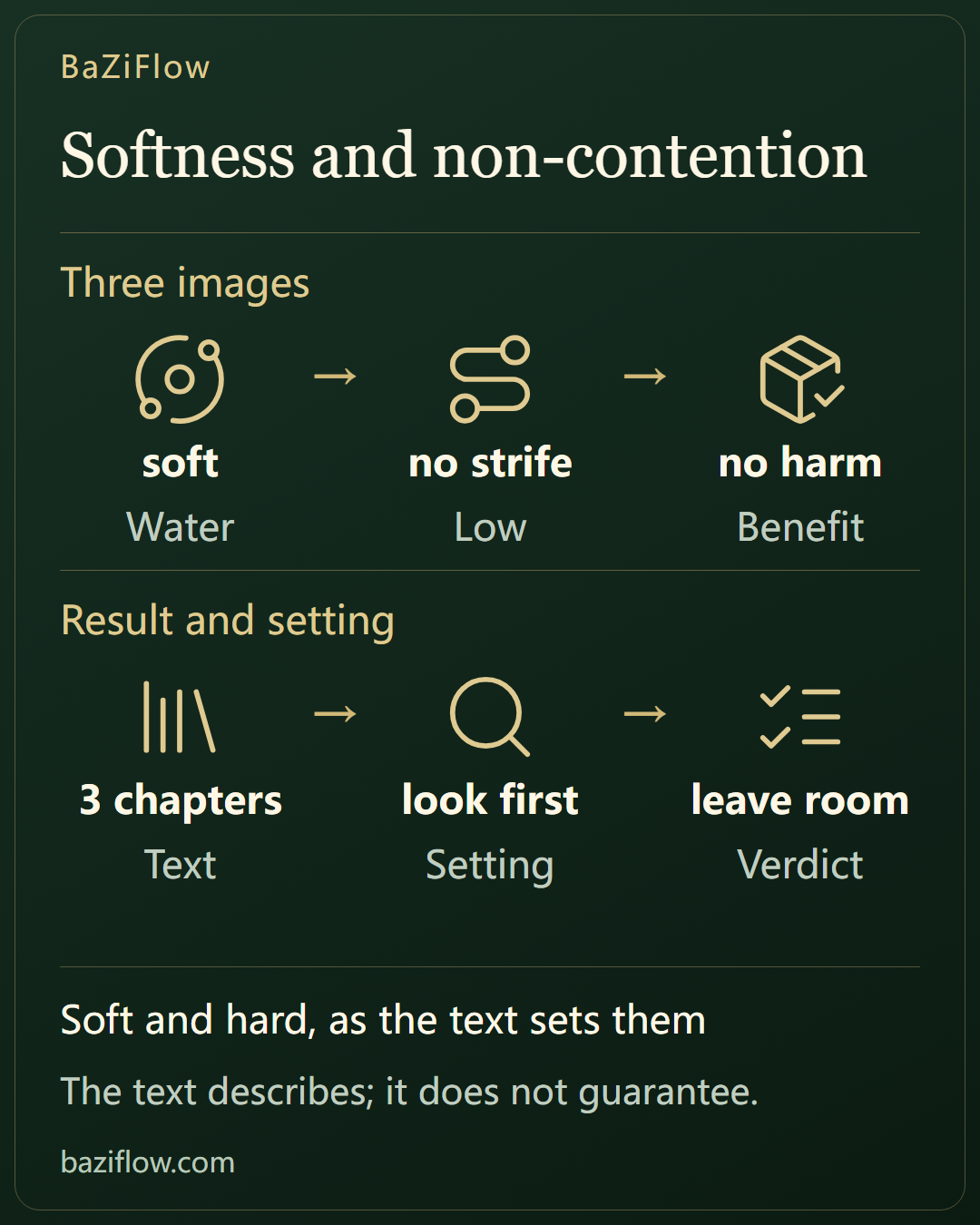
Water, life and death, plants and the sea show what softness (柔弱) and non-contention (不争) mean in the Laozi. Chapter 78 itself adds "none can practice it", which sets the text apart from later "yield and win" readings.
The short version8 min read
Softness is the Laozi's description of water, a living body and plants; non-contention describes a person's stance. Together they ask where strength is placed, not how to win.
- Softness describes a kind of thing (water, a living body, a young shoot); non-contention describes a stance: the first looks at the object, the second at conduct.
- The Laozi seldom argues first. It sets out water, life and death, plants and the sea, each beside a hard opposite.
- Chapter 78 follows "the weak overcome the strong, the soft the hard" with "everyone under heaven knows it, and none can practice it": the text admits knowing is easier than doing and gives no rule that yielding wins.
Read first
Dao and De in the Laozi: Reading Chapters 1, 21, 25, 38 and 51 ↗
Wu Wei: Why It Is Not Doing Nothing, Read Through Chapters 2, 48, 57 and 64 ↗
Two words, two jobs
In the Laozi, softness (柔弱) and non-contention (不争) are often mentioned together, yet each does its own job: softness describes the quality of a thing, non-contention describes a person's stance. The first asks "what is it like", the second "what does the person do".
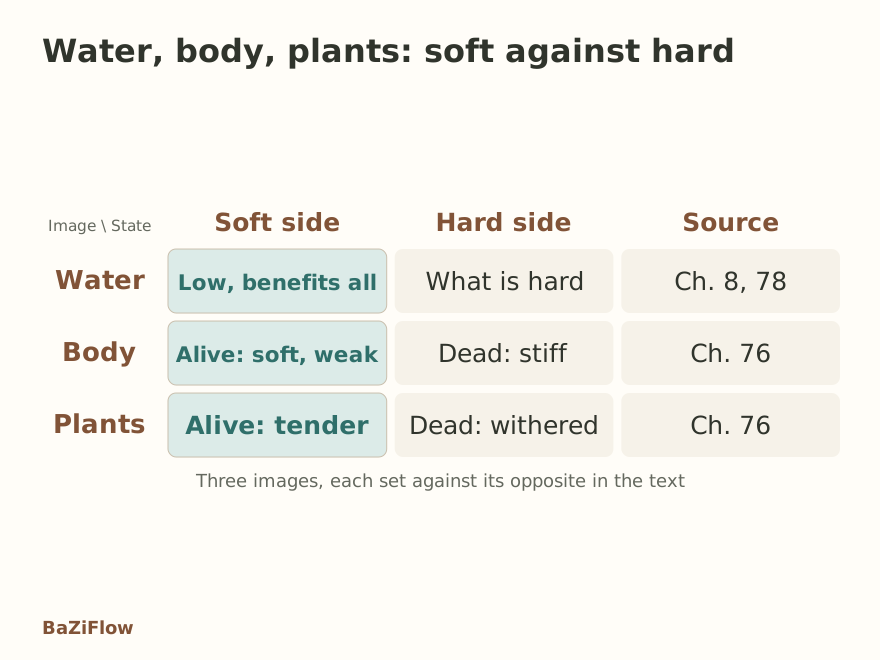
Image comparison: all three come from the text and the table repeats the contrasts the text sets out; it does not predict any particular dispute.
When the Laozi speaks of softness it seldom argues first. It sets out something concrete, such as water, a living body or a young shoot, and puts a hard opposite beside it. The table puts three images side by side, and every row holds the same pair: the soft side and the hard side.
Water: lying low, benefiting all, not contending
The fullest portrait of non-contention is water. Chapter 8 says in one sentence what water does and where it stands:
The highest good is like water. Water is good at benefiting the myriad things and does not contend; it settles in the places that people dislike, and so it comes close to the Way.
"The highest good" is often read as the best kind of person or the best state. The sentence has three layers: water is good at helping things, does not contend with them, and stays in places most people dislike, so it is said to come close to the Way. "Places people dislike" is traditionally taken as low ground, and chapter 66's remark that the rivers and sea are "good at keeping below" reads well alongside it.
Enlarge diagram · scroll sideways to read
The very next sentence lists seven things the text calls "good at", traditionally read as the seven strengths of a person who is highest in goodness like water:
The seven "good at"
- Dwelling
- Where one settles: good at low, steady ground.
- Heart
- The inner state: good at depth, like a still pool.
- Giving
- Dealings with others: good at kindness.
- Speech
- Words: good at keeping faith.
- Governing
- Rule: good at order.
- Work
- Tasks: good at using one's abilities.
- Moving
- Action: good at seizing the right moment.
The whole passage closes with: "Because he does not contend, he is without blame." The outcome stated here is very small: only freedom from blame. Nobody is named the winner.
Three images: body, plants, and the softest against the hardest
Chapter 76 puts soft and hard at the two ends of life and death:
People are born soft and weak; at death they are stiff and hard. The myriad plants and trees are born tender and supple; at death they are dry and withered. So the stiff and hard are companions of death, and the soft and weak are companions of life.
Enlarge diagram · scroll sideways to read
A living body gives; a dead one is rigid. A living plant bends; a dead one snaps. "Companion" is traditionally read as one of the same company: the stiff and hard keep company with death, the soft and weak with life. The chapter then moves to armies and warns that a force which only relies on strength will not win. The softness here is a feature seen in living things, and the text uses it to warn against the danger of rigidity.
Two further passages set softness closer to the Way:
Two shorter lines
Reversal is the movement of the Way; weakness is its use
The word for "reversal" can mean either "opposite" or "return", and both readings have supporters: a thing that reaches one extreme turns toward the other. "Weakness is the Way's use": softness is how the Way works.
The softest under heaven gallops through the hardest
"Gallops" suggests a horse running straight through: the softest thing can pass through the hardest. The next line, that what has no substance enters where there is no gap, is traditionally read as leading to "the benefit of non-action".
"Soft beats hard": what does the text promise?
Chapters 36 and 78 say outright that something wins. First the shortest line of chapter 36, with the pairs before it:
What you would shrink, you must first stretch; what you would weaken, you must first strengthen. ... This is called subtle insight. The soft and weak overcome the hard and strong.
Readers do not agree on this chapter: some take it as a description of how things rise and fall, others hear a ruler's craft in it. The text lists a few pairs and ends on "subtle insight", without saying whom to use it against. Now chapter 78:
Nothing under heaven is softer or weaker than water, yet nothing surpasses it in attacking what is hard and strong, for nothing can take its place. That the weak overcome the strong and the soft the hard, everyone under heaven knows, yet no one can practice it.
The first half speaks of water: nothing is softer, yet nothing beats it against hard and strong things. The second half says that the principle "weak beats strong, soft beats hard" is known to everyone and practiced by no one. The text itself admits that this is easy to say and hard to do; it is not a method that works on demand. The chapter then turns to government: whoever can bear the disgrace of the state is fit to be lord of the altars of the land.
Enlarge diagram · scroll sideways to read
Three stances on "soft beats hard"
What the text states
- Water, life and death, plants and the sea each show softness.
- Chapter 78 itself writes "none can practice it".
What was added later
- Turning it into a rule that yielding always wins.
- Reading softness as weakness or timidity.
A steadier reading
- First see whether the line speaks of water, of heaven or of government.
- Take "wins" as the text's description, not as a guarantee.
Acting without contending
The last chapter of the Laozi ends on this line:
The Way of heaven benefits and does not harm; the Way of the sage acts and does not contend.
Heaven benefits things and does no harm; the sage acts and does not contend. The weight falls on "acts and": the work is done, and what is laid down is the contending. It can be set beside wu wei.
What non-contention means in practice is spelled out in chapter 22 in four items:
Not displaying himself, he is clear-sighted; not asserting himself, he stands out; not boasting, he has merit; not exalting himself, he endures. Because he does not contend, no one under heaven can contend with him.
Enlarge diagram · scroll sideways to read
Two borrowings are common today: one reads the words as a tactic of looking weak in order to win, the other as an easygoing refusal to contend about anything. Both add something that the lines do not say. For the discussion of desire and limits that sits next to non-contention, continue with knowing enough; for how the Way itself is read, see the Way and De.
Which image is it?
Say first whether it is water, the body, plants or the sea, then see what soft and hard each refer to in the line.
A result, or a method?
"Hence no blame" and "hence king of the hundred valleys" are stated results; "lie low" and "not boasting" are stances. Do not turn a result into a guarantee.
Did you read "none can"?
Chapter 78 itself says knowing is easier than doing; when you quote "soft beats hard", bring that half with it.
Questions readers ask next
Does "non-contention" mean wanting nothing and letting others decide?
The text does not say that. Chapter 81 says "acts and does not contend": the work gets done, and what is set down is contending. The water of chapter 8 "benefits the myriad things", which is a great deal of giving. Check what is being contended over in each line: usually rank, credit and force, not the work itself.
Can the Laozi be turned into "overcome force with softness"?
Taking that as a conclusion goes beyond the words. Chapters 36, 43 and 78 do speak of the soft beating the hard, but through images such as water and the softest against the hardest, in settings of government and the Way of heaven. Chapter 78 also adds that nobody can do it. Turning it into a technique against an opponent is a later reading.
Does chapter 36, "what you would shrink you must first stretch", teach manipulation?
Readers disagree: some read it as describing how things rise and fall, others hear a ruler's craft in it. The text lists a few pairs and closes with "subtle insight", without saying whom to use it against. Quote it with both readings in view.
Was this article helpful?
Sources & references
Continue reading
Dao and De in the Laozi: Reading Chapters 1, 21, 25, 38 and 51 ↗
Wu Wei: Why It Is Not Doing Nothing, Read Through Chapters 2, 48, 57 and 64 ↗
Ziran: Read It as "So of Itself" First, Then Talk About Landscape ↗
Knowing Enough and Knowing When to Stop: "How Much" Versus "Where", Then Desire and Limits ↗