

Fix the returning direction before classifying it
Content version · · Sources & references
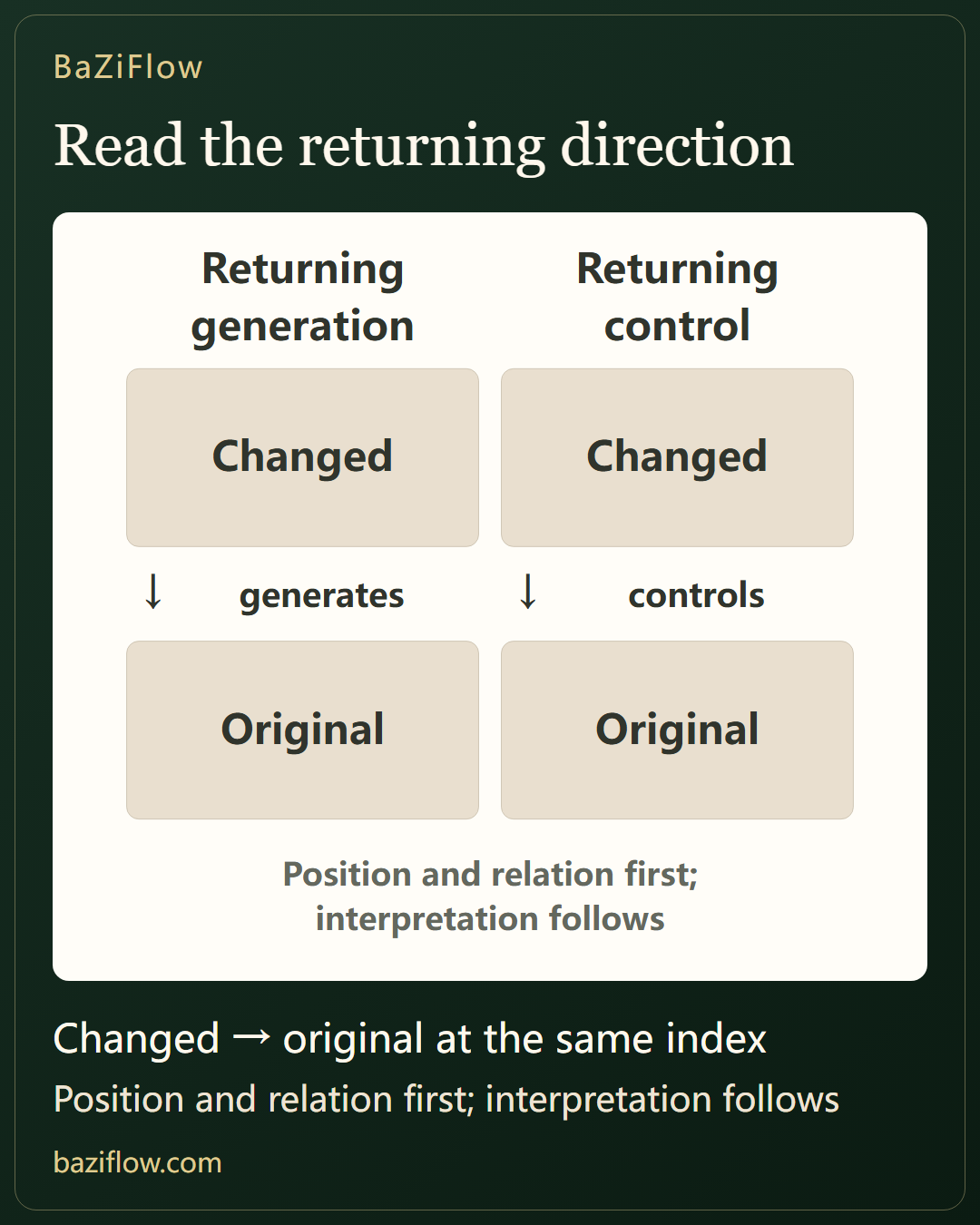
Recalculate four local trigram changes to distinguish return action, reversed generation, and a shared phase before assessing strength or the selected object.
The short version7 min read
Returning relations run from a changed line to its original counterpart at the same position. In Kan changing at the middle line, changed Snake Fire generates original Dragon Earth. In Qian changing at the bottom, changed Ox Earth controls original Rat Water. Classification precedes strength and role.
- Construction runs from original to changed; a returning relation runs back from changed to original.
- Check branch assignment and phase at the same index; shared phase and original-to-changed generation remain separate categories.
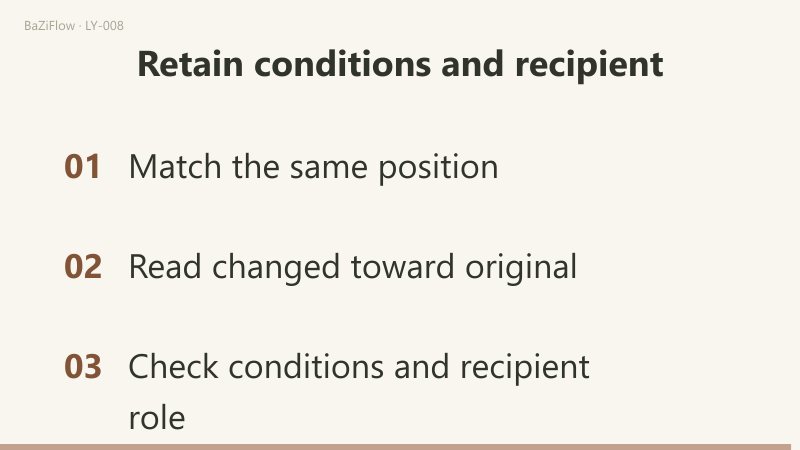
- After naming the relation, examine calendar conditions and the recipient’s role before interpreting its significance.
Read first
Najia, Six Relatives, and Six Spirits: three chart layers ↗
Moving lines and changed counterparts: auditing Xu to Song ↗
Choosing the useful god: define the subject and retain candidates ↗
A relation, its strength, and its meaning are separate questions
Return generation and return control are directional terms in the Liuyao rules discussed here. They describe a changed counterpart generating or controlling the original moving line at the same position. They do not, by themselves, announce a favorable or unfavorable outcome.
Three questions need separate answers. Does the pair have the stated five-phase relation? Under the recorded conditions, is the relevant line able to act? How would that action matter to the object selected for this particular question? The first may be answerable even when the other two are not.
This lesson follows the named approach in Zengshan Buyi. Its chapter on moving and changed lines limits a changed line's action to its own original position, while still discussing the influence of the day and month on the changed line. A same-position restriction is therefore not a claim that all other conditions disappear. Review moving lines and their counterparts if the original movement record is unclear.
Construction
Returning action
Compute a small pair before interpreting a whole reading
The following examples use only a lower trigram and one specified moving position. A three-digit pattern is written from bottom to top: 1 means yang and 0 means yin. These are four independent exercises, not stages in a single reading. No upper trigram, calendar record, or question has been supplied.
For A, start with lower Kan, 010. Change its second line from yang to yin, producing lower Kun, 000. Kan's lower branches are Tiger (寅), Dragon (辰), and Horse (午); Kun's are Goat (未), Snake (巳), and Rabbit (卯). At the second position, original Dragon Earth therefore changes to Snake Fire. Fire generates Earth. Because the Fire belongs to the changed counterpart and the Earth to the original moving line, this is return generation.
For B, lower Qian is 111. Its first line changes from yang to yin, producing lower Xun, 011. Lower Qian assigns Rat (子) to the first position, while lower Xun assigns Ox (丑). The pair is original Rat Water changing to Ox Earth. Earth controls Water, so this is return control.
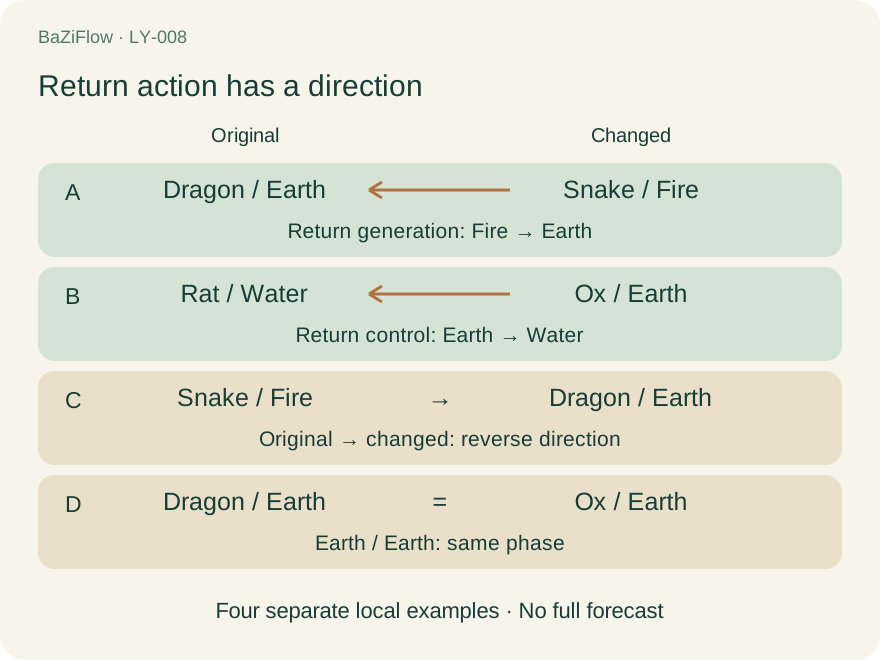
Original BaZiFlow direction diagram. Each row is a separate exercise; only the first two have a return-action arrow.
The branch assignments come from the source's Najia chapter. Their role is essential: changing a line's yin or yang does not license inventing the branch at that position. Nor can an upper-trigram branch assignment silently replace a lower-trigram assignment. Najia and the six relatives explains the surrounding chart conventions.
A
B
Changed → original, same position
Two counterexamples expose a reversed arrow
For C, reverse the structural exercise in A. Start with lower Kun, 000, and move its second yin line to yang. The result is lower Kan, 010. Now the original second line is Snake Fire and its changed counterpart is Dragon Earth. Fire still generates Earth, but the generating side is now the original line. Calling this return generation would reverse the definition. The presence of a generating relation somewhere in a pair is not enough.
For D, start with lower Qian, 111, and change its third yang line to yin. Lower Dui, 110, results. Qian's third lower branch is Dragon Earth; Dui's third lower branch is Ox Earth. Both are Earth. At this level the relation is same-phase, not generation or control. Different branch names do not guarantee different phases.
| Exercise | Local change | Original to changed branch | Classification checked here |
|---|---|---|---|
| A | Kan, line 2, to Kun | Dragon Earth to Snake Fire | Changed Fire generates original Earth |
| B | Qian, line 1, to Xun | Rat Water to Ox Earth | Changed Earth controls original Water |
| C | Kun, line 2, to Kan | Snake Fire to Dragon Earth | Original Fire generates changed Earth |
| D | Qian, line 3, to Dui | Dragon Earth to Ox Earth | Same phase: Earth |
There are two different arrows in this vocabulary. “Original to changed” describes the construction of the changed chart. “Changed back to original” describes the action being tested. Keeping both labels visible prevents a correct transformation record from acquiring an incorrect return-action label.
C
- Original Fire → changed Earth
D
- Earth / Earth: same phase
A correct label does not complete the strength analysis
Zengshan Buyi's chapter on the source line (元神, the line that generates the Useful God) and the adverse line (忌神, the line that controls it) discusses return generation among conditions associated with an effective source line. It also discusses support, weakness, injury, and the receiving line's capacity to benefit. Extracting one phrase from that discussion does not turn it into a universal numerical threshold.
In particular, the source line's ability to generate the selected object cannot be settled merely by identifying a favorable-looking pair. That chapter asks about the condition of both the acting line and the recipient. The moving-change chapter also allows day and month influences on changed counterparts. Those qualifications remain relevant after the relation has been named.
A useful record can therefore retain three fields: the calculated same-position relation, the conditions affecting its action, and its significance for the selected object. In A, only the first field is established by the supplied exercise. Filling the second with today's date would invent a casting context. Filling the third with a success prediction would invent a question. See day, month, and strength for why their different relationships should remain visible.
Support for an adverse line is not automatically helpful
A source line generates the selected useful line; an adverse line controls it. Supporting those two actors can therefore have different implications for the selected object. The text explicitly discusses an adverse line obtaining return generation and becoming effective in controlling the useful line. “Generation” cannot simply be translated into “good for the person asking.”
First identify the object of the question and the role of the line being examined. Then assess its actual changed counterpart and recorded conditions. Reversing that order encourages an interpreter to pick a pleasing label first and alter the object afterward to fit it.
Hidden movement also requires care. A discussion of day-induced movement does not authorize changing the recorded casting value or manufacturing a changed branch. The four exercises above use explicit yin-yang changes at specified positions; their counterparts are calculated from those changes.
An adequate answer to these exercises is deliberately limited: A is return generation, B is return control, C has the opposite generation direction, and D shares a phase. This preserves four distinct results without turning incomplete teaching inputs into four unsupported forecasts. Other branch relationships or a complete interpretation would require their own rules and the missing context.
Useful recipient
- Support has one role
Adverse recipient
- Support has another role
Questions readers ask next
Can the changed line target any original line for this label?
This article pairs each changed entry with its own indexed original moving line. Fix that index before comparing branches. A claim about another position needs a separate rule and cannot be justified by borrowing the returning label.
Does any generating pair count as returning generation?
The source of the action matters. When the original generates the changed entry, record that direction. Reversing the order in which the two names are displayed does not reverse the generating cycle itself.
Why is returning generation insufficient for a verdict?
The label identifies one relation. Calendar and other conditions affect its operation, while the recipient’s role affects its significance for the question. Without those fields, the relation can be recorded but a complete judgment remains open.
Was this article helpful?
Sources & references
Continue reading
Choosing the useful god: define the subject and retain candidates ↗
Month and day effects: preserve the evidence behind strength ↗