

Jiaren: wind from fire, substance and constancy
Content version · · Sources & references
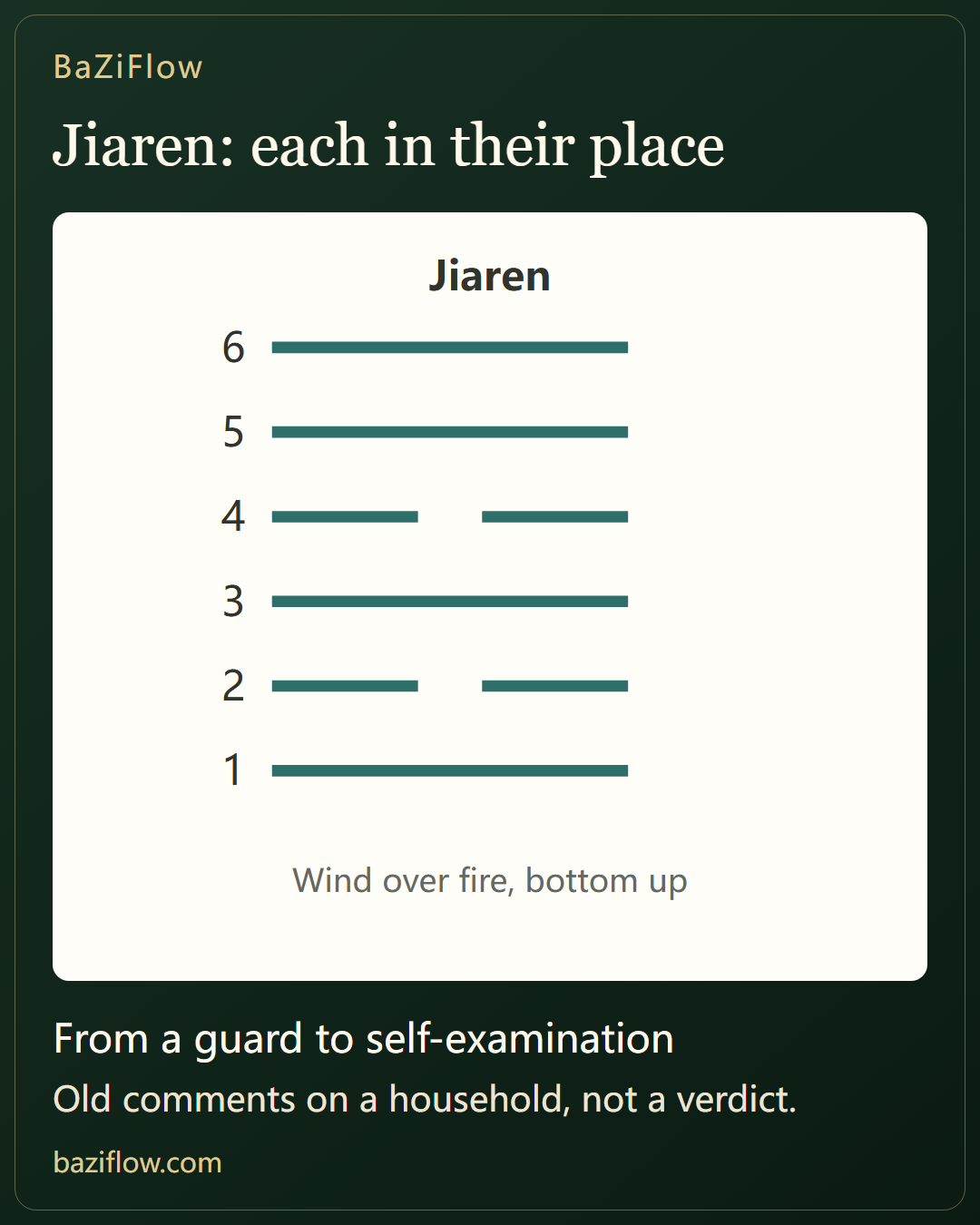
Jiaren is the 37th hexagram: Xun (wind) above Li (fire). Read the Commentary on places and names, the Image’s “words with substance, conduct with constancy”, and six lines running from a guard to self-examination.
The short version8 min read
Jiaren writes the household as a series of places: who is within, who is without, who is the strict sovereign, who is stern, who is giggling. Its six lines run from a guard set at the first line to “turning back to oneself” at the last.
- Jiaren stacks Xun (wind) on Li (fire). In its six lines the yang lines at 1, 3, 5 and the yin lines at 2, 4 all sit in their proper places; only the top yang line is the exception.
- The Commentary on the Judgments moves from “the woman holds her proper place within, the man without” to “let a father be a father, a son a son”, and then to “set the household upright and the world is settled”: each name in a household carries its own duty.
- The “constancy” in the Great Image’s “conduct with constancy” is the same word as hexagram thirty-two, Heng; the last Small Image, “it means turning back to oneself”, gathers the whole hexagram back onto the self.
Read first
The Sixty-Four Hexagrams: How Upper and Lower Trigrams Form One Figure ↗
Judgment and Line Statements: Whole Hexagram or Single Line? ↗
Wind from fire: Li below, Xun above
Jiaren (家人) is Xun (wind) above and Li (fire) below. In the Shuo Gua, Li is “clinging” and Xun is “entering”. The first line of the Great Image gives the picture: wind comes out of fire.
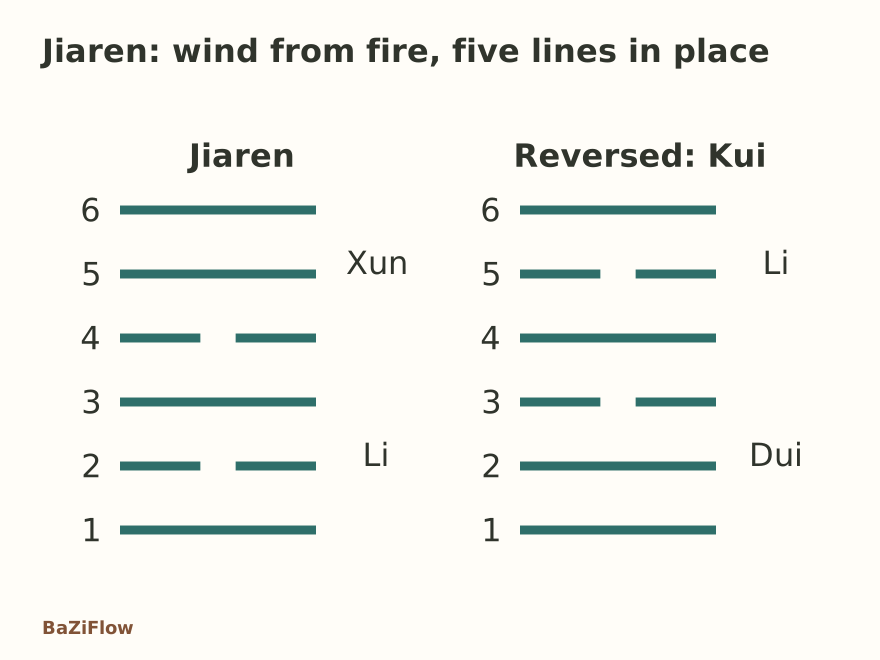
Jiaren and its reversed hexagram Kui: reversing turns the whole figure over, so the Li that is below in Jiaren rises to the top in Kui.
Each place carries a polarity of its own: odd places (first, third, fifth) are yang and even places (second, fourth, top) are yin, and a line whose polarity matches its place is called “in place”. Count them in Jiaren: the first five all match, and only the top yang line does not.
Enlarge diagram · scroll sideways to read
Phrases to know before the text
- Jiaren
- The name means the people of a household, not only the house as a place. The Commentary uses it that way when it says a household has a strict sovereign.
- Proper place
- The Commentary says “the woman holds her proper place within, the man holds his proper place without”: the inner (lower) trigram and the outer (upper) trigram are each taken as one place. Tradition usually matches them to line 2 and line 5, both in place and both at the middle of their trigram.
- Strict sovereign
- “A household has a strict sovereign: this means the parents.” The one in a family who commands awe is the parent.
The judgment and the Commentary: names turned into duties
The judgment is three characters (利女貞), “fitting for the woman to stay on course”. The Commentary does not explain it word by word. It turns to places and names instead, and writes a long passage.
Jiaren: the woman holds her proper place within, the man holds his proper place without. That man and woman are each in their proper places is the great principle of heaven and earth. A household has a strict sovereign: this means the parents. Let a father be a father, a son a son, an elder brother an elder brother, a younger brother a younger brother, a husband a husband, a wife a wife, and the way of the household is upright. Set the household upright and the world is settled.
Enlarge diagram · scroll sideways to read
In the string “let a father be a father, a son a son …”, the first word of each pair is the name and the second is a verb. Tradition usually reads it as: whoever is a father acts as a father, whoever is a son as a son, and so on. When name and conduct match, “the way of the household is upright”. The last sentence widens the scope from the household: “set the household upright and the world is settled”.
Note what kind of passage this is. It describes the form that each place and name should take, not the story of any particular household, and the way it divides inner from outer belongs to the period of the text, so here it is read only for how it is written.
The Great Image: words with substance, conduct with constancy
The Great Image (大象) of Jiaren has two parallel short clauses.
Wind comes out of fire: Jiaren. The noble person’s words have substance and his conduct has constancy.
Enlarge diagram · scroll sideways to read
“Words with substance” means that what is said has real content, and “conduct with constancy” means conduct that goes on. The word for “constancy” is the same as the name of hexagram thirty-two, Heng: Heng’s Image says “stand and do not change direction”, while Jiaren’s lands on everyday conduct. One clause about speaking and one about acting, set in this hexagram, can be read as what is said and done in a household every day.
Six lines: from the guard to turning back
The six statements of Jiaren run from setting a guard at the first line to turning back to oneself at the last, a line that goes from outside to inside.
Enlarge diagram · scroll sideways to read
Line 1, “set a guard around the household”, uses a word for a fence or precaution: from the start, rules are put around the household, and “regret vanishes”. The Small Image says this happens while the intention has not yet changed. Line 2 reads “she has nothing to pursue; her place is in the middle, with the household meals”, and then “staying on course brings good fortune”, and the Small Image says she is yielding and gentle.
Line 3 is the loudest line of the hexagram: “The household is stern, a stern voice: regret and danger, yet good fortune. If wife and children laugh and giggle, in the end there is regret.” One word is a harsh voice and the other is laughter, two tones in one statement: stern, with regret and danger but in the end good fortune; giggling, in the end regret. The Small Image comments that stern means nothing is lost, and giggling means losing the household’s measure.
Line 4, “enrich the household: great good fortune”, is called yielding in its place: a yin line sitting in the fourth place. Line 5, “the king draws near to his household; do not worry; good fortune”, has a verb that tradition reads as to arrive or to draw near, and the Small Image says they love one another in turn. Line 6 says “sincere and dignified: in the end, good fortune”, and the last Small Image comment is: “the good fortune of dignity means turning back to oneself”.
From the guard at line 1 to the self-examination at line 6, there is one line running from outside to inside: first a boundary is drawn around the household, and in the end what is looked at is oneself.
Kui, Xie and Weiji: neighbors of Jiaren and its place in the sequence
Turn Jiaren upside down and you get Kui (睽), so Kui is the reversed hexagram (综卦) of Jiaren, shown above. The inverse hexagram (错卦) is Xie (解) and the nuclear hexagram (互卦) is Weiji (未濟). The nuclear hexagram is interesting: none of the six lines of Weiji sits in its proper place, and it is taken from the middle of Jiaren, which itself has five lines in place.
Enlarge diagram · scroll sideways to read
The Xu Gua puts Jiaren after Mingyi, writing:
One hurt abroad must return to his home, and so Jiaren is received next.
Someone hurt in the world has to come back home, which is why Jiaren follows Mingyi. After Jiaren comes Kui, and there the Xu Gua says that when the way of the household has run out, its members are bound to drift apart. Seen like that, Jiaren sits between “hurt outside” and “drifting apart at home”, and what it writes about is how to hold a household up after coming home.
Questions readers ask next
What does “let a father be a father, a son a son” mean?
Tradition usually reads it as: a father should act as a father, a son as a son. The same word is written twice, the first as the name and the second as acting according to that name; brothers and husband and wife are written the same way.
Which is better, “stern” or “giggling”?
Line 3 puts the two tones in one statement: the household stern, with regret and danger, yet in the end good fortune; wife and children giggling, in the end regret. The Small Image comments that stern is “nothing lost” and giggling is “losing the household’s measure”.
How are Jiaren and Kui related?
They are each other’s reversed hexagram: turn Jiaren upside down and you have Kui. The Xu Gua says that when the way of the household has run out, its members must drift apart, which is why Kui follows Jiaren.
Was this article helpful?
Sources & references
Continue reading
Mingyi: light goes into the earth, from the drooping wing to the entering earth ↗
Kui: fire over a lake, and five of its six lines are about seeing or meeting ↗
The Sixty-Four Hexagrams: How Upper and Lower Trigrams Form One Figure ↗
Judgment and Line Statements: Whole Hexagram or Single Line? ↗