

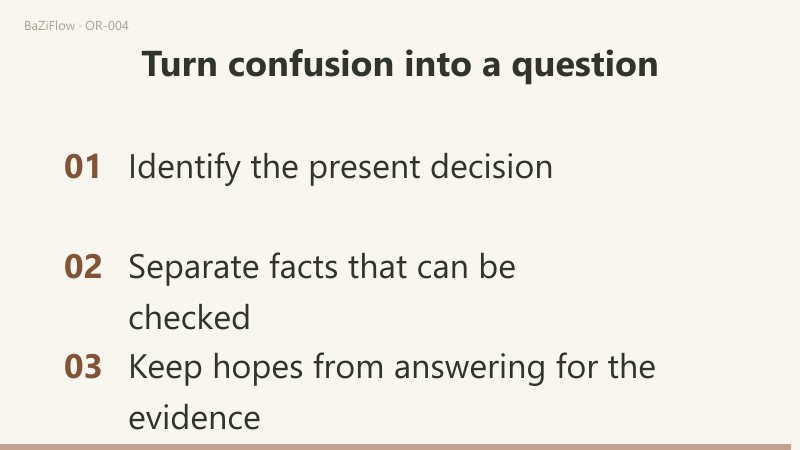
Turn confusion into a question
Content version · · Sources & references
Separate facts, choices, missing information, and hopes through an eight-week course example, while distinguishing ritual permission from an event outcome.
The short version6 min read
An enrollment question can conceal concerns about scheduling, skill and another person’s approval. Separate these targets before interpreting an answer, and keep practical information that still needs checking visible.
- Enrollment, mastery and a teacher’s opinion are different targets.
- Eight conflicting hours out of sixteen teaching hours is a time share, not a failure probability.
- Ritual permission, a lot identifier and course arrangements have different confirmation objects.
Read first
What are oracle lots? Numbers, poems, and narrative references ↗
Permission to draw is not a prediction about your decision
In Lungshan Temple's guide, requesting permission to seek a lot and confirming the subsequently drawn number are separate steps. Their objects differ: one concerns the ritual request, the other the lot identifier. Neither can simply be translated into “this plan will suit me” or “my application will succeed.”
Keeping that distinction clear starts before interpretation. Decide which real-world matter you are bringing to the reading, rather than allowing a procedural confirmation to become the answer to an unstated question.
Permission
- The ritual request
Number
- The lot identifier
Practical conditions
- A real-world arrangement
Facts, choices, unknowns and hopes differ
- Focal matter
- The specific issue addressed now, rather than every concern surrounding it.
- Missing information
- An unresolved practical condition that can be checked with the relevant person or provider.
Separate what is known from what must be asked elsewhere
Consider an invented eight-week course. It has two teaching hours and one practice hour each week. Four teaching sessions conflict with a known work rota, and the availability of make-up sessions has not yet been checked.
| Given condition | Calculation | What the calculation establishes |
|---|---|---|
| Weekly teaching over eight weeks | 8 × 2 = 16 hours | Scheduled teaching time |
| Weekly practice over eight weeks | 8 × 1 = 8 hours | Planned practice time |
| Combined commitment | 16 + 8 = 24 hours | Total time in this exercise |
| Four conflicting sessions | 4 × 2 = 8 hours | Half of the 16 teaching hours |
The 50 percent figure is a share of scheduled teaching time, not a probability of failure. It does not establish whether the course can be completed. The make-up policy remains a question for the provider; a favorable lot cannot create a permission or policy that has not been supplied.
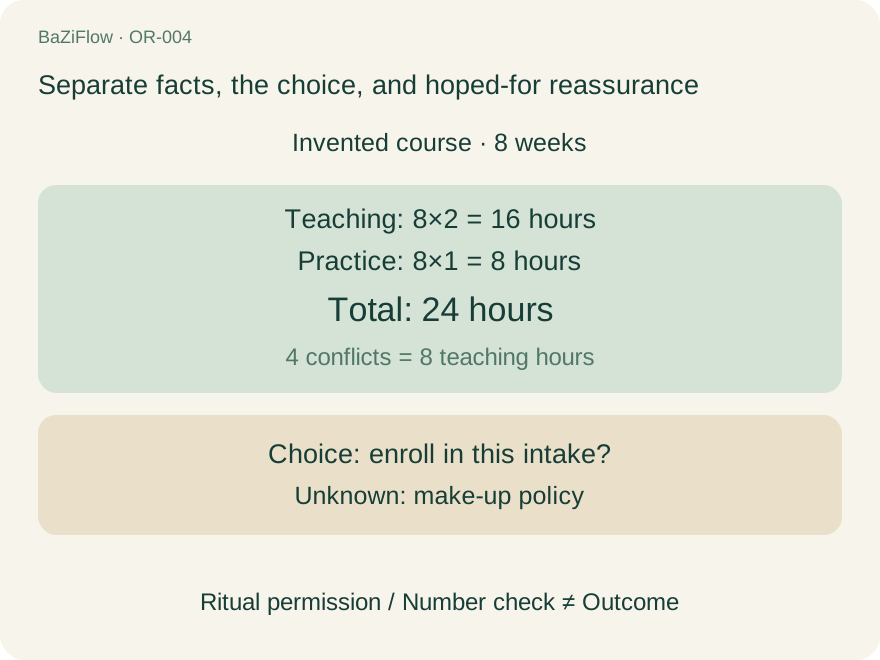
Original BaZiFlow question-preparation diagram. The arithmetic describes stipulated time commitments, not a fortune score.
Four sessions
- Conflicting teaching
- 4×2 = 8 hours
- Share of 16 hours
- 8÷16 = 50%
Two sessions
- Conflicting teaching
- 2×2 = 4 hours
- Share of 16 hours
- 4÷16 = 25%
Choose which uncertainty this reading is about
“Should I enroll, will I master the skill, and will the teacher like me?” contains three targets. Enrollment is a choice, mastery is an outcome requiring a standard, and the teacher's opinion is a claim about another person's private evaluation. Putting them in one sentence does not make them one question.
If the immediate choice is this particular course intake, record the eight-week period, the known rota conflicts, and the missing policy. A preparatory note might say: “I am considering this intake, with four known teaching conflicts and an unconfirmed make-up policy; this reading concerns that enrollment choice.” This is a teaching example for a private note, not a prescribed prayer accepted by every temple.
If the intended target is producing a particular piece of work, define that outcome separately. Do not move from enrollment to skill development only after seeing the result. Nor can a suggestive phrase establish what the teacher privately thinks. Your fear of disapproval can be recorded as a concern without being treated as the teacher's actual view.
Enroll now?
- A current choice
Master the skill?
- A defined outcome
Teacher approves?
- Another person’s evaluation
Local guidance supports a focused matter, not a universal script
Hsing Tian Kong's official instructions use a one-matter-per-lot principle, and Lungshan's guide likewise limits a poem to one question. These are two named places' instructions. They do not establish identical wording requirements for every religious setting.
The worksheet proposed here separates known facts, a current choice, missing information, and personal hopes. It is a practical preparation method. The local explanation governs how to state the request on site; procedure and local custom discusses why those details should retain their setting.
Separating three concerns does not require drawing three lots immediately. Some missing facts can be checked directly, and some uncertainties can be explored through ordinary conversation or a small trial. Focus on the matter that actually requires your attention rather than converting every worry into another request.
This course intake
- The focal matter
- Rota and make-up conditions
- Separate inquiry
- Ask the provider
A completed work
- The focal matter
- Standard and deadline
- Separate inquiry
- Define the outcome
Give the desired reassurance its own name
Sometimes the strongest wish is not for information but for confirmation that the choice is not a mistake. Write that wish separately from the course conditions. “I want reassurance” is useful information about the reader's expectations; it is not evidence that the timetable works.
One check is to ask whether you could still state the original question accurately if the text did not support enrollment. If the question immediately shifts into a vague inquiry about general learning luck, retain the first wording and notice the change. A new matter may justify a new record, but it should not erase the old one.
This is a check on interpretive drift, not a judgment of religious sincerity. The article on repeated drawing and what you want to confirm considers the follow-up issue in more detail.
Personal hope
- Wanting reassurance
Practical conditions
- Time and available arrangements
Carry a short record into the reading
The example's 24-hour commitment and known conflicts belong under facts. Whether to enroll belongs under choice. The make-up policy belongs under missing information. The wish to feel certain belongs under expectations. Do not let one column supply an answer that belongs to another.
After receiving the text, identify its edition and return to the note rather than reconstructing the earlier conditions from memory. If a policy or work rota changes later, append when that change became known. Recording the source helps preserve the material that was actually read.
A focused question does not guarantee a definite answer. It does make it possible to see whether an interpretation addresses the matter you brought, and which practical information still needs to be obtained independently.
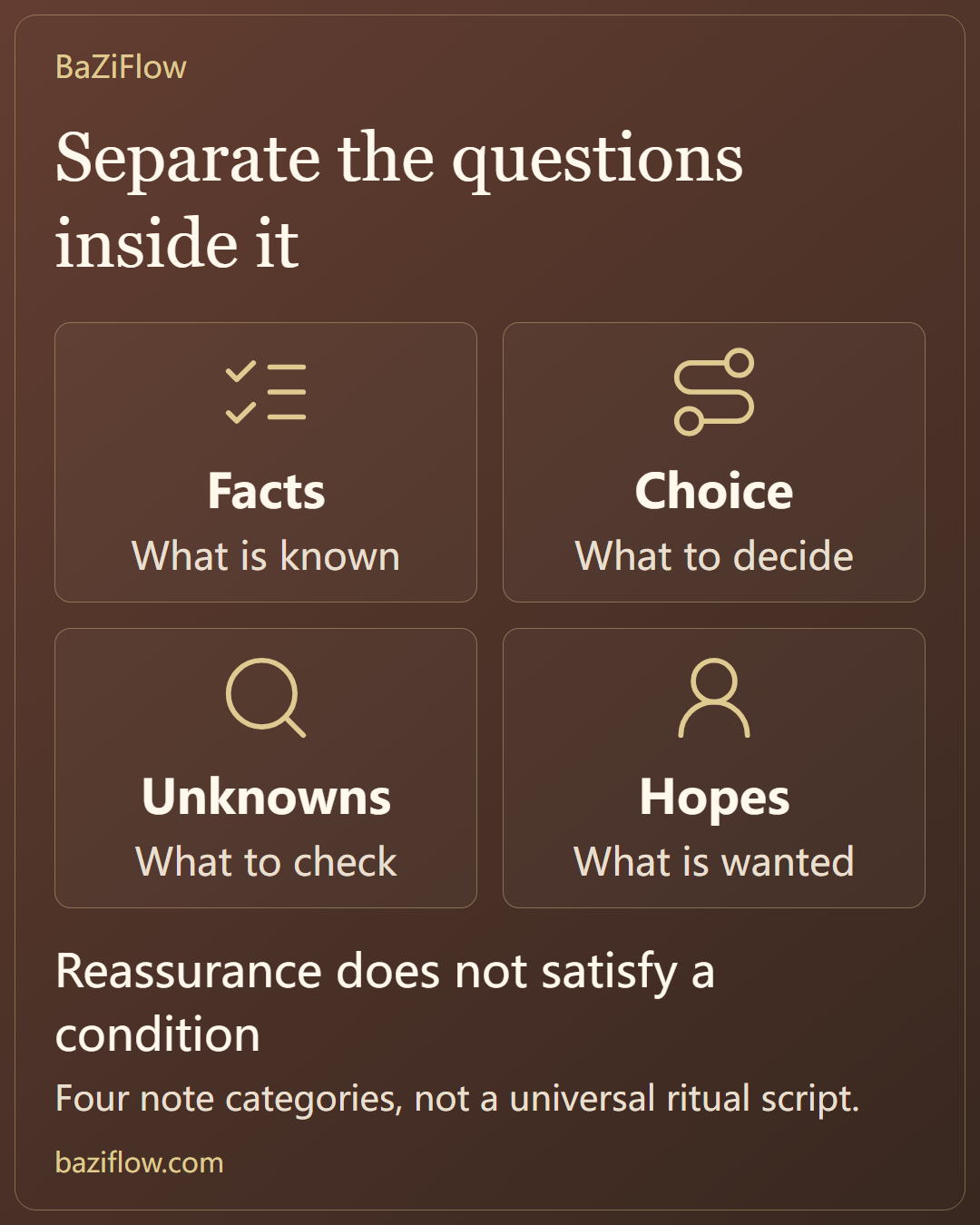
Known facts
- What belongs here
- 24 hours and known conflicts
Choice
- What belongs here
- Whether to enroll in this intake
Unknowns
- What belongs here
- The make-up policy
Hopes
- What belongs here
- Wanting a positive answer
Keep the denominator fixed
Eight weeks at two teaching hours per week gives sixteen teaching hours in this exercise.
Change only the given conflicts
Four sessions conflict for eight hours. If a revised rota conflicts with two, that is four hours: fifty and twenty-five percent of teaching respectively.
Retain the unresolved conditions
A lower share does not establish make-up permission or mastery. Ask about the policy and define the work standard separately.
Questions readers ask next
Does separating three concerns require drawing three lots?
No. Choose the present matter and handle directly checkable facts separately, while following the named place’s guidance.
Does a fifty-percent conflict mean a fifty-percent failure risk?
No. The fraction compares teaching hours and contains no data establishing an outcome probability.
What if a make-up policy changes later?
Add the information and when it became known. Do not backdate it into the original conditions; identify any resulting change of question.
Was this article helpful?