

Turtle Beak: end of the ahead six
Content version · · Sources & references
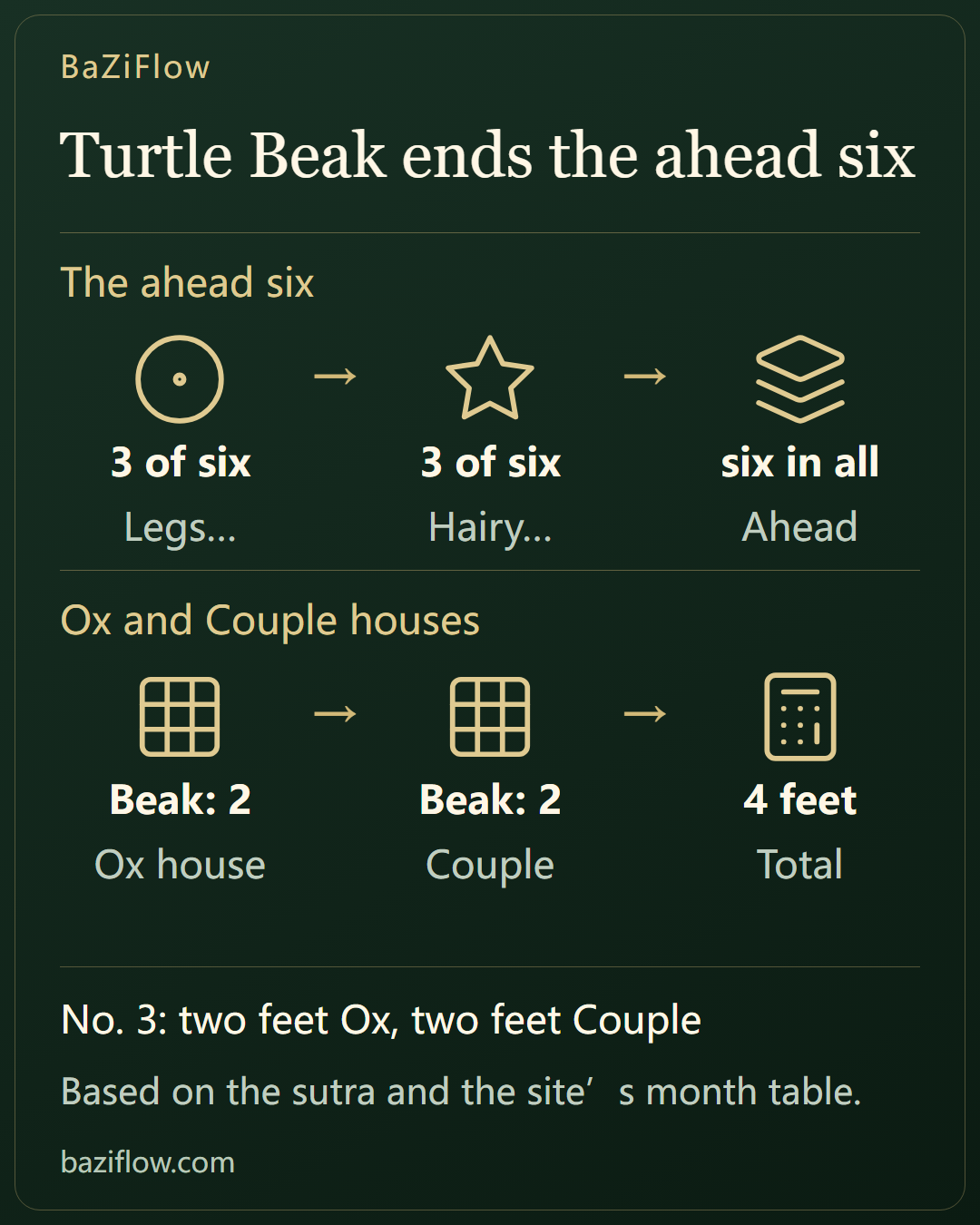
Turtle Beak (觜) is position 3 on the 27-mansion ring. Both layers of text give it three stars; the sutra files it last of six “ahead” mansions and splits its four feet over two houses; a worked date wraps past a lap.
The short version6 min read
Turtle Beak (觜, Shi in Japanese) is position 3 on the site’s ring, between Net and Three Stars. The sutra gives it three stars shaped like a deer’s head, files it last among six "ahead" mansions and splits its four feet across two houses.
- Among the first seven mansions Turtle Beak is the one whose two layers agree on the star count: both say three, while Hairy Head, Net and the others differ between sutra and note.
- The sutra sorts the mansions by how the Moon stands relative to them. The six "ahead" mansions are Legs, Bond, Stomach, Hairy Head, Net and Turtle Beak, and the three classes total 6 + 12 + 9 = 27.
- Each of the twelve houses is allotted nine feet and each mansion four; Turtle Beak has two feet in the Ox house and two in the Couple house, and each house sums to nine.
Read first
What is Sukuyō astrology? How a birth mansion is found ↗
Sukuyō 27 mansions vs the 28 lunar mansions: what is the difference? ↗
Position 3, with three stars on both layers
Turtle Beak (觜, Shi in Japanese) is position 3 on the site’s ring, after Net (毕) and before Three Stars (参), and its picture in the sutra has only three stars.
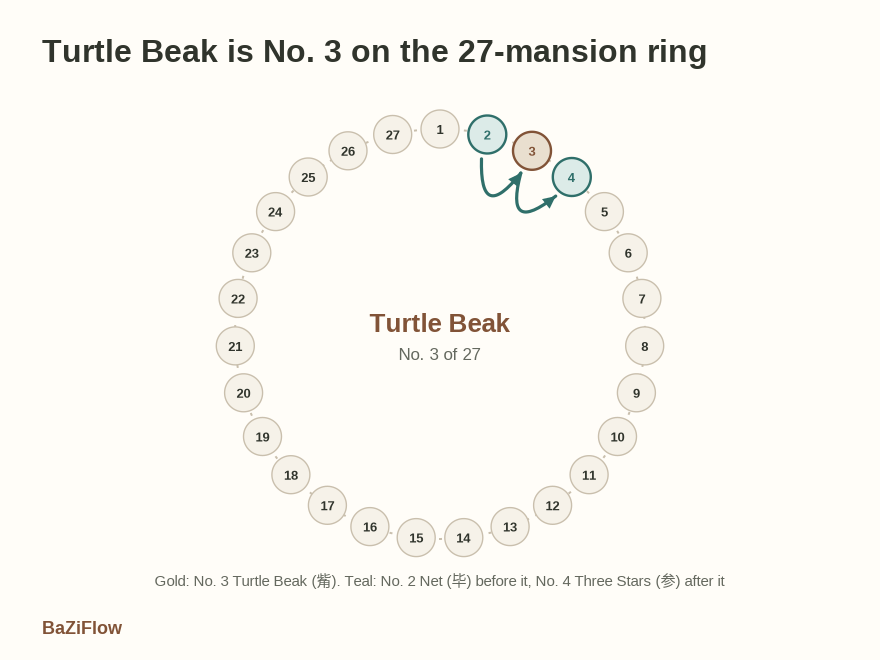
Turtle Beak at position 3 closes the six ahead mansions counted from Legs.
The sutra’s Turtle Beak picture reads:
Turtle Beak has three stars shaped like a deer’s head. It is a moon deity.
After the picture the commentator Yang Jingfeng added the Chinese-astronomy view: Turtle Beak has three stars, governs soldiers and is a western mansion. This time the star counts of the two layers agree, three and three. Among the first seven mansions Hairy Head is six against seven, Net five against eight, and Three Stars, Well, Ghost and Willow do not match either; Turtle Beak is the only one that does.
Ahead, following or side by side: three ways the Moon joins a mansion
The sutra has a question-and-answer passage on how a day is assigned to a mansion. The sage asks: the 27 mansions in the sky are wide and narrow, and all are divided into four equal feet, while the Moon may stand ahead of a mansion or behind it, so how is the governing mansion of a day to be fixed? The bodhisattva answers:
There are three ways the Moon and a mansion join: the ahead join, the following join and the side-by-side join.
The test is the relative position of Moon and mansion. When the mansion is ahead and the Moon behind it, so the Moon has not yet reached it, the join is "ahead" (前合). When the Moon is ahead and the mansion trails, like a calf following its mother, it is "following" (随合), and when the two travel together it is "side by side" (并合). A verse in the second fascicle opens with "six mansions the Moon has not yet reached," and the gloss on it names them: Legs, Bond, Stomach, Hairy Head, Net and Turtle Beak.
Enlarge diagram · scroll sideways to read
Turtle Beak closes the ahead group: counting round the ring from Legs gives Legs, Bond, Stomach, Hairy Head, Net, Turtle Beak, the sixth. These classes are the sutra’s way of handling mansions of uneven width, while the site’s calendar moves exactly one place per day, so the two can be read side by side but are different things.
One mansion, two houses
The twelve houses are another ledger in the sutra, and the sutra states it at the start:
Moreover, each house is allotted nine feet of the mansions.
Each mansion has four feet and each house takes nine, so a house can hold pieces of three mansions. Turtle Beak’s four feet divide two and two. The Ox house holds three feet of Hairy Head, four of Net and two of Turtle Beak; the Couple house (淫宫) holds two of Turtle Beak, four of Three Stars and three of Well. The house names come from the house deity’s look: one deity is like an ox, hence the Ox house, and the other is like a married couple.
Enlarge diagram · scroll sideways to read
The ledger can be audited line by line. Adding up all twelve houses in the sutra’s list gives four feet for each of the 27 mansions and nine for each of the twelve houses, and 12 times 9 equals 27 times 4, both 108.
How the sutra identifies a mansion: touch first, then read
Turtle Beak has one more, rather unusual, appearance. In chapter 5, on miscellaneous divination, the sutra says that if someone cannot remember which mansion they belong to, you watch which part of the body they touch first when they arrive:
Whoever first touches the brow belongs to Turtle Beak.
The rule is a list: the head belongs to Hairy Head, the forehead to Net, the brow to Turtle Beak, the eyes to Three Stars, then the cheeks and ears to Well, the teeth and chest to Ghost, the front teeth to Willow, and so on down the body until the feet, which belong to Stomach. The first entries run neatly from the top of the head downward.
Enlarge diagram · scroll sideways to read
This is the book’s own practice and has nothing to do with the site’s method: the site never asks anyone to touch anything, and starts from the old-calendar birth date and the month table.
One lap and one step more
To place a Gregorian date, the site looks up its old-calendar month and day (Japan’s calendar, with each new moon taken at Tokyo time), takes the first-day mansion of that month as the starting point and adds one place for each further day. Take 26 May 2025, which is old-calendar month 4, day 29. Month 4 opens on Net, so day 29 means 28 steps: 27 steps bring the count back to Net, and one more reaches Turtle Beak.
Enlarge diagram · scroll sideways to read
In the same year Turtle Beak falls on these Gregorian dates: 9 January, 5 February, 5 March, 1 April, 29 April, 26 May, 22 June, 19 July, 18 August (inside the leap sixth month), 13 September, 10 October, 6 November, 4 December and 31 December, 14 days in all.
The mansion before it is Net and the one after is Three Stars. Why the ring has no Ox mansion is told in the 27 and 28 lists compared; where the site’s calendar and other methods part ways is in where calculation methods diverge.
Questions readers ask next
What does "foot" mean for Turtle Beak?
The sutra uses "feet" (足, literally feet) to share the sky out: each mansion has four and each house nine, and twelve houses times nine equals 27 mansions times four, 108 either way. Turtle Beak’s four feet split two and two between the Ox house and the Couple house. This is an accounting division, a different matter from how wide Turtle Beak is in the sky.
Are the ahead, following and side-by-side classes the site’s way of finding a birth mansion?
No. They are the sutra’s classes for the fact that mansions are wide and narrow in the sky, and they describe where the Moon stands relative to a mansion. The site finds birth mansions from the old-calendar day-1 mansion and the day number and uses none of the three classes. The two can be read side by side but not swapped.
Can "whoever first touches the brow belongs to Turtle Beak" identify my mansion?
It is a rule in the Sukuyō Sutra for someone who has forgotten the mansion they belong to, based on the first body part touched. It has no astronomical or calendar basis behind it. To confirm a mansion, go back to the old-calendar birth date and look it up in the month table.
Was this article helpful?
Sources & references
Continue reading
Net (毕): The Sutra’s Own Worked Example, Born on Month 2, Day 5 ↗
Three Stars (参): One Star Against Ten, a List Written Twice, and a Count Across the Seam ↗