

Three sides, four directions: the four palaces read together
Content version · · Sources & references
Anchor, opposite and two trine palaces: compute the set for any Zi Goat palace as i, i+4, i+6, i+8, and keep branches, palace names and school methods apart.
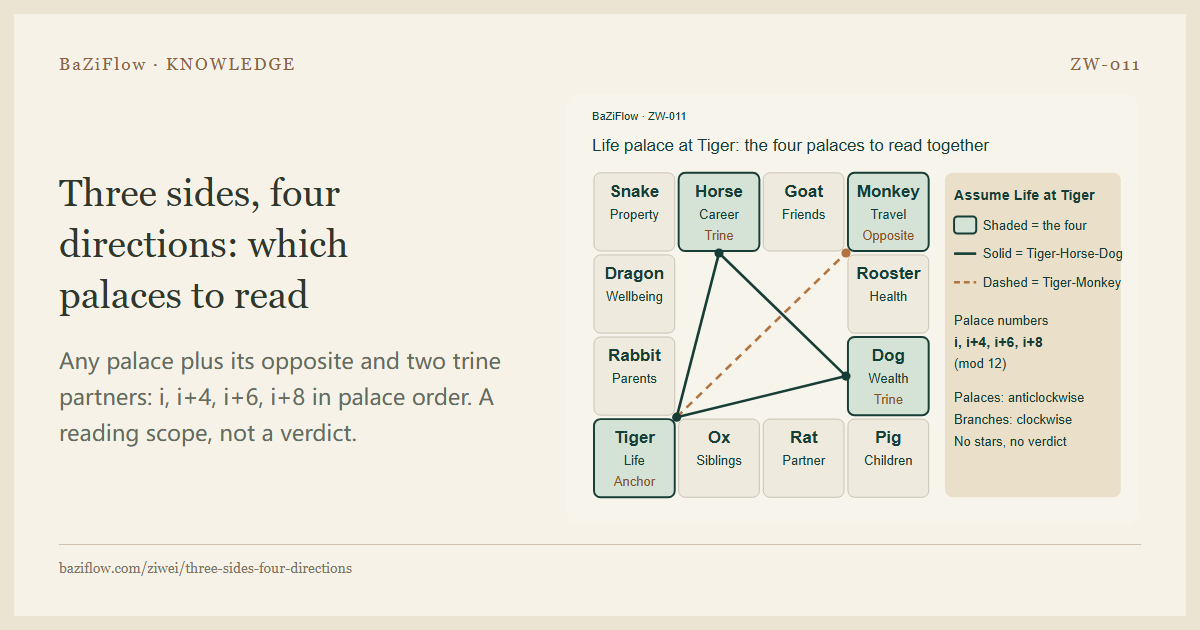
Any palace plus its opposite and two trine partners: i, i+4, i+6, i+8 in palace order. A reading scope, not a verdict.
Read first
A two-minute exercise first
Sketch the twelve-box Zi Goat Dou Shu grid and pick any box. Count four boxes around the ring and mark it; count four more and mark again. Rooster have a triangle. Now mark the box straight across from your start. Those four marks are what the tradition calls three sides and four directions (三方四正). A first chart record used it once, from the Life palace; here we take it apart so you can compute it for any palace.
The short version: this is a scope rule. It says which palaces to pull into view when you study one palace. It carries no verdict, and treating the phrase as good or bad news skips the step where a method has to be named.
The geometry: a triangle and a diameter
Branches six steps apart are opposites: Rat-Horse, Ox-Goat, Tiger-Monkey, Rabbit-Rooster, Dragon-Dog, Snake-Pig. Branches four steps apart form a trine (三合): Monkey-Rat-Dragon, Pig-Rabbit-Goat, Tiger-Horse-Dog, Snake-Rooster-Ox, each an equilateral triangle on the ring.
The anchor plus its two trine partners make the "three sides"; the opposite box completes the four. Teachers parse the wording differently, but modern textbooks point to the same set. The compendium Zi Goat Dou Shu Quan Shu uses the phrase in passages on the Life and Children palaces, among others, without stating any arithmetic; the numbering below is a modern teaching aid you can check by hand.
A formula for every palace
Number the palaces in order: Life 0, Siblings 1, Partner 2, Children 3, Wealth 4, Health 5, Travel 6, Friends 7, Career 8, Property 9, Wellbeing 10, Parents 11. Palaces run against the direction of the branches, so four steps in palace order are four branches backward, still inside one trine; six steps reach the opposite. For palace i the set is i, i+4, i+6, i+8, subtracting 12 when a result exceeds 11.
- Life (0): 0, 4, 6, 8 = Life, Wealth, Travel, Career.
- Partner (2): 2, 6, 8, 10 = Partner, Travel, Career, Wellbeing.
- Health (5): 5, 9, 11, 13→1 = Health, Property, Parents, Siblings.
Grouped by remainder after dividing by four, the palaces form four trine families: Life-Wealth-Career, Siblings-Health-Property, Partner-Travel-Wellbeing, Children-Friends-Parents. Each reading set is one family plus an opposite borrowed from another. For each palace's topic, see the twelve palaces.
A schematic chart, no birth data needed
Assume only that Life sits at Tiger. Counting backward through the branches: Life Tiger, Siblings Ox, Partner Rat, Children Pig, Wealth Dog, Health Rooster, Travel Monkey, Friends Goat, Career Horse, Property Snake, Wellbeing Dragon, Parents Rabbit. The Life set is Tiger, Horse, Dog and Monkey: Tiger-Horse-Dog is the trine, Monkey the opposite.
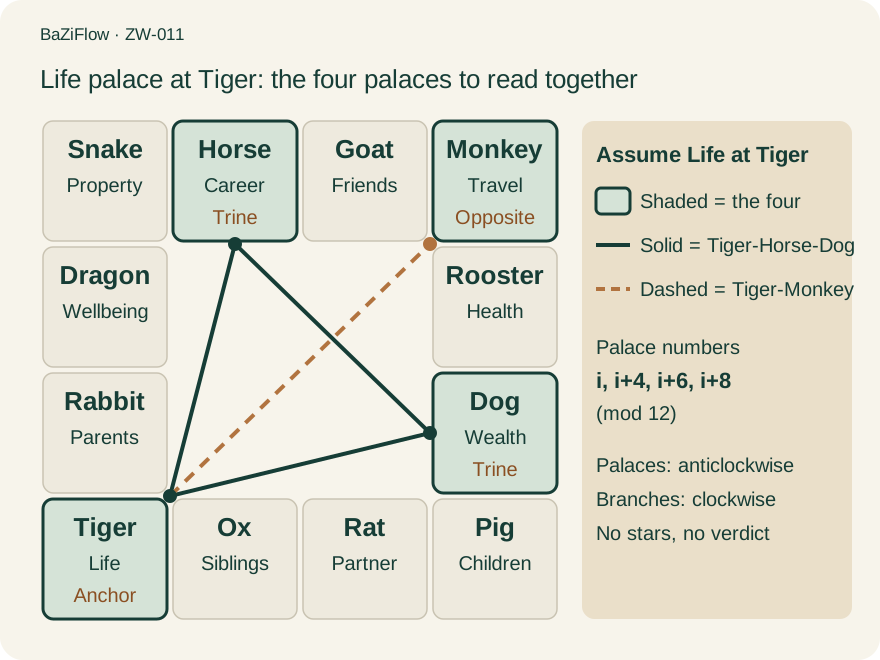
Original BaZiFlow teaching diagram; a schematic of which palaces are read together, not a personal chart and not a star reading.
Branches are coordinates; palace names move
The Tiger-Horse-Dog trine is fixed, but its labels change. With Life at Rat, Tiger is Wellbeing, Horse Travel and Dog Partner; adding Career at Dragon as the opposite gives the Partner palace's set. With Life at Horse, the same triangle holds Wealth, Life and Career, with Travel opposite at Rat. So "Tiger-Horse-Dog" is not shorthand for a topic, and labels cannot be copied between charts. Record the branch, then the palace name this chart gives it.
After the scope, choose a method
Four palaces only put material on the table. Which stars count as reaching the anchor, and how they are weighted, belongs to an interpretive method. The Three Harmonies school leans on what gathers across these four; the Flying Star school follows the paths of the four transformations, so the two weight the same set differently. Flanking palaces and finer kinds of "reaching" have their own rules, mentioned here only by name. When the anchor has no major star, a common practice consults the opposite palace's stars; that separate rule leaves the four-palace scope unchanged.
Change the question and you change the anchor: partnership starts from Partner, work from Career, developed in the career-palace article. Write down the anchor, the four palaces and your convention, so others can check the reading against the chart.
Part of a learning path
Zi Wei: from palaces and stars to the Four Transformations · Step 4 of 4 available
Sources & references
Continue reading
Your first Zi Wei chart: make a map before a reading ↗