

White Tiger: the palace across from the Chief
Content version · · Sources & references
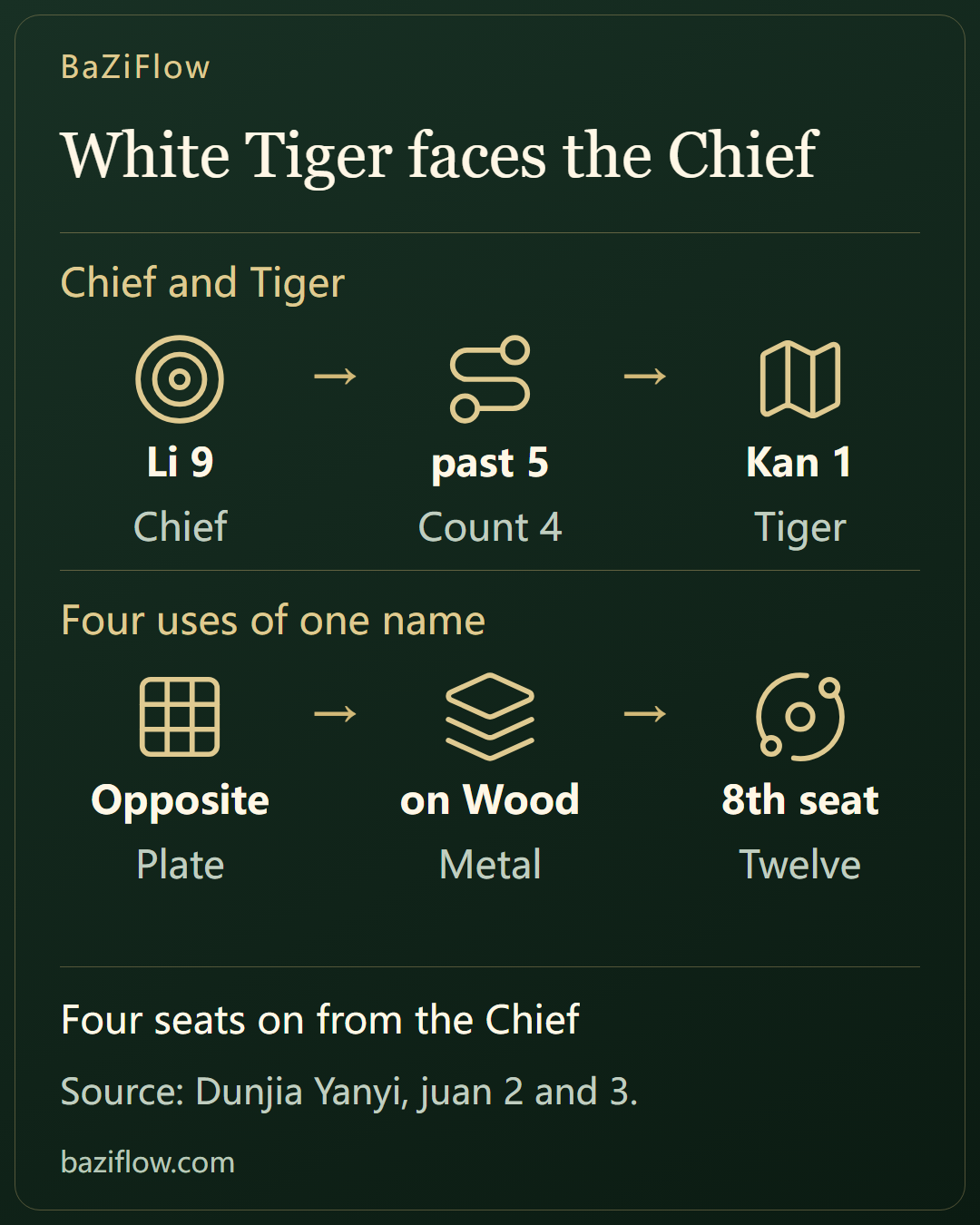
The White Tiger is the fifth of the eight Qimen gods and always sits across from the Chief. What Dunjia Yanyi says about it, and how the same name appears in a pattern, a twelve-god cycle and a spell.
The short version9 min read
The White Tiger is the fifth of the eight gods and always sits across the center from the Chief; the book also uses the name for a stem pattern, a twelve-god cycle and a spell, each on its own layer.
- The eight gods are dealt out from the Chief, and the White Tiger is the fifth, so it always faces the Chief. Yang and Yin modes count in opposite directions, yet this seat does not move.
- Juan 3 gives the White Tiger one line: a "fierce and ill-omened" god useful for guarding against night raids, with an escape clause for a direction where a wonder and a gate meet.
- "White Tiger Runs Wild" is the name of a pattern (heaven Yin Metal over earth Yin Wood), and a twelve-god cycle has a White Tiger too. Each is dealt out separately, so one palace may or may not hold more than one of them.
Read first
Fifth in line, and directly across from the Chief
In plain words first: the eight gods of a Qimen (奇门) chart form a ring of eight seats. Count from the Chief (值符) and the White Tiger (白虎) is fifth; on a ring of eight, the fifth seat lands exactly opposite the first.
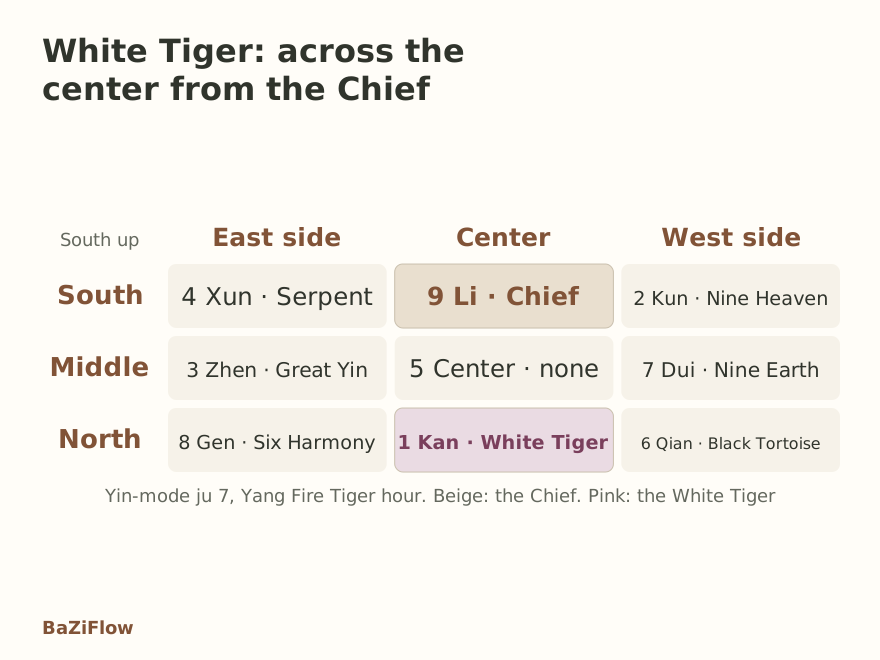
Nine-palace base, south up and east on the left. The seats follow one example in juan 2 of Dunjia Yanyi (Yin-mode ju 7, Yang Fire Tiger hour): the four places the book names match the engine, and the rest are filled in by the same order. Beige is the Chief, pink the White Tiger.
The picture is one chart from juan 2 of Dunjia Yanyi (遁甲演义), a Ming-era compendium: Yin-mode (阴遁) ju 7, Yang Fire Tiger (丙寅) hour. The book states that the Chief is in palace 9, Nine Heaven (九天) in 2, Nine Earth (九地) in 7 and the Life Gate in 1. Re-casting the same ju and hour with the site's hourly engine reproduces all four. The remaining seats follow from the same order: the White Tiger is in Kan One, the Serpent (螣蛇) in Xun Four, Great Yin (太阴) in Zhen Three, Six Harmony (六合) in Gen Eight and the Black Tortoise (玄武) in Qian Six. Li Nine and Kan One lie on one north-south line through the center, palace five.
The order itself is given in juan 3: Chief, Serpent, Great Yin, Six Harmony, White Tiger, Black Tortoise, Nine Earth, Nine Heaven, laid forward in Yang mode and backward in Yin mode. "Forward" means going round the outer ring from Kan in the north through Gen, Zhen, Xun, Li, Kun and Dui to Qian, then back to Kan. Palace five is not on the ring, so the center holds no god.
Enlarge diagram · scroll sideways to read
In both charts the Chief is in Li Nine and the White Tiger in Kan One. Counting forward in one and backward in the other sends only the gods that are not opposite, such as Nine Heaven and Nine Earth, to different sides.
The book's one line: a rank, a use and an exception
Juan 3 of Dunjia Yanyi has a section on the lucky and unlucky gods of the Heavenly One, the Chief (天乙直符吉凶神说), with one sentence for each of the eight. The White Tiger's reads:
The White Tiger is a fierce and ill-omened god. It can be used to guard against enemy soldiers raiding the camp. Where a wonder and a gate meet, it need not be treated as a taboo.
The sentence has three steps: a rank ("fierce and ill-omened"), a use (guarding against night raids, the defensive side of a campaign) and an exception (in a direction where a wonder and a gate meet, the taboo falls away).
Enlarge diagram · scroll sideways to read
In the same passage the Serpent ("deceitful") and the Black Tortoise ("a petty thief") carry an exception clause with the same meaning (the Serpent's is worded slightly differently), while the Chief, Nine Heaven, Nine Earth, Great Yin and Six Harmony get only a use and no exception. So the three gods the book gives a negative rank each get a way out. "Where a wonder and a gate meet" reads, from context, as a direction reached by one of the three wonders together with a lucky gate; this passage does not spell out which gates.
One name, four places
Search Dunjia Yanyi for "White Tiger" and you meet four unrelated uses. Lay them side by side first:
Enlarge diagram · scroll sideways to read
The third use is in juan 2, in the section on the "private gate of the earth" (地私门). The book adds the monthly general to the hour and sets out twelve names: the Noble (贵人), Serpent, Vermilion Bird (朱雀), Six Harmony, Gou Chen (勾陈), Azure Dragon (青龙), Tian Kong (天空), White Tiger, Tai Chang (太常), Black Tortoise, Great Yin and Tian Hou (天后). This is a separate cycle of twelve, not the eight gods. The book's example is the first month with the monthly general at the Pig branch, on a Yang Wood day at the Dragon hour. The Yang-side Noble lands on the Rat and, counting on, the White Tiger is on the Goat; with the Yin-side Noble counted backward it is on the Pig. I recast the sequence and it matches the book's twelve positions one by one.
Enlarge diagram · scroll sideways to read
The fourth use is the shortest. A spell in juan 3 contains the line:
The Azure Dragon flanks the axle, the White Tiger holds the shafts.
Here the White Tiger is a name called up as an escort. It has no palace and no lucky or unlucky label.
Yin Metal over Yin Wood: why a pair of stems is also called the White Tiger
Juan 2, in its group of "inauspicious patterns of the Three Wonders", lists four patterns named after animals: Azure Dragon Flees (Yin Wood over Yin Metal), White Tiger Runs Wild (Yin Metal over Yin Wood), Vermilion Bird Enters the River (Yin Fire over Yin Water) and Serpent Leaps (Yin Water over Yin Fire). "Over" means the heaven-plate stem pressing on the earth-plate stem. White Tiger Runs Wild is the heaven stem Yin Metal sitting on the earth stem Yin Wood.
The Canopy Star (华盖) belongs to Metal and is the White Tiger, so Yin Metal over Yin Wood is the White Tiger running wild.
The reason for the name is the elements: this Yin Metal stem belongs to Metal, and Metal is matched with the White Tiger. The neighboring pattern says it more bluntly: "Metal is the Great White Star, the White Tiger; Wood is the Azure Dragon; Metal restrains Wood, so dragon and tiger fight." Yin Metal restrains Yin Wood, and the two patterns are the same pair of stems read from opposite sides. The Song of the Angler on the Misty River in juan 1 also lists it with Azure Dragon Flees, Vermilion Bird Enters the River and Serpent Leaps, and calls the four of them inauspicious.
Enlarge diagram · scroll sideways to read
I recast both book examples. The palace where heaven Yin Metal sits on earth Yin Wood is Zhen Three, and in that same chart the god of Zhen Three happens to be the White Tiger. The Azure Dragon Flees chart lands in Gen Eight, where Nine Heaven stands. The pattern layer and the god layer are dealt out separately: in one example they coincide and in the other they do not, which is the "separate layers" point of the previous section.
Before writing it down, ask which White Tiger
Name the layer
If the god column of the chart reads White Tiger, it is the plate's tiger. Yin Metal over Yin Wood is a pattern name. Twelve names counted from a monthly general are the nobles. Keep the three apart.
Then count the seat
On the plate, find the Chief first; the palace across from it is the White Tiger. Four seats forward or backward land on the same palace, so of the eight gods only the Chief and the White Tiger keep their place whichever way Yang or Yin mode counts.
Quote with the condition
When citing "fierce and ill-omened", quote the exception clause with it, give the juan 3 section as the source, and say that the White Tiger and Black Tortoise name set is the one in use.
The names come in two sets as well. The site's hourly experimental chart writes White Tiger and Black Tortoise; the daily experimental chart writes Gou Chen and Vermilion Bird in the same two seats. Whether the two sets are equivalent depends on the method version, and the site glossary does not swap them automatically. For the division of labor among gates, stars and gods see what doors, stars and spirits each do; the count starts from the Chief, and the seat after the White Tiger is the Black Tortoise.
Questions readers ask next
Is the White Tiger the worst of the eight gods?
The book gives it three words, "fierce and ill-omened". In the same passage the Serpent is called deceitful and the Black Tortoise a petty thief, and all three carry the same kind of escape clause. A ranking of "worst" does not appear in the text.
My White Tiger palace also shows the White Tiger Runs Wild pattern. Is that a double warning?
They come from different procedures: one is the seat reached by counting round the gods, the other is a heaven stem sitting on an earth stem. The book names the pattern because Yin Metal belongs to Metal, not because of any god. Where the two meet, note two separate entries rather than one stronger verdict.
The White Tiger sits in Gen Eight on my chart. Is that common?
The site engine has laid out all 1,080 combinations of 18 ju and 60 hour pillars. The White Tiger lands in Gen Eight in 240 of them and in every other outer palace in 120; the center never holds a god. Gen Eight is doubled because the Chief lands in Kun Two twice as often. That is a count of combinations, not how often real charts occur.
Was this article helpful?
Sources & references
Continue reading
Six Harmony: Three From the Chief, and the Same Name in the Stems and the Branches ↗
Black Tortoise in Qimen: a Northern Name on a Chart That Can Seat It in the South ↗