

Turn career imagery into work
Content version · · Sources & references
A technical-writing example shows how to move from the Eight and Three of Pentacles to role requirements, a bounded work sample and specific feedback, without treating a card as a hiring decision.
The short version7 min read
The Eight of Pentacles foregrounds a craftsperson’s work; the Three places craft in another setting and stage in Waite’s account. A career exercise can make that connection tangible through one small sample, a stated task and feedback precise enough to guide a revision.
- Waite connects the Eight and Three through craft; numerical order does not prescribe a person’s career progression.
- A vacancy, your sample and a reader’s feedback answer different questions. Preserve an inspectable process instead of replacing it with an aptitude label.
- Locate feedback in a particular step, revise that part and retest the same task so that a concrete change can be assessed.
Read first
What the work imagery can contribute
Waite describes the Eight of Pentacles through a craftsperson at work and associates it with work and skill, including preparation. For this exercise, that can prompt attention to a repeatable process: draft instructions, test them, locate the confusing step and revise it. The process is proposed here; it is not a technical-writing method dictated by the card.
The Three of Pentacles depicts a sculptor working in a monastery in Waite's account, which explicitly compares it with the Eight. A present-day reader may use it to ask who will inspect the work and according to what criteria. This should not become “the hiring team will recognize my talent.” No member of that team has supplied information through the picture.
Nor does a difficult interpretation establish that you lack aptitude. If the image brings up concern about experience, identify the relevant experience and look for evidence. An untested self-description, flattering or discouraging, remains untested. The useful movement is from a broad label toward a question that a real task can help answer.
A detail in Waite overturns a simple numerical ladder: the Three refers back to the apprentice or amateur of the Eight as rewarded and now working in earnest. Preparation in Eight and earnest work in Three form the author’s comparison, not “three is lower than eight, therefore earlier”. Attend to action, setting and cross-reference before inventing a progression.
Eight of Pentacles
- Working and displaying craft
- Skill and preparation
Three of Pentacles
- Sculptor in a monastery
- Waite compares it with Eight
A source-based craft connection, not a career sequence dictated by 3→8
Choose an output before asking for a verdict
Suppose you are curious about technical writing. Asking “Am I meant to do this?” gives a reading a large claim to make and very little work to inspect. A smaller experiment is to write a short instruction page for a tool you already understand, then ask someone unfamiliar with it to follow the steps.
The output might contain a clearly named audience, prerequisites, numbered actions and a description of what completion looks like. These are choices for this fictional exercise, not a universal specification for every technical-writing job. The actual role you are exploring may require different materials, tools or experience.
With that output in view, the tarot question can become “What part of my preparation am I failing to examine?” A card may help you notice a topic to investigate. It cannot establish that an employer needs your skill set, that your writing meets a requirement, or that you will receive an offer.
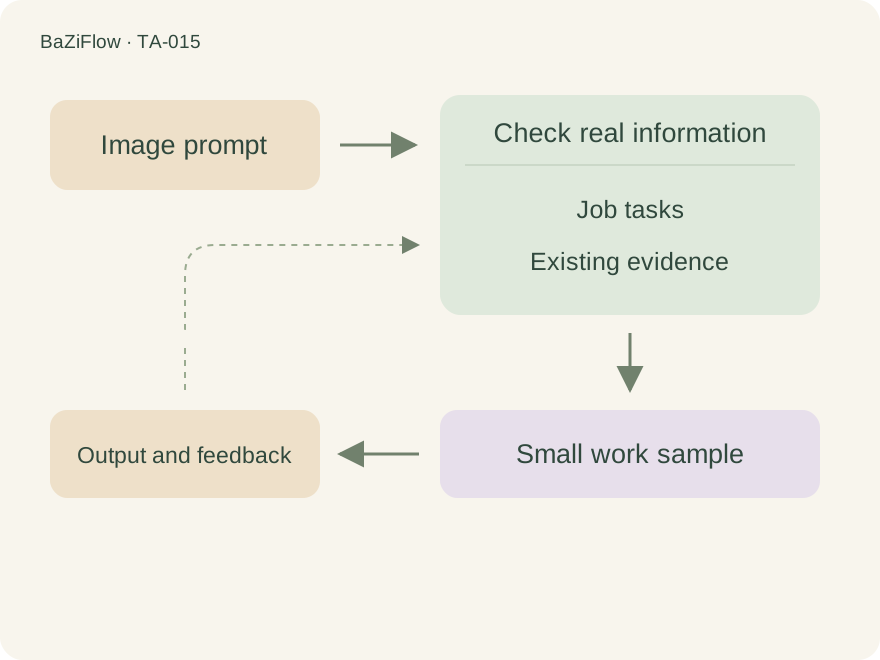
An original workflow: an image starts a question; evidence and an inspectable output carry the exercise forward.
Keep the occupation, vacancy and exercise distinct
An occupational description gives a broad account of a kind of work. A particular vacancy sets requirements for a specific opportunity. A practice sample shows what you did under the conditions you chose. These sources answer different questions and should not be collapsed into one claim that you are qualified.
The U.S. Bureau of Labor Statistics' handbook separates duties, working conditions and preparation for entry, among other topics. That way of organizing information is useful when deciding what information to collect. Its occupational information concerns the United States; a reader elsewhere should not treat U.S. pay or credentials as local facts.
Even within one location, two positions with the same title can emphasize different tasks. Save the date and source of the vacancy you use. If it asks for a portfolio explaining complex processes, inspect that requirement directly rather than inferring it from the word “writing” or from a favorable card.
| Material | Question it can help answer | What it cannot establish alone |
|---|---|---|
| Occupational profile | What work commonly belongs to this occupation? | The exact requirements of this vacancy |
| Vacancy description | What does this employer say it needs? | Whether your sample meets those needs |
| Your instruction page | What can a reader do with this version? | A guaranteed hiring outcome |
For a practice document, use a tool and material you have permission to describe. You do not need confidential workplace files to make the exercise realistic. A small invented example can expose an unclear instruction just as well as a sensitive production document.
Invented tool
Step 1
- Instruction
- Open Export
- Reader sees
- Share menu
- Revision
- Name Share first
Step 2
- Instruction
- Save the file
- Reader sees
- Name dialog
- Revision
- Specify a filename
Check
- Instruction
- File is ready
- Reader sees
- No output named
- Revision
- Show expected file
A fictional interface test; the reader follows this version, not the writer’s memory
Ask feedback to point to a place in the work
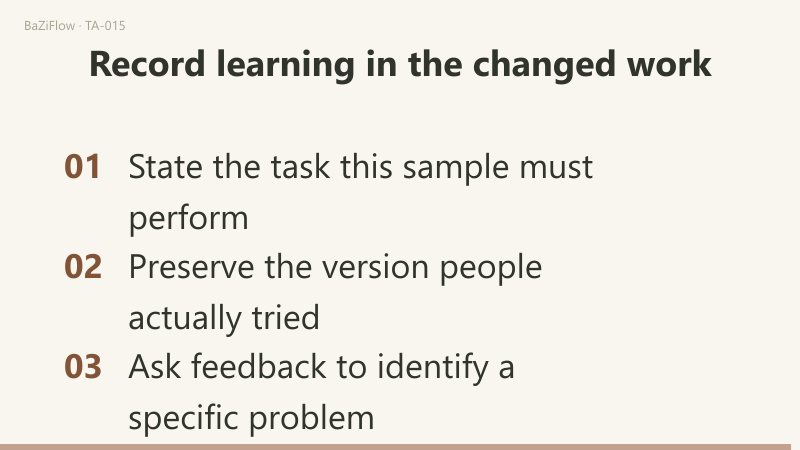
“Promising” is encouraging but hard to revise against. “I could not find the setting mentioned in step three” identifies a location and an observable problem. Ask the reader to show where they stopped, what they expected to see and what information they needed next.
Record the version they tested. If you edit while they are describing the problem, preserve the earlier copy so that the feedback still has a clear target. Then change the relevant passage and check whether the reader can proceed. This is a bounded learning exercise, not a claim that one test measures your entire professional ability.
The reading's association belongs in a separate note: perhaps the Eight of Pentacles prompted you to practice a neglected step. The evidence of improvement belongs in the document and the test result. Keeping those records separate lets you appreciate a useful prompt without inventing an ability for the card to assess your performance.
You may also discover that you dislike this kind of detail work, or that the task interests you but the role you found includes other duties you do not want. Both are information. An exploratory sample does not have to end with a decision to pursue the job in order to have served its purpose.
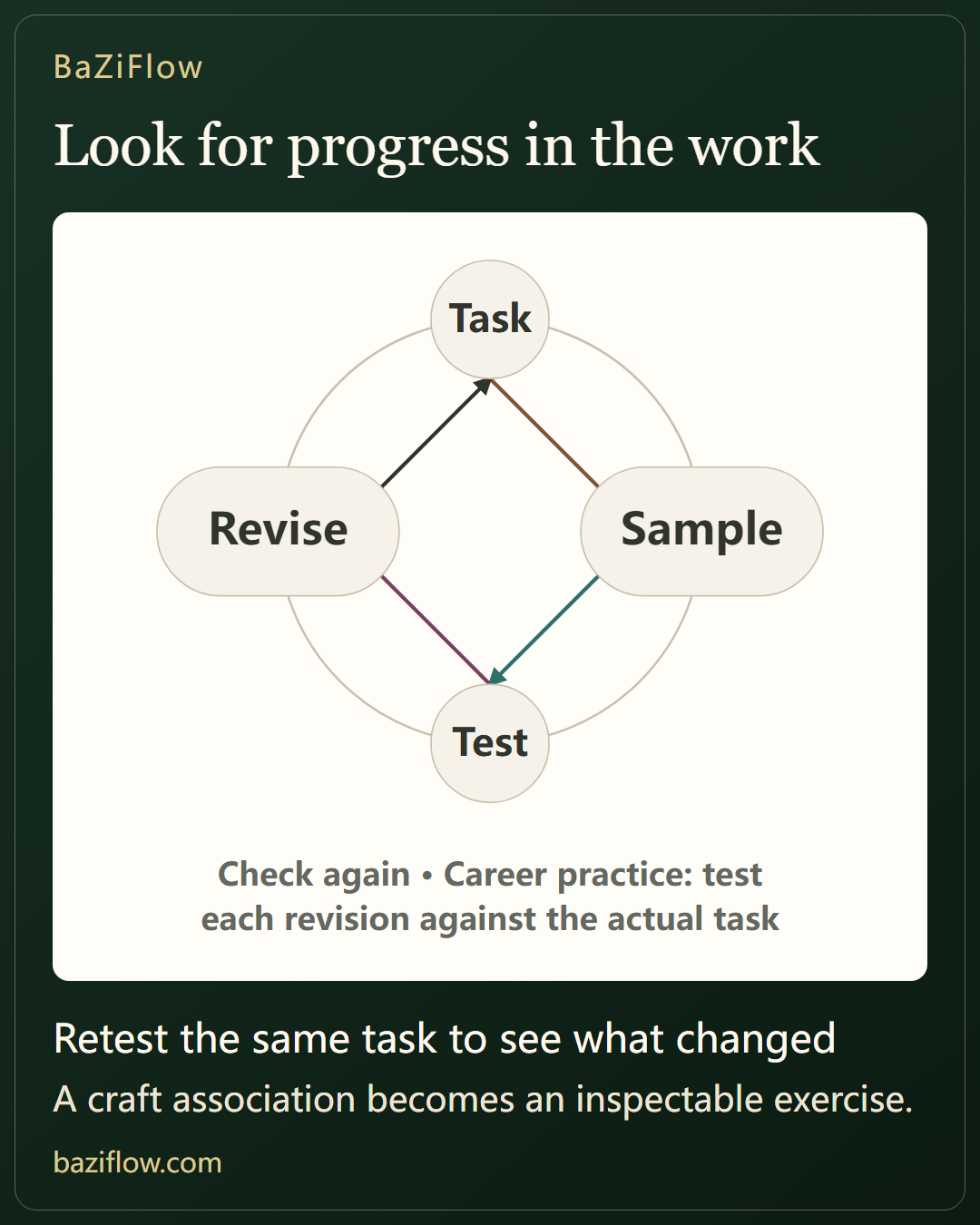
Keep the task constant across versions to identify the change
Define the next step without precommitting the whole career
A suitable next step here might be to finish one instruction page and collect one round of focused feedback. Its endpoint is a revised document and a short list of unresolved questions. It is not a commitment to leave a job, pay for training or accept an offer. Those decisions involve additional conditions that a small exercise does not settle.
When comparing two possible roles, use the same factual categories for both: tasks, working arrangements, preparation and the conditions you care about. Do not ask only about opportunity in your favorite option and only about obstacles in the other, then treat the resulting contrast as a fair comparison. The guide to asking tarot questions explains how to keep the task defined before the draw.
Later, review the original sample, the feedback and the changes. An interview invitation would involve your application, the employer's needs and other real processes; it would not isolate a card's predictive accuracy. A rejection would likewise not be a verdict on every future role. Keep conclusions proportionate to what happened in this case, using the record-review guide to distinguish initial expectations from later explanations.
Keep the old version
Keep feedback tied to the line or step that was actually tested.
Name the change
Identify the exact rule, wording or structure that changed.
Retest the task
Retain successes and unresolved points separately to choose the next practice step.
Questions readers ask next
Does the Eight of Pentacles require exactly eight practice attempts?
No. The number identifies the card, not a required dose of practice. The task, time available and kind of feedback should determine the scope. What matters is an inspectable result, not reproducing the numeral in the exercise.
Why not read Three followed by Eight as career advancement?
In the Three’s entry, Waite instead refers back to the apprentice or amateur of the Eight as now working in earnest. That is his symbolic comparison, not a universal chronology that can be derived from numerical order.
Does one well-received sample establish fitness for the role?
It can identify strengths in that version on that particular task. A vacancy may involve other requirements that were not tested. Preserve specific feedback and untested conditions before comparing the sample with the current role description.
Was this article helpful?
Theme: Career & learning
Sources & references
Continue reading
A single-card practice can record a correction ↗
Review the whole tarot journal, not just the memorable matches ↗