

Direction and seasonal conditions are separate
Content version · · Sources & references
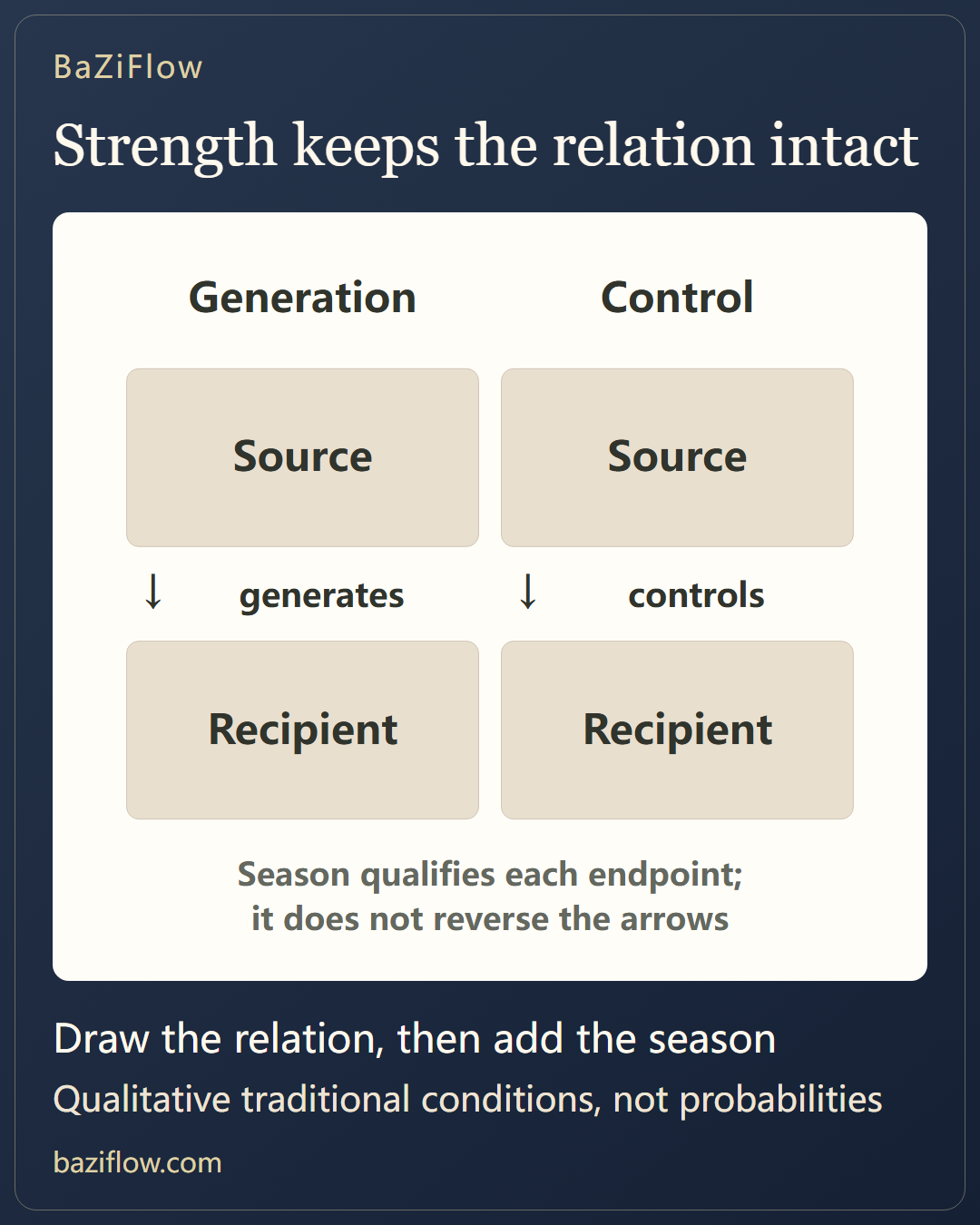
Compare five relationships to a supplied Qian body, then contrast summer and autumn without reversing fire’s control of metal or inventing probabilities.
The short version6 min read
With Li fire as Use and Qian metal as Body, autumn strength and summer decline do not reverse fire controlling metal. Identify the source and target first, then add each side’s seasonal condition. This separates a reversed relation from missing strength data or an invented success rate.
- Earth Use generating metal Body differs from metal Body generating water Use. Keep Body as the same reference in each independent exercise.
- Autumn makes metal Body strong; summer makes it decline while fire Use is strong. Fire still controls metal in both conditions.
- The influencing figure has its own seasonal condition. Without that information, record the relation without inventing its strength.
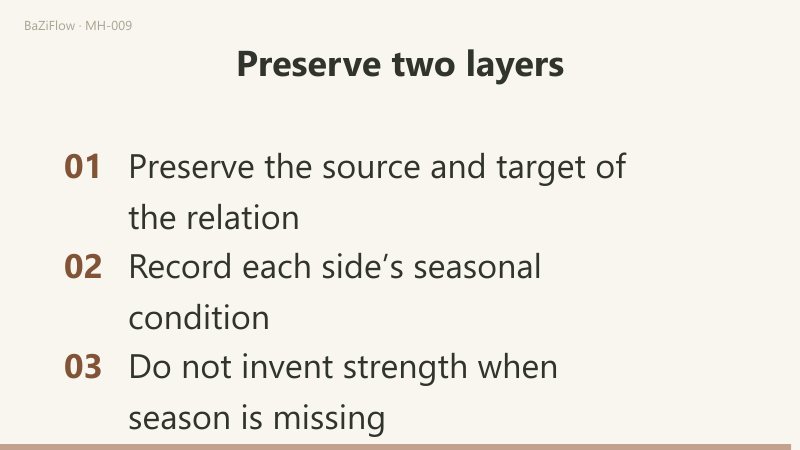
Read first
A seasonal label cannot reverse an arrow
Suppose body is Qian metal and use is Li fire. In the traditional five-phase scheme, fire controls metal: use controls body. That direction remains the same whether the exercise is assigned to summer or autumn. Seasonal strength supplies another condition; it does not authorize replacing fire controlling metal with metal controlling fire.
This distinction is central to reading Meihua without compressing every statement into a favorable or unfavorable label. Volume two of the Meihua Yishu asks the reader to establish generation and control, then examine strength and decline. Here those are treated as two layers of a traditional interpretive framework, not as measured energy or a statistically calibrated probability of success.
Relation direction
- Source and target
Seasonal strength
- Declared season
Five relationships, one fixed reference
Start with a supplied body trigram, Qian, assigned to metal. Independently pair it with each use trigram below. The five rows are relationship exercises, not five use trigrams generated by a single unreported casting. The trigram–phase associations follow volume one; body and use explains how the roles themselves are allocated.
| Supplied use trigram | Phase relationship | Role-relative description |
|---|---|---|
| Kun earth | Earth generates metal | Use generates body |
| Li fire | Fire controls metal | Use controls body |
| Kan water | Metal generates water | Body generates use |
| Zhen wood | Metal controls wood | Body controls use |
| Dui metal | Metal matches metal | Same-phase accord |
The word “generates” is insufficient without a subject and an object. The text distinguishes body generating use, described as expenditure or discharge, from use generating body. Likewise, body controlling use and use controlling body point in opposite role-relative directions. A bare occurrence of “control” cannot tell you which side receives the action.
Same-phase accord does not require identical trigram names. Qian and Dui differ as trigrams but both belong to metal. Conversely, two pleasant-sounding symbolic associations do not establish accord. The comparison is made between their declared phases, not between the emotional tone of their names.
Add the seasonal condition without changing the relation
Return to Qian as body and Li as use. Volume two's discussion of strength identifies metal with autumn strength and summer decline, while fire is strong in summer. In an autumn exercise, body metal is strong but still receives fire's controlling relation. In a summer exercise, body metal is declining while use fire is seasonally strong. Both remain cases of use controlling body.
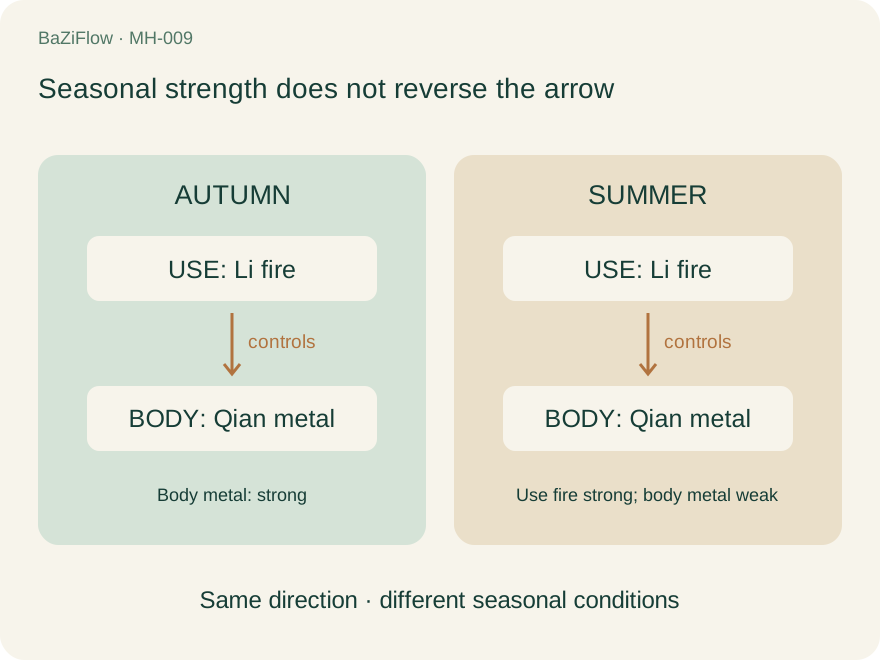
Original BaZiFlow comparison. The seasonal condition changes; the direction from use fire to body metal does not. These are supplied exercises, not observed outcomes.
The source distinguishes receiving control while strong from receiving it while weak. That is a qualitative distinction within the method. It is not a numerical scale from which a seventy-percent chance can be calculated. Nor should a broad traditional phrase such as “even if another trigram controls it, there is no great harm” be promoted into a guarantee about an actual event.
The same passage lists wood with spring, fire with summer, metal with autumn, water with winter and earth with its designated seasonal months. This article uses the explicit summer–autumn contrast rather than inventing a complete daily scoring system. In particular, the expression for earth's seasonal months should not be read as saying that earth is strong in every month of every season.
Autumn
- Metal Body strong
- Fire Use → controls → metal Body
Summer
- Metal weak / fire strong
- Fire Use → controls → metal Body
Examine the influencing side as well
Checking body alone is incomplete even within the cited framework. Volume two says that a figure generating body should itself be strong, while a figure controlling body is preferably weak. Volume three likewise asks for examination of strength and decline. A useful note therefore identifies body, the direction of the relation, and the condition assigned to the influencing figure.
For example, earth generating a metal body is a valid phase relationship before its strength has been assessed. If no seasonal information is supplied, the relationship can still be recorded, but earth should not silently be marked strong. Missing a condition is different from having evidence for a weak condition, and neither should be replaced with a convenient default.
When nuclear or changed figures are added, counting how many times a word such as “generates” appears is not an assessment of influence. Each comparison needs its own identified figure and scope. The number of metal mentions in this teaching table is also not a count of metal in a person's chart; it is simply repeated explanatory text.
Volume three's treatment of external responses further distinguishes actual objects from resemblance in shape or color, and discusses differences of scale. A red surface and a fire in a furnace are not treated as interchangeable merely because both can be associated with fire. This is a distinction inside the traditional interpretive account, not proof that those associations predict real events.
Body condition
Relation
Influencer condition
Record what was known before interpreting the result
Turning an actual date into a seasonal category requires a declared calendar and boundary convention. The seasonal passage alone does not supply the precise time of every transition. Since these exercises provide seasons directly, no date is invented. If another source uses different boundaries, keep that choice visible and consistent instead of switching it after seeing the outcome.
A reproducible note can preserve four separate items: the phase assignments of body and use, the directional relation, the seasonal classification and any missing conditions. Record the real-world outcome separately. Revising the original roles or season to fit what happened makes later review unable to distinguish a calculation error from an interpretive overreach.
The next useful step is reviewing Meihua cases, where those original assumptions can remain visible rather than being absorbed into a retrospective story.
Questions readers ask next
Can strong metal reverse fire controlling metal?
No. Strength adds a seasonal condition within the traditional framework; it does not change the direction assigned by the five-phase relation. Autumn metal can be described as strong while still receiving fire’s control.
Why can Qian and Dui have same-phase accord despite different names?
The comparison concerns their declared phases, and both belong to metal. Same-phase accord does not require identical trigram names. Conversely, two agreeable symbolic associations do not establish a shared phase.
Can earth’s support of metal be rated without seasonal data?
The direction earth generating metal can be recorded, but the seasonal conditions of earth and metal remain undetermined. Missing information is not evidence of weakness or permission to default to strength. Keep those statuses separate.
Was this article helpful?
Sources & references
Continue reading
Line texts and external signs: preserve the evidence layers ↗