

The Emperor: a staff and a globe on stone
Content version · · Sources & references
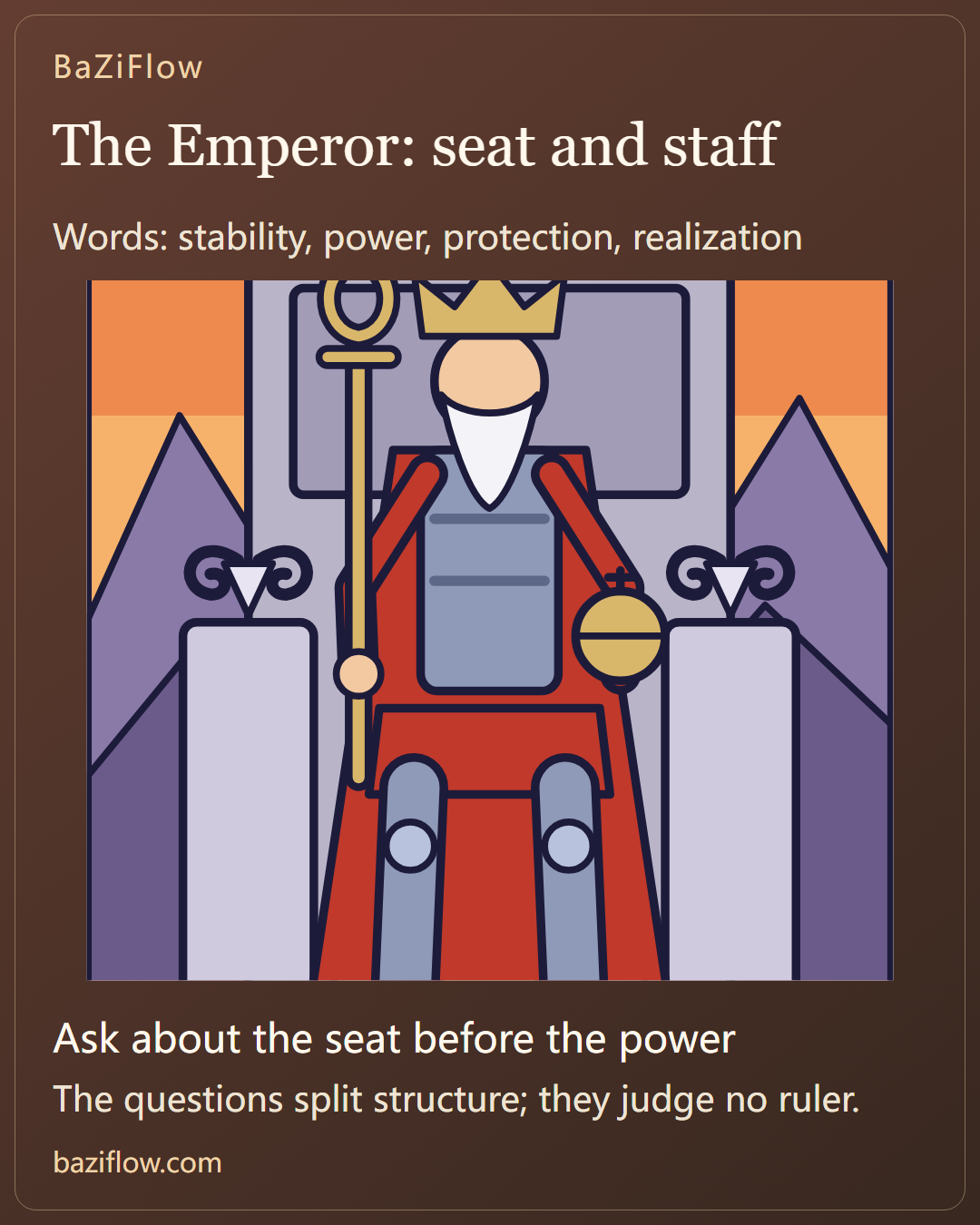
The Emperor sits on a throne with rams' heads, holding an ankh-shaped staff and a globe. Separate Waite's picture, word list and symbols, then ask three questions (seat, staff, globe) about a student club's recruiting.
The short version7 min read
The Emperor sits in a stone seat with a staff in one hand and a globe in the other. Waite describes him almost entirely in objects, so the way into this card is to split "power" into those objects first.
- Waite's picture: a crowned monarch, commanding and stately, on a throne whose arms are fronted by rams' heads; the sceptre a form of Crux ansata, a globe in the left hand; he is "executive and realization", the power of this world.
- The list leans on stability, power, protection, realization, with aid, reason and conviction; the reversed column puts benevolence and credit first and obstruction and immaturity after, qualities side by side.
- The practice splits "power" into three things, the seat, the staff and the globe, with one question each, and applies them to a club's recruiting notice.
Read first
Start with the picture: a stone seat, rams' heads, a staff in one hand and a globe in the other
Waite's description of the Emperor is almost all objects. He has a form of the Crux ansata for his sceptre and a globe in his left hand. He is a crowned monarch, commanding, stately, seated on a throne, the arms of which are fronted by rams' heads. Then comes the verdict: he is executive and realization, the power of this world, here clothed with the highest of its natural attributes. Waite adds that he is occasionally represented as seated on a cubic stone, which however confuses some of the issues.
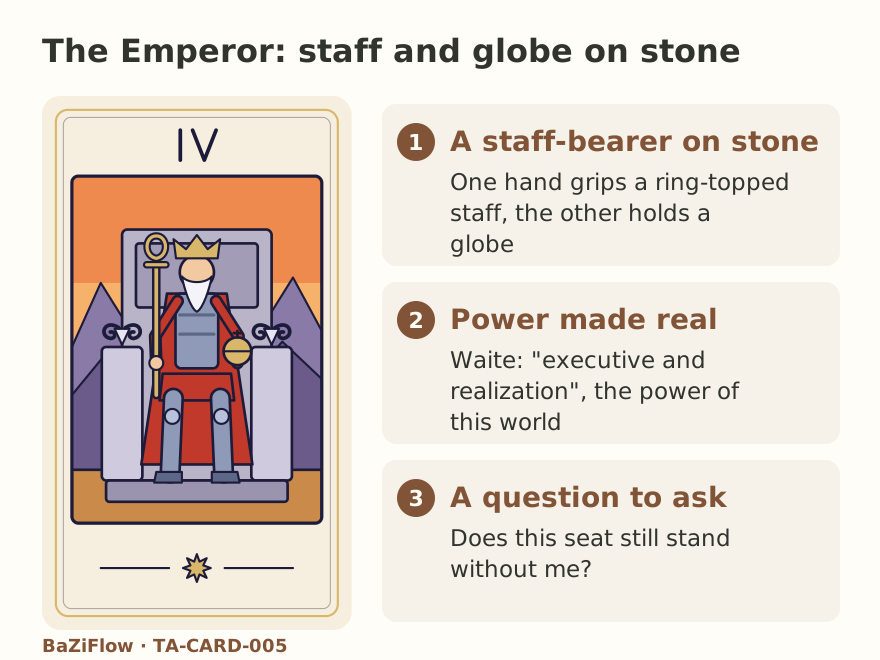
The Emperor: BaZiFlow's card with three prompts
Set the Rider-Waite-Smith original beside this and you can check it: the Roman numeral IV at the top and an orange-red sky; an old man with a white beard in a gold crown, one hand on a gold staff topped with a ring, the other holding a small globe; armor showing under the red robe; a grey stone throne with ram's heads at the top of the back and at the front of the arms; mountains behind. The picture divides into three places: the seat, the figure and the hands.
Enlarge diagram · scroll sideways to read
What Waite lists: stability and power, with gentle and blocking words side by side when reversed
The Emperor's divinatory meaning is: stability, power, protection, realization; a great person; aid, reason, conviction; also authority and will. Reversed: benevolence, compassion, credit; also confusion to enemies, obstruction, immaturity.
Stability, power, protection, realization; a great person; aid, reason, conviction; also authority and will. Reversed: Benevolence, compassion, credit; also confusion to enemies, obstruction, immaturity.
Enlarge diagram · scroll sideways to read
"Realization" echoes Part II, where he calls the Emperor executive and realization. In the reversed column benevolence, compassion and credit come first, then confusion to enemies, obstruction and immaturity: three kinds of quality side by side, which Waite does not separate.
Staff, globe and rams' heads: how far Waite goes
Part II first speaks of the surface, then of what lies behind. On the surface the Emperor and Empress are mundane royalty, uplifted on the seats of the mighty; above this there is a suggestion of another presence, a higher kingship occupying the intellectual throne, the lordship of thought rather than of the animal world. He also notes that both personalities are "full of strange experience" after their own manner, though theirs is not consciously the wisdom which draws from a higher world.
Three objects and who is speaking
- The staff shaped as a Crux ansata
- Waite writes "a form of the Crux ansata for his sceptre". The ankh is an ancient Egyptian sign of life; that is common lore, not his explanation in this entry.
- The globe in the left hand
- Waite says the globe is in his left hand and calls him "the power of this world". A globe and staff as emblems of kingship are common knowledge.
- Rams' heads on the arms
- Waite says only that the arms of the throne are fronted by rams' heads, with no meaning given. Under the King of Pentacles he also points to a bull's head recurring on the throne, again without explaining it.
Enlarge diagram · scroll sideways to read
Reading the staff as "the decisions I can make" and the globe as "the area I am responsible for" is a modern borrowing. It works, but Waite writes of objects, so say that the reading is borrowed.
How to read it: one seat, two hands, three questions
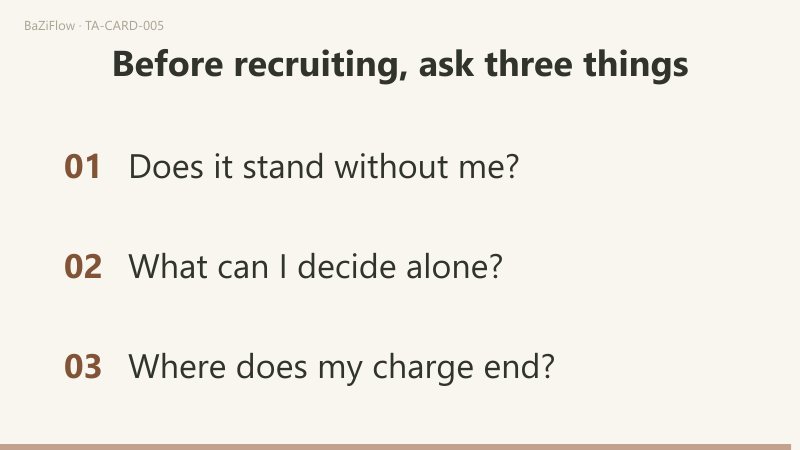
The picture lays "power" out as three things that can be checked one by one: the seat, the staff, the globe. Used on a club's recruiting, they become three questions.
The seat: does it stand without me?
A stone seat does not collapse because the sitter changes. Ask whether, when officers change over, the charter, contacts and accounts have a handover written on one page. If not, the seat is held up by one person.
The staff: which decisions are mine?
List separately the things one person may decide and the things that must be discussed: who to admit, which events to run, how money is spent. If you cannot write the list, "having authority" is still only a feeling.
The globe: where does my charge end?
The globe in the other hand is a definite area: equipment, venue, budget. Say which parts are yours and which belong to others, so newcomers know whom to ask.
An example: a university photography club is setting up a freshers' booth, and the president wants to state who is responsible for what. The three questions become:
Enlarge diagram · scroll sideways to read
After the three lines at the booth
Can be told to newcomers
- Who decides
- Which kinds of matters
Cannot be promised to them
- How good the club will be
- How long they will stay
Add before recruiting
- A one-page handover
- A list of what is voted on
Reversed and neighboring cards: benevolence and obstruction, and three cards that hold a "position"
The Emperor's reversed words come straight after the upright ones:
Benevolence, compassion, credit; also confusion to enemies, obstruction, immaturity.
In this column the first three words lean gentle and the later ones lean blocking; when you read a reversal, say which half you mean.
Three cards and how each places a "position"
The one who responds
The card before. In the Emperor entry Waite calls him the virile power to which the Empress responds, yet says the two cards do not precisely represent married life.
Authority of outward religion
The next card. Waite calls him the ruling power of external religion and the head of the recognized hierarchy; the Emperor is "the power of this world". Both have a seat and a staff, but the area each governs differs.
Seated in judgment
Waite writes that he sits in judgment and is the power of life and death in virtue of his office; the list has power, command, authority. The Emperor's list also has power and authority, but its weight falls on stability, protection and realization.
Enlarge diagram · scroll sideways to read
Questions readers ask next
Is the Emperor the "authority" or "control" card?
Waite's list says stability, power, protection, realization, and also aid, reason, conviction, authority and will; "control" is not in it. Part II adds that behind this kind of kingship lies "the lordship of thought", so he writes of more than power over others.
What does the Emperor mean reversed?
In Waite's reversed words one half is gentle (benevolence, compassion, credit) and the other half blocks (confusion to enemies, obstruction, immaturity). Terms like "tyranny" or "abuse of power" were added by later methods, so say whose rules you are using.
Are the Emperor and Empress a "married couple" pair?
In the Emperor entry Waite writes that these two cards do not precisely represent the condition of married life, though that state is implied; on the surface they are mundane royalty, with another presence above it.
Was this article helpful?
Sources & references
Continue reading
The Empress: grain in front, a waterfall behind, and a dark half in the word list ↗