

Kan One: the northern Water palace of the nine
Content version · · Sources & references
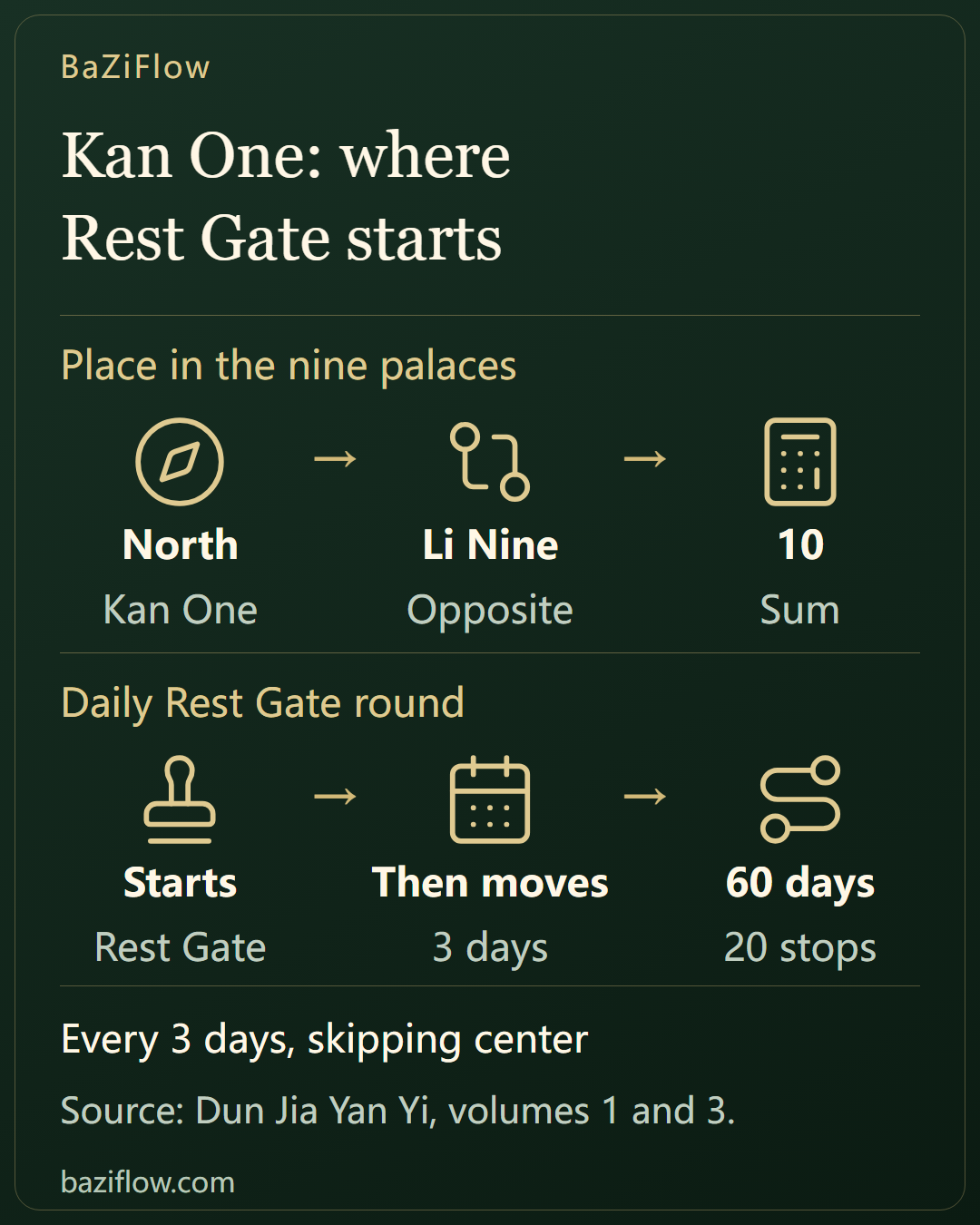
Kan One is the northernmost of the nine palaces: number 1, trigram Kan, Water. Using the daily and hourly examples in Dun Jia Yan Yi, we see what the palace itself covers and why stars and doors are a separate layer.
The short version9 min read
The daily Qimen round in Dun Jia Yan Yi starts its count at Kan One, the due-north box with Luoshu number 1, the Kan trigram and Water. Tian Peng and the Rest Gate have their home here, but what a given ju puts in the box is a separate question.
- Each of the four marks has its own source. North, Water and the Kan trigram come from the usual palace assignments and the number 1 from the Luoshu. The opposite palace is Li Nine, and the two numbers add up to 10.
- The daily example in Dun Jia Yan Yi starts the round at the Kan palace, changes palace every three days, steps through eight palaces by number and skips the center. Sixty days make twenty stops, and Kan One comes up three times.
- In the hourly Yang-mode ju 1 example, the Yang Wood Rat cycle head sits at Kan One with Tian Peng as duty star and Rest Gate as duty gate. That holds for this ju and this cycle only; change either and it no longer applies.
Read first
North, Water, Kan, one: four fixed marks on one box
In plain words first: Kan One (坎一) is the northernmost of the nine palaces. Its Luoshu number is 1, its trigram is Kan and its element is Water. All four marks together make the full name "Kan One".
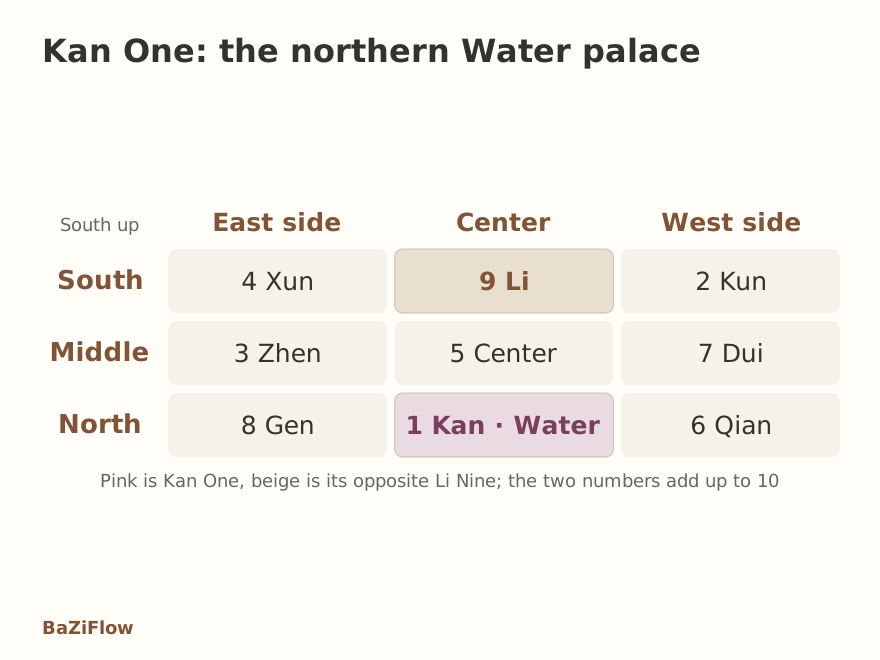
Nine-palace base grid with south at the top and east on the left. Directions and elements follow the usual assignments, the numbers are Luoshu numbers. Pink marks Kan One and beige its opposite, Li Nine.
The grid is drawn with south at the top, so north is at the bottom and Kan One sits in the middle of the bottom row. Facing it across the center is Li Nine, in the middle of the top row, and 1 + 9 = 10. The Shuo Gua (说卦), chapter 5, places Kan in the due north:
Kan is water, the trigram of the due north, the trigram of toil, the place to which all things return; hence "toil in Kan".
"Water" and "due north" match the position and element in the picture. "Trigram of toil" and "where all things return" are how the Shuo Gua describes the trigram itself. What a Kan One palace borrows on a Qimen chart is mainly the direction and the element.
The daily scheme: the Rest Gate leaves Kan and changes palace every three days
The "daily Qimen" section of volume 1 of Dun Jia Yan Yi (遁甲演义), a Ming-dynasty text, starts at the Kan palace:
The method starts the Yang Wood Rat day at the Kan palace and changes every three days, flying in order through the eight directions without entering the central five. See which palace the day has reached, and from there set out the Rest Gate, rotating on in sequence.
So the Yang Wood Rat (甲子) day puts the Rest Gate in Kan. Every three days it moves on to the next palace, through eight outer palaces in all, and the central five never takes part. The book then lists all sixty days in groups of three: Yang Wood Rat, Yin Wood Ox and Yang Fire Tiger days have the Rest Gate in Kan; Yin Fire Rabbit, Yang Earth Dragon and Yin Earth Snake days have it in Kun; Yang Metal Horse, Yin Metal Goat and Yang Water Monkey days in Zhen; Yin Water Rooster, Yang Wood Dog and Yin Wood Pig days in Xun; then Qian, Dui, Gen and Li follow, and the round comes back to Kan.
Enlarge diagram · scroll sideways to read
The order is 1, 2, 3, 4, 6, 7, 8, 9. It follows the numbers upward rather than neighboring directions, so after Kan One the Rest Gate jumps to Kun Two in the southwest, not to Gen Eight in the northeast. Sixty days make exactly twenty stops. Kan One takes the 1st, 9th and 17th, beginning on the Yang Wood Rat, Yang Earth Rat and Yang Water Rat days. The last stop is Xun Four, and after the Yin Water Pig (癸亥) day the next Yang Wood Rat day starts again at the Kan palace.
The hourly scheme: in Yang-mode ju 1, the Yang Wood Rat cycle head sits in Kan One
The same volume's "hourly Qimen" works differently. The solar term fixes the Yin or Yang mode and the ju number, one ju covers five days and sixty double-hours, and these are divided into six cycles of ten double-hours each. The Yang-mode ju 1 example begins like this: the Yang Wood Rat cycle head is at Kan, Tian Peng is the duty star, the Rest Gate is the duty gate, and the cycle governs ten double-hours up to the Yin Water Rooster hour. Yang Wood Dog at Kun, Yang Wood Monkey at Zhen, Yang Wood Horse at Xun, Yang Wood Dragon at the center and Yang Wood Tiger at Qian follow.
Enlarge diagram · scroll sideways to read
Compare this with the table of home positions in what the doors, stars and spirits are. The palace of each cycle head in this ju turns out to be the home palace of its duty star and gate: Peng and Rest in Kan One, Rui in Kun Two, Chong and Harm in Zhen Three, Fu and Block in Xun Four, Xin and Open in Qian Six. The first rows of this ju look much like the home-position table. In another ju the cycle heads land elsewhere, the stars and gates change with them, and what Kan One holds must be looked up again.
Three talents in place: why Peng, Rest and Kan are named together
Volume 3 of Dun Jia Yan Yi, in its section on how a Qimen chart is laid out, begins by dividing the chart into three layers:
The method of dun jia has three tiers that mirror the three talents. The upper tier mirrors heaven and lists the nine stars; the middle tier mirrors people and opens the eight gates; the lower tier mirrors earth and lists the eight trigrams and nine palaces. Tian Peng and the Rest Gate face the Kan One palace: this is the placement of the three talents.
Stars, gates and palaces each take a tier, and the first item of each tier is Tian Peng, the Rest Gate and Kan One. The book lines these three up as the starting point of the three-talent placement. That is where the habit of saying "Peng, Rest, Kan" in one breath comes from.
Enlarge diagram · scroll sideways to read
Heaven, people and earth here mean the star, gate and palace tiers. They are not the same pair as the heaven plate and earth plate of the Three Wonders and Six Instruments (the upper and lower layers of stems; see the Three Wonders, Six Instruments and the two plates). Lining up the starting points only says how the lists are ordered. Where Peng and Rest stand at a given hour still depends on the ju.
Winter Solstice, Minor Cold, Major Cold: the solar terms of Kan
The same passage goes on to match the twenty-four solar terms to the trigrams: the twenty-four qi are "assigned to the eight trigrams", three to each, and Kan takes the Winter Solstice (冬至), Minor Cold and Major Cold. It adds that the twelve qi after the Winter Solstice make the Yang mode, all running forward, and the twelve after the Summer Solstice make the Yin mode, all running backward. The Winter Solstice is the first of the twelve Yang-mode terms, so the Yang-mode half of the year starts at the terms of the Kan palace.
Enlarge diagram · scroll sideways to read
A term belonging to Kan does not make its ju number one. The ju follows from the upper, middle or lower period, a step covered on its own in solar terms and ju numbers.
Two small daily-scheme exercises
On a Yin Earth Ox (己丑) day, in which palace is the Rest Gate?
Yin Earth Ox belongs to the group Yang Earth Rat, Yin Earth Ox, Yang Metal Tiger, which is the 9th stop and has come around to Kan One again.
And on a Yin Water Rooster day?
Yin Water Rooster, Yang Wood Dog and Yin Wood Pig make the 4th stop, in Xun Four. The 1st and the 4th stops start nine days apart, with three days each.
From this box you can go on to the neighboring Kun Two palace, or go back to the nine-palace base grid to check the south-up, east-left orientation.
Questions readers ask next
If a note says "Kan palace", does it mean the Rest Gate and Tian Peng?
No. The home positions of Tian Peng and the Rest Gate are Kan One, which is why they are so often named together. In an actual chart their current palace depends on the setup, and Kan One may hold other stars and gates. Palace, star and gate are three layers, so record them separately.
Why does the daily scheme walk only eight palaces and skip the center?
The text says it flies "through the eight directions, not entering the central five", so it cycles through 1, 2, 3, 4, 6, 7, 8 and 9 and passes over 5. The book gives no further reason for this, and this article does not supply one for it.
Does "Kan One" mean the same procedure in the daily and the hourly examples?
No. The daily example finds the Rest Gate from the day pillar, moving every three days. The hourly example builds a whole chart from the solar term, the ju number and the cycle head. Both use the position called Kan One, but they are different procedures.
Was this article helpful?
Sources & references
Continue reading
Kun Two: the Southwestern Earth Palace, and Why "Ju Two" Is Not "Palace Two" ↗