

Tai Chi Nobleman: five stem pairs, twelve branches
Content version · · Sources & references
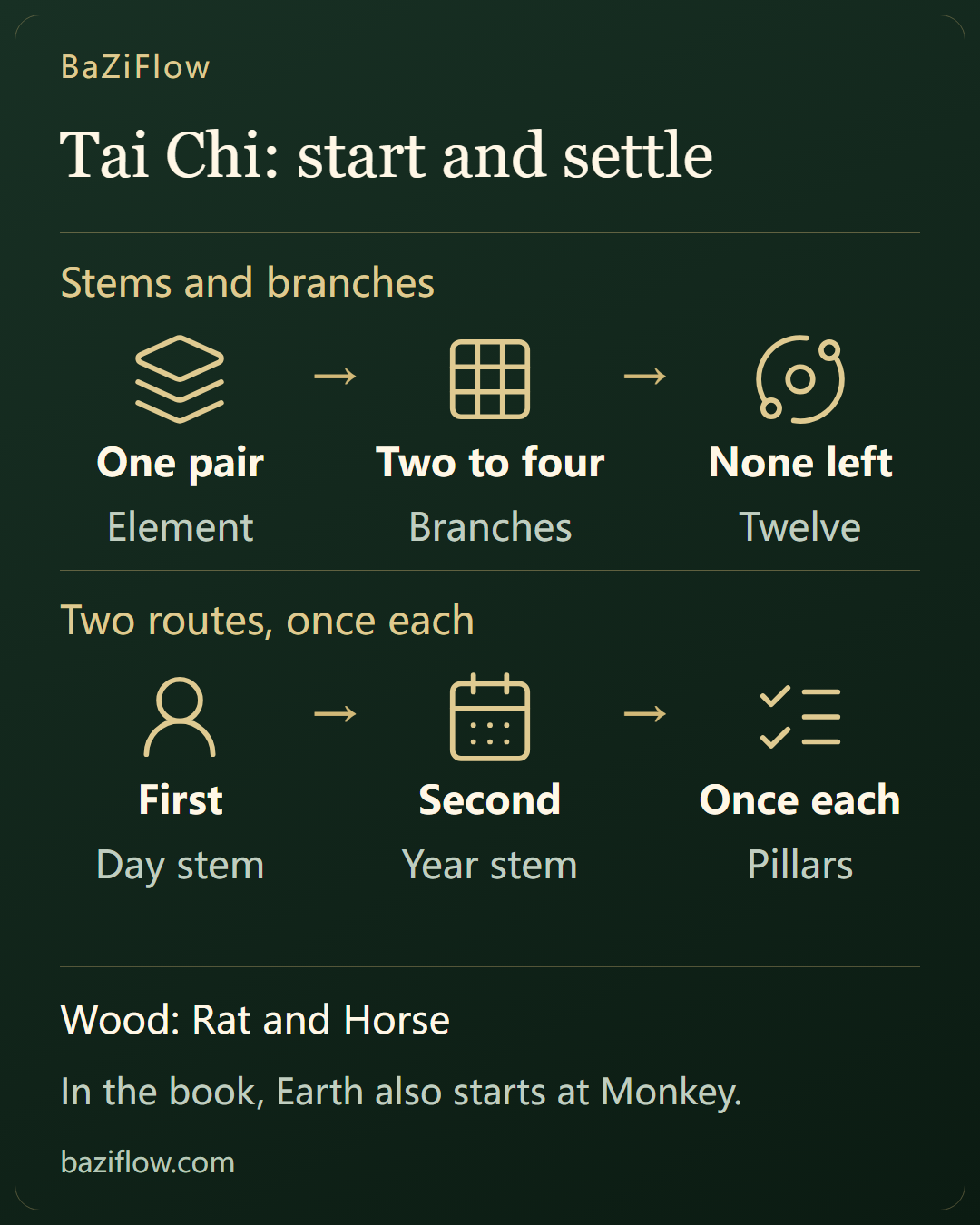
Tai Chi Nobleman is looked up by day stem and year stem, and five stem pairs share all twelve branches. A table, the Sanming Tonghui juan 3 reading of the name and two sample charts show the look-up and its limits.
The short version8 min read
Tai Chi Nobleman splits the ten stems into five pairs, and each pair shares a few branches: the site's engine looks up the day stem, then the year stem, searches the four pillars for the branches, and records each pillar once.
- Together the five pairs use up all twelve branches: Wood and Fire get the cardinal four, Metal and Water the corner four, Earth the storage four. In the site's table, any branch is the Tai Chi of exactly one pair of stems.
- Sanming Tonghui juan 3, in the Tai Chi entry (the Examination Star), reads the name as "Tai the start, Ji the settling place" and gives each element a start and an end; Earth is born at Monkey with four storehouses, and the site keeps only the storehouses.
- The engine searches by day stem and by year stem, and a pillar hit by both is recorded once. The summary line about insight and reflection cannot be found in this passage of the book; its source is still to be checked.
Read first
Symbolic Stars in BaZi: Check the Reference and Rule Before the Meaning ↗
Five pairs of stems, twelve branches, none left over
Tai Chi Nobleman (太极贵人) has a short rhyme: Yang Wood and Yin Wood take Rat and Horse; Yang Fire and Yin Fire take Rabbit and Rooster; Yang Earth and Yin Earth take Dragon, Dog, Ox and Goat; Yang Metal and Yin Metal take Tiger and Pig; Yang Water and Yin Water take Snake and Monkey. Look up the day stem and the year stem, collect the branches, then search the four pillars for them.
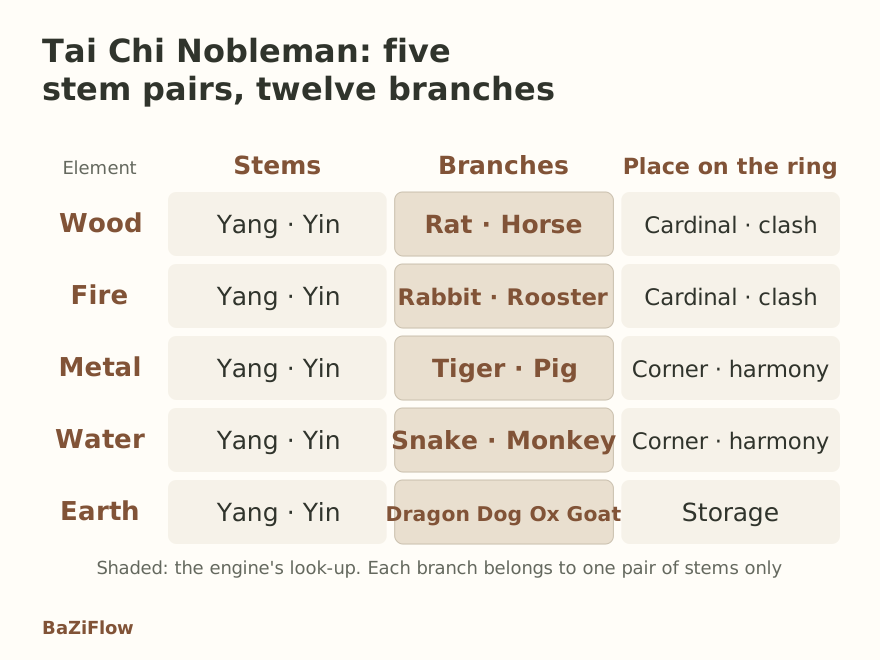
Comparison table: the stems and branches columns come from the site engine's Tai Chi Nobleman table and were checked row by row; the last column is the place read off the twelve-branch ring, with clash and harmony in the usual sense of the six clashes and six harmonies.
Each row is an element. The second column holds its two stems, the shaded third column the branches they share, and the fourth column where those branches sit among the twelve, which section three examines.
Tai the start, Ji the settling: how the book splits the name
The Sanming Tonghui (三命通会) devotes a section of its third juan to this star, "On the Tai Chi Nobleman", with a small note "also called the Examination Star". It opens by taking the name apart:
Tai Chi is the very first, the beginning: what is made at the outset is the Tai Chi. It is also completion and gathering in: where a thing finally settles is called the Ji. When creation and ending keep each other, that is the Tai Chi nobleman.
Tai is the starting point where a thing is first made, and Ji is the place it is finally drawn back to; an element has a beginning and an end, and the branches of that beginning and end together make the element's Tai Chi. The book then goes through them one by one:
Yang Wood and Yin Wood, Wood, are first made at Rat, where the water of Kan helps them into life; they end at Horse, where the fire of Li burns them to death. Yang Fire and Yin Fire, Fire, first like to come out at Zhen, the Rabbit, and later like to hide at Dui, the Rooster.
The next three lines are written the same way. Yang Metal and Yin Metal, Metal, at Tiger are "Metal born in Gen" and at Pig are "Metal enthroned in Qian"; Yang Water and Yin Water, Water, first get Monkey and are born, and later get Snake and are taken in; Yang Earth and Yin Earth, Earth, like to be born at Monkey and find their "proper storehouses" in Dragon, Dog, Ox and Goat. So the Earth line carries one extra branch, Monkey: the book has Earth born there before naming the four storages, while the site engine and the usual rhyme give Yang and Yin Earth only Dragon, Dog, Ox and Goat. Zhen, Dui, Gen and Qian are bagua directions, and Rabbit, Rooster, Tiger and Pig are the branches that sit at them.
Enlarge diagram · scroll sideways to read
Cardinal, corner and storage: how the twelve branches are divided
Draw the branches of the five pairs on the ring of twelve and the division is plain: the four cardinal branches Rat, Rabbit, Horse and Rooster go to Wood and Fire, the four corner branches Tiger, Snake, Monkey and Pig go to Metal and Water, and the four storage branches Dragon, Goat, Dog and Ox all go to Earth.
Enlarge diagram · scroll sideways to read
In the site's table every branch belongs to one pair of stems, none twice and none missing: point at any branch and you can say which two stems it is the Tai Chi of. Ox belongs to Yang and Yin Earth, Pig to Yang and Yin Metal.
The ring shows one more shape, read off the table. The Rat and Horse of Wood and the Rabbit and Rooster of Fire are each a pair that clash; the Tiger and Pig of Metal and the Snake and Monkey of Water are each a pair that harmonize. The shape shows when the table is laid out; the books do not mention it. For what clash and harmony mean, see the six harmonies, three harmonies and directional groups.
Day stem and year stem, each looked up once
The engine looks up the day stem first and then the year stem, and a pillar is recorded at most once. Two sample charts, checked with the engine:
Enlarge diagram · scroll sideways to read
The second chart is hit on all four pillars, two for each route: the Ox of the month pillar and the Dragon of the day pillar come from the Yang Earth day stem, the Rat of the year pillar and the Horse of the hour pillar from the Yang Wood year stem.
Four neighbors in the same section, and the site's own line
"On the Tai Chi Nobleman" is not just one entry. Right after it the book lists four more noble stars of the same study-and-fame kind:
The four entries that follow in the same section
A song, one branch for each of ten stems
Another entry placed in the same section as the Tai Chi.
Yang Water Dog and Yang Fire Tiger seen with Yang Wood Rat as examples
It speaks of the spots just before and after Emolument.
Another song, stem by stem
It stands beside the Literary Star as a second table in the same section.
Yang Wood Rat at Tiger, Yin Wood likewise at Pig
A name close to the Seal of Office, see the Seal of Office Nobleman.
At the end of the Tai Chi entry the book sets a precondition:
When a life enters the pattern and fortunate noble spirits also support it, how could that not be fine?
The chart should first enter its pattern, and then a noble spirit of good fortune should support it. The book does not name which spirit it means. The site has a separate article on the Fortune Star Nobleman, looked up in a different way, so this line is not a rule that pairs Tai Chi with the Fortune Star.
The next star is the Heavenly Virtue Nobleman.
Questions readers ask next
Is the "Tai Chi" in this star the same as the Tai Chi of yin-yang philosophy?
The book does begin by explaining the characters: Tai is the first beginning and Ji is the gathering in, the place where a thing settles. After that it uses only those two senses, to give every element a branch to start from and a branch to end at. The passage does not go into the philosophy, and the site simply looks up a table.
My day stem and year stem find the same branch. Is it counted twice?
No. The engine looks up the day stem first and the year stem second, and each pillar gets one record, filed under the day-stem route. With a Yang Wood day and a Yin Wood year, which share Rat and Horse, each pillar hit by both routes still counts once.
Does a Tai Chi Nobleman in my chart mean sharp insight and a taste for the esoteric?
The site's wording says so, but this passage of the book is about examination success and calls the star the Examination Star; words like insight or reflection do not appear in it. The site's line is a modern summary with the source still to be checked, and the hit itself is only a table entry to read with the whole chart.
Was this article helpful?
Sources & references
Continue reading
Fortune Star Nobleman (福星贵人): A Look-up by Day Stem, and the Xieji Rule by Hour ↗
Heavenly Virtue (天德贵人): One Character from the Month Branch ↗