

Whole-chart reading and evidence
Content version · · Sources & references
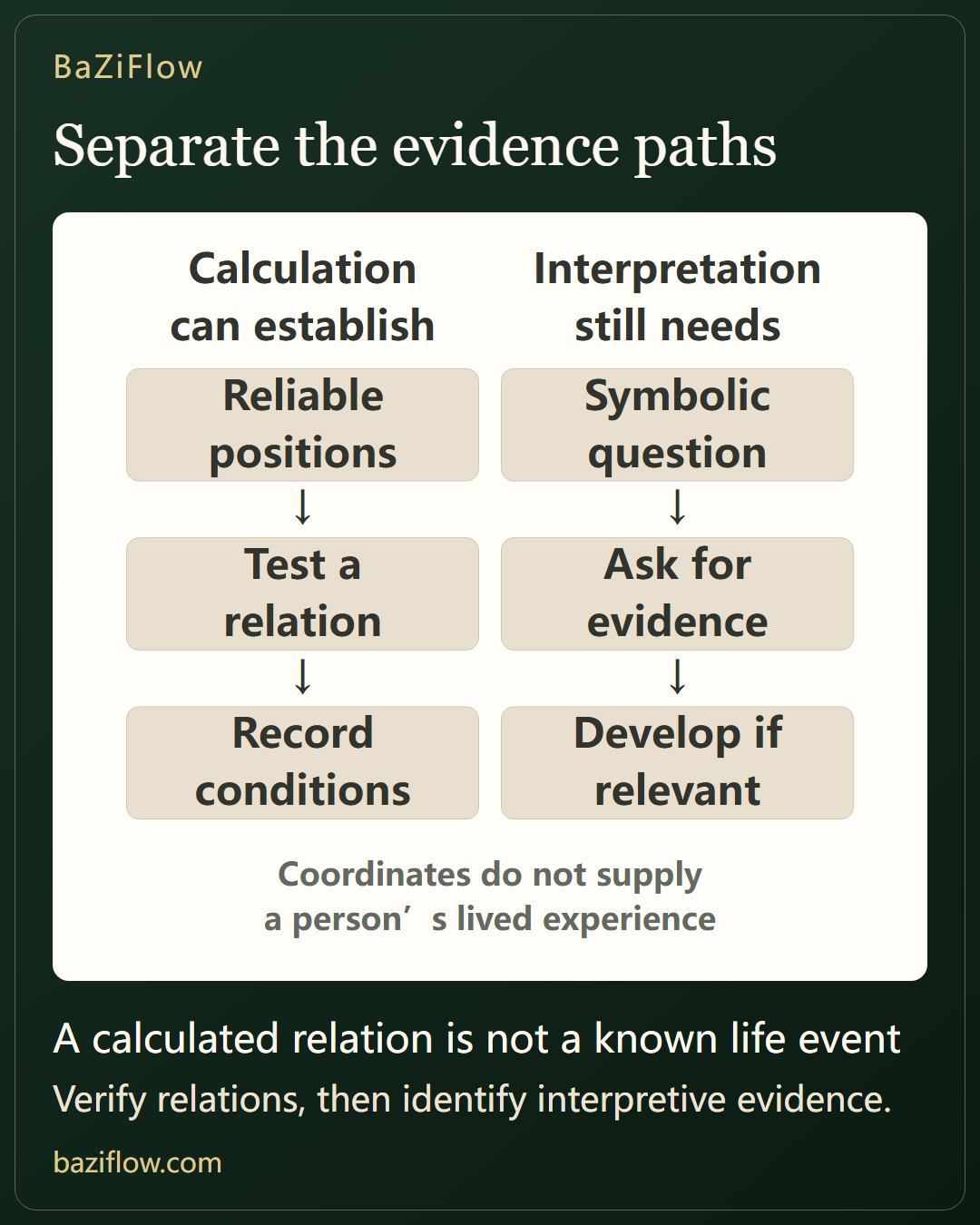
Organise a reading around a question, a reliable chart inventory and a small set of relevant relationships. Use a partial worked record to distinguish synthesis from repeated labels and unverified biography.
The short version7 min read
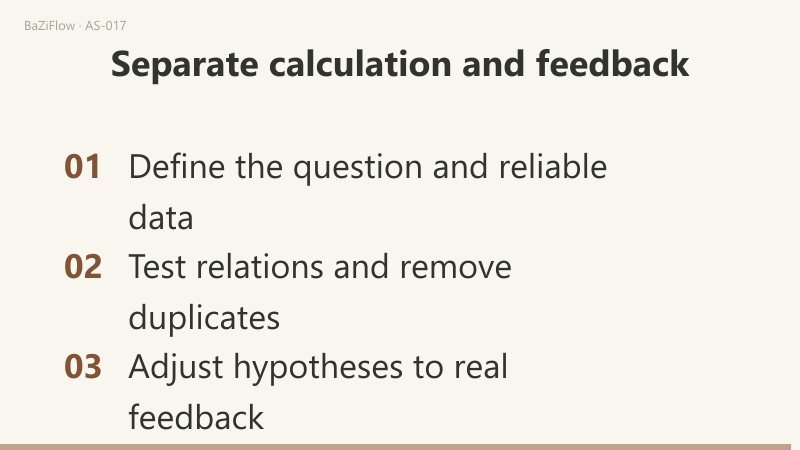
Whole-chart reading is more than linking planet keywords. Establish the question, inventory reliable positions, test relevant relationships and distinguish symbolic hypotheses from information the reader supplies. A 30° pair cannot become 60° to balance the story.
- The question defines the scope; birth-data quality and calculation settings determine which positions and houses are established.
- Renaming an aspect adds no support: Mercury at 72° and Venus at 42° are 30° apart, not a sextile that can rescue a narrative.
- Withdraw a hypothesis that does not fit the actual feedback. Different chart structures and real circumstances should change the synthesis.
Read first
Aspect Angles and Orbs: Calculate One Line from Two Positions ↗
House ruler, occupant and dispositor: keep the roles distinct ↗
Begin with the deliverable: a paragraph someone can audit
A useful synthesis should let a reader identify the chart facts behind its main points. It should also reveal which parts come from an interpretive tradition and which parts came from the reader's own account. Without those distinctions, a fluent paragraph can disguise a wrong house, a repeated aspect or a life story added after the fact.
For this exercise, imagine preparing a short public talk. The reading question concerns preparation and communication habits; it does not assume stage fright or predict success. A final note should address that question, rather than drifting through every topic associated with every house.
Ray Grasse's consultation article recommends establishing what the reader hopes to discuss. The workflow here is our own teaching arrangement built around that limited principle: define the scope, inventory reliable data, inspect relevant relationships, form a bounded synthesis and check it against information actually supplied. It is not a universal order inherited unchanged from a single school.
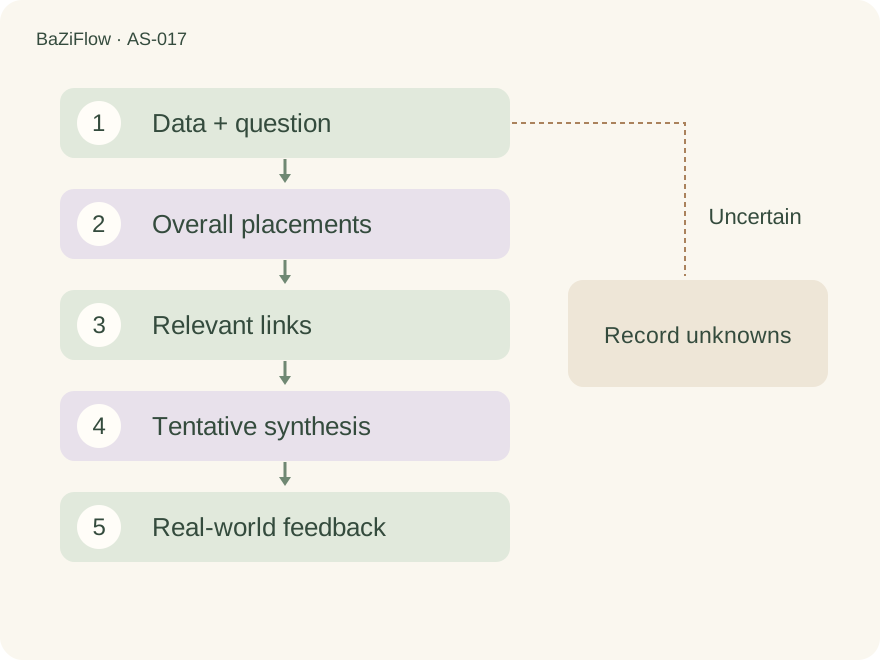
An original study workflow, not a claim that all schools share one compulsory reading order.
Make an inventory before choosing an explanation
Record the source and precision of the birth time, the location, the time-zone treatment and the zodiac and house-system settings. If the time is uncertain, exact angles and houses may not be established. Swiss Ephemeris makes time, geographic coordinates and house-system choice explicit inputs; a plausible-sounding interpretation cannot supply a missing input.
Then list the available positions. Keep the Sun and Moon, other planets, chart angles and calculated relationships distinguishable. A solar sign is not a substitute for this inventory. Nor does naming the Sun, Moon and Ascendant complete a synthesis merely because those three items are commonly introduced early.
A broad view can include distribution by sign, element or modality, but specify the objects counted. A seven-object tally and a ten-object tally have different denominators. A missing category in a selected count does not establish a missing human capacity. The inventory stage records what the chart contains under the selected rules, before turning it into descriptive language.
Assume one object
A
- Total counted
- 7
- Share
- 1 ÷ 7 ≈ 14.29%
B
- Total counted
- 10
- Share
- 1 ÷ 10 = 10%
Follow one relevant thread without pretending it is the whole chart
Modern introductory texts often associate Mercury with communication and thought. Linda Reid's planetary lesson is one example of that symbolic vocabulary. Use it as an entry into a question, not as a measured assessment of someone's intelligence or speaking ability.
Take a deliberately partial record: Mercury at 72°, Saturn at 252° and Venus at 42°. Mercury and Saturn are 180° apart; Mercury and Venus are 30° apart. Suppose the exercise enables only 0°, 60°, 90°, 120° and 180° aspects, each with a 3° maximum deviation. The opposition qualifies. The 30° pair is not in this selected list.
Do not rename 30° as a sextile to create a reassuring counterweight. A method using minor aspects could discuss it separately, but would need to say so. Likewise, these three coordinates do not provide houses, a reliable Ascendant or the rest of a natal chart. A whole-chart workflow should expose those omissions rather than hide them behind a complete-sounding report.
In a full record, continue to the relevant placements, rulership links and verified aspects, keeping the question in view. A conspicuous red line is a reason to inspect a relationship, not a reason to stop inspecting everything else. Sign, house and ruler together explains how to preserve the direction of those links.
Mercury–Saturn
252° − 72° = 180°
Venus–Mercury
72° − 42° = 30°
Each pair has its own zero: relative angles, not absolute positions
Remove duplicate support before assigning priority
“Mercury opposite Saturn,” “Saturn opposite Mercury” and “Mercury has a Saturn contact” may all refer to the same relationship. Repeating it in three sections does not provide three independent reasons for a conclusion. A simple evidence table makes that visible.
| Note | What kind of information is it? | What can it support here? |
|---|---|---|
| 72° and 252° differ by 180° | Position and arithmetic | Recognition of one opposition |
| Mercury as communication, Saturn as structure | Selected modern symbolism | A limited topic for discussion |
| The speaker reports three rehearsals running long | Reader-supplied information, if actually given | Investigation of timing and script length |
| A revised introduction reduced the duration | Observed change, if documented | A practical comparison of two versions |
The final two rows are hypothetical feedback for the exercise. They must never be presented as facts discovered in the chart. If a real reader supplies different information, the discussion must change. If no timing problem exists, preserve that non-match instead of inventing an invisible internal equivalent.
Priority can reflect the question, reliability of the data and the chosen method. Different traditions may give different emphasis to angularity, rulership, tight aspects or repeated themes. State the reason for the emphasis rather than treating the longest paragraph as the strongest evidence.
Reversing the names adds no independent evidence
Synthesis can retain a tension without becoming vague
Two symbolic strands need not collapse into one adjective. But joining opposite adjectives is not enough: “you are both outgoing and reserved” can fit almost anyone. Ask whether the distinction refers to a real setting, such as explaining familiar material versus answering unexpected questions. If that distinction has not been established, leave it as a question.
Also check that apparently conflicting strands belong to the same person and time layer. A natal placement, next month's transit and another person's comparison-chart position cannot be silently merged into a permanent personality statement. Transits and the natal chart keeps those layers separate.
A proportionate synthesis for the imagined talk might say: “This reading uses the Mercury–Saturn relationship to explore communication and structure. If your rehearsals are running long, the length of the background section is one concrete point to review.” The condition matters. Remove it and the sentence claims knowledge the chart record did not provide.
If the rehearsal evidence really is available, cite it as rehearsal evidence. An improvement after editing a script does not demonstrate that the aspect caused the original problem. The reading can be a setting for reflection while the practical conclusion rests on an observable comparison.
Runs long
- Check rehearsals
- Compare edits
On time
- Drop that claim
- Ask actual needs
Finish with a note that can be compared
When several verified edges form a larger structure, aspect patterns in the whole chart explains how to test the complete pattern and identify shared evidence.
Before finishing, compare the note with one written for a structurally different chart. If changing the planet names leaves almost the whole paragraph intact, revisit the relationship selection. A reading order should make differences easier to see, not guarantee the same sequence of conclusions. The final result may contain only a few well-supported points and a clear list of unknowns; completeness means representing the available evidence faithfully, not filling every possible slot.
List verified relations
Keep checked objects, positions and relevant calculations.
Identify interpretive sources
Name the symbolic method and preserve unconfirmed questions.
Record actual feedback
Separate reader-supplied information from chart calculations and retain mismatches.
Questions readers ask next
Must a whole-chart reading explain every body and house?
No. State the question and available data, then select relevant, verified relationships. Covering every keyword without connecting the evidence is not synthesis, and missing conditions should remain visible.
Do three phrasings of one aspect count as three reasons?
No. Mercury opposite Saturn and Saturn opposite Mercury identify the same pair. Track the objects and angle, then distinguish calculated relations from symbolic vocabulary and actual feedback.
What if the reader does not have the proposed difficulty?
Withdraw that direction or ask about the real situation. Do not reinterpret a mismatch as an invisible inner problem. The discussion should change with the evidence instead of defending the same conclusion.
Was this article helpful?
Theme: Parenting
Part of a learning path
Astrology: from four components to the whole chart · Step 5 of 5 available