

Heavenly Joy: the branch facing Red Phoenix
Content version · · Sources & references
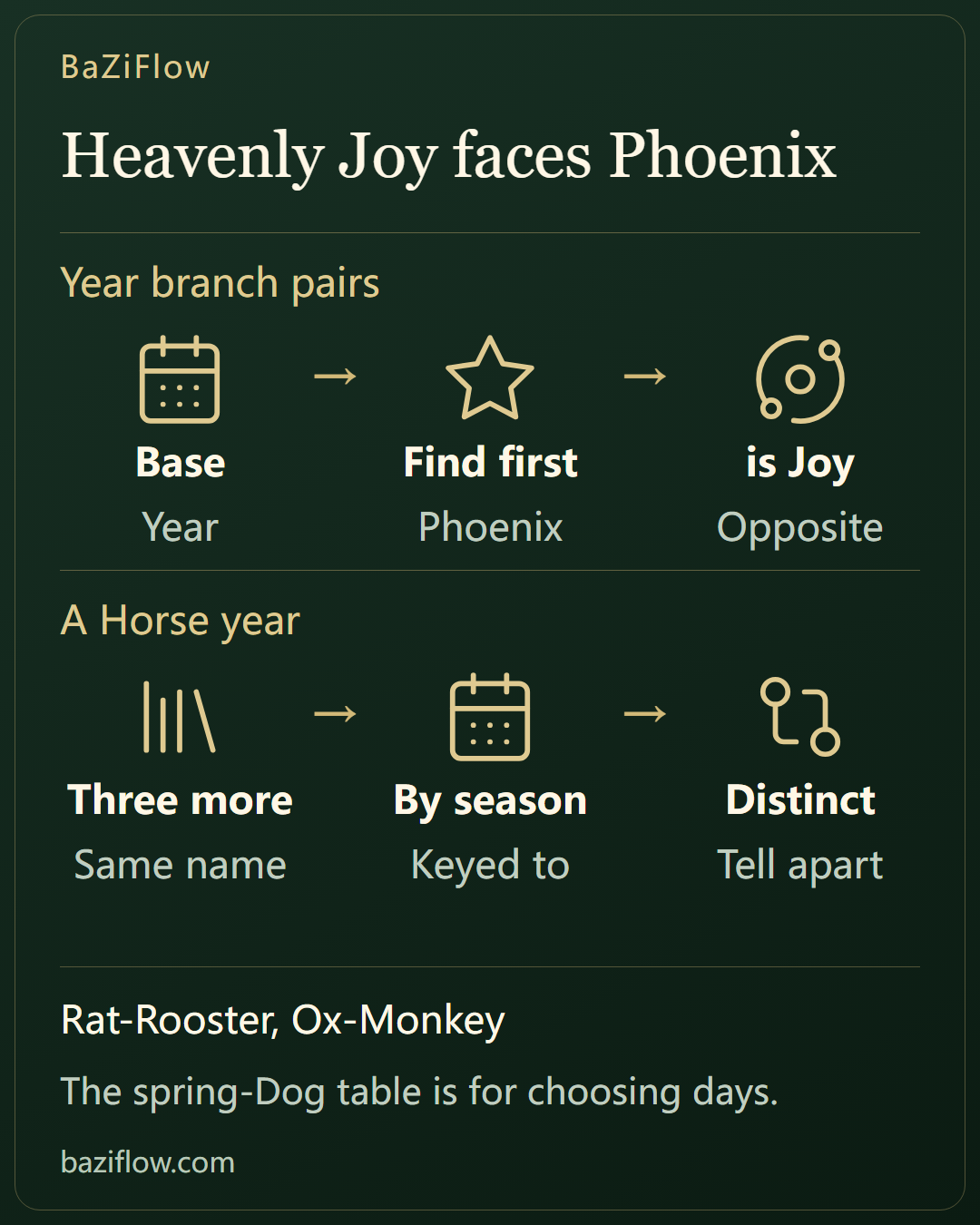
Heavenly Joy starts from the year branch and takes the branch opposite Red Phoenix. A ring chart, the Ziwei Doushu Quanshu verse and three same-name tables from the Xieji Bianfang Shu show the look-up and its sources.
The short version7 min read
The base of Heavenly Joy is the year branch: find Red Phoenix by counting back from Rabbit, take the branch directly opposite it, and search the four pillars for that branch. The books also carry other tables of the same name, keyed to months or seasons, which the site does not use.
- The twelve year branches pair off as mutual Heavenly Joy, each pair one Yang and one Yin, so the year pillar can never hit its own Heavenly Joy; only the month, day and hour branches can.
- The site's rule matches the verse in juan 2 of the Ziwei Doushu Quanshu. Juan 36 of the Xieji Bianfang Shu itself lists three other schemes of the same name, and juan 4 notes that two of them agree only in the four first-of-season months.
- The site's "celebration and likeability in social settings" has no counterpart in these passages; the books speak of marriage and happy events in youth, and put both stars under Water. The site line is a modern summary, source still to be checked.
Read first
Symbolic Stars in BaZi: Check the Reference and Rule Before the Meaning ↗
A year branch and its partner, one Yang and one Yin
Heavenly Joy (天喜) asks only about the year branch: take the branch of the birth year, find the branch paired with it among the twelve, and see whether that branch appears in the four pillars.
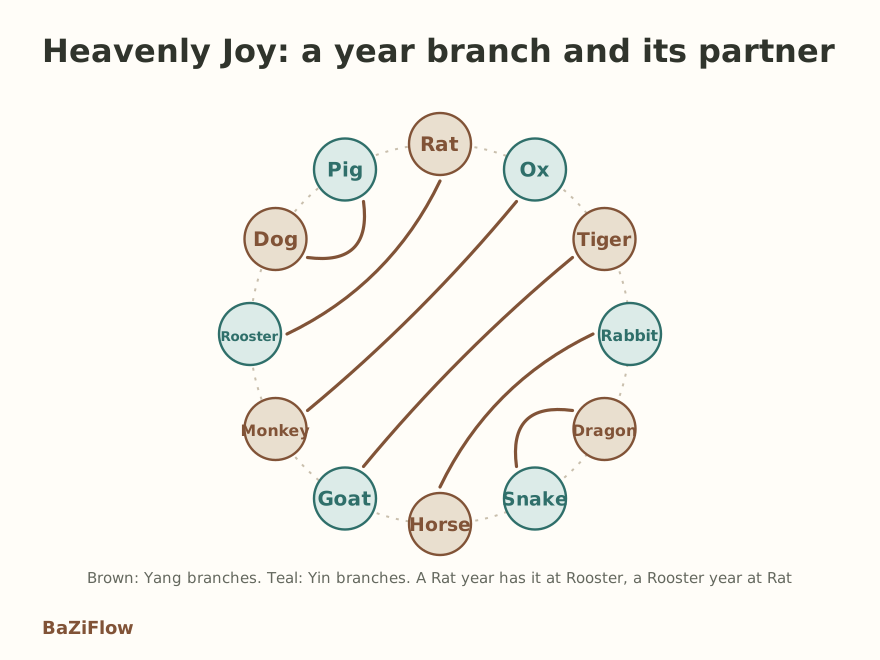
Ring chart: the six chords are the six pairs of year branches that are each other's Heavenly Joy, checked item by item against the site engine's table; each chord joins one Yang branch and one Yin branch.
Each chord on the ring joins a pair of year branches that are each other's Heavenly Joy: a Rat year has it at Rooster and a Rooster year at Rat; Ox and Monkey, Tiger and Goat, Rabbit and Horse, Dragon and Snake, Dog and Pig work the same way, six pairs and no branch left out. Every chord ends on one Yang branch (Rat, Tiger, Dragon, Horse, Monkey, Dog) and one Yin branch (Ox, Rabbit, Snake, Goat, Rooster, Pig).
The Ziwei verse: where Red Phoenix sits, Heavenly Joy faces it
The site's rule says the same as the second half of the "verse for placing Red Phoenix and Heavenly Joy" in juan 2 of the Ziwei Doushu Quanshu (紫微斗数全书), a manual of the Ziwei system:
The palace where Red Phoenix sits; opposite it, Heavenly Joy, never off by a step.
Whichever palace holds Red Phoenix, the palace straight across holds Heavenly Joy. Ziwei Doushu places the star on the twelve palaces of its own chart; the site's BaZi engine uses the same starting rule but looks for the result among the branches of the four pillars: find the branch Red Phoenix lands on, then count six places across. The two are same-name stars in different systems and are read separately; for the Ziwei star, see Tian Xi in Ziwei Doushu. How Red Phoenix is counted is in Red Phoenix.
Enlarge diagram · scroll sideways to read
Same name, other tables: the Xieji Bianfang Shu lists three
The imperial Qing almanac Xieji Bianfang Shu (协纪辨方书) discusses wedding days in juan 36 and goes through the "Heavenly Joy" sayings then current:
As for Heavenly Joy, some say Dog in spring, Ox in summer, Dragon in autumn, Goat in winter; some say the day of Completion in the Three Harmony; and some say Goat, Horse, Snake in the spring season, Dragon, Rabbit, Tiger in summer, Ox, Rat, Pig in autumn, Dog, Rooster, Monkey in winter.
None of the three starts from the year branch; they run by month or season. The first also appears in juan 3 of the Sanming Tonghui, as "Dog in spring, Ox in summer, Dragon in autumn, Goat in winter", followed by "those who meet it bring cheer". Put four tables on one sample chart and each gives a different answer:
Enlarge diagram · scroll sideways to read
The first row is the site's Heavenly Joy, used on a chart; the other three are date-selection tables from the Xieji, about which day's branch is called Heavenly Joy. The name is the same, so check which table is meant.
How Dog came to be the spring Heavenly Joy
Why does the almanac table take Dog for spring? Juan 4 of the Xieji Bianfang Shu quotes Cao Zhengui:
Spring belongs to Wood; Wood produces Fire; the tomb of Fire is at Dog; when it reaches Dog the way of Fire is complete, and so spring takes Dog as Heavenly Joy.
"Joy" here is the joy of accomplishment: Wood produces Fire, Fire enters its tomb at Dog, its road is finished and counts as achieved.
Enlarge diagram · scroll sideways to read
"Completion in the Three Harmony" is the other road: the day of Completion, ninth among the twelve day officers, belongs to the same Three Harmony group as the month branch; for a Tiger month it falls on Dog. Set out for twelve months and checked against the season table, they agree only in the four first-of-season months, Tiger, Snake, Monkey and Pig, and differ in the other eight. The compilers of the Xieji reach the same conclusion:
Only in the four opening months, Tiger, Monkey, Snake and Pig, do they match Dog, Ox, Dragon and Goat.
The compilers go on to say the reasoning of the Completion day is the stronger, so they standardize on the Completion day and keep the other saying alongside for reference.
Two sample charts: one hit, one miss
Now two charts through the engine:
Enlarge diagram · scroll sideways to read
In the first chart the same character on two pillars gives two records. The second has no Rooster, so no Heavenly Joy is recorded; the Rabbit on the month pillar is the other star, Red Phoenix.
The other half of the pair is Red Phoenix; other stars with the year branch as their base are the Mourning Gate (丧门) and the Visiting Guest (吊客).
Questions readers ask next
If my chart has Red Phoenix, does it also have Heavenly Joy?
Not necessarily. The two always sit opposite each other, but the character has to actually appear among the four branches. With a Rat year, Red Phoenix is at Rabbit and Heavenly Joy at Rooster; a chart with a Rabbit and no Rooster has only the Phoenix.
Is the almanac line "Dog in spring, Ox in summer, Dragon in autumn, Goat in winter" the site's Heavenly Joy?
No. That table runs by season and serves date selection. The site's Heavenly Joy runs by the birth-year branch and sits opposite Red Phoenix. The name is shared, the look-up and the use are not, so check which table is meant.
Which Heavenly Joy table did the Xieji compilers settle on?
In their note in juan 4 they judge the Completion-day reasoning the stronger, standardize on it, and keep the "Dog in spring, Ox in summer" line alongside for reference. Both are tables for choosing days; the site's Heavenly Joy runs from the birth-year branch and is not part of that choice.
Was this article helpful?
Sources & references
Continue reading
Red Phoenix (红鸾): Counted Back from Rabbit to the Year Branch ↗