

Strength: flowers and a subdued lion
Content version · · Sources & references
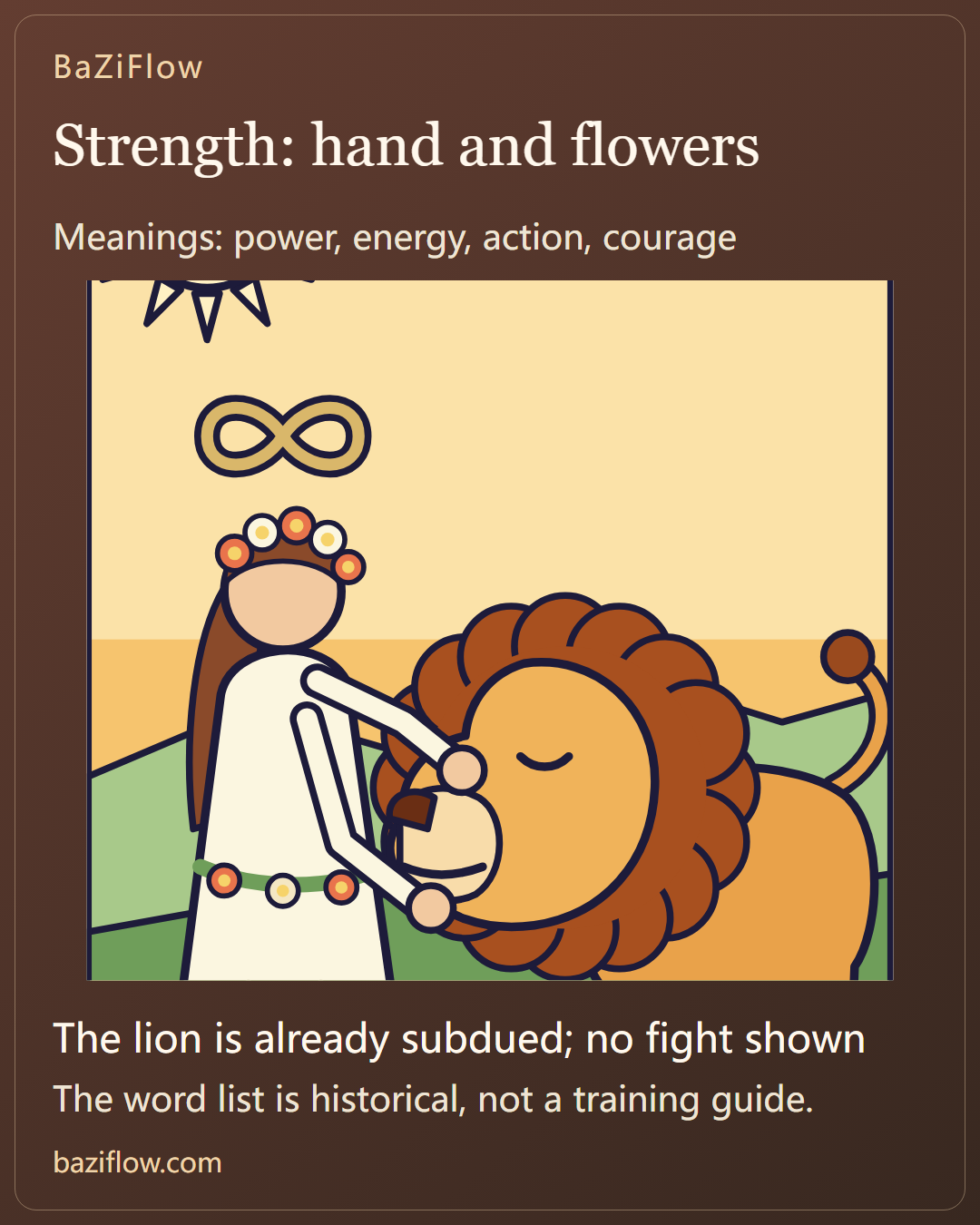
Strength (Waite's Fortitude) shows a woman closing a lion's jaws, the lion led by flowers. Separate picture, word list and Waite's inference, then ask three questions before grooming a cat that dreads clipping.
The short version7 min read
Strength does not picture a fight. Waite writes that the lion is already subdued, led by a chain of flowers, and the woman's hands only close its jaws.
- The picture: a woman with a "symbol of life" over her head closing a lion's jaws; Waite says the one change from the usual designs is that her beneficent fortitude has already subdued the lion.
- The upright words are all favorable, from courage to honours; the sting sits in the reversed ones, and even there the last word is hedged with "sometimes".
- Waite calls the higher meanings (union, strength in contemplation) inference, not something plain on the card. The practice: where the hand rests, how light the chain is, what has already yielded.
Read first
One hand on the jaws, a lion gone quiet
In Part II Waite titles the card "Strength, or Fortitude". He writes: a woman, over whose head broods a "symbol of life", is closing the jaws of a lion. The only point where this design differs from the conventional presentations is that her beneficent fortitude has already subdued the lion, which is being led by a chain of flowers. He adds that, for reasons that satisfy himself, the card has been interchanged with Justice, which is usually numbered eight; this site follows the Rider-Waite-Smith numbering: Strength 8, Justice 11.
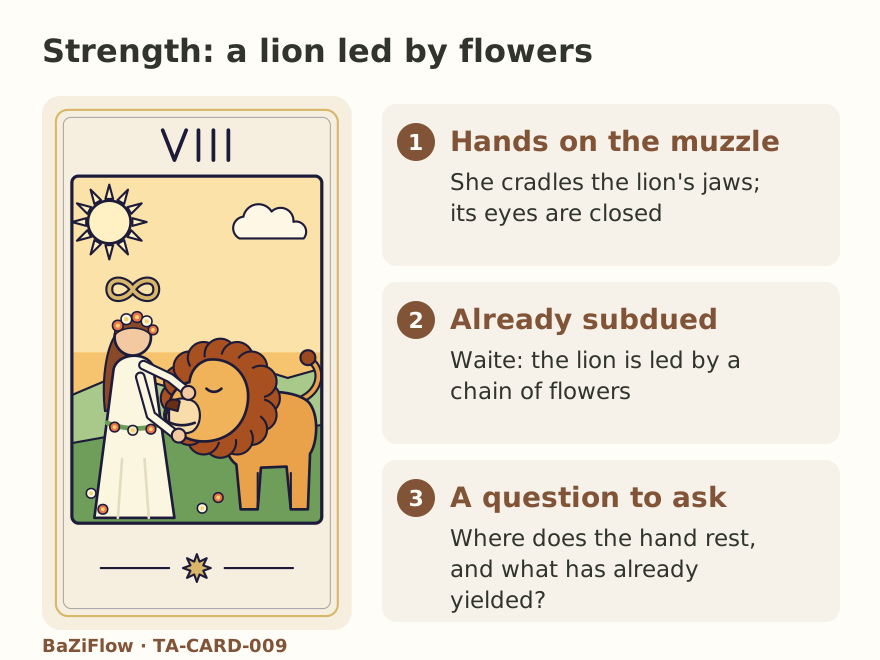
Strength: a woman cradles the muzzle of a closed-eyed lion.
On the original Rider-Waite-Smith card the numeral VIII sits at the top, under a yellow sky. The woman wears a white gown and a flower wreath, with a horizontal figure 8 hovering over her head; she bends a little and rests both hands on the lion's mouth. The lion is red-orange, head lowered, tongue out, and a garland of flowers joins it to her; a blue mountain stands far off.
The picture holds one point of contact, one chain and one sign: hands on the mouth, a garland between the two, the figure 8 above.
Enlarge diagram · scroll sideways to read
What Waite lists: power, energy, action, and not one negative word
Waite's divinatory meanings read: power, energy, action, courage, magnanimity; also complete success and honours. Reversed: despotism, abuse of power, weakness, discord, sometimes even disgrace.
Power, energy, action, courage, magnanimity; also complete success and honours. Reversed: Despotism, abuse of power, weakness, discord, sometimes even disgrace.
Enlarge diagram · scroll sideways to read
Flowers, lion and the sign overhead: what is said, what is inferred
Waite's Part II comment on this card carries a caution from the author himself: the higher meanings are "matters of inference", and he does not suggest "that they are transparent on the surface of the card". So it pays to read them apart.
Three things, and which are stated and which inferred
- Chain of flowers
- Stated: the lion is led by a chain of flowers. Waite says the chain signifies, among many other things, "the sweet yoke and the light burden of Divine Law" once taken into the heart of hearts; that layer is inference, intimated "in a concealed manner".
- The lion
- Waite says that in "one aspect" the lion signifies the passions, and she is the higher nature in its liberation, which "has walked upon the asp and the basilisk and has trodden down the lion and the dragon". "One aspect" shows this is not the only reading.
- Sign overhead
- Waite says it is the symbol of life seen before, and names the Hierophant's card; the card where he actually describes that sign is the Magician: a horizontal 8 like an endless cord. The two chapters do not match, so quote the Magician's description to be safe.
Enlarge diagram · scroll sideways to read
How to read it: grooming a cat that dreads nail clipping, start from what has yielded
The card's picture is a scene already settled: a hand on the jaws, a chain of flowers, a lion with its head lowered. Carry it to a pet at home: a cat that struggles every time the nails are clipped.
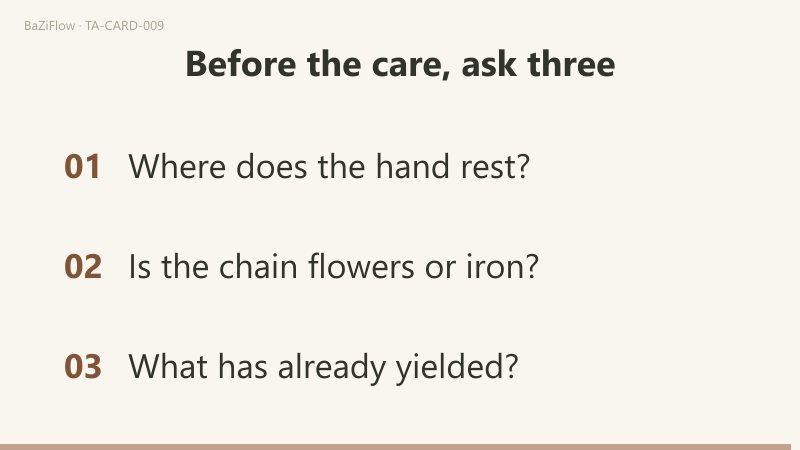
Where does the hand rest?
In the picture the hands are in one place only: the lion's mouth. For the cat, pick a single point of contact as well, say holding one paw first; keep the hand in the same spot and the pressure the same each time.
Is the chain flowers or iron?
Waite calls the chain a "sweet yoke". Write down the restraints you use now: holding down, shouting, shutting the cat in a crate are iron; a fixed time, the same cue and a treat afterward are flowers. A chain of flowers is something the cat can bear every day.
What has already yielded?
Waite writes of the lion after it is subdued, and no struggle is drawn. Find what the cat already accepts, begin there, and push only one small step further.
An example: the cat lets you touch its paws but runs when it sees the clippers. Put the three questions on one table:
Enlarge diagram · scroll sideways to read
Grooming a cat that dreads clipping: how to use the card
What you can borrow
- One fixed point of contact
- Start from what already yields
What it cannot settle
- Why the cat is afraid
- Whether a vet should look
What you judge
- Whether the reaction is growing
- Which flower works for this cat
Reversed and neighboring cards: after "sometimes even", three cards that put force elsewhere
In Waite's reversed words, despotism and abuse of power speak of force pushed too far, weakness of force falling short, and discord and disgrace look more like consequences; the directions do not agree. When you read a reversal, ask first which direction you are taking.
Where the force goes: neighbors compared
The card before: won on the outside
Waite writes that the charioteer's conquest lies on external and rational planes; in Strength he calls the lion the passions and the woman the higher nature in its liberation, so both sit within the person.
The card whose number was swapped
Waite says Strength and Justice were interchanged. Justice's words center on fairness and its execution, with the side that deserves it winning at law; it judges "according to his works", a judging this card's list does not carry.
The card after: the one holding a lamp
That Strength is "strength in contemplation" is Waite's inference; the Hermit holds a lamp high on a height, which Waite says means "where I am, you also may be". Neither card has anyone subduing anyone by force.
Enlarge diagram · scroll sideways to read
Questions readers ask next
Does the lion in Strength stand for instinct or desire?
Waite says only that in "one aspect" the lion signifies the passions and that she is the higher nature in its liberation. He does not make it the only reading. Taking the lion as your own instincts is teaching built out from that one aspect.
Is Strength a self-confidence card?
Waite writes that the card has nothing to do with self-confidence in the ordinary sense. What he describes is the confidence of those whose strength is God and who have found refuge in Him. Reading it as self-confidence or self-control is a later phrasing.
Does Strength reversed just mean "no strength"?
Not quite. In the reversed words, despotism and abuse of power are force pushed too far, weakness is force falling short, and discord and disgrace look more like consequences. The directions do not agree, so say which one you are taking.
Was this article helpful?
Sources & references
Continue reading
The Chariot: a black and a white sphinx, and a victor who won on the outside ↗
The Emperor: a staff and a globe on a stone seat, and a description made of objects ↗