

Prosper–Kin: six landing places in pairs
Content version · · Sources & references
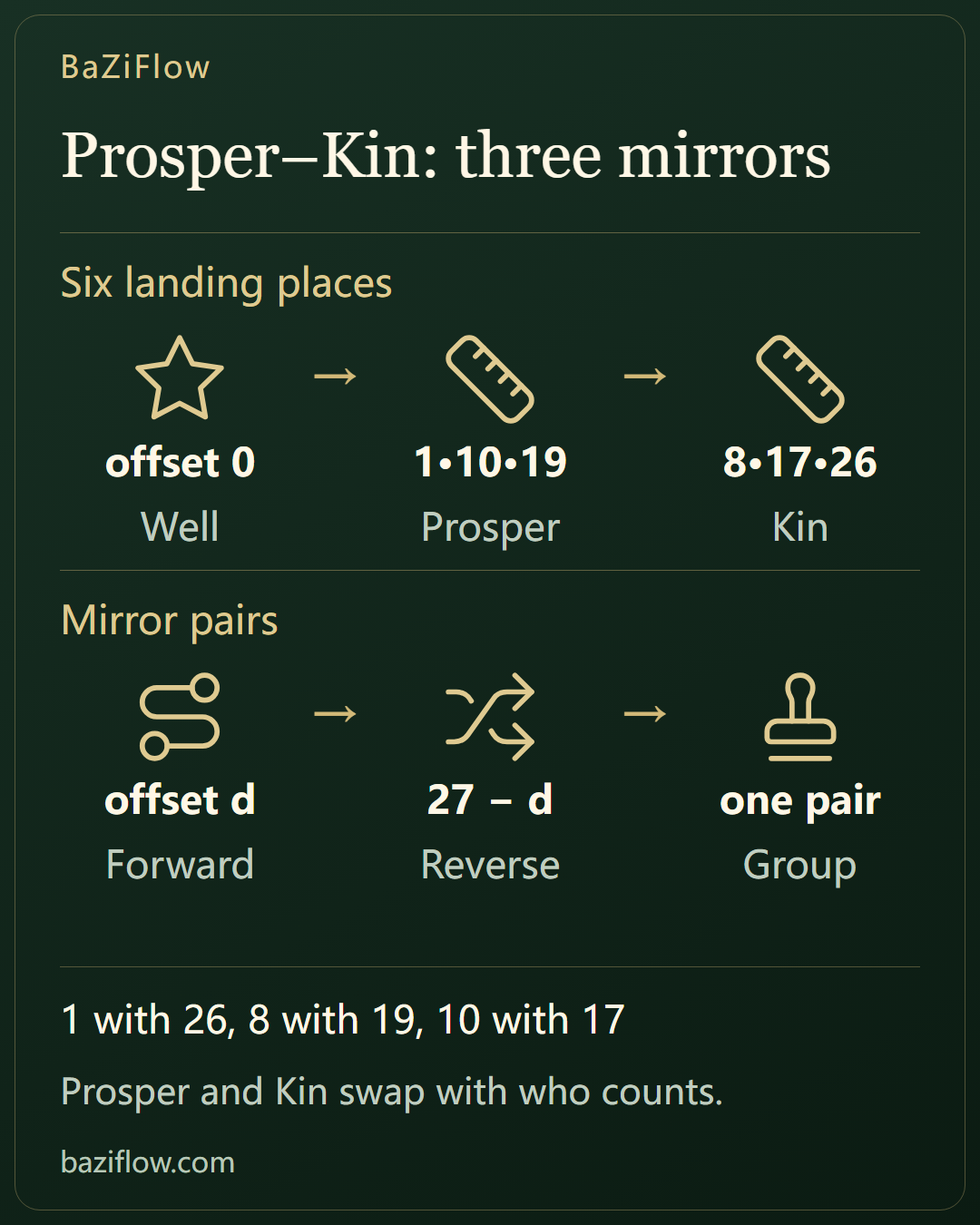
Prosper lands on offsets 1, 10 and 19, Kin on 8, 17 and 26. A ring, a six-place table, a mirror diagram and the book's own uses of the two names show how they pair into one group.
The short version6 min read
Prosper follows each row head directly and Kin sits just before the next head, each with three landing places; my count to you and your count to me always add up to 27, so my Prosper is your Kin.
- Every row head (Fate, Karma, Womb) is followed by Prosper and preceded by the Kin of the row before, so the three heads are each sandwiched by Kin and Prosper. That gives Prosper the offsets 1, 10, 19 and Kin 8, 17, 26.
- 1 pairs with 26, 8 with 19 and 10 with 17 as three mirror images. Taking the shorter way round, the gaps are 1, 8 and 10, and the two mansions at gap 1 sit side by side on the ring.
- The book writes Prosper and Kin in three settings: "good" for first friendships, a day for official business or for making friends when choosing days, and "what one seeks is not achieved" when the luminaries encroach.
Read first
Prosper is second in the row, Kin is last
In plain words first: each row of the three-nine count has nine places, the second after the row head is called Prosper (栄) and the last, the ninth, is called Kin (親). There are three rows, so Prosper has three landing places and Kin has three.
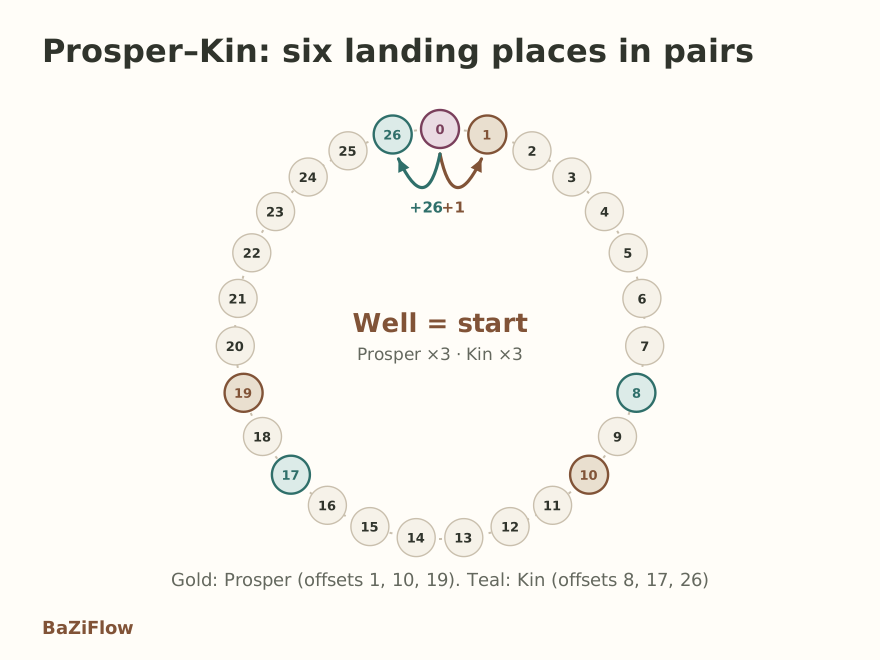
Sketch: the ring of 27 mansions starting at Well, with the start at offset 0 (place 1 if the start is counted); the two arcs mark offsets 1 (Prosper) and 26 (Kin) right beside the start.
The picture puts Well (井) at the top as the start. The three gold slots are Prosper at offsets 1, 10 and 19: Ghost, Room and Wall. The three teal slots are Kin at offsets 8, 17 and 26: Neck, Rooftop and Three Stars. Look at the two sides of the purple start: the slot after it (Ghost) is Prosper and the slot before it (Three Stars) is Kin.
Six landing places, nine apart
Prosper lands on 1, 10 and 19 and Kin on 8, 17 and 26. Neighbors in each set differ by 9, which is the length of a row. With Well as the start, here are the six places:
Enlarge diagram · scroll sideways to read
Of the 27 places, Prosper–Kin takes six; the other twenty-one go to Fate, Karma, Womb and the three remaining groups.
Counting back: 1 with 26, 8 with 19, 10 with 17
The other person's count to me is 27 minus my count to them. If I see them as Prosper at offset 1, they see me at 26, which is Kin; offset 8 reverses to 19, and offset 10 reverses to 17. All three pairs belong to the Prosper–Kin group, with who is Prosper and who is Kin turned around. Draw each pair as a horizontal bar and the three bars are symmetric around 13.5:
Enlarge diagram · scroll sideways to read
Taking the shorter way round, the gaps of the three pairs are 1, 8 and 10: offsets 1 and 26 are both one place apart, so Well and Ghost sit side by side on the ring. Whether to call those gaps near, middle or far is a separate convention, covered in near, middle and far distances.
Enlarge diagram · scroll sideways to read
How the book uses Prosper and Kin
The two names appear in the Sukuyō Sutra in several settings, each with its own words. When choosing days, a Prosper day is described at the greatest length:
On a Prosper-mansion day it is suitable to enter office and receive an appointment, and to be received by a great man; to submit a memorial to the ruler.
A Kin day is written together with a Friend day, and is about contact with others:
On Friend and Kin days, making friends is very auspicious.
Enlarge diagram · scroll sideways to read
The third column comes from another passage in the same chapter, on the luminaries' positions among the mansions:
If they encroach on the Karma mansion or on Prosper, Ease, Attain, Friend or Kin, what one seeks is not achieved and everything goes with difficulty.
The sentence on first friendships, by contrast, puts Prosper and Kin among the "good": the book says that, in general, Prosper, Ease, Attain, Friend and Kin are good and suitable for making friends. The same pair of names therefore says different things in three settings, and has to be read together with its setting.
Checking one Prosper–Kin pair yourself
Checking takes three numbers: my count to the other mansion, their count to mine, and whether the two add up to 27. For Prosper–Kin the offset can only be one of 1, 10, 19, 8, 17 and 26.
Two exercises
What does Three Stars see in Turtle Beak, and Turtle Beak in Three Stars?
Three Stars is place 4 and Turtle Beak place 3, so counting from Three Stars to Turtle Beak goes almost all the way round: offset 26, Kin. From Turtle Beak to Three Stars it is offset 1, Prosper. 26 plus 1 is 27.
Wings looks at Girl: what offset? And the reverse?
Wings is place 10 and Girl place 20, ten apart, which is Prosper; the reverse is 27 minus 10, which is 17, Kin. The shorter gap is 10 in both directions.
For how the row heads are counted, see Fate; the group next to Prosper–Kin is Karma–Womb; for how six groups come from two directions, see the six relationship types.
Questions readers ask next
How do I tell which person is Prosper and which is Kin?
It depends on who is counting. If I count to the other person and land on offset 1, 10 or 19, they are Prosper to me; on 8, 17 or 26, they are Kin to me. Their count to me is 27 minus mine, so my Prosper is their Kin.
Both are Prosper–Kin, so why is one offset 1 and another 10?
Prosper is second and Kin ninth in every row of nine, and there are three rows. The same name therefore has three landing places, and the gap on the ring differs: offset 1 puts two mansions side by side, offset 10 puts them far apart. Look at the gap as well as the name.
Is Prosper–Kin a "good" relationship in the Sukuyō Sutra?
The book's lines have to be read with their setting. The sentence on first friendships lists them as "good"; on choosing days each has things it suits; and when the luminaries encroach the text says what one seeks is not achieved. "Good" is not a property of the two words, only what one passage says in one setting.
Was this article helpful?
Sources & references
Continue reading
Fate (命): the zero-offset slot the Sukuyō Sutra counts from ↗
Karma–Womb (業胎): offsets 9 and 18, the thirds of the ring, and how the book treats the two ↗