

King of Pentacles: the throne of bulls
Content version · · Sources & references
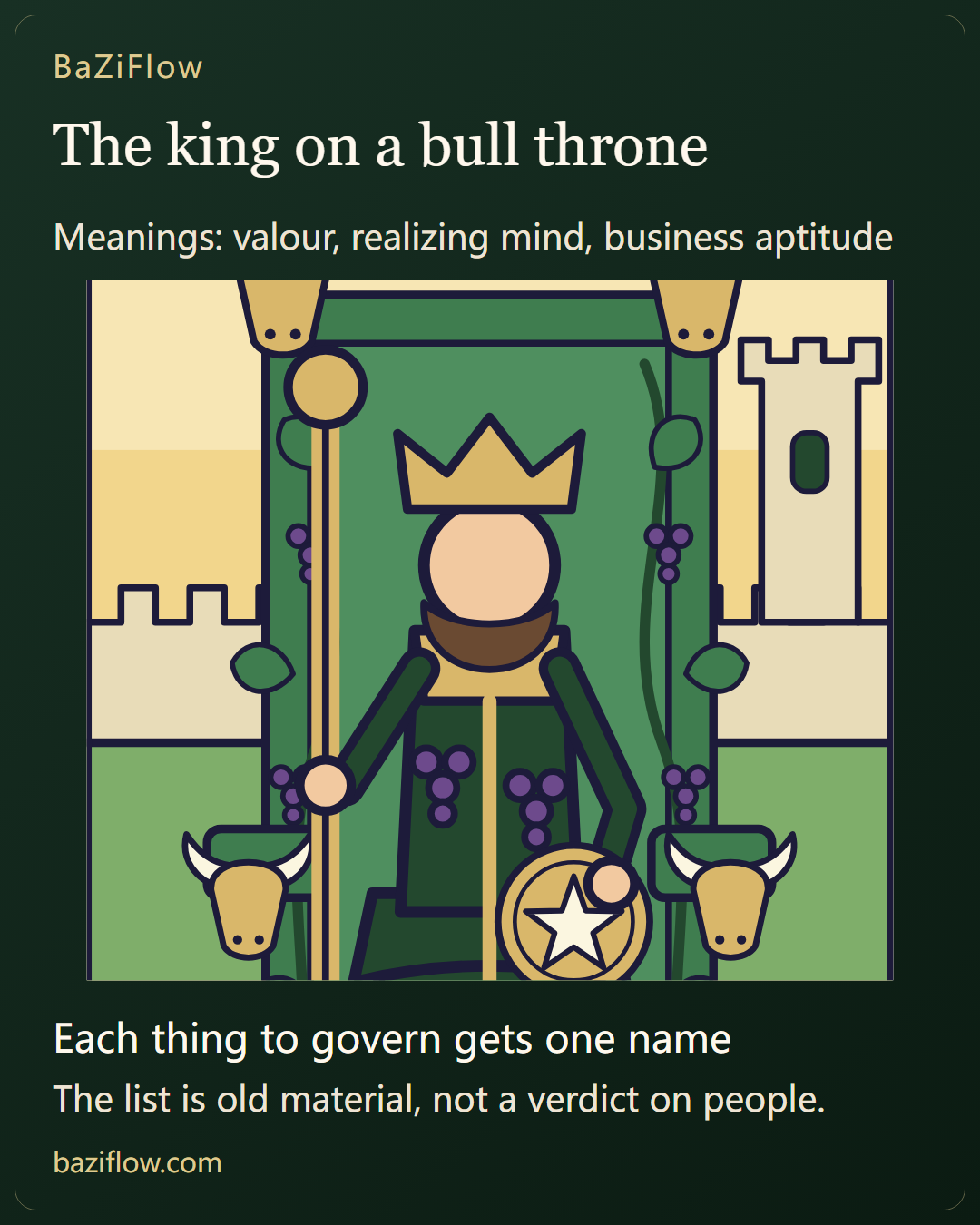
The King of Pentacles sits on a throne of bulls’ heads, and Waite uses his entry for a note on the whole suit: the pentagram and the old name “coins”. Separate description, list and extras, then split a show’s jobs.
The short version6 min read
The King of Pentacles sits on a throne of bulls, and Waite says he needs no special description. The substance of the entry is valour, realizing intelligence, and the note on the suit that Waite adds on the way.
- The description is brief: a rather dark face suggesting courage but somewhat lethargic in tendency; the one thing singled out is the bull’s head recurring on the throne.
- The same entry carries a note on the whole suit: its sign is a coin engraved with the pentagram, typifying the four elements in human nature and what governs them; in old packs the suit meant coins, yet the meanings do not especially concern money.
- The list gives valour, realizing intelligence, business and normal intellectual aptitude, sometimes mathematical gifts; the reversed list runs from vice and weakness to peril.
Read first
The throne of bulls: a king who “calls for no special description”
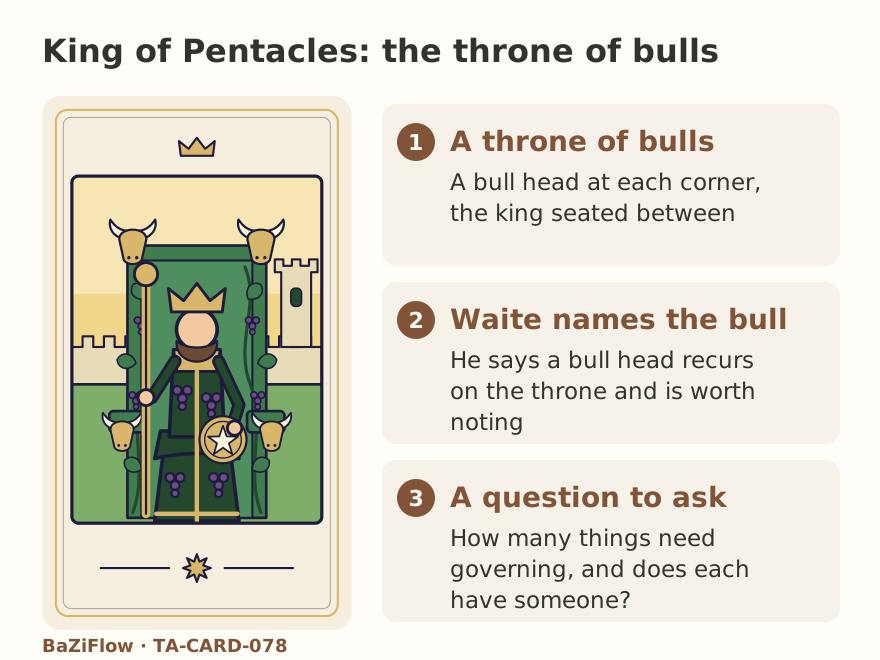
Waite’s description of this king is short. The figure calls for no special description; the face is rather dark, suggesting courage but somewhat lethargic in tendency. The only thing he singles out is the bull’s head recurring on the throne.
King of Pentacles: the throne of bulls
Compare the Rider-Waite-Smith plate. The king wears a wreath set with small red flowers and a red hood over the shoulders, in a dark robe embroidered with vines and clusters of grapes. One hand holds a scepter topped with a gold ball, the other rests the coin on his knee, and one foot is in an iron boot. A bull’s head sits at each upper side of the throne back, and a castle tower rises far off at right. In the original BaZiFlow art the bulls’ heads are drawn at all four corners of the throne, the king wears a beard, and city walls and a tower stand behind.
Read it from back to front and the picture has three layers: the seat, the person, the coin.
Enlarge diagram · scroll sideways to read
What Waite lists: valour, realizing intelligence, business and mathematical aptitude
The meanings run in this order: valour; realizing intelligence; business and normal intellectual aptitude, sometimes mathematical gifts and attainments of this kind; success in these paths. What “realizing” precisely means, Waite does not expand.
Valour, realizing intelligence, business and normal intellectual aptitude, sometimes mathematical gifts and attainments of this kind; success in these paths.
Grouped by sense, the words fall into two kinds: traits, namely valour and realizing intelligence; and fields, namely business with normal aptitude, and mathematical gifts. The grouping is a reader’s tidying; the original is a run of words.
Enlarge diagram · scroll sideways to read
Bulls, pentagram, old name “coins”: the note on the suit Waite slipped in
This entry holds a passage about the whole suit that has nothing to do with the king himself and yet explains the name “pentacles”.
Three points: bull, pentagram, old name
- Bull
- Waite says the bull’s head recurs on the throne and should be noted, with no explanation. In Latin, pecunia (money) and pecus (cattle) are related; livestock was once a form of property. That is language history, not Waite.
- Pentagram
- Waite says the sign of the suit is represented throughout as a coin engraved or blazoned with the pentagram, typifying the correspondence of the four elements in human nature and that by which they may be governed.
- Old name
- In many old packs, he writes, this suit stood for current coin, money, deniers. He did not invent the substitution of pentacles and has no cause to defend the alternative; the consensus of meanings just favors a change, since the cards do not especially deal with money.
Enlarge diagram · scroll sideways to read
Put that beside the list: no word there names wealth outright, though “business” does sit close to commerce. It is worth keeping in mind when this king comes up.
Reading drill: backstage jobs for a small show, and who owns each bull
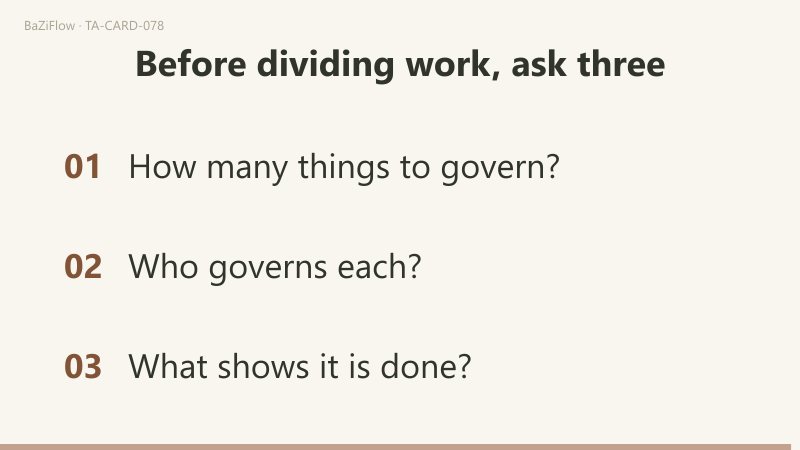
The throne of bulls, together with the line about a pentagram answering to four elements and to what governs them, gives this card its own shape: several things, each with an owner.
Count what needs governing
Split the job into parts that can be handled separately, one line each and one thing per line. The number is open; if a line will not stay short, it still mixes two things.
Give each one a name
The list opens with valour, which here can be read as being willing to be named as responsible. One name per item: two owners come to the same as none.
Set a sign for “realized”
The list has realizing intelligence. Say what done looks like, for instance “we can get in on Thursday and test sound”; if no sign can be written, go back and fix the step before.
An example: three friends put on a small community show, and this is the backstage split:
Enlarge diagram · scroll sideways to read
What a split sheet can confirm
Can confirm
- Every item has a name
- Every item has a sign
Cannot confirm
- Whether the night goes wrong
- Whether the audience likes it
Agree next
- Who decides if things slip
- A debrief after the show
Reversed and neighboring cards: vice and corruption in one run, and the “old man” of the extras
Waite’s reversed reading is six words: vice, weakness, ugliness, perversity, corruption, peril. The reversed entry in the extras reads “an old and vicious man”, which is period wording given here for contrast and not to be pinned on anyone.
Vice, weakness, ugliness, perversity, corruption, peril.
The description already says “somewhat lethargic in tendency”, and one can hold the reversed “weakness” beside it, though Waite does not connect the two. The last word, “peril”, points outward, while most of the earlier ones pass judgment on character.
Enlarge diagram · scroll sideways to read
Three kings, three thrones, and what each throne carries
A lion on the back
He lifts a flowering wand, with a lion emblazoned on the throne back; the list leans on friendly, honest, conscientious.
A throne set on the sea
A short scepter and a great cup, a ship on one side and a leaping dolphin on the other; the list includes a man of business, law or divinity, and creative intelligence.
Seated in judgment
He holds the unsheathed sign of his suit; the list is power, command, authority, militant intelligence, law. The Pentacles king’s throne carries bulls.
Questions readers ask next
Does the King of Pentacles stand for a rich and powerful person?
No word in the list names wealth directly; it gives valour, realizing intelligence, and aptitude in business and mathematics. Waite also says in the same entry that these cards do not especially deal with money. “A merchant” in the extras is other readers’ way of naming a role, and the safer teaching reading is a style of getting things done.
Why was the suit once called coins?
Waite writes that in many old packs the suit stood for current coin, money and deniers (small old coins). He says he did not invent the switch to pentacles and has no special cause to defend the alternative; the consensus of divinatory meanings simply leans toward the change.
What does “realizing intelligence” mean?
The original is “realizing intelligence”. In English, realizing can mean making a thing real or seeing it clearly, and Waite does not expand; the common teaching reading takes the first and writes it as intelligence that puts ideas into practice.
Was this article helpful?
Sources & references
Continue reading
Queen of Pentacles: a gaze at the coin in her lap, and a list of opulence and security ↗