

Long phases and present questions
Content version · · Sources & references
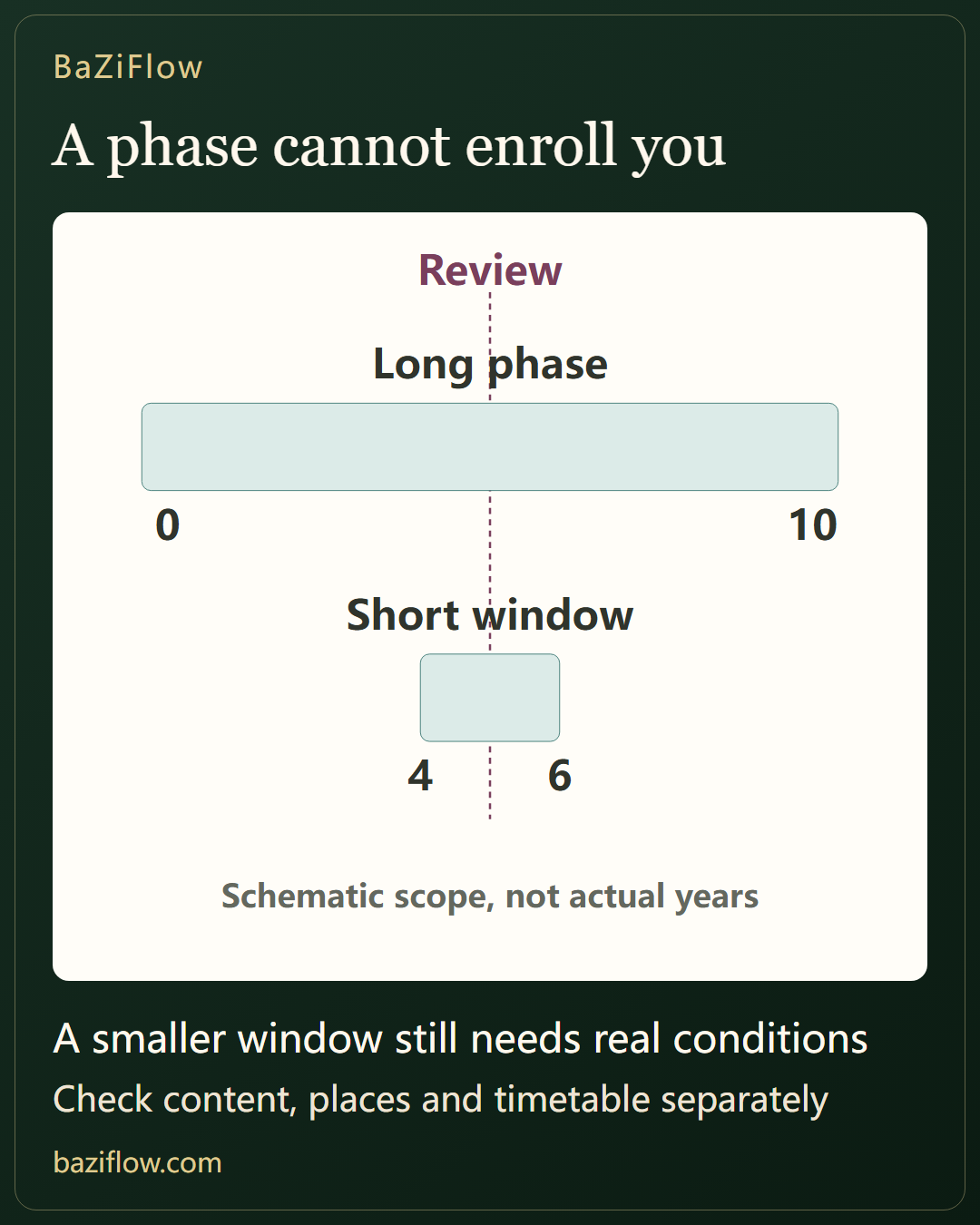
Separate a background phase from a bounded question. A course-choice example shows why real constraints, question scope and review dates must survive a symbolic reading.
The short version6 min read
Planning years of learning and considering this week’s course require different information. A phase provides a background frame; it does not supply an available place or a workable timetable.
- A shared topic does not make long-term planning, a single choice and a retrospective question equivalent.
- Containment of a short window in a phase is not a deduction about an action.
- A new question should identify changed conditions or a repaired ambiguity, not merely a more convenient deadline.
Read first
Design a question that can survive a change of circumstances
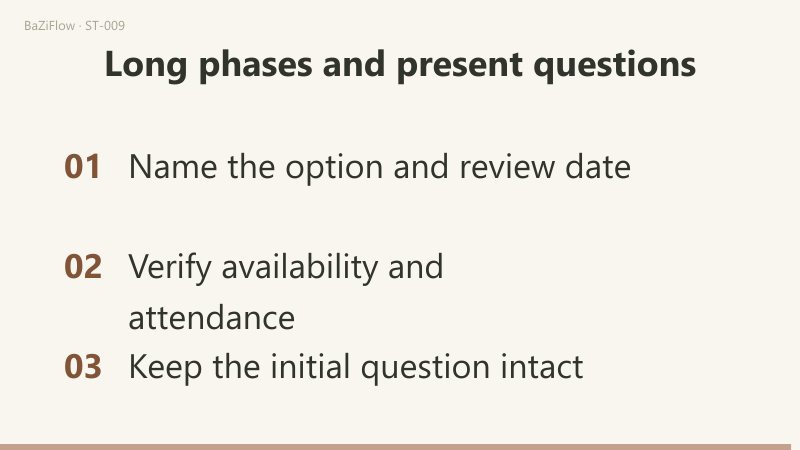
Take a teaching example with no birth data: a course starts this week, and someone wants to consider enrolling. The useful information includes what the course teaches, whether a place is available, its timetable and the alternatives. If any of those facts changes, the decision may change even though a long-term symbolic reading stays exactly the same.
Now widen the question to organizing learning over several years. The course is no longer the whole subject. Time, resources and sustained goals become the frame. A statement that was relevant to this wider frame cannot simply be pasted into the enrollment decision as its answer. The shared topic of learning does not make the questions equivalent.
This distinction is not a permanent classification of traditions into long-term and short-term camps. Traditions contain different methods, and a tool's name does not tell us which one was used. Ask about the actual input, rules and scope of the current reading.
Years of learning
- Sustained goals
- Resource limits
This week’s course
- Specific content
- Attendance conditions
From a learning theme to this week’s course
- Containment
- A short interval falls within a broader period.
- Action grounds
- Specific conditions supporting a choice, such as suitable content and feasible attendance.
Build the boundary into the wording
A bounded question names its subject and a period in which it will be reviewed. It need not force a yes-or-no response. It should make missing information visible. “Consider this course by its enrollment deadline” has a different scope from “describe a long-term learning theme,” even if a reader later uses both as material for reflection.
| Version of the question | What would count as relevant context? | Boundary to preserve |
|---|---|---|
| How should learning resources be organized over time? | Goals and sustained limits | It does not select a particular day's action |
| Is this course an option worth considering now? | Content, availability, timetable and alternatives | It does not define lifelong ability |
| Why were several previous plans interrupted? | Separate records of each interruption | It does not assume one shared cause |
The last row matters because retrospective questions often import an explanation too early. Several interrupted plans may have different causes. A phase label should not erase those differences before they have even been recorded.
Real constraints remain independent. A full course or an unavoidable scheduling conflict does not become available because a reading sounds encouraging. A cautious symbolic theme does not automatically invalidate a feasible option either. Keep what can be checked in the world separate from the language used to interpret symbols.
Long organization
- Required information
- Goals and durable limits
Present choice
- Required information
- Course, places and timetable
Past interruption
- Required information
- Separate dates and causes
Where the distinction appears in traditional methods
The major-luck discussion in San Ming Tong Hui, volume 2, organizes Bazi timing through extended phases and relates them to the natal structure. This is a historical framework for phase reading. A phase name does not itself contain a course description, cancellation terms or an enrollment date, and the historical text is not a modern guarantee of outcomes.
For a different kind of frame, part 3, section 7 of Waite's The Pictorial Key to the Tarot presents a spread for a definite question. Its positions assign different roles, including influences, obstacles and environment. That is a particular method and version, not a rule shared by every modern spread. This article does not adopt the book's old appearance-based classifications or treat its future-oriented language as established fact.
These sources illustrate a distinction in method design, rather than demonstrating predictive accuracy. Birth-based traditions can also use shorter timing layers, and a question-based reading is not automatically precise merely because it concerns the present. Luck Pillars, Ziwei decades and transits compares several timing structures in more detail.
Phase framework
- Natal structure and timing
Question spread
- Position roles and a defined question
A window inside a phase is not a deduction
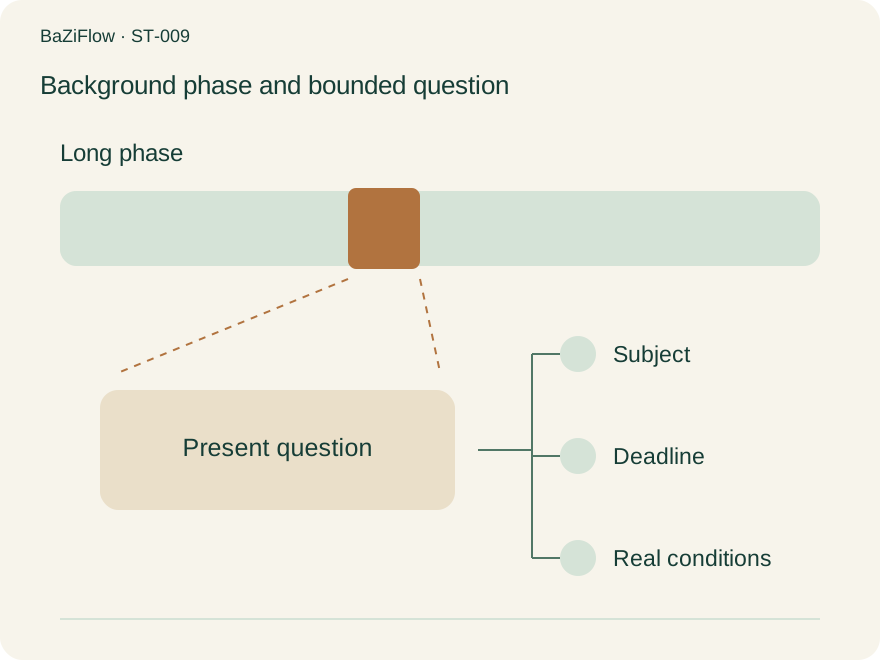
Original BaZiFlow scale diagram; the bands describe question scope, not fortune scores or a personal timeline.
The short window sits inside the long band. That is a relation between intervals, not a proof about an action. The three nearby checks ask what the subject is, when the question will be reviewed, and what real conditions apply. There is intentionally no direct arrow from a favorable-looking phase to a decision.
For the course example, an integrated note could retain a background interpretation and a separate account of practical conditions. They need not become a single score. If the practical information is missing, the note can remain incomplete at that point. Symbolic language should not fill in whether a seat exists or whether attendance is possible.
This also prevents an unnoticed change of force. “A theme for discussion” can quietly become “therefore take this action” when the connecting reasoning is omitted. A careful reading shows what additional facts support the transition and what remains only an interpretation.
Case A
- Background wording
- Encouraging theme
- Practical condition
- Full course: no current place
Case B
- Background wording
- Cautious theme
- Practical condition
- Place available: check other conditions
Review the original question, not an improved version of it
Save the initial wording, review period and known conditions. Record the symbolic interpretation separately from the reasons for the eventual choice. That way a later review can distinguish an image used for reflection from a timetable fact that actually determined the decision.
When the review date arrives, check what happened and which conditions changed before rereading the interpretation. Leave unresolved outcomes unresolved. Do not broaden the original subject until an ambiguous phrase appears to have matched something. Non-matches belong in the record alongside striking matches.
Repeatedly trying other methods without a new condition can make the question progressively less clear. A new attempt has an intelligible purpose when it addresses a changed circumstance, repairs an ambiguous question or examines a genuinely different layer. Merely changing the deadline until an answer feels welcome removes the original standard of comparison.
The aim is not to quantify every personal choice or to turn a small notebook into proof of a predictive system. It is to prevent two common scope errors: using a long phase to decide a specific action, and using one bounded reading to define an entire life. The guide to decisions and questions develops the next part of that process.
Fix the candidate action
Keep the course description, enrollment deadline and original question about considering this course.
Change one fact
If availability changes from a place to a full course, current enrollment becomes unavailable while the background reading can remain unchanged.
Explain a renewed question
Record the change or a newly offered alternative before asking again. Preserve the original comparison standard.
Questions readers ask next
Does an encouraging phase mean I should enroll?
Check suitability, availability, attendance and cancellation conditions. A background theme cannot remove these constraints.
Must a bounded question be yes-or-no?
No. It needs an identifiable subject, options and review period that expose missing information.
When is asking again useful?
When circumstances change, the question needs clarification or a distinct layer matters. Merely shifting the deadline removes the original test.
Was this article helpful?
Theme: Timing & action
Sources & references
Continue reading
Asking a question: separate what happened from what you assume ↗