

Huan: what is scattered, and where it gathers
Content version · · Sources & references
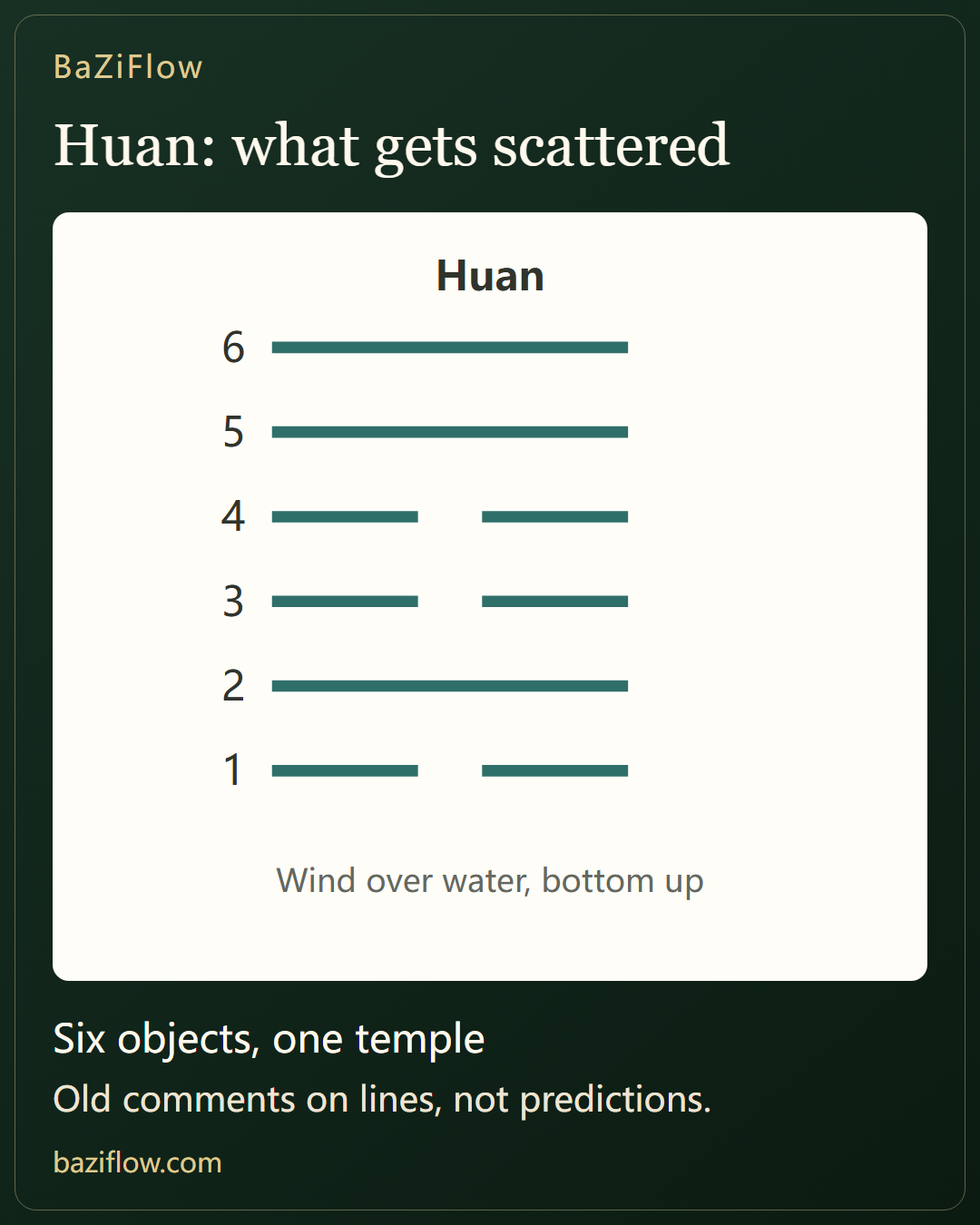
Huan (渙) is the 59th hexagram: Xun (wind) above Kan (water). Read “the king comes to the temple”, the Great Image of temples, and six lines in which “scatter” takes a new object each time.
The short version7 min read
Huan means to scatter, yet each line scatters something different: a support, the self, a band, a proclamation, the king’s dwelling, blood. The Great Image, though, takes the ancient kings back to the temple.
- Huan stacks Xun (wind) on Kan (water). The Commentary on the Judgments says “riding on wood brings merit”: Xun is wood, resting on the water of Kan.
- The second sentence of the judgment is “the king comes to the temple” and the Great Image is “offered to the Lord and set up temples”: judgment and Image both land at the temple. The Xu Gua glosses Huan as separating.
- In the six lines, “scatter” takes a new object each time: his stool, his self, his band, sweat-like proclamations, the king’s dwelling, his blood. None of the six lines ends in misfortune.
Read first
The Sixty-Four Hexagrams: How Upper and Lower Trigrams Form One Figure ↗
Judgment and Line Statements: Whole Hexagram or Single Line? ↗
Wind over water: Xun above, Kan below
Huan (渙) is Xun (wind) above and Kan (water) below. In the Shuo Gua, Xun is “entering”, pictured as wood and wind; Kan is “sinking in”, pictured as water. From the bottom the lines run yin, yang, yin and then yin, yang, yang. Kan has a single yang line held between two yin ones, while Xun puts one yin line beneath two yang ones.
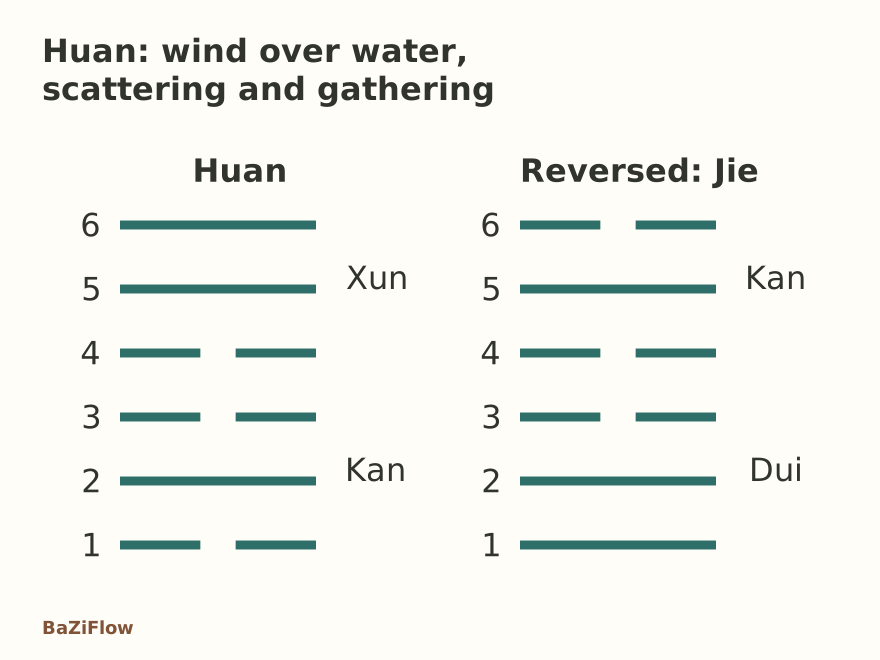
Huan and its reversed hexagram Jie: the yin line at the bottom of Huan ends up at the top of Jie.
Enlarge diagram · scroll sideways to read
Three words to know first
- Huan
- To scatter, to come apart. The Xu Gua glosses it directly: Huan means separating.
- Come to
- In the judgment’s “the king comes to the temple”, tradition usually reads the verb as arrive: the king reaches the ancestral temple.
- Riding wood
- The Commentary says “riding on wood brings merit”. In the Shuo Gua Xun is wood and Kan is water, so wood rests on water, which can be read as a boat.
The judgment and the Commentary: the king at the temple, crossing the great river
The judgment of Huan reads: success; the king comes to the temple; fitting to cross the great river; fitting to stay on course. Two of the four sentences name a place, the temple and the river, and the Commentary on the Judgments takes them in turn.
Huan, success: the firm comes and is not exhausted, and the yielding gets its place on the outside and joins those above. “The king comes to the temple”: the king is then at the center. “Fitting to cross the great river”: riding on wood brings merit.
Enlarge diagram · scroll sideways to read
The figure bears each of these out. “The firm comes and is not exhausted” is traditionally read of line 2: a yang line arrives in the middle of the lower trigram, Kan, and is not trapped. “The yielding gets its place on the outside and joins those above”: line 4 is yin and stands in the fourth place, a yin place, in the upper trigram, the “outside”, with line 5 directly above it, which is the “joining”. “The king comes to the temple; the king is then at the center” goes on from there. The last sentence is “riding on wood”: Xun above is wood, Kan below is water, and wood on water is what carries one across.
The Great Image: wind over water, offerings and temples
The Great Image of Huan reads:
Wind moving over water: Huan. The former kings made offerings to the Lord and set up temples.
Wind moves over the surface of water. Tradition usually reads it this way: the ripples are driven outward in every direction, and from this the former kings took their conduct, to make offerings to the Lord and to establish temples, gathering scattered hearts around a shared rite.
Enlarge diagram · scroll sideways to read
Huan is scattering, and the Great Image ends in gathering. It is not the first time the hexagram lands there: the second sentence of the judgment is already “the king comes to the temple”, and the Image closes on “set up temples”, so judgment and Image both land at the temple. This Image uses the opening “the former kings”, not “the noble person”.
Six lines: what comes after “scatter”
In the six statements, the thing that follows “scatter” is different on almost every line.
Enlarge diagram · scroll sideways to read
Line 1 is at the bottom and its statement has no “scatter” in it; it begins “to rescue, he uses a strong horse”, and the Small Image (小象) says he goes along. Line 2 reads “scattering, he runs to his stool”. The word for stool is traditionally read as a low table, something to lean on, so as things scatter he runs to what he can lean on, and the Small Image says he gets his wish. Line 3, “scatters his own self: no regret”, takes even his own body into the scattering, and the Small Image puts his aim outside. Line 4, “scatters his band: great good fortune”, goes on: “scattering, there is a hill; not what ordinary minds think of”, which tradition reads as scattering that ends in a mound heaped up; the Small Image calls bright and great.
Line 5 reads “scattering like sweat, his great proclamations; scattering the king’s dwelling: no blame”. Tradition usually takes sweat as a figure for orders that cannot be recalled once out. The Small Image says his position is right: line 5 stands in the fifth place. Line 6 reads “scatters his blood; goes away, far off, and leaves: no blame”, and the Small Image says he keeps far from harm.
Set the objects side by side: stool, self, band; proclamations and the dwelling belong to the one in the high place; at the end is blood, sent far off. The results are good fortune, regret vanishes, no regret, great good fortune, no blame, no blame, and none of the six reads misfortune.
Jie, Feng and Yi: neighbors of Huan and its place after Dui
Huan’s reversed hexagram is Jie, already in the figure above. Its inverse is Feng, which flips each line of Huan to the opposite polarity. Its nuclear hexagram, Yi (頤), comes from the middle lines: Zhen (yang, yin, yin) below and Gen (yin, yin, yang) above.
Enlarge diagram · scroll sideways to read
The Xu Gua puts Huan after Dui:
After delight comes scattering, so what follows is Huan; Huan means separating.
Delight first, then scattering. The next hexagram is Jie, and the Xu Gua’s reason is that separation cannot go on to the end, so limits must come. In the Xu Gua, Feng (豐) means “great”, and Huan is scattering, so the inverse pair is one of greatness and one of dispersal.
Questions readers ask next
Huan means scattering, so is it a bad hexagram?
The text does not say so. The judgment opens with “success”, and the six lines read good fortune, regret vanishes, no regret, great good fortune, no blame, no blame, with none of them reading misfortune. The Xu Gua only says that separation cannot go on forever, and so the next hexagram, Jie, follows.
What is the “sweat” in “scattering like sweat, his great proclamations”?
Literally sweat. Tradition usually takes it as a figure for orders: sweat that has come out cannot go back, and an order that has been issued cannot be taken back. That comparison comes from later readers; the old text only says “scattering like sweat, his great proclamations”.
How are Huan and Jie related?
They are each other’s reversed hexagram: Huan turned upside down is Jie (節). Huan is wind over water and Jie is water over a lake. The Xu Gua orders them Dui, Huan, Jie: first delight, then scattering, then limits.
Was this article helpful?
Sources & references
Continue reading
Dui: lake over lake, from “harmonious delight” to “delight that draws” ↗
Jie: water over a lake, from “does not go out” to the bitter limit ↗
The Sixty-Four Hexagrams: How Upper and Lower Trigrams Form One Figure ↗
Judgment and Line Statements: Whole Hexagram or Single Line? ↗