

Hairy Head: first on the ring
Content version · · Sources & references
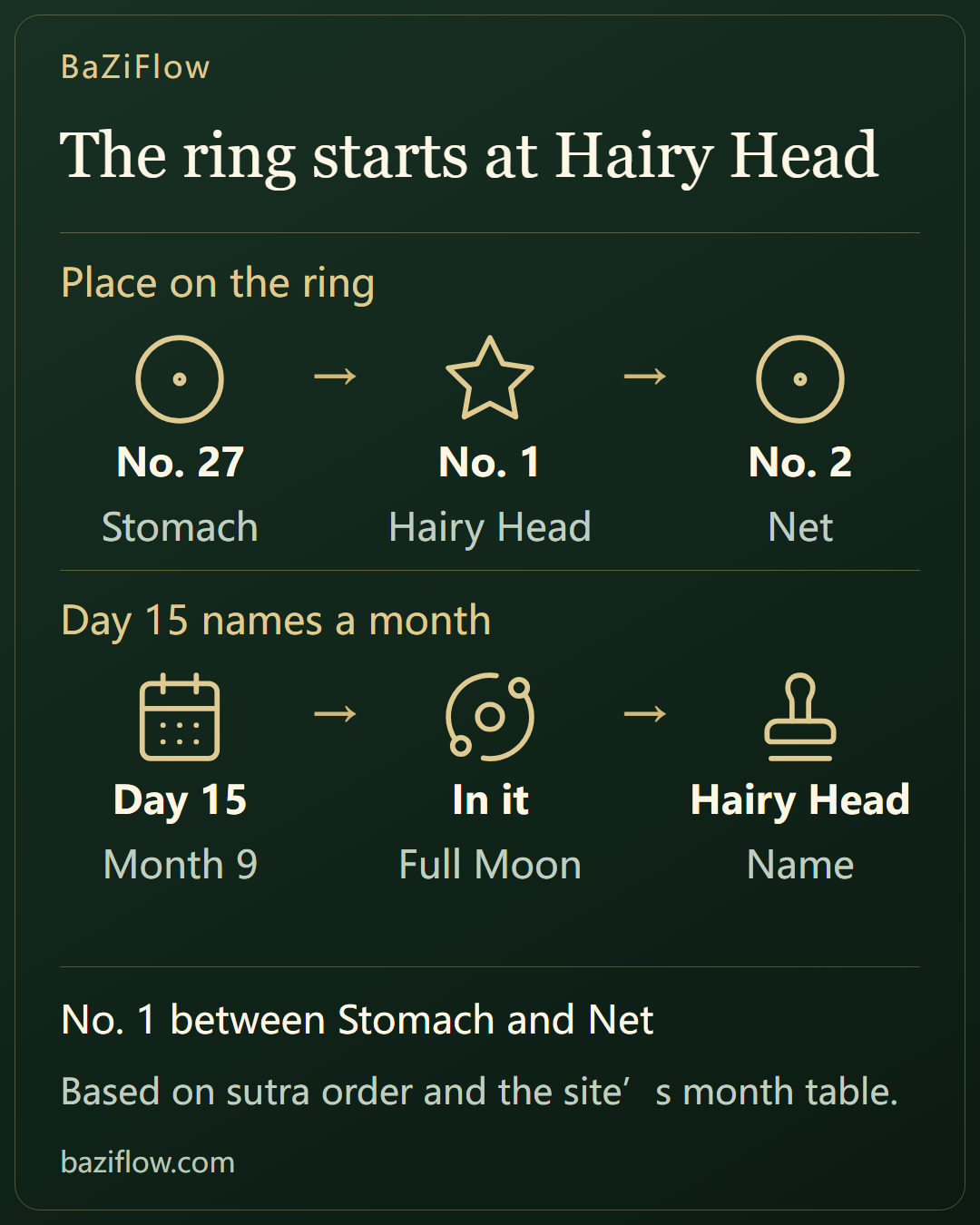
Hairy Head (昴) is position 1 on the site’s 27-mansion ring. A ring, the sutra’s picture and Yang Jingfeng’s note, the month named after it, its old-calendar dates and its class show where it stands.
The short version8 min read
Hairy Head (昴, Bō in Japanese) is position 1 on the site’s 27-mansion ring, between No. 27 Stomach and No. 2 Net. The Sukuyō Sutra draws a picture for it and names a month after it.
- Its picture has two layers: the sutra gives six stars shaped like a razor, while Yang Jingfeng’s note counts seven stars in Chinese astronomy. Both numbers sit side by side.
- The sutra names each month after the mansion holding the full Moon on day 15. The site’s month-start table reproduces all twelve names, and month nine is the Hairy Head month.
- The sutra sorts the 27 mansions into seven classes. Hairy Head and Root form the smallest one, and that class is a different label from the relation names in the three-nine method.
Read first
What is Sukuyō astrology? How a birth mansion is found ↗
Sukuyō 27 mansions vs the 28 lunar mansions: what is the difference? ↗
Twenty-seven places, counted from Hairy Head
In plain words first: Sukuyō arranges the twenty-seven stops the Moon passes in one trip around the sky into a ring, and the site counts that ring in the Sukuyō Sutra’s order starting from Hairy Head (昴, Bō in Japanese), position 1.
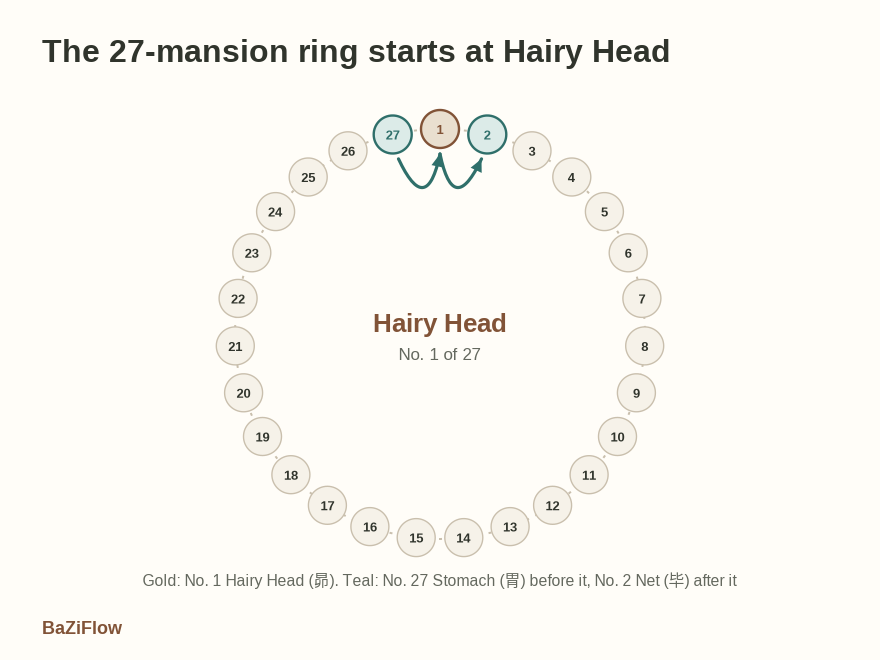
The ring’s seam falls between Stomach and Hairy Head, where the count begins; even spacing does not show widths in the sky.
The gold circle in the picture is Hairy Head and the teal circles are its neighbors: Stomach (胃) is position 27 just before it and Net (毕) is position 2 just after it. The seam of the ring falls between Stomach and Hairy Head, so the seven mansions of the White Tiger of the West are split in two: Hairy Head, Net, Turtle Beak (觜) and Three Stars (参) come first, while Legs (奎), Bond (娄) and Stomach come last.
In its second chapter, on the days a mansion governs and the people born under it, the sutra draws one "picture" per mansion. The first is Hairy Head, followed by Net, Turtle Beak, Three Stars, Well (井), Ghost (鬼), Willow (柳) and so on. The site’s ring keeps that order, except that the sutra also has an Ox picture between Dipper and Girl, and the ring leaves the Ox mansion out. The text in hand never says why Hairy Head leads, and this article does not guess.
The picture: a fixed pattern of text, plus a note
Every mansion’s picture in the sutra follows one pattern: star count, shape and presiding deity first, then a family name, a diet, advice on suitable days and a remark about people born under it. The first three items describe the mansion itself. The Hairy Head picture opens like this:
Hairy Head has six stars shaped like a razor. It is a fire deity.
The sutra was translated by Amoghavajra with commentary by Yang Jingfeng. After the picture, Jingfeng added a note of his own:
In Chinese astronomy, Hairy Head has seven stars, governs the foreign troops and is a mansion of the west. But on reading the sutra, its star counts often fail to match the Chinese ones.
He goes on to say that readers who see the numbers disagree tend to doubt the text, so he asks them to follow Chinese astronomy and draws the star figures at the foot of the picture. He leaves the sutra alone and sets the Chinese account next to it.
Enlarge diagram · scroll sideways to read
So when someone says "Hairy Head has this many stars," ask which layer was quoted. Both numbers have a source, and neither needs to be rewritten into the other.
Why month nine is called the Hairy Head month
The second fascicle’s chart of the twenty-seven mansions and twelve houses explains how months are named:
In the western countries the mansion holding the full Moon on day fifteen gives the month its name.
The mansion that holds the full Moon on day 15 is the "full-Moon mansion." The list of twelve month names starts with the Horn month, passes through the Hairy Head month and ends with the Wings month. In the matching list of month names in the first fascicle, Jingfeng adds which month of the Tang calendar each corresponds to, and the Hairy Head month is the Tang ninth month.
This can be checked with the site’s engine. It uses the NAOJ month-start table to find the mansion on day 15 of each old-calendar month, and all twelve agree with the sutra’s month names. The table shows the second half of the year.
Enlarge diagram · scroll sideways to read
As for why the month is called "Hairy Head," the note says Sanskrit calls the Hairy Head star Krittika (迦提), and that the month simply borrows the star’s name. The site’s table pairs Hairy Head with the Indian lunar mansion Krittika.
The days that fall on Hairy Head
The site’s birth-mansion rule is short: take the mansion of day 1 of the old-calendar month, then step forward by the day number minus one. The old calendar is the Japanese one with new moons fixed in Tokyo time. Month 1 opens on Encampment (室), month 2 on Legs (奎) and month 3 on Stomach, and the opening mansion keeps moving forward until month 12 opens on Emptiness (虚). By that table Hairy Head falls on these days:
Enlarge diagram · scroll sideways to read
The dates slide earlier because of the day-1 table. From one month to the next, the day-1 mansion moves forward by 2, 2, 2, 2, 2, 3, 3, 2, 2, 3, 2 and 2 places, which adds up to exactly 27, one lap in a year. A lunar month lasts 29 or 30 days, so it overshoots one lap of 27 by two or three, and the same mansion turns up two to three days sooner each month. Month 3 begins on Stomach and its days 28 to 30 run through Stomach, Hairy Head and Net again, which is why both day 2 and day 29 of that month are Hairy Head.
In Gregorian terms, 2025 has 14 Hairy Head days: 7 January, 3 February, 3 March, 30 March, 26 April, 24 May, 20 June, 17 July, 16 August (in the old calendar’s leap sixth month), 11 September, 8 October, 4 November, 2 December and 29 December.
Hairy Head and Root: the smallest of seven classes
The sutra sorts the 27 mansions into seven classes by the character of the days they govern, and Hairy Head’s class is the smallest:
Hairy Head and Root are the "firm-and-gentle" mansions.
The seven classes are Steady and Heavy (Net, Wings, Dipper, Wall), Gentle and Good (Turtle Beak, Horn, Room, Legs), Poisonous (Three Stars, Willow, Heart, Tail), Swift (Ghost, Chariot, Stomach, Bond), Fierce (Star, Extended Net, Winnowing Basket, Encampment), Light and Restless (Well, Neck, Girl, Emptiness, Rooftop) and Firm-and-Gentle (Hairy Head and Root). Their sizes are 4, 4, 4, 4, 4, 5 and 2, a total of 27 with no overlap and no gap. The firm-and-gentle class has only two members.
Now look at their places on the ring. Hairy Head is position 1 and Root is position 14, 13 steps apart, the farthest gap possible on a ring of 27. In the three-nine method Hairy Head sees Root as Peril (危) and Root sees Hairy Head as Attain (成), one Peril–Attain pair at far distance.
Enlarge diagram · scroll sideways to read
The class describes the character of the days a mansion governs, while the three-nine name describes the position of one mansion relative to another. They answer different questions. The derivation of the relation names is laid out in the six relationship types, and the distance bands are in near, middle and far distances.
Two exercises
Which mansion is old-calendar month 2, day 4?
The day-1 mansion of month 2 is Legs; three more steps run Legs, Bond, Stomach, Hairy Head, so the answer is Hairy Head.
Which mansion is month 9, day 15, and what does the sutra call that month?
The day-1 mansion of month 9 is Root; 14 steps forward lands on Hairy Head, and the sutra calls the month the Hairy Head month.
Next on the ring is position 2, Net. For the wider background see what Sukuyō is, and for how this ring differs from the 28-mansion list see 27 versus 28 mansions.
Questions readers ask next
Why is Hairy Head the first of the 27 mansions?
The site’s ring follows the order in which the sutra draws the mansions: the first picture in its second chapter is Hairy Head, then Net, Turtle Beak and Three Stars. The text in hand gives no reason for starting there, so the safe statement is simply that this is the sutra’s order.
Do the days that fall on Hairy Head stay fixed from month to month?
No. Within one old-calendar month a mansion appears once or twice, and in the next month its day moves 2 or 3 days earlier because the month-start mansion shifts 2 or 3 places. A Gregorian date must first be converted to the old calendar, so 2025 has 14 Hairy Head days at uneven intervals.
Does Hairy Head have six stars or seven?
It depends on the layer being quoted. The sutra’s own text says six stars, while the commentator’s note says seven in Chinese astronomy. Both numbers come from the same page, so a citation should say which layer it uses.
Was this article helpful?
Sources & references
Continue reading
Stomach (胃): The Sutra’s Last Picture, and a Body Guide That Ends at the Foot ↗
Net (毕): The Sutra’s Own Worked Example, Born on Month 2, Day 5 ↗