

Rest Gate: the Water gate at home in Kan One
Content version · · Sources & references
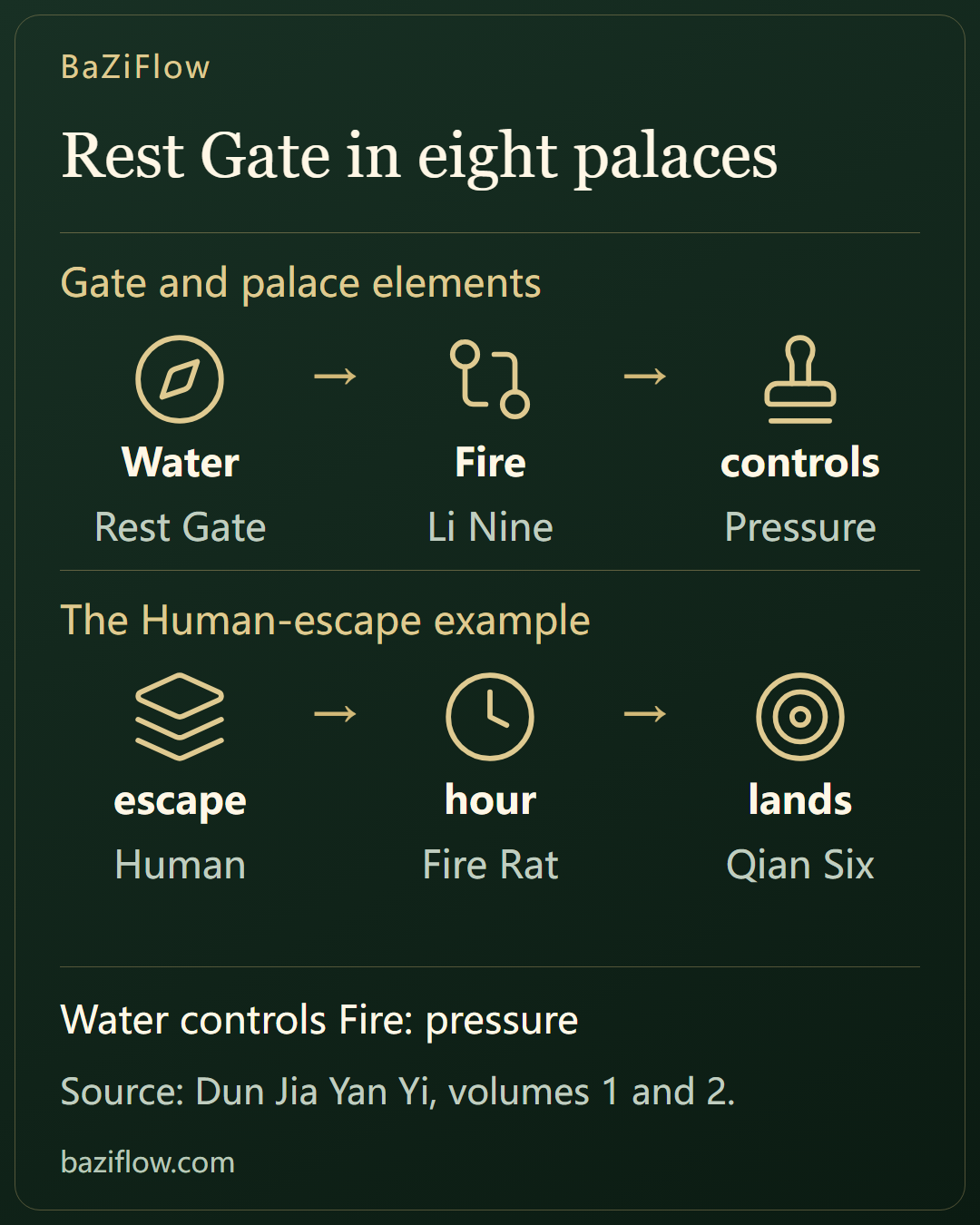
The Rest Gate has its home in Kan One and the element Water. Using the gate-pressure verse, the Human-escape example and the monthly example in Dun Jia Yan Yi, see how gate and palace elements are compared.
The short version10 min read
The first example in the gate-pressure passage of Dun Jia Yan Yi is the Rest Gate in the ninth palace: the Water gate of Kan One set in the Fire palace of Li Nine. Starting from that case, this article compares the gate with each palace and works through the book's Human-escape and monthly examples.
- Four results in the outer palaces: the gate controls Li Nine, Kun Two and Gen Eight control the gate, the Wood and Metal palaces are linked by generation, and Kan One is Water on Water. All eleven pressure examples and both volume 3 cases are gate over palace.
- The book says the Open, Rest and Life gates meet affairs "as one wishes", yet it also lists the Rest Gate in the ninth palace as a lucky gate under pressure, and the Yang Fire wonder at Kan as restrained.
- The Human-escape example in volume 2 (Yang-mode ju 7, Yang Fire Rat hour of a Yin Wood or Yang Metal day) can be worked out: the Rest Gate leaves Kan One and lands in Qian Six with the Yin Fire wonder on the heaven plate and Great Yin from the spirit layer.
Read first
A Water gate in eight palaces: eight relationships
In plain words first: the Rest Gate (休门) is the first of the eight gates. Its home palace is Kan One and its element is Water. On a chart a gate can leave its home, and once it has landed in some palace, the first comparison the book makes is between the element of the gate and the element of the palace.
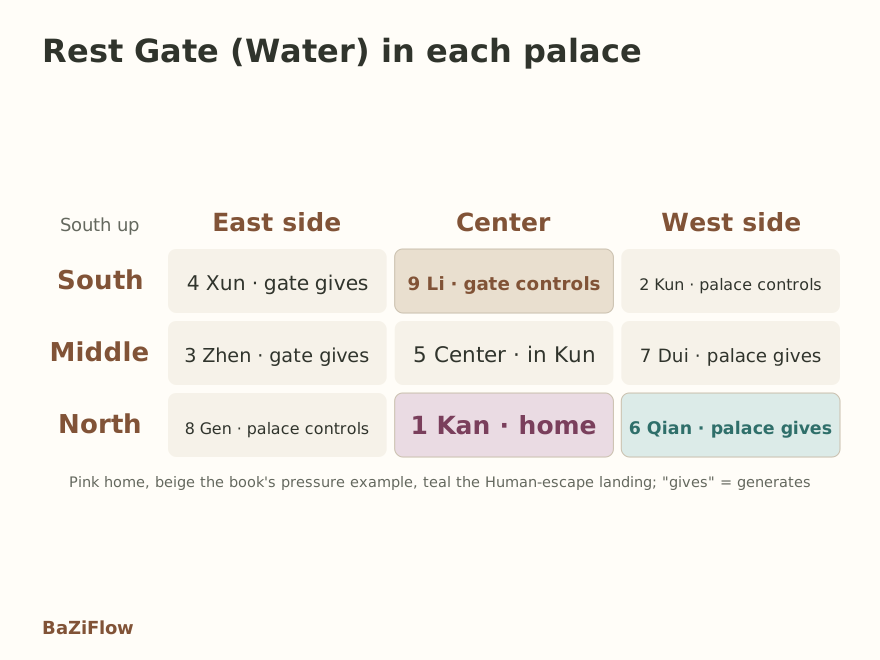
How Water, the element of the Rest Gate, relates to each palace, with south at the top and east on the left. The gate element is taken from its home palace, palace elements follow the usual assignments, and the relation names follow the pressure passage in volume 2 of Dun Jia Yan Yi.
The picture drops the Rest Gate (Water) into every outer palace and marks one thing only: how that palace's element stands to Water. Li Nine is Fire and Water controls Fire, so the gate controls the palace. The two Metal palaces, Qian Six and Dui Seven, generate Water: the palace gives to the gate. Kun Two and Gen Eight are Earth, which controls Water: the palace controls the gate. Zhen Three and Xun Four are Wood, which Water generates: the gate gives to the palace. Kan One is the home, Water on Water.
Which way the comparison points is fixed by the gate-and-palace pressure passage (门迫宫迫) of the Ming-dynasty text Dun Jia Yan Yi (遁甲演义), volume 2:
If the palace controls the gate, that is not pressure; if the gate controls the palace, that is the dominant kind of pressure.
The examples that follow start with "the Rest Gate in the ninth palace": a Water gate in a Fire palace, the gate controlling the palace, counted as a favorable gate under pressure. The book also names a gate that generates its palace "harmony" and a palace that generates its gate "righteous" (义). The very next line, a note, then calls a palace controlling its gate "harmful pressure", which disagrees with the verse above it. That line awaits collation against a better edition, and this site has not fixed one reading, so the picture simply records "palace controls gate" and passes no verdict.
Beyond the lucky label: two places where the book leaves the Rest Gate "unaccomplished"
That the Rest Gate is a lucky gate has a source in the book. The passage on the eight gates in the Yan Bo Diao Sou fu (烟波钓叟赋), a rhymed piece printed in volume 1, reads:
If you meet the Open, Rest or Life gate, whatever you undertake all turns out as wished.
The daily Qimen section calls Rest, Open, Life and View lucky gates together, and volume 2 quotes an old classic: "whoever seeks anything, let him choose Rest, Open or Life, and if below them they join the Yin Wood, Yang Fire or Yin Fire wonders, it is lucky". All three put the Rest Gate in a lucky list, and all three carry a condition of the kind "joined to the Three Wonders".
Yet the same book has two places where the label does not hold. One is the gate pressure above: "when a lucky gate is under pressure, lucky affairs do not succeed", and the Rest Gate in the ninth palace is the book's own example. The other is the restrained wonder, in a note by Wang Zhang (王璋), a commentator the book quotes:
When the Yang Fire wonder reaches Kan, with the Rest Gate and the Yang and Yin Water stems there, it is imprisoned and dead: fire has entered the land of water.
The Yang Fire wonder enters the Kan palace, where the Rest Gate and the stems of Water stand, and the note lists this under "nothing should be undertaken". The first case compares a gate with a palace and the second compares a heaven-plate wonder with a palace, so the objects differ, but the Rest Gate is in both.
Enlarge diagram · scroll sideways to read
Human escape: the Yin Fire wonder, the Rest Gate and Great Yin in one palace
Volume 2 names one stacking pattern the "Human escape" (人遁):
The Rest Gate and the Yin Fire wonder share Great Yin; if you seek the Human escape, nothing surpasses this. Upper plate the Yin Fire, middle plate the Rest Gate, lower plate Great Yin.
The three layers each name one kind of item. The upper plate is the Yin Fire wonder (丁) on the heaven plate, the middle plate is the Rest Gate, and the lower plate is Great Yin (太阴) of the spirit layer. When all three fall in one palace, that is the shape of the Human escape. The entry goes on to say that this place is "shielded by the essence of the stars", and then lists many uses, which are left aside here: the question is only how the shape comes about.
Enlarge diagram · scroll sideways to read
The book gives an example that can be worked out: Yang-mode ju 7, a Yin Wood or Yang Metal day, the Yang Fire Rat (丙子) hour. Following the rotating-plate rule step by step: Yang Fire Rat is the third double-hour of the Yang Wood Dog (甲戌) cycle (Yang Wood Dog, Yin Wood Pig, Yang Fire Rat). Yang Wood Dog hides under Yin Earth, and in Yang-mode ju 7 Yin Earth sits in Gen Eight on the earth plate, whose home items are Tian Ren and the Life Gate, so the duty star is Tian Ren and the duty gate is the Life Gate. The hour stem, Yang Fire, sits in the fifth palace on the earth plate (lodged in Kun Two), and Tian Ren carries the heaven plate there. The Life Gate counts two double-hours on from Gen Eight and reaches Kan One. The whole gate ring shifts with it, and the Rest Gate arrives in Qian Six. The star plate carries the Yin Fire wonder to Qian Six as well, and Great Yin, two places ahead of the duty position, is also Qian Six.
Enlarge diagram · scroll sideways to read
The book states the result as "the Rest Gate and the Yin Fire wonder come down two ahead of the duty position, in the sixth palace, within Great Yin", which matches the Qian Six that was just derived. Going back to the relation map, the Rest Gate in Qian Six is Metal generating Water: the palace gives to the gate.
Dragon escape and Ghost escape: two more groups with the Rest Gate
Among the lucky patterns of volume 2 the Rest Gate appears in two more escapes. The Dragon escape (龙遁) reads:
The day wonder joins the Rest Gate in the Kan palace; this is the Dragon escape, where clouds follow.
The day wonder is Yin Wood (乙). The same entry says that Yin Wood joining the Rest Gate and landing on Yin Water, or at Kan, is "shielded by the dragon". The Ghost escape (鬼遁) takes the Yin Fire wonder joined to the Rest Gate and landing on Nine Earth (九地).
Enlarge diagram · scroll sideways to read
Every three months: the Rest Gate in the monthly example
In the daily scheme the Rest Gate moves on after three days; see the Kan One palace for the walk. In the "monthly Qimen" of volume 1 the name is the same, and the rhythm is stretched to three months:
From the Yang Wood Rat month, the eleventh month of year 42 of Jiajing, the Rest Gate is in Kan and moves every three months, until the Yang Wood Rat month, the eleventh month of year 41 of Wanli, when the Rest Gate is again set in Kan.
Both starting points are the eleventh month of a Yin Water (癸) year, whose month pillar is exactly Yang Wood Rat (Jiajing 42 is a Yin Water Pig year and Wanli 41 a Yin Water Ox year). Fifty years lie between them, 600 months; moving every three months makes 200 moves; with eight outer palaces, 200 is 25 times 8, so the gate goes round 25 times and returns to Kan. The end point the book names agrees with this arithmetic.
Enlarge diagram · scroll sideways to read
Two small exercises
Work it out once
The Rest Gate lands in Gen Eight. How do gate and palace relate?
Gen Eight is Earth and Earth controls Water: the palace controls the gate. The verse says a palace controlling its gate is "not pressure", the note beside it says otherwise, and this site records the relation without a verdict.
The monthly Rest Gate starts in Kan. Where is it after the eighth move?
Eight outer palaces make one round, so after the eighth move it is back in Kan, 24 months later.
How the three pressure-type labels differ from striking punishment and tomb entry is in gate pressure, striking punishment and tomb entry; the home-position table of the gates is in what the doors, stars and spirits are; after the Rest Gate comes the Life Gate.
Questions readers ask next
In the Human-escape lines, is the "lower plate" Great Yin a stem on the earth plate?
No. The three layers of the Human escape are three kinds of item stacked in one palace: the Yin Fire wonder of the heaven plate, the Rest Gate, and Great Yin of the spirit layer. They are not on one plate, they merely share a palace. In other entries "lower plate" may mean an earth-plate stem, so ask which layer each line means.
Does "Rest" mean that meeting this gate is a signal to stop and rest?
Rest is simply the gate's name. In the lines quoted here the Rest Gate stands with the Open and Life gates among the favorable gates, and the lines are about which wonders and spirits it overlaps with. None of them reads it as "stop acting".
The Rest Gate in the ninth palace counts as gate pressure. Is it safe everywhere else?
The book names only gate-controls-palace as pressure, gives separate names to gate-generates-palace and palace-generates-gate, and says two inconsistent things about palace-controls-gate. It gives no verdict for each landing place, and this site does not write one for it.
Was this article helpful?
Sources & references
Continue reading
Life Gate: Gen Eight Earth Gate, the Middle of the Heaven Escape and the Third Win ↗