

Quincunx: 150° and five signs apart
Content version · · Sources & references
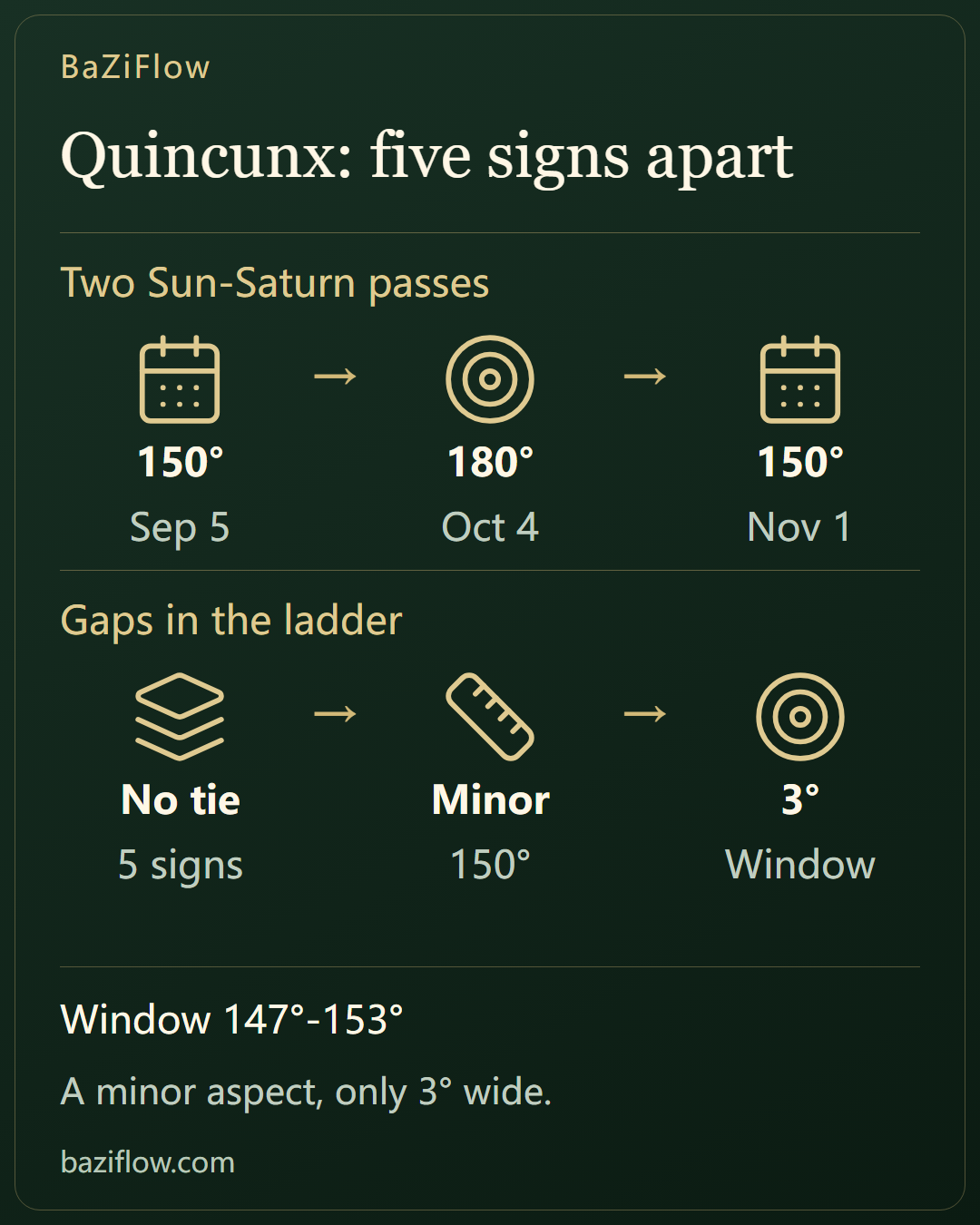
A quincunx is a minor aspect at 150°, with a 3° orb. Two Sun-Saturn passes in 2026, Ptolemy's "unconnected" signs, 150° = 180° - 30° and two real exercises show how it is built.
The short version6 min read
A quincunx puts two points 150° apart, five signs away, as a minor aspect with a 3° orb on this site, while Ptolemy files signs five apart as having no connection.
- The quincunx window runs 147°-153°, 6° wide. Minor aspects get the same 3° whether or not the Sun or Moon takes part.
- Ptolemy files signs one and five apart as unconnected: five signs split the circle into 150° and 210°, unequal parts, while his four configurations all divide it evenly.
- An exact quincunx always falls on the same degree in two signs five apart. The two Sun-Saturn passes of 2026 are 56.7 days apart, with the opposition between them.
Read first
Aspects and orbs in astrology: how to calculate the angle between two planets ↗
The Sun chases Saturn: through 150°, up to 180°, back to 150°
In plain words first: a quincunx is the opposition pulled back by 30°, a gap of 150° and five signs.
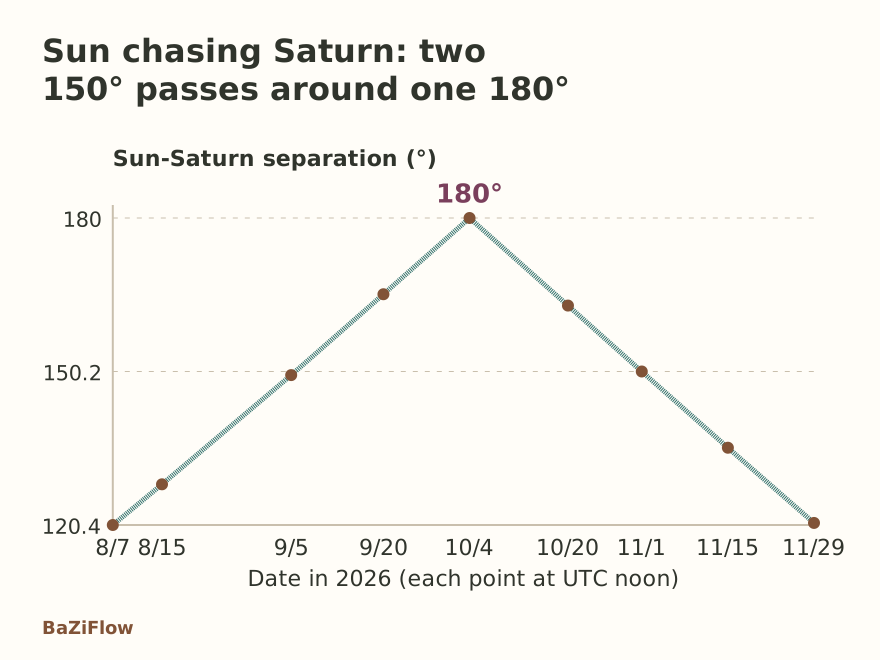
Line plot: each point is the Sun-Saturn separation at UTC noon; the 147°-153° quincunx window is the site's convention.
The picture shows the Sun-Saturn separation from August to December 2026. From September to November Saturn moves backward from 13° to 9° Aries, and the Sun gains on it by about 1° a day, so it sweeps through three readings:
- 5 September, 22:45 UTC: the separation rises through 150°, with the Sun at 13°23′ Virgo and Saturn at 13°23′ Aries.
- 4 October, 12:26: the separation reaches 180°, with the Sun at 11°17′ Libra and Saturn at 11°17′ Aries.
- 1 November, 15:58: the separation falls back to 150°, with the Sun at 9°14′ Scorpio and Saturn at 9°14′ Aries.
The two 150° passes are 56.7 days apart, with the opposition in the middle, about 28 days to either side. Each window lasts about 5.7 days: 3 September 00:49 to 8 September 20:21, and 29 October 20:15 to 4 November 11:46.
Two rungs missing from Ptolemy's ladder
Count the signs between two points from 1 to 6, and each rung is a multiple of 30°. Ptolemy takes only four of them in his chapter on configurations. A few chapters later he gives one to signs with no tie (XIX in Ashmand's numbering, I.16 in Robbins'):
All signs that share none of the familiarities above are unconnected and separate: neither commanding nor obeying, not beholding each other, not equal in power. Signs a single sign apart (30°) or five signs apart (150°), and with no share in the opposition, trine, quartile or sextile, belong here as well.
Enlarge diagram · scroll sideways to read
The book gives two different reasons. Signs one apart are "averted from each other". Signs five apart split the whole circle into two unequal parts, 150° and 210°, while the four configurations divide the circle into 2, 3, 4 and 6 equal parts. A quick sum shows the two cases differ: 30° divides 360° into 12 equal parts, so its rejection rests on the "averted" reason alone.
150° plus 30° is 180°: the neighbor of the opposite point
The angles 150° and 30° are supplements. A body that makes a quincunx with A is also standing 30° from the point opposite A.
Check it with the reading of 5 September at 22:45: Saturn is at 13°23′ Aries, so its opposite point is 13°23′ Libra. The Sun, at 13°23′ Virgo, is 29.996° from that point, almost exactly 30°.
Enlarge diagram · scroll sideways to read
It also shows what an exact quincunx looks like: 150 is five times 30, so it always falls on the same degree of two signs five apart. 13°23′ Virgo against 13°23′ Aries, and 9°14′ Scorpio against 9°14′ Aries, are both of this kind.
A 3° window: the Sun gains slowly, the Moon quickly
The site gives the quincunx and the semisextile 3° each, whether or not the Sun or Moon is involved. The 8° that the opposition allows with the Sun or Moon is withdrawn here. The time a window lasts then depends enormously on how fast the two bodies close:
Enlarge diagram · scroll sideways to read
The same full moon of 26 October has an opposition window of 28.7 hours, covered in the opposition article. Turn that Sun-Moon pair into a quincunx and the window shrinks to under half a day. The ratio between the two widths is just the ratio of the orbs, 8° to 3°.
Three standings: unconnected, added later, tense
One 150° has three standings, depending on where you look:
Enlarge diagram · scroll sideways to read
In Christian Astrology (1647), where Lilly explains how to use an ephemeris, he says the usual aspects are only conjunction, sextile, square, trine and opposition, and that "of late" a learned man named Kepler has added some new ones, the semisextile and the quincunx among them. His ephemeris example reads that the Sun and Jupiter "are in quincunx aspect that day", and he explains that this aspect is made of five signs, or 150°. He lists them, he says, only so that readers who meet them elsewhere will understand.
Two exercises (22 August 2025, UTC noon)
The Sun is at 29°39′ Leo and Saturn at 0°38′ Aries. Is that a quincunx?
The separation is 149.02°, 0.98° off 150° and inside 3°, so yes. The signs are four apart, which would count as a trine by sign.
At the same moment Pluto is at 1°57′ Aquarius. And with the Sun?
The separation is 152.30°, 2.30° off and inside the window, so yes. Leo and Aquarius are opposite signs, an opposition by sign.
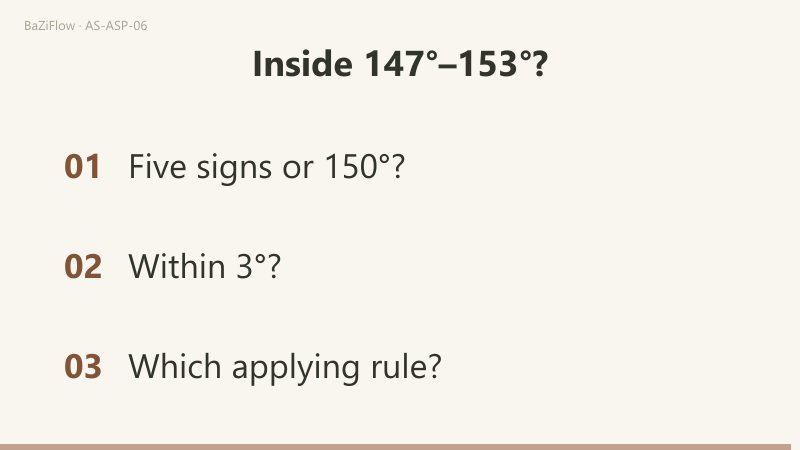
Before reading a quincunx, ask three things:
Five signs or 150°?
Counting signs is one ruler and measuring degrees is another; the site goes by degrees.
Within 3°?
The window is 147°-153°, with no widening for the Sun or Moon.
Applying or separating?
In one window the half approaching 150° is applying and the half leaving it is separating.
Then put it back into the whole chart: aspect angles and orbs explains how windows are measured, and conjunction, opposition and square explains why no aspect gives a verdict by itself. Its neighbor at 30° is the semisextile, and Saturn from the exercises is in Saturn by sign and house.
Questions readers ask next
Is a quincunx the same as being five signs apart?
No. Counting five signs measures signs, and a quincunx measures degrees. With the Sun at 29° Leo and Saturn at 0° Aries the signs are four apart, yet the separation is 149° and inside the window. The site goes by degrees.
Can one pair of bodies show both a quincunx and an opposition?
Not at once. The quincunx window is 147°-153° and the nearest edge of the opposition window is 172° or 174°, about 20° away. At any moment a pair sits inside at most one of them.
Why does the quincunx get only 3° even with the Sun or Moon?
The site lists 150° and 30° as minor aspects with one orb of 3°. The 8° widening applies only to the five major aspects: conjunction, sextile, square, trine and opposition.
Was this article helpful?
Sources & references
- Ptolemy, Tetrabiblos Book I (F. E. Robbins text on Perseus/LacusCurtius): the four configurations and the signs without familiarity ↗
- TimePassages Support: Why Don’t I See Certain Aspects in My Chart? ↗
- NASA JPL Solar System Dynamics, Planetary Physical Parameters: sidereal orbital period ↗
- William Lilly, Christian Astrology (1647), Of the Twelve Houses (cited for the passages named in the text; chapter and page cross-check pending) ↗
- Ptolemy, Tetrabiblos (J. M. Ashmand translation, 1822), chapter numbering as cited in the text ↗
Continue reading
Opposition (180°): Why the Orb Has Only One Side, From a Full Moon to Sun-Saturn ↗
Semisextile (30°): One Sign's Distance, Read From Same-Sign, Adjacent and Two-Apart Cases ↗
Conjunction, opposition and square aspects: measure the angle before judging good or bad ↗