

Gen Eight: ending and beginning in the northeast
Content version · · Sources & references
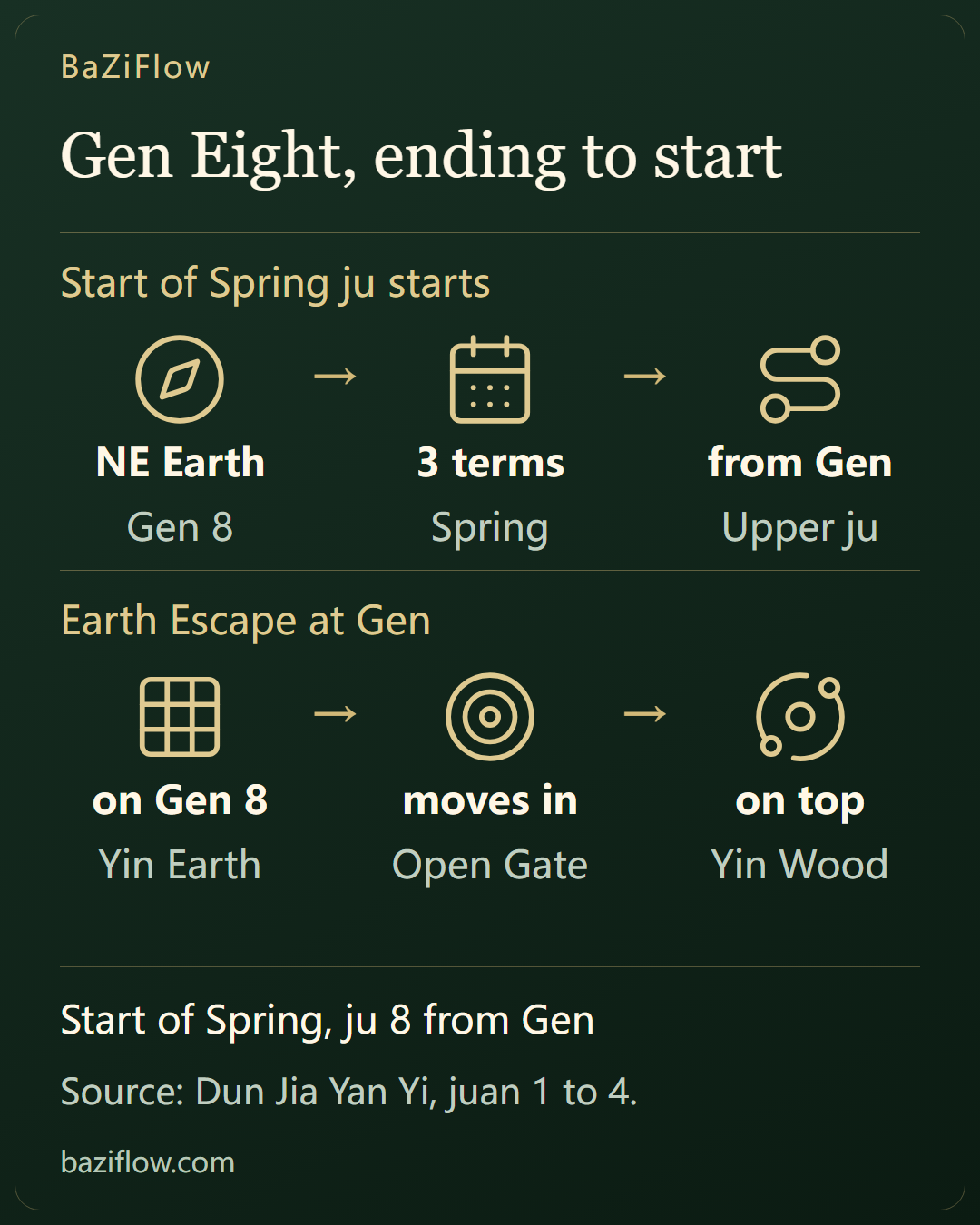
Gen Eight is the northeast box of the nine palaces: number 8, trigram Gen, element Earth. Start of Spring and its ju, the wonders at Gen, the Earth Escape cell and the Heavenly Net eight feet high show what it holds.
The short version10 min read
The Shuo Gua calls the northeast the place where all things complete their end and their beginning. In the nine palaces that is Gen Eight, Luoshu number 8 and Earth: the upper ju of Start of Spring begins its count here, and the three layers of an Earth Escape example stack in this box.
- Gen is the one trigram the Shuo Gua says both ends and begins the myriad things; Gen Eight and Kun Two are the only opposite pair of palaces whose two ends share an element, Earth.
- The three ju of Start of Spring begin at Gen Eight, the center and Kun Two; marked on the grid they form one diagonal whose numbers sum to fifteen.
- In the Earth Escape example of juan 2, Yin Wood in the heaven layer, the Open Gate and Yin Earth in the earth layer meet in Gen Eight; the Heavenly Net example uses the palace number itself as a height of eight feet.
Read first
Completion spoken in Gen: the northeast corner, ending and beginning
Gen Eight (艮八) is the northeast corner of the nine palaces: number 8, trigram Gen, element Earth. The book gives it a keyword pair of opposites, ending and beginning.
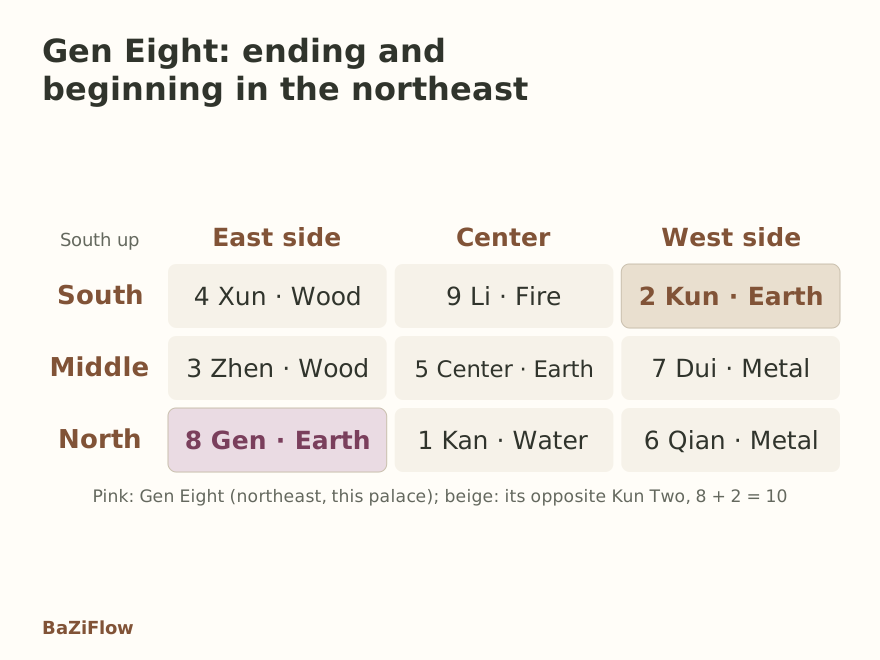
Nine-palace base grid with south at the top and east on the left; elements follow the usual assignment and numbers are the Luoshu numbers. Pink marks Gen Eight and beige its opposite, Kun Two.
Northeast sits at the lower left of the picture, facing Kun Two at the upper right across the center. The Shuo Gua (说卦) writes of Gen in its fifth chapter:
Gen is the trigram of the northeast, where the myriad things complete their ending and complete their beginning; hence "completion is spoken in Gen".
Chapter 6 puts it another way, "nothing ends and begins the myriad things more fully than Gen"; chapter 7 settles on one word, "Gen is stopping"; and in the family roles of chapter 10 Gen is the youngest son. The northeast is where winter gives way to spring, so the wording and the position fit each other. Juan 3 then assigns the palace to old provinces: "The Gen palace, the northeast, answers to the share of Yan province and of Han and Zheng."
The three terms of Gen: Start of Spring, Rain Water, Awakening of Insects
In juan 3 every one of the twenty-four solar terms is given to a trigram, and Gen receives three:
Gen takes Start of Spring, Rain Water and Awakening of Insects.
Juan 1, on how Feng Hou made Qimen, first splits the trigrams into two groups: with the Winter Solstice yang is born, starting from Kan, Gen, Zhen, Xun; with the Summer Solstice yin is born, starting from Li, Kun, Dui, Qian. Gen is the second of the four Yang-mode trigrams, after Kan and before Zhen. Juan 3 also cites the Book of Grand Unity (太乙书), which calls Kan, Gen, Zhen and Xun the yang palaces and writes "Liaodong is Gen's land", using Gen to point to the Liaodong region.
The Wanli 24th-year example (juan 1) has all three ju of Start of Spring in it. The upper ju reads:
The upper ju of Start of Spring, Yang mode eight, jumping ahead to Yang Wood Rat from the Gen palace.
In the same example the middle ju is "Yang five, starting Yang Wood Rat from the center" and the lower ju "Yang two, starting from Kun Two". The three starting points are Gen Eight, the center and Kun Two.
Enlarge diagram · scroll sideways to read
On the picture the three starts lie on one diagonal from northeast to southwest, and 8 plus 5 plus 2 is 15, one of the "fifteens across and down", with the two ends 8 and 2 being opposite palaces. For how terms map to ju numbers, see how solar terms relate to ju numbers.
The wonders arriving at Gen Eight: one name, different words after it
At Gen, the "rejoice or rage" section of juan 3 gives three names. Gen holds the Ox (丑) and Tiger (寅) branches, and juan 4 writes "Ox, Gen, Tiger", setting Gen beside those two; the book calls the direction the Ghost Gate, and the wonders section uses the words "ghost road" and "ghost gate".
Enlarge diagram · scroll sideways to read
The Yang Fire row shows best how a name relates to its conditions. In the wonders section, "Phoenix Enters the Cinnabar Mountain" is followed by "Gen is the ghost road, and Yang Fire burns there". In the actual chart for the Yang Fire Horse (丙午) hour of the Grain Buds middle ju, the same name is followed by "the Open Gate is in harmony": the Open Gate is Metal, Earth generates Metal, and the palace generates the gate. One name in one volume carries two different notes, so the reader has to see whether the chart in hand has that Open Gate.
The Yin Fire row ties into the tomb entries of juan 2: Yin Wood on palace two, Yang Fire on palace six and Yin Fire on palace eight are all recorded as entering the tomb. The same entry also gives a thread for Yin Fire: the canon it quotes sends Yin Fire "toward the Ox", and Ge Hong's note places the tomb of Yin Fire at the Ox (丑). Gen holds the Ox, which is why Yin Fire on palace eight is recorded as entering the tomb. The conditions for a tomb entry are set out in what conditions make a three-wonder tomb entry hold.
Earth Escape in Gen Eight: three layers in one box
Juan 2 lists a run of patterns named "escapes", and the rule for Earth Escape is three layers lying together: Yin Wood on the upper plate, the Open Gate in the middle, Yin Earth on the lower plate. The book's example is the Summer Solstice chart in Yin ju 9, at the Yang Fire Tiger (丙寅) hour of a day of Yang Wood or Yin Earth, and it concludes that the Open Gate "joins Yin Earth and comes down in palace eight". That lands the pattern in Gen Eight.
Handing this hour to the site's engine, the Gen Eight box comes out with Yin Wood in the heaven layer, the Open Gate and Yin Earth in the earth layer, so all three layers fit. The book's statement and the computed result agree, and the steps are:
Enlarge diagram · scroll sideways to read
In this box the earth stem, Yin Earth, is fixed by the ju: in Yin ju 9 the six instruments run backward from Li Nine, and Yin Earth falls exactly on Gen Eight. The Yin Wood and the Open Gate are turned in by the rotation and change with the hour. So one and the same "Gen Eight" has a ground layer set when the chart is cast, and heaven and gate layers that are turned out at that moment.
Yin Wood is Wood, the Open Gate is Metal and Yin Earth is Earth. The Earth of the palace generates the Metal gate, so the palace generates the gate; no gate controls the palace in this box.
The Heavenly Net eight feet high: the palace number as a measure
In the entry on the Heavenly Net spread on four sides (天网四张格) in juan 2, the palace number is used directly as a quantity. The verse says:
The Heavenly Net spreads on four sides, no road to run; palaces one and two, the net is low and leaves a path; three and four, walking in to the tomb; eight and nine, high and strong, go east or west at will.
The commentary says the net lies where the heaven-layer Yin Water (癸) falls: on palaces one to four the net is low, on five to eight high. The verse and the commentary do not draw the line the same way: the verse sets three and four apart as "tomb" and counts eight and nine as high, while the commentary counts one to four as low and five to eight as high. The book's own worked example is a Yin ju 4 chart for Major Heat, on a day of Yin Wood or Yang Metal at the Yin Earth Rabbit (己卯) hour, and the Yin Water lands on palace eight:
The heaven-layer Yin Water added to the earth-layer Yin Water: the Heavenly Net is eight feet high.
Laying this hour out again, Yin Water does lie on palace eight, with Yin Water in both the heaven and the earth layer and Tian Ren at home as the star; in this chart heaven and earth match in every palace and nothing has turned. Following the wording of the example, the height of the net is the palace number counted in feet: Yin Water on palace eight makes it eight feet high.
Enlarge diagram · scroll sideways to read
Two quick checks on Gen Eight
Where do the upper, middle and lower ju of Start of Spring start?
The upper ju, Yang eight, starts at Gen Eight, the middle ju, Yang five, at the center, and the lower ju, Yang two, at Kun Two.
Which palace holds Yang Metal on the Yang ju 8 ground plate?
The instruments run forward from Gen Eight: Yang Earth at Gen Eight, Yin Earth at Li Nine and Yang Metal at Kan One, so Yang Metal is at Kan One.
The opposite of Gen Eight is Kun Two, its home gate is covered in the Life Gate and where it falls, and the next to read is Li Nine.
Questions readers ask next
Why are Gen Eight and Kun Two a special pair?
The four opposite pairs have elements Water and Fire, Wood and Metal, Wood and Metal, and Earth and Earth. Only Kun Two and Gen Eight share an element, which is why the verse writes "Kun and Gen" as one line, both Earth. A shared element does not make them one box; position, trigram and number stay separate.
Does every Start of Spring ju start Yang Wood Rat at Gen Eight?
No. The upper ju, Yang eight, starts at Gen Eight, but the middle ju, Yang five, starts at the center and the lower ju, Yang two, at Kun Two. The book's example writes the three side by side with three different starting points.
Does "Earth Escape" mean Gen Eight is a lucky palace?
No. Earth Escape is the name of a pattern of three layers lying together: Yin Wood above, the Open Gate in the middle, Yin Earth below. The book's example has them meet in Gen Eight at one particular hour; on another chart the same palace holds other combinations.
Was this article helpful?
Sources & references
Continue reading
Dui Seven: the Metal of Due West, and How the View Gate and Yin Fire Read There ↗
Li Nine: the Fire of Due South, Where Yin Mode Begins and the Flying Bird Falls ↗