
What is Liu Yao? From a single question to an assembled hexagram chart
Content version · · Sources & references
Liu Yao turns one bounded question into a six-line chart: coins are cast, stems and branches are attached to each line, and the reading follows the Useful God. A map of the whole sequence and where each step comes from.
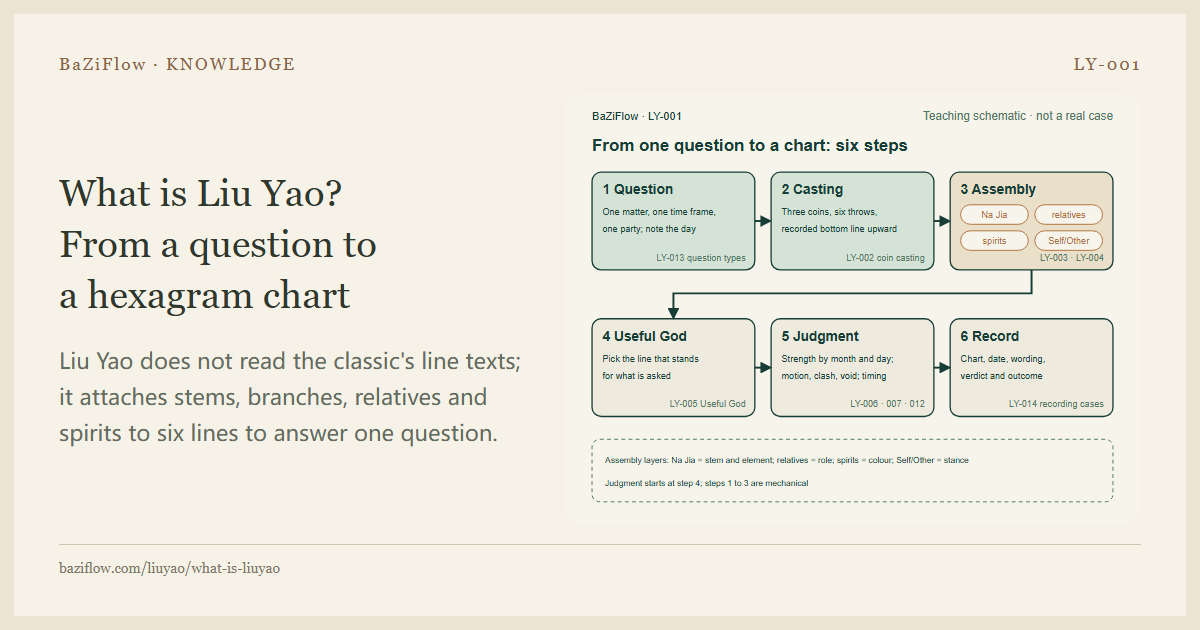
Liu Yao does not read the classic's line texts; it attaches stems, branches, relatives and spirits to six lines to answer one question.
Read first
Five Elements cycles: learn the relationships, not just the order ↗
Start with the question, not the coins
Suppose someone wants to know whether an application sent this week will be approved. Before any coin is thrown, Liu Yao (六爻) requires that the question be narrowed to one matter, one time frame and one clearly identified party; the tradition calls this a "question event". Volume one of Zeng Shan Bu Yi, a Qing-dynasty manual, insists that a cast should be "for this matter alone, not for some other matter as well". Liu Yao also differs from reading the Book of Changes directly: it does not lean on the hexagram and line texts, but attaches Heavenly Stems and Earthly Branches to the six lines and reasons with the Five Elements, the six relatives, the six spirits and the Self and Other lines. This article maps the sequence and where each step comes from; it judges nobody's question.
Where the method comes from
The Great Commentary (Xi Ci) of the Book of Changes describes casting with yarrow stalks: "the number of the great expansion is fifty, of which forty-nine are used", divided, set aside and counted by fours through eighteen operations before six lines appear. In the Han dynasty, the school of Jing Fang (77–37 BCE, a student of Jiao Yanshou) produced Jing Shi Yi Zhuan, which sorts the sixty-four hexagrams into eight palaces, marks a Self line and an Other line in each, and under the hexagram Qian already writes that the stems Yang Wood (甲) and Yang Water (壬) are "paired with the outer and inner trigrams" and that "Yang Wood-Rat (甲子) Water is Qian's Offspring". What later ages call Na Jia (纳甲) and the six relatives (六亲) is visible here in outline. The attribution is disputed, however: some scholars argue that the eight-palace scheme and Na Jia came from another lineage of Changes scholarship (Xun Shuang, Yu Fan, Gan Bao) and were attached to Jing Fang's name afterwards.
Coins replacing yarrow is recorded by the Tang dynasty at the latest: Jia Gongyan's commentary on the Yili mentions marking lines with coins, and the Taiping Guangji tells of a Daoist in the Changqing era whose "three coins danced together, settled after a long while, and all six places came up the same (重)". The Song-era book Huo Zhu Lin made the procedure standard; the bibliographer Chen Zhensun noted that "fortune-tellers who throw coins today all use this book", while Zhu Xi remarked that "people now use three coins in place of the yarrow... this merely attaches Na Jia to the six lines, and Na Jia is the learning of Jiao Gong and Jing Fang of the Han". Printed editions credit the book to the Daoist Mayi, yet Qing printings quote a Yuan-dynasty work, so researchers treat the attribution as a later addition. Ming and Qing manuals such as Yi Mao, Yi Lin Bu Yi, Yi Yin, Zeng Shan Bu Yi and Bu Shi Zheng Zong all build on the Huo Zhu Lin method. "Liu Yao", "Wen Wang hexagram", "Na Jia divination", "Huo Zhu Lin method" and "coin hexagram" therefore name one method; the story that King Wen invented it is legend.
Six steps from question to chart
The order below reflects common modern teaching; names vary slightly between schools, the skeleton does not.
| Step | What is done | What it yields |
|---|---|---|
| Question | Narrow the matter; note the stems and branches of the casting day | The scope of one cast |
| Casting | Throw three coins six times, recording from the bottom line upward | Primary hexagram, moving lines, changed hexagram |
| Assembly | Attach stems and branches (Na Jia); set relatives by the palace element; set spirits by the day stem; place Self and Other by hexagram order | Four layers on every line |
| Useful God | Choose the line that stands for what is asked, by question type | Useful God, with its helper and enemy lines |
| Judgment | Weigh the Useful God against month and day, then movement, combination, clash and void | A verdict and the conditions it rests on |
| Record | Keep the chart, date, wording, verdict and outcome | A case that can be reviewed |
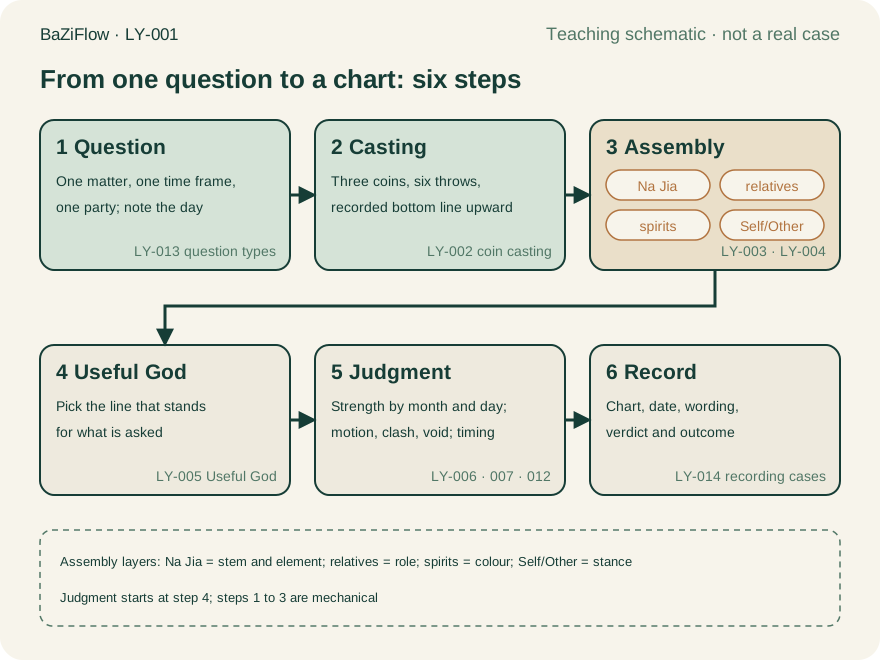
Original BaZiFlow teaching diagram; it shows only the order of steps from question to chart, with no real case.
Assembly splits across two articles: stems, relatives and spirits in Na Jia, six relatives and six spirits, and line placement in the Self line and the Other line. How the Useful God follows the question type is covered in choosing the Useful God.
Why four layers
Na Jia answers "which stem and branch, which element is this line?", and only then can the line be compared with the month and day of the cast for strength. The six relatives answer "what part does this line play in the matter?": taking the palace element as "self", what produces self is Parents, what self produces is Offspring, what controls self is Officer-Ghost, what self controls is Wife-Wealth, and what matches self is Siblings. The six spirits (六神) are placed from the bottom line upward according to the day stem and add colour to the matter. The Self line (世爻) belongs to the asker's side and the Other line (应爻) to the counterpart or the matter itself. Zeng Shan Bu Yi recounts how its author gave a friend a complete chart of the eight palaces so that someone who could not assemble a hexagram could still copy the Self, Other, elements and relatives from it. Assembly is mechanical; judgment begins with the Useful God.
Limits and common misreadings
Liu Yao is not a natal chart. It needs no birth data, and one cast answers one question; the same person asking about a different matter casts again. Meihua Yishu (梅花易数) also works from hexagrams but casts differently and reasons mainly through Body and Use; the comparison belongs to Meihua versus Liu Yao.
Schools disagree in at least three places. First, the weight of the six spirits: Zeng Shan Bu Yi calls them "attached spirits" that make an auspicious hexagram better with the Azure Dragon and a bad one worse with the White Tiger, whereas another view treats them as descriptive only, never a basis for good or ill. Second, stems and Na Yin: some insist a chart is incomplete without stems and Na Yin, while another approach judges generation and control by branch elements alone. Third, recasting: the author of Zeng Shan Bu Yi allows a second cast when the first shows nothing, where earlier writers refused to cast twice. Whatever you read, identify its convention first.
What the chart cannot supply must come from the world: deadlines, review criteria, who the counterpart is, when the result becomes visible. Write the conditions of a verdict down with the hexagram, so that a wrong step can later be found. To practise the first hands-on step, read recording the six coin throws.
Part of a learning path
Liu Yao: from casting to the Useful God and movement · Step 1 of 1 available