

Literary Star: one name, two tables
Content version · · Sources & references
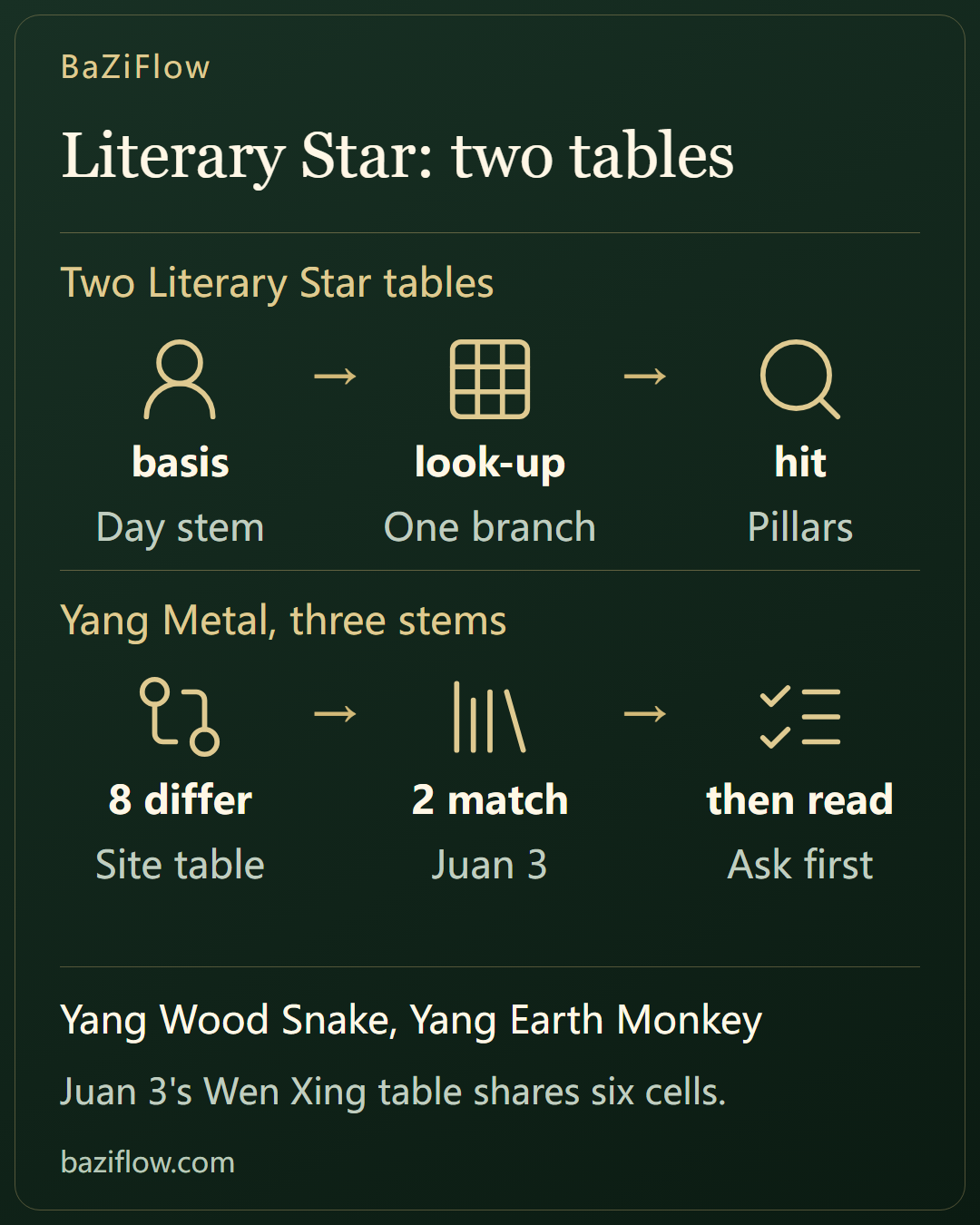
The Literary Star maps the Day Master stem to one branch. Two charts and a comparison table set the site table against the Sanming Tonghui juan 3 list, which agrees on two stems, and trace the site table to its source.
The short version9 min read
The Literary Star maps the Day Master stem to one branch, which is then searched in the four pillars. Under the same name, the site table and the list in juan 3 of the Sanming Tonghui place only two of the ten stems on the same branch.
- The basis is the Day Master stem, one stem to one branch, and the year, month, day and hour branches are all checked. Yang Fire and Yang Earth share Monkey; Yin Fire and Yin Earth share Rooster.
- Eight of the site table's ten cells equal the Emolument position of the stem's Eating God, with Fire stems as the exception. The pattern is read off the table; the only old line found is a date-selection year spirit in the Xieji Bianfang Shu.
- Juan 3 files a "Literary Star noble" under the Tai Chi Nobleman, also called the exam-name star, with a different stem table. Before trusting any result, ask which table it used.
Read first
Symbolic Stars in BaZi: Check the Reference and Rule Before the Meaning ↗
One day stem, one branch
The Literary Star (文昌贵人) takes the Day Master stem as its basis, like the Heavenly Nobleman, but each stem maps to just one branch. Once it is found, it is searched for across the whole chart, the day pillar's own branch included; a branch that shows up twice is a match twice.
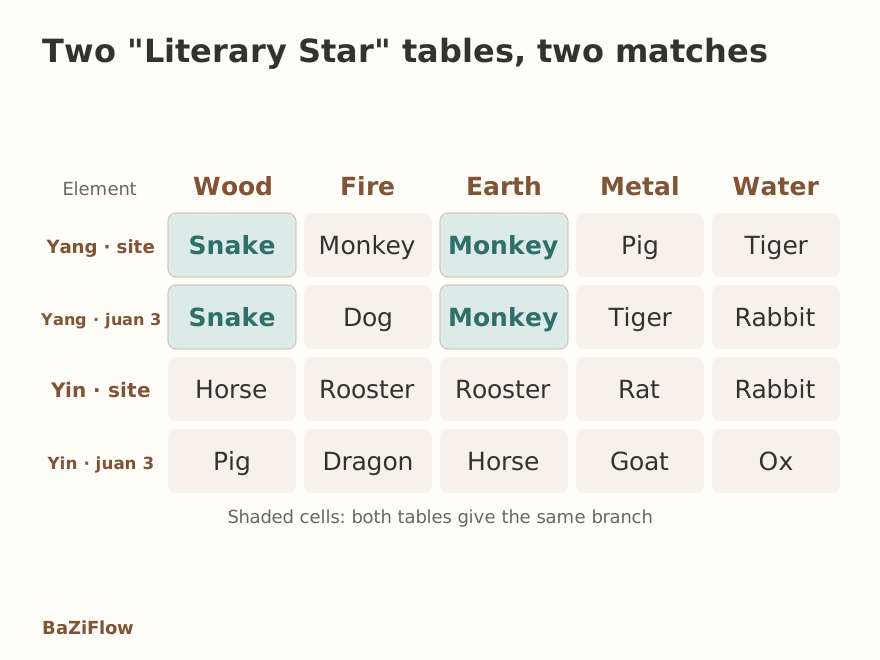
Comparison sketch: in each pair of rows the upper one is the site engine's table and the lower one is the Sanming Tonghui list under the "Tai Chi Nobleman" chapter in juan 3. Cells give the branch for each stem.
In the picture, each pair of neighboring rows sets the site engine's table above the list printed in juan 3 of the Sanming Tonghui (discussed in the fourth section). The two shaded cells, Yang Wood and Yang Earth, are where the tables agree. For now, read only the "site" rows: Yang Wood Snake, Yin Wood Horse, Yang Fire Monkey, Yin Fire Rooster, Yang Earth Monkey, Yin Earth Rooster, Yang Metal Pig, Yin Metal Rat, Yang Water Tiger, Yin Water Rabbit.
Change the Day Master, change the result
Imagine a chart with a Yang Metal Day Master and the branches Pig, Rat, Monkey, Pig. The Literary Star of Yang Metal is Pig, and Pig turns up twice, in the year and in the hour pillar. Now freeze the branches as Dragon, Monkey, Rat, Horse and change only the Day Master: Yang Earth and Yang Fire both have Monkey as their Literary Star, which sits in the month pillar; Yang Wood has Snake, and the chart holds no Snake, so it carries no Literary Star.
Enlarge diagram · scroll sideways to read
Changing the Day Master on the same set of branches can change the result completely, and that is what "the basis is the Day Master" means. No match is also a definite result: it says only that the table found no corresponding branch among the four.
A pattern inside the table: most cells are the "Eating God's Emolument"
Compare the site table with one more clue. The stem a Day Master produces with the same polarity is called the Eating God (食神): Yang Wood produces Yang Fire, so Yang Fire is the Eating God of Yang Wood. The Emolument (禄) of that stem is its Establishment position in the twelve-stage table. Eight of the ten cells fit: the Eating God of Yang Wood is Yang Fire, whose Emolument is at Snake, and the Literary Star of Yang Wood is Snake; the Eating God of Yang Earth is Yang Metal, whose Emolument is at Monkey, and the Literary Star of Yang Earth is Monkey.
Enlarge diagram · scroll sideways to read
The Fire stems are the exception. The Eating God of Yang Fire is Yang Earth, whose Emolument in the site's twelve-stage table is at Snake, yet the Literary Star table gives Monkey. The Eating God of Yin Fire is Yin Earth, with its Emolument at Horse, while the table gives Rooster. Another site Symbolic Star, the Heavenly Kitchen (天厨贵人), has a rule that reads exactly "take the Emolument of the Eating God", and its table differs from the Literary Star table only at those two Fire cells. The one line found in the old texts is in juan 35 of the Qing-dynasty Xieji Bianfang Shu (协纪辨方书): "the Literary Star is the Emolument of the Eating God". There, though, it is a year spirit counted from the year stem for date selection, not a Symbolic Star looked up from the day stem, and by the usual Emolument positions it would put the Fire stems at Snake and Horse, not Monkey and Rooster.
One name, another table in juan 3
The chapter on the Tai Chi Nobleman in Sanming Tonghui juan 3 first explains the name, and the first table it then lists is a ten-stem table for the Literary Star noble:
The Literary Star noble: for Yang Wood, the snake's mouth; for Yin Wood, the pig's head; for Yang Fire, the dog; for Yin Fire, the dragon; for Yang Earth, facing the monkey ... for Yin Water, meeting the ox.
The snake's mouth is the Snake branch, the pig's head is the Pig, the dog is the Dog, the dragon is the Dragon, the monkey is the Monkey and the ox is the Ox. Reading all ten cells, the list matches the site table only at Yang Wood (Snake) and Yang Earth (Monkey); the other eight stems differ. The chapter title also carries a note that the Tai Chi Nobleman is "also called the exam-name star". The Literary Star is not alone in that chapter:
Enlarge diagram · scroll sideways to read
The Wen Xing noble in the same chapter deserves a second look. Its verse runs "Yang Wood the horse, Yin Wood the snake, Yang Fire and Yang Earth the monkey; the Rooster terrace for Yin Fire and Yin Earth, the Pig sought by Yin Metal; Yang Metal meets the dog, Yang Water the tiger; of the ten Wen Xing places, Yin Water roams with the rabbit" (the original is unpunctuated and is read here in lines of seven characters). Against the site's Literary Star table, six cells agree: Yang Fire, Yin Fire, Yang Earth, Yin Earth, Yang Water and Yin Water. Yang Wood and Yin Wood are swapped (Horse and Snake in the Wen Xing table, Snake and Horse on the site), and the Metal stems differ (Dog and Pig there, Pig and Rat on the site). The site table is far closer to the Wen Xing table than to the Literary Star table of the same name, but the name differs and four cells still disagree, so this does not show that the site table comes from it.
So the name "Literary Star" can point to different tables in different books and programs. Which tradition the site's table belongs to is a separate question, and once two tables each produce an output they can give the same person entirely different results.
Three questions before using it
The site describes the Literary Star as "clever, studious, strong at writing, good for exams and study". Juan 3 files the star in the chapter on the Tai Chi Nobleman, whose second name is the exam-name star, where "name" means standing in the imperial examinations. So the exam direction is old, and the modern description generalizes from it.
Enlarge diagram · scroll sideways to read
When reading a Literary Star result
What the site table answers
- What the Day Master stem is
- Which branch the table returns
- Which of the four pillars matched
What to confirm separately
- Which table was used
- Whether the program counts the day pillar's own branch
- How much weight it carries in the whole chart
The previous Symbolic Star with a day-stem basis is the Heavenly Nobleman; next comes a Symbolic Star based on the day branch, the Traveling Horse; and how to record the basis, rule and hit of any Symbolic Star is set out in where Symbolic Stars sit in a chart.
Questions readers ask next
Yang Fire and Yang Earth Day Masters both get Monkey. Is that a typo?
It is how the table is built: two pairs of stems land on the same spot, which leaves ten stems spread over only eight branches.
The Sanming Tonghui also discusses a Literary Star. Why does it differ from software output?
The book has its own ten-stem table for the Literary Star noble, and it matches the site table only at Yang Wood and Yang Earth; the two tables share a name but not their contents. The site table is found in juan 1 of the Xingxue Dacheng, "On the Literary Star", which agrees on nine of ten cells and differs only at Yin Metal (Dog in the book, Rat on the site). The Wen Xing table in the same chapter of juan 3 also shares six cells with it, under another name.
Does a Literary Star really raise exam results?
There is no evidence for that. The site's wording, "good for exams and study", is a modern summary of the position. The book files the star under the "exam-name star", where the name means imperial-exam standing, and even there it is a minor clue in a chart.
Was this article helpful?
Sources & references
Continue reading
Heavenly Nobleman: Which Two Branches Your Day Stem Looks Up ↗
Traveling Horse: Find the Head of the Three Harmony Group, Then Its Clash ↗