

Keep source and conditions for every relation
Content version · · Sources & references
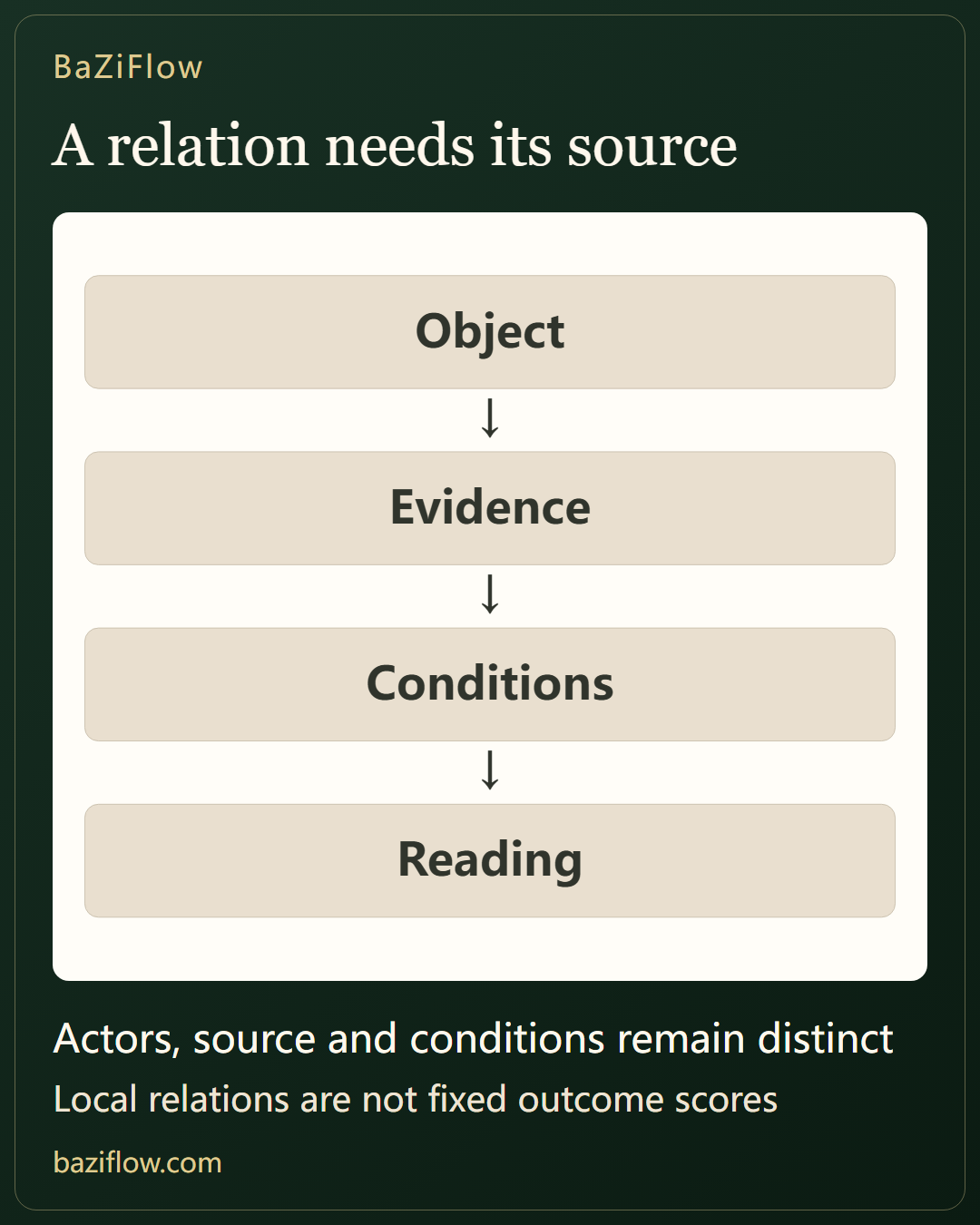
Compare four partial exercises to separate movement states, branch opposition, phase direction, and conditional tomb or extinction interpretations.
The short version7 min read
Rat–Ox combination needs the original movement state. Rooster changing to Rabbit requires separate clash and control tests. Wood meeting Goat needs a day or changed-line source, while Earth meeting Snake needs strength conditions. Each exercise retains its own inputs.
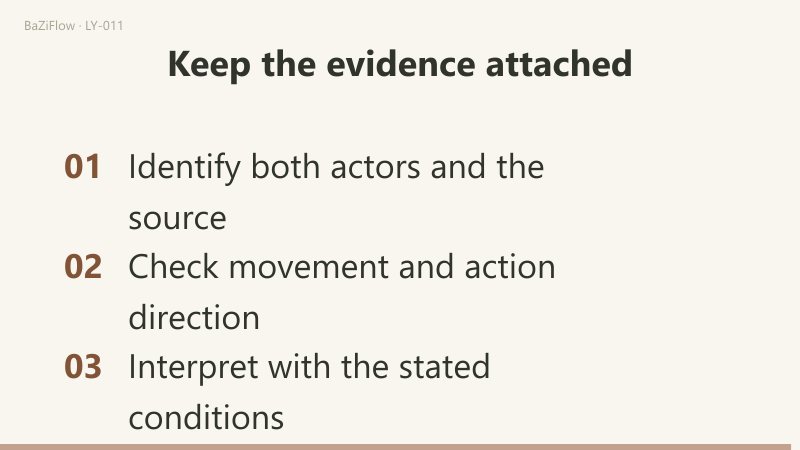
- Record both actors, the calendar or changed-line source, and original movement rather than treating matching words as evidence.
- Rabbit–Rooster opposition and changed Wood controlling original Metal are separate tests with different answers.
- Keep phase-stage correspondence distinct from operative conditions, leaving unsupported strength assumptions unresolved.
Read first
Month and day effects: preserve the evidence behind strength ↗
Moving lines and changed counterparts: auditing Xu to Song ↗
Several labels do not add up to a reliable score
A Liuyao chart may contain combination, clash, tomb, and extinction labels at the same time. Assigning a positive point to combination and negative points to the others does not resolve the interpretation. The labels may describe different actors, different time references, or different kinds of relationship.
This article uses line-level rules from Zengshan Buyi. It does not merge every rule for combining hexagrams, clashing hexagrams, or three-branch formations into one universal checklist. The aim is narrower: preserve the inputs behind each relation, then identify the conditions needed to interpret it.
Tomb and extinction are traditional technical names here. They are not literal statements that a person will die or that a physical grave is involved. Start with the recorded chart and question rather than the emotional force of an English translation. Moving and changed lines explains the positional record used below.
Calendar sources
- Month / day
Line sources
- Moving / changed
The same combining pair can meet different movement conditions
Take a Rat (子) Water line and an Ox (丑) day branch. Rat and Ox combine. In exercise A the original line is still; in independent exercise B it is moving. The source's combination chapter distinguishes a still line meeting combination from a moving line meeting combination, discussing the former as being activated by combination and the latter as being bound by it.
The branch pair has not changed, but the original movement state has. A bare “Rat combines with Ox” label therefore does not preserve enough information. Nor does activation mean that the original casting value should be edited to manufacture a new moving line.
The chapter also distinguishes combinations involving moving lines from a line changing into a combining counterpart. The day-combination explanation cannot be silently applied to every changed pair. The relevant question matters as well: the chapter treats a combination as suitable for a favorable matter and unsuitable for an unfavorable one, so what is being asked changes what the combination means.
Neither exercise supplies a complete calendar record or question, so neither licenses a concrete travel or success prediction. What is established is the difference between still and moving inputs under a named rule.
Rat: still
- Ox day → activation
Rat: moving
- Ox day → binding
A returning clash need not be returning control
In the source's Heng-to-Yu example, the original third line is Rooster (酉) Metal and its changed counterpart is Rabbit (卯) Wood. Rabbit and Rooster oppose each other, so a clash is present. But the changed Wood does not control the original Metal. In this example the source points out that the Rooster-to-Rabbit change clashes without controlling the Self line.
These tests use different evidence. Clash asks whether the branches form an opposing pair. Return control asks whether the changed phase controls the original phase at that position. One can be true while the other is false. Return generation and return control develops the directional test.
This lesson extracts the positional relation, not the historical case's claimed trading outcome. It also keeps month opposition, day opposition, and a changed counterpart's opposition separate. Calling them all “clashed away” would remove the information required to apply their different conditions.
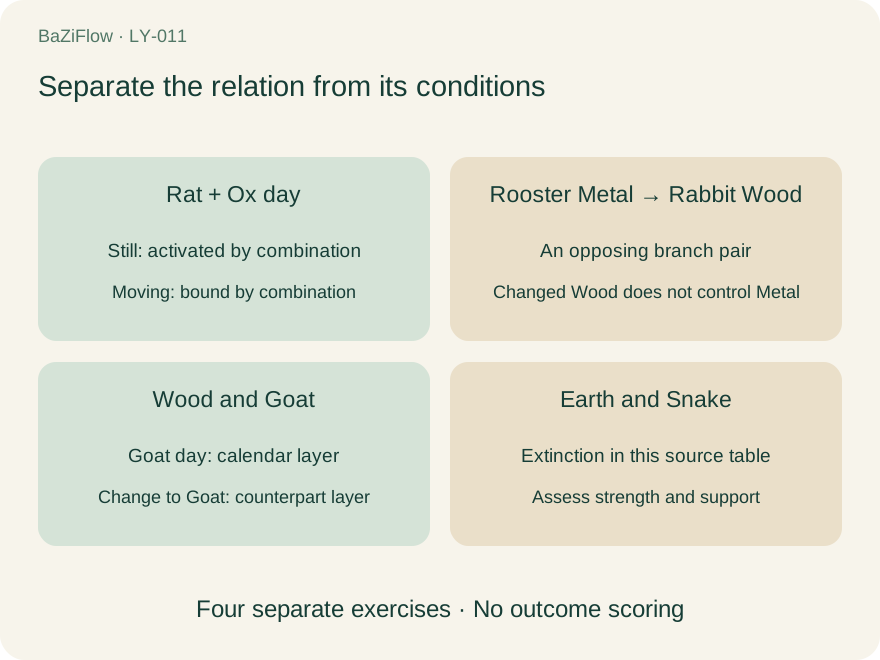
BaZiFlow relation-layer diagram. The panels are separate partial exercises, not a complete chart or a point-scoring system.
Rabbit–Rooster clash; changed Wood does not control original Metal
Wood and Goat: identify the layer before calling it tomb
The source's growth, strength, tomb, and extinction chapter places Wood's tomb at Goat (未). It distinguishes a Wood line being considered on a Goat day from a moving Wood line actually changing into Goat Earth. The former is a day-level relationship; the latter is a changed-counterpart relationship.
Knowing that the day branch is Goat does not establish a moving line or create a Goat counterpart. Knowing that a Wood line changes to Goat does not establish the day branch. Both facts could appear in a full record, but each needs its own evidence.
| Supplied fact | Relation that can be recorded | Unsupported extra inference |
|---|---|---|
| Wood line on a Goat day | Day-level tomb correspondence | The line must move and change to Goat |
| Moving Wood line changes to Goat | Same-position changed-tomb correspondence | The casting day must be Goat |
| Rooster Metal changes to Rabbit Wood | Clash without changed Wood controlling Metal | Every return clash is return control |
This is not a claim that locating a tomb correspondence completes the assessment of its effect. Strength, support, and the object's role remain relevant. It is a way to prevent the interpretation from borrowing a missing fact from another layer.
Day Goat
- Day-level tomb
Changed Goat
- Changed-line tomb
Earth meeting Snake exposes a conditional rule
Zengshan Buyi uses a convention placing Earth alongside Water in this part of its phase-cycle table, with extinction at Snake (巳). The chapter also discusses disagreement over Earth's starting point. That makes the convention source-specific; it should not be presented as an uncontested table shared by every divination system or replaced with Bazi stem-polarity cycles.
More importantly, a note in the same chapter, signed “Juezi says” (覺子曰), qualifies how Earth meeting Snake is interpreted. Weak Earth without support is discussed under extinction, while strong or supported Earth can receive generation from Snake Fire. In the latter situation the explanation gives priority to generation rather than mechanically applying the extinction label.
If an exercise supplies only “Earth meets Snake,” it has not supplied the facts needed to choose between those conditions. The table correspondence can be noted, but strength and support must remain unresolved. Assuming strength would invent evidence; assuming weakness because strength was not mentioned would do the same.
Earth: weak
- Snake: extinction condition
Earth: strong / supported
- Snake Fire generates Earth
Integrate relations by explaining their targets and conditions
A reviewable note can identify the selected object, original line, movement state, other actor, source layer, and supporting conditions before stating an interpretation. That sequence does not make the whole tradition a mechanical decision tree. It keeps the explanation attached to facts that another reader can inspect.
The four exercises resist different shortcuts: identical branch combinations do not erase movement differences; a clash does not necessarily include return control; day tomb does not create a changed line; and an extinction correspondence does not replace the source's strength qualifications.
If voidness or month break is also relevant, retain its own derivation, as explained in cycle void versus month break. Integration means accounting for these distinct relationships in the stated question, not compressing them into a generic favorable or unfavorable label. Missing context should remain visible rather than being filled with an impressive-sounding conclusion.
Questions readers ask next
Does activation by combination change the original casting value?
No. Activation is the chapter’s interpretation of an interaction; the original value and movement field remain intact. Editing the number to fit the terminology would manufacture a different changed figure and destroy the evidence needed for review.
If a day branch matches a changed branch, can one entry replace both?
Keep both fields and their separate provenance. They may support relations at different layers, but neither supplies missing evidence for the other. Removing the source makes it impossible to identify which rule was actually applied.
How should Earth meeting Snake be recorded without strength data?
Record the source’s table correspondence and leave support or weakness pending. Choosing its generation or extinction explanation requires the stated conditions. Absence of a strength statement does not prove weakness, just as absence of weakness does not establish support.
Was this article helpful?
Sources & references
Continue reading
Return generation and control: direction before interpretation ↗
Cycle void versus month break: two independent calendar tests ↗