

Ten of Wands: carrying the whole bundle
Content version · · Sources & references
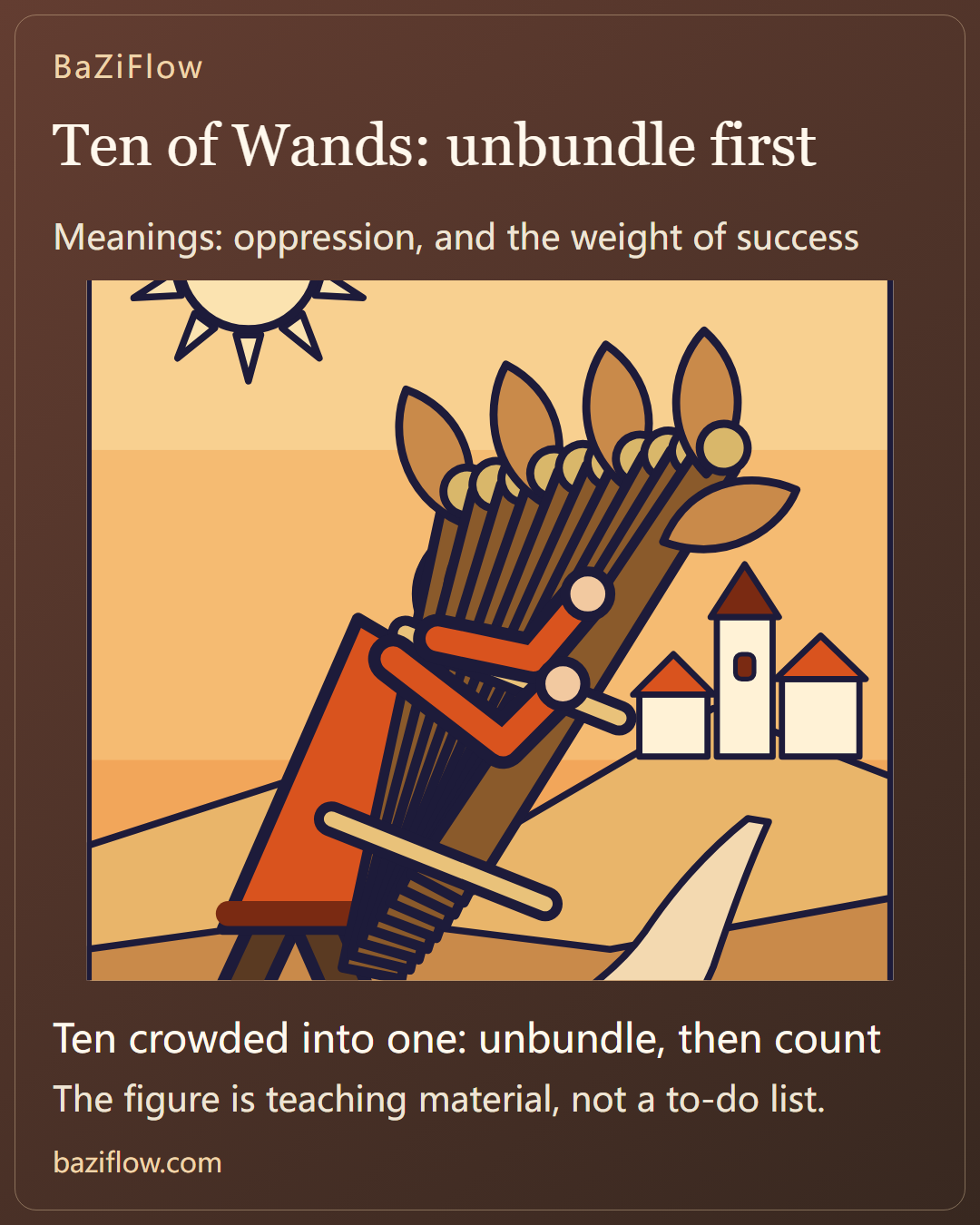
The Ten of Wands shows a figure bent under ten staves, walking toward a distant village. Read Waite's "oppression" and "the oppression of these things", then unbundle ten tasks from a one-week sale.
The short version8 min read
The Ten of Wands shows a figure with his back to us, ten staves gathered in his arms so that they hide his face. Waite gives the chief meaning as one word, oppression, and counts fortune and success among the things that press down.
- Waite gives the picture one sentence: a man oppressed by the weight of the ten staves he carries. The subject is the whole bundle, not any single staff.
- The word list has several lines side by side: oppression; fortune, gain, success and the oppression of these; disguise and perfidy; and a place that may suffer from the rods carried toward it.
- Reversed it is contrarieties, difficulties, intrigues; the additional list says difficulties and contradictions near a good card. In the text, a neighbor is a condition: the Nine of Swords following stultifies success.
Read first
Start with the picture: one back, ten staves crowded into one
Waite gives this card a single sentence of picture: a man oppressed by the weight of the ten staves which he is carrying.
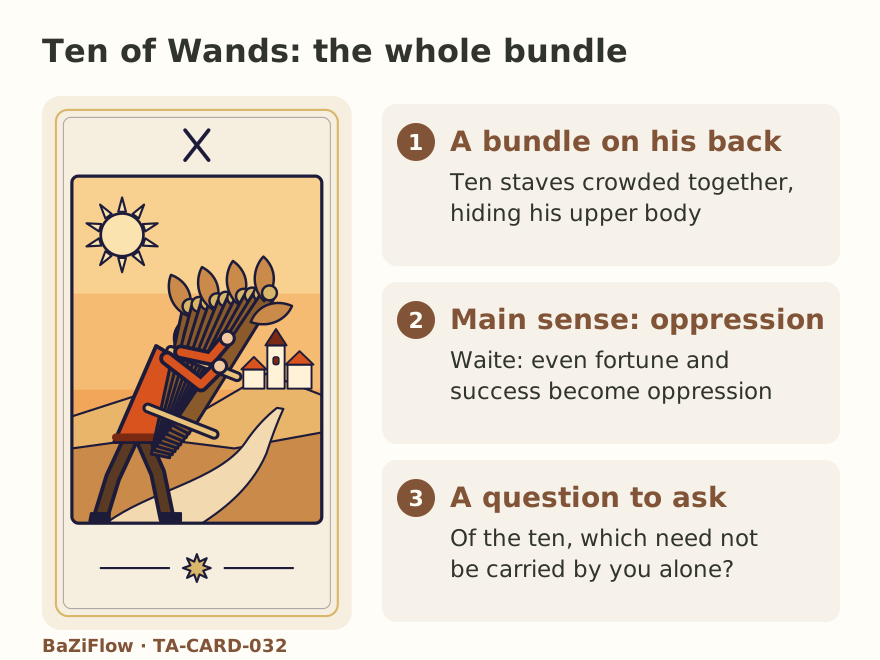
Ten of Wands: a figure under the bundle
On the Rider-Waite-Smith card the man has his back to us and is bent forward, walking to the right. His face is hidden behind the staves, with only a little hair showing. All ten are gathered in his arms, their tops fanned out with small leaves. Far off at the right there are a few houses and trees, and he walks on level ground. The picture comes apart into three layers: one person, one bundle, one place to go. The staves no longer stand one by one or swing in anyone's hand; they have become a single weight.
Enlarge diagram · scroll sideways to read
What Waite lists: oppression first, with fortune and success counted in
Waite begins by admitting that this is a card of many significances, some of which cannot be harmonized, and he sets aside the reading that connects it with honour and good faith. Then the list: the chief meaning is oppression simply, but it is also fortune, gain, any kind of success, and after those comes the oppression of these things.
A card of many significances, and some of the readings cannot be harmonized... The chief meaning is oppression simply, but it is also fortune, gain, any kind of success, and then it is the oppression of these things.
Enlarge diagram · scroll sideways to read
The list then changes line. It is also a card of false-seeming, disguise and perfidy, and the place the figure is approaching may suffer from the rods he carries. Two more sentences, about neighboring cards, come in the last section. These lines do not run into one another, so say which one you are quoting.
Bundle, back, distant houses: each with its own footing
The picture offers three points worth separating: the whole bundle, the hidden face and the houses far off at the right. Waite wrote the first, plus one sentence about "the place"; the face and the houses come from the Rider-Waite-Smith picture.
Bundle, back, destination: who said what
- The ten staves
- In this entry Waite writes only "the ten staves which he is carrying". Ten is a count of the staves and brings no further reading with it.
- The place approached
- The list says the place which the figure is approaching may suffer from the rods he carries, and does not say what the place is. The houses and trees at the right of the Rider-Waite-Smith card are the spot on the picture that fits; reading them as that place joins the picture to the sentence.
- The hidden face
- Waite does not mention the face. In the Rider-Waite-Smith card it is behind the staves, and modern teaching often reads that as "the load blocks the view", which is a borrowing.
Enlarge diagram · scroll sideways to read
The word "place" repays a second look. What Waite writes is that the one who may suffer is not the man under the load but the place he is heading for. That direction is exactly where the third question of the next section comes from.
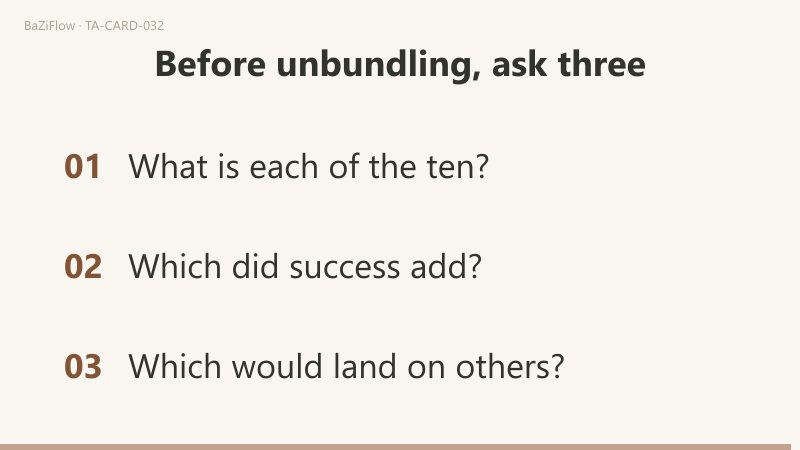
How to read it: unbundle the ten and ask "who carries this?" three times
When the Ten of Wands comes up, the easy jump is from "the whole bundle is heavy" to "this cannot be done", or to "I have to grit my teeth and carry it all". What the picture lets you take apart is precisely the bundle.
Unbundle: which ten are in it?
The picture shows one bundle and gives no way to count what each staff is. Write "too much lately" out as ten lines of concrete work, one verb to a line, with no "assorted odds and ends".
Weigh: which did success put there?
After fortune, gain and success Waite writes "the oppression of these things". Some of the weight comes from things going well: more orders, more inquiries. Mark those apart, so the source of the pressure is not mixed in with what mistakes caused.
Arrive: which would land on the place?
Waite has the place the figure approaches suffering from the rods. If you push the load through regardless, the ones affected are those who receive it. Ask which tasks, done in a rush, would hurt them.
An example: a small online tea shop runs a one-week anniversary sale. Orders are double the usual, and every job sits on the owner. Unbundle the load into ten and sort by who carries it:
Enlarge diagram · scroll sideways to read
With the ten laid apart, only three really have to be carried by the owner. Then comes the third question: of the four handed over, packing and labeling is the one done in the biggest hurry, and a mistake falls straight on the person who opens the box. When a part-timer takes it, writing the check steps as one line does more than saying "as fast as you can".
After unbundling
Now clear
- Every staff has a name
- Who carries it is on each line
Still in the bundle
- "All of it matters", in one breath
- Other people's jobs counted as mine
Add a line
- Write which three to set down
- Tell the people affected
Reversed and neighboring cards: contrarieties, intrigues, and a neighbor as a condition
Waite's reversed words are contrarieties, difficulties, intrigues and their analogies, in one line. The additional meanings are other readers: near a good card the Ten means difficulties and contradictions. Waite himself leaves neighbor conditions in the main entry: success is stultified if the Nine of Swords follows, and in a question about a lawsuit there will be certain loss.
Enlarge diagram · scroll sideways to read
Three neighbors, and which side of the bundle each stands on
One staff, held by a hand from a cloud
The other end of the same suit: Waite has a hand from a cloud grasping a stout wand, and the list is creation, beginning, source. One staff against ten.
The card Waite names
A figure seated on her couch in lamentation with swords above; the list includes failure, delay, deception, disappointment, despair. The Ten says that when it follows, success is stultified.
The next card: a staff back in one hand
A young man stands in the act of proclamation; the list has an envoy and a postman. The staff has gone from a load to a message.
Questions readers ask next
Is the Ten of Wands always a bad card?
Its chief meaning is oppression, but the next words are fortune, gain and every kind of success, which Waite says oppress in their turn, so the weight on the card does not have to come from bad news. Another line of the list speaks of disguise and perfidy, and Waite admits that some readings cannot be harmonized, so say which line you are quoting.
What does the Ten of Wands mean reversed?
Waite's reversed words are contrarieties, difficulties, intrigues and their analogies, in a single line. The additional list is other readers: near a good card it means difficulties and contradictions. The text never writes the reversal as the load growing lighter.
What does the village on the Ten of Wands stand for?
Waite's description of the picture mentions no village; in the word list he writes that the place the figure approaches may suffer from the rods he carries. The Rider-Waite-Smith card does show houses and trees at the right, and reading them as that place joins the picture to the sentence.
Was this article helpful?
Sources & references
Continue reading
Nine of Wands: a figure leaning on a staff, eight more standing like a palisade ↗