

Song: watch the start, and the end
Content version · · Sources & references
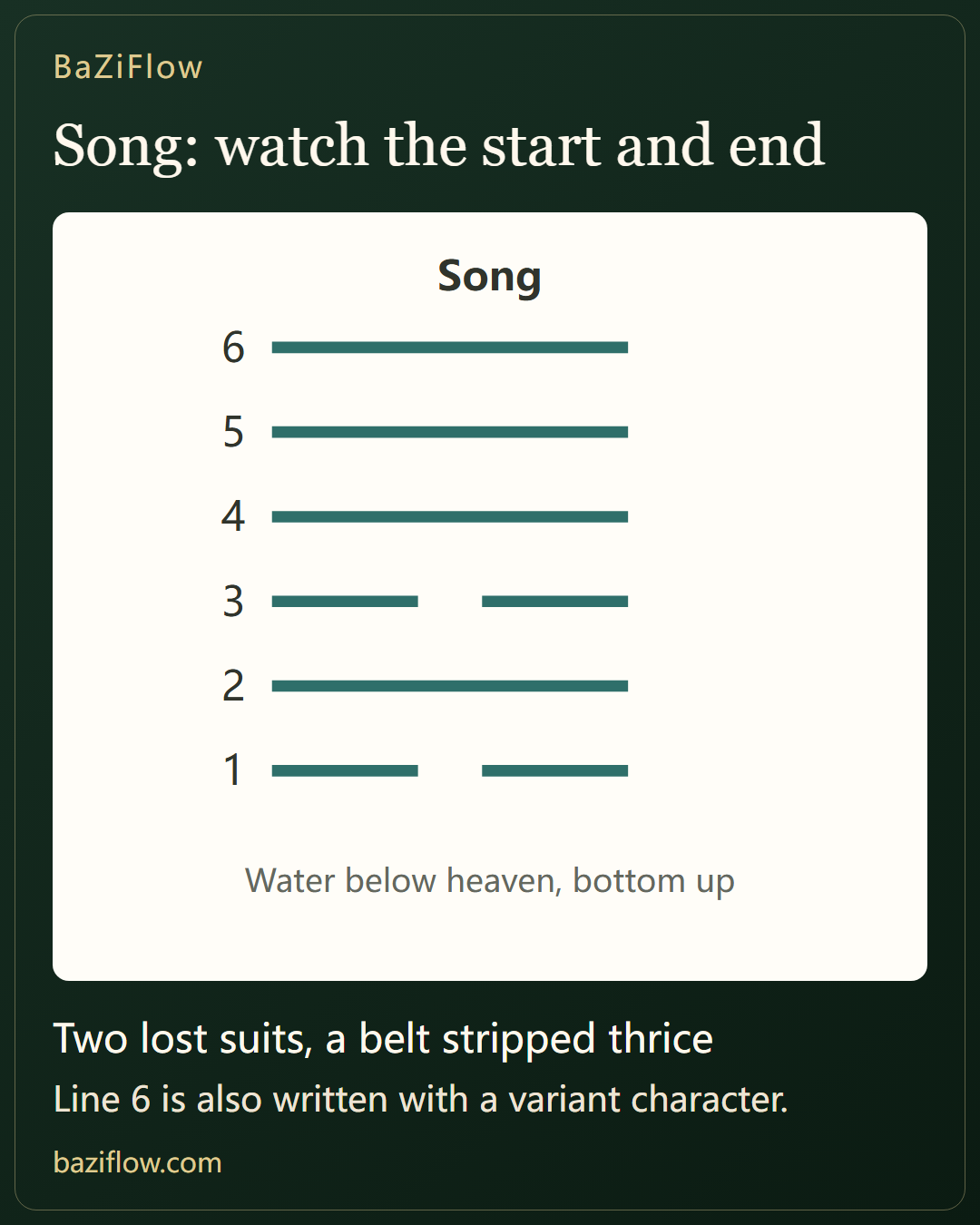
Song is the sixth of the 64 hexagrams, water below and heaven above, the same trigrams as Xu in swapped places. The judgment says "ominous at the end", the Great Image "plan the start", and two lines are unable to win.
The short version7 min read
The judgment and the Great Image of Song speak from opposite ends: the judgment looks at the outcome, "halfway good fortune, ominous at the end", and the Great Image at the beginning, "plan the start". The six lines show several ways a dispute can run from start to finish.
- Song puts water below heaven, and the Commentary on the Judgments says "above, the firm; below, danger; with danger, and strength: Song". It is the same pair of trigrams as Xu, with the places swapped.
- The judgment reads "halfway good fortune, ominous at the end" and the Great Image "plans the start". One looks at the outcome and one at the beginning; the Commentary on the Judgments reads "ominous at the end" as a suit that must not be carried through.
- The six lines are six ways a suit goes: not prolonged, "unable to win" twice, living on old virtue, "the suit: primal good fortune", and a gain that is stripped away.
Read first
The Sixty-Four Hexagrams: How Upper and Lower Trigrams Form One Figure ↗
Judgment and Line Statements: Whole Hexagram or Single Line? ↗
Strength above, danger below: heaven over water
Song (訟) is the sixth hexagram. Its upper trigram is heaven, three yang lines side by side; its lower trigram is water, a single yang line with a yin line on either side. The Shuo Gua calls the first strong and the second a pit, and the Commentary on the Judgments (彖传) joins the two words: "Song: above, the firm; below, danger. With danger, and strength: Song." Strength sits above and danger below, and that pairing is a suit.
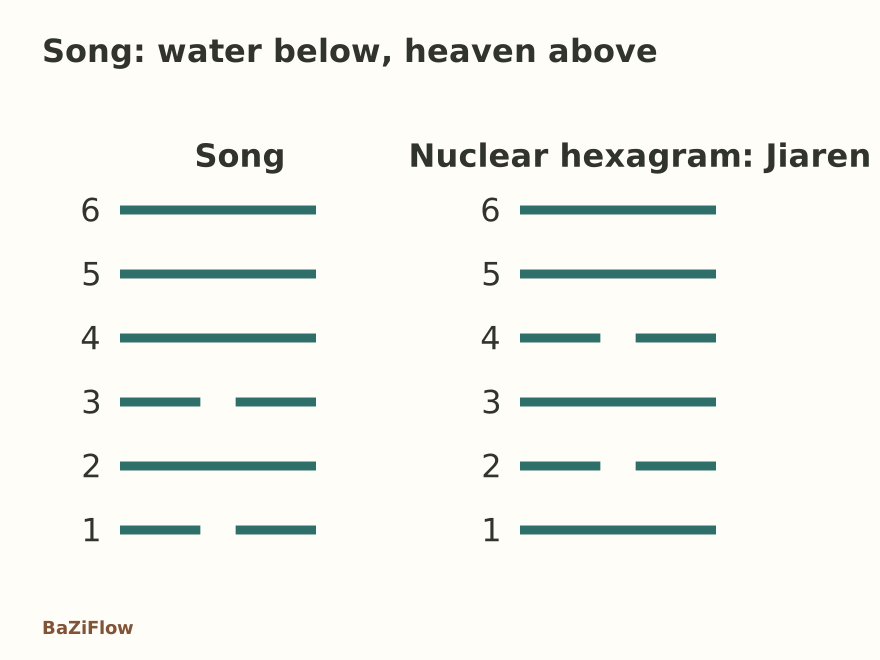
Song and its nuclear hexagram Jiaren: a nuclear hexagram restacks lines 2 to 5 of the original.
Enlarge diagram · scroll sideways to read
The previous hexagram, Xu (需), has the same two trigrams with their places swapped: heaven below and water above in Xu, water below and heaven above in Song. The Commentary on the Judgments of Xu says "danger lies ahead" and the Commentary on the Judgments of Song says "above, the firm; below, danger". The same two images, in swapped places, are described in different words.
The judgment: trust, blocked, wary, halfway good, ominous at the end
Song's judgment is longer than most, and it turns several times.
Having trust, but blocked; be wary. Halfway, good fortune; at the end, ominous. Fitting to see the great person; not fitting to cross the great river.
Having trust is being sincere, "blocked" is stopped up, and "wary" is staying alert: there is sincerity, but the road is blocked, so one must be careful. Then come two points on a timeline: halfway, good fortune; at the end, ominous. "Halfway good fortune" can be read as good in the middle of the course or as good when one holds the middle; the Commentary on the Judgments explains it as "the firm has come and found the center", placing the middle in line 2, the central seat of the lower trigram.
Enlarge diagram · scroll sideways to read
The Commentary on the Judgments explains "ominous at the end" as "a lawsuit must not be carried through", and "fitting to see the great person" as "it honors the central and upright". "Not fitting to cross the great river" is explained as "it would enter the abyss".
Heaven and water travel apart: the Great Image (大象) looks at the start
The Great Image for Song reads: "heaven and water travel in opposite directions: Song. The noble person plans the start when beginning any undertaking." Heaven is above and water below, and their courses run against each other, which is why it says "travel in opposite directions". The noble person acts by "planning the start": in beginning an undertaking, laying plans at the outset.
Enlarge diagram · scroll sideways to read
Side by side, the judgment fixes on the outcome, "ominous at the end", and the Great Image on the beginning, "plan the start". With one looking at the end and the other at the start, the six line statements are the several ways of going from the one to the other.
Unable to win, twice: how the six lines end
The six line statements of Song read like six ways a suit can go. "Unable to win the suit" occurs twice, in lines 2 and 4.
Enlarge diagram · scroll sideways to read
Line 1: "Not prolonging the matter. A little talk is heard; in the end, good fortune." The matter is not drawn out, a few words are exchanged, and it ends well. The Small Image says "a suit must not be long drawn out" and "the argument is made clear".
Line 2: "Unable to win the suit; goes home and flees. The three hundred households of his town have no mishap." He cannot win, goes home and hides, and the three hundred households of his town have no disaster. The Small Image says "he flees into hiding" and "suing the one above from below, trouble arrives, to be picked up", meaning it is picked up by oneself (for how above and below are counted, see line positions).
Line 3: "Living on old virtue. Steadfast, with danger; the end is good fortune." Then: "Perhaps serving the king's affairs, with no achievement." The Small Image says only "following the one above brings good fortune".
Line 4: "Unable to win the suit; returns and accepts the command, and changes. Settled in steadfastness: good fortune." Again he cannot win, but this time he comes back, accepts the order, changes his mind, and settles in steadfastness. In line 2 he flees home, and in line 4 he changes his mind: two defeats, two different ends.
Of the six lines only line 5 writes the suit itself with praise: "the suit: primal good fortune", and the Small Image says "because it is central and upright". Line 6: "Perhaps he is granted a leather belt; in the course of a morning it is stripped from him three times." The Small Image says "garments received through a suit are not worthy of respect either".
Now look for the word "end": the judgment has "ominous at the end", line 1 "the end is good fortune", line 3 "the end is good fortune", and line 6 "in the course of a morning". The same word sits in different places, with good fortune in some and misfortune in others.
Eating and drinking lead to disputes: from Xu to Song, then Shi
The Xu Gua strings Xu, Song and Shi into a chain: xu is the way of eating and drinking, eating and drinking will bring disputes, and a dispute will bring a crowd rising up, so what follows is Shi (師), "Shi means the multitude".
Enlarge diagram · scroll sideways to read
Xu and Song are the same two trigrams in swapped places, that is, each other's reversed hexagram. Their judgments take opposite attitudes to crossing the great river.
Enlarge diagram · scroll sideways to read
Xu says "fitting to cross the great river" and the Commentary on the Judgments gives "to go brings achievement"; Song says "not fitting to cross the great river" and the Commentary on the Judgments gives "it would enter the abyss". Song's inverse hexagram is Mingyi (明夷) and its nuclear hexagram is Jiaren (家人).
Questions readers ask next
Does "unable to win the suit" mean losing a lawsuit?
Literally it is not being able to win. Line 2 goes on with "goes home and flees", line 4 with "returns and accepts the command, and changes". The two ends differ, and the Small Image gives each a remark of its own.
Does "ominous at the end" mean a dispute always ends badly?
The judgment says "halfway good fortune, ominous at the end", and the Commentary on the Judgments explains it as a lawsuit that must not be carried through. In the lines, line 1 and line 3 say "the end is good fortune", lines 4 and 5 give good fortune, and line 6 has the stripping away three times, so the ends of the lines are not the same.
What is "a leather belt, stripped three times in the course of a morning"?
"Granted" is given as a gift, the belt is a leather belt, and "stripped" is taken away: perhaps a belt is granted and stripped off three times in the course of a morning. The Small Image says "garments received through a suit are not worthy of respect either", about what is won by a suit. The text does not say what the belt stands for.
Was this article helpful?
Sources & references
Continue reading
Xu: from "waiting in the outskirts" to "entering the cave", six places of waiting ↗
Shi: one yang line leading five yin lines, and who leads the army in each line ↗
The Sixty-Four Hexagrams: How Upper and Lower Trigrams Form One Figure ↗
Judgment and Line Statements: Whole Hexagram or Single Line? ↗