

The Friends palace: three names, kin on its axes
Content version · · Sources & references
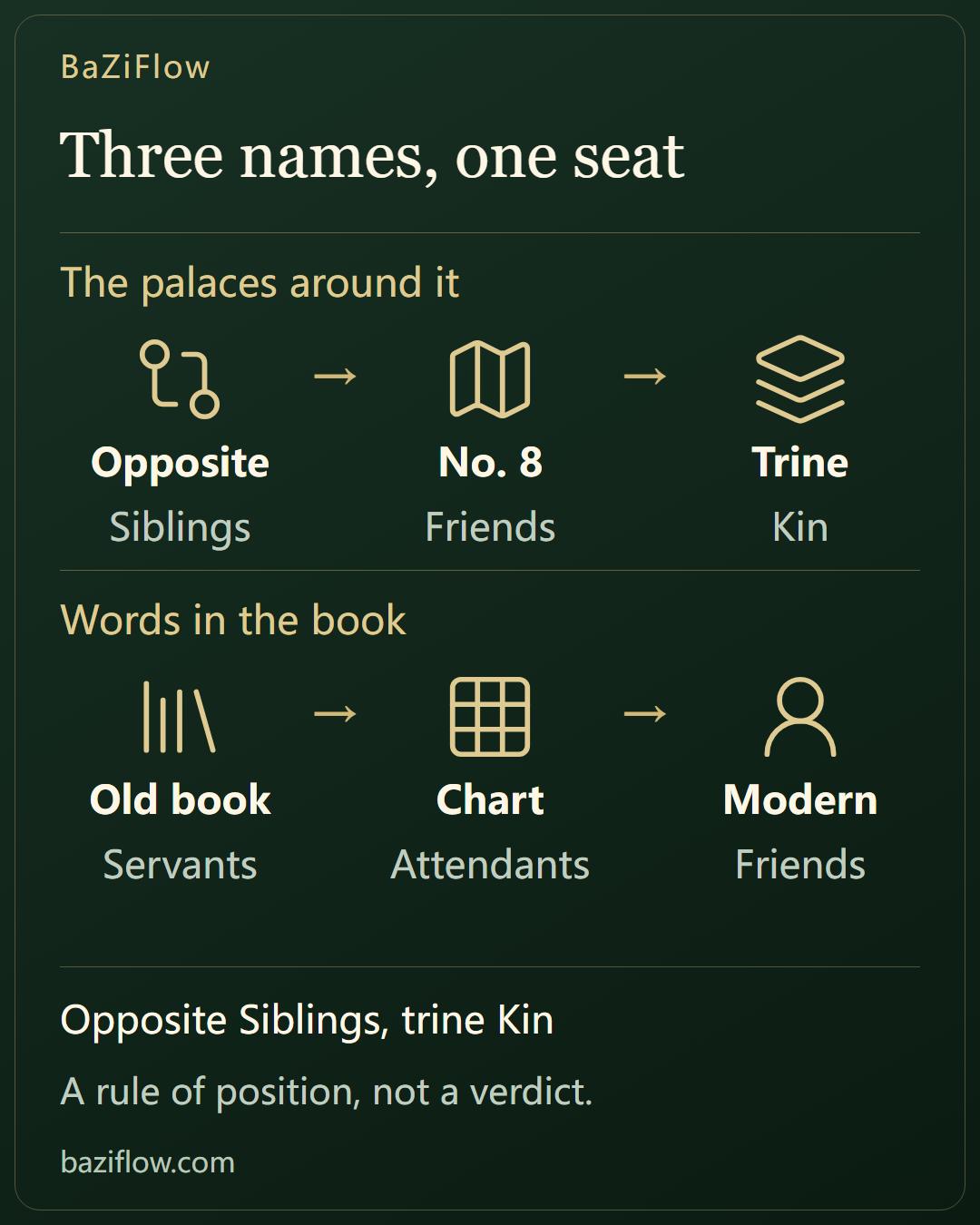
The Friends palace is the eighth of twelve, the servants palace in the old book. Work out its opposite and trine palaces, weigh the book's wording, and place it with the rule "six from Life is Tian Shang."
The short version6 min read
The Friends palace (交友宫) is the eighth of the twelve; the Zi Wei Dou Shu Quan Shu calls it the servants palace and chart software shows it as "attendants," and its opposite is the Siblings palace while its trine palaces are Children and Parents, so the three palaces on its axes are all family palaces.
- One seat has three names: "servants" in the Quan Shu, "attendants" on the software chart, "friends" in modern writing. All three mean the same no. 8.
- Position facts: the opposite palace is Siblings (no. 2), the trine palaces are Children (no. 4) and Parents (no. 12), and the two neighbors are Travel and Career.
- The servants entry in juan 2 has 24 paragraphs: "capable" 16 times, "turns on the master" 12, "lacks effort" 11, "resents the master" 7. It writes the palace as master and servant, in the terms of its day.
Read first
One seat, three names
The Friends palace is the eighth of the twelve, and the sources you will open give this one seat three different names.
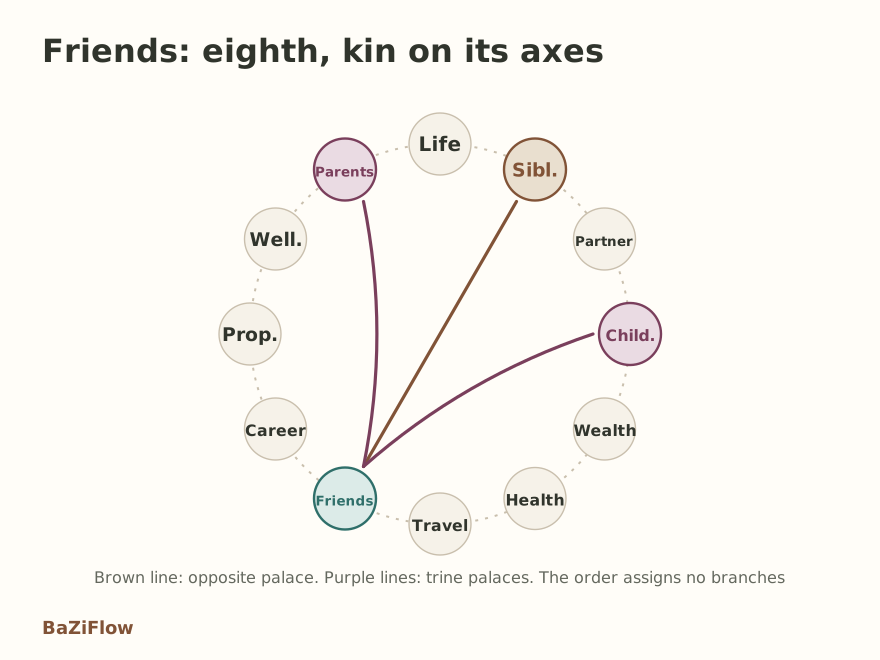
Around Friends (green): Siblings across (brown), Children and Parents on the trine (purple), all kin palaces; the neighbors Travel and Career stay outside the set.
The Zi Wei Dou Shu Quan Shu (紫微斗数全书) lists this seat in its palace order as "the eighth, servants," the iztro chart software prints "attendants" on its charts, modern articles mostly write "friends," and this site's chart pages say "Friends palace." The seat is identical; the words differ by era, and the meaning shifted with them. A servant is someone who waits on a master, "attendant" is a milder word for the same thing, and "friends" describes dealings between equals.
The picture marks the four directions of this palace: the Siblings palace at no. 2 is directly across, and the Children palace at no. 4 and the Parents palace at no. 12 sit four places away on either side.
No outsider among the four directions
The four directions of the Friends palace are the palace itself plus three others: one opposite and two trine. Lay them out and a curious pattern shows:
Enlarge diagram · scroll sideways to read
The four directions of Friends (the opposite palace and the two trine ones) are Siblings, Children and Parents, which is to say kin, while the two palaces right beside it are Travel and Career, which are about going out and work. This is a fact of position that comes from the palace order, and the book draws no verdict from it. Its use is to keep "other people" from being lumped together: a different kind of person calls for a different palace.
The book's ledger of master and servant
Servants is the eighth entry in the book's palace-by-palace listing. Its 24 paragraphs each name a star and then say whether that star brings people to the palace and whether they pull their weight. Four words recur most:
Enlarge diagram · scroll sideways to read
Together these words make a ledger of master and servant. "Capable" and "lacks effort" ask whether someone pulls their weight; "turns on the master" and "resents the master" ask whether they will leave or hold a grudge. The entries also use "a call, a hundred answers" (4 times) and "runs off" (8 times in two forms). The Quan Shu describes Po Jun (破军) in this system as the star that governs "spouse, offspring and servants," and juan 1 says so outright.
This vocabulary has a social background: it writes the palace as the household's servants. This site's reading does not carry that frame over, taking the palace as friends, colleagues and cooperation. When quoting the book you can keep literal words such as "capable" and "lacks effort," as long as the object is replaced with today's relationships.
Tian Shang lands in this palace
The Friends palace has a very clean placement rule, from the star-placement verse of the same volume:
Six places before Life is Tian Shang; six places after Life, Tian Shi is placed.
In counting, the book treats the Life palace as the first place. Counting backward along the palace order, Life, Parents, Wellbeing, Property, Career and Friends make six, so Tian Shang lands in Friends; counting forward, Life, Siblings, Partner, Children, Wealth and Health make six, so Tian Shi lands in Health. The iztro output for four charts with different birthdays agrees: Tian Shang is always in Friends and Tian Shi always in Health.
Enlarge diagram · scroll sideways to read
So "Tian Shang in the Friends palace" is a fact common to every chart and sets one reader apart from no other. How Tian Shang is read depends on what the book and the school say about this minor star, and is not to be read off the word "harm" in its name. How the neighboring Travel palace sits between Tian Shi and Tian Shang is covered in its own article.
Keeping the "others" apart: siblings, partner, friends
The Siblings, Partner and Friends palaces all concern other people, but each sits in its own place and reads a different relationship:
Enlarge diagram · scroll sideways to read
Siblings and Friends are opposite palaces, directly across from one another, so they are often consulted together: peers by blood and peers by relationship look at each other on the chart. The Partner palace lies to one side of Friends and is not opposite, and the fact that both concern other people is no reason to merge them.
Ask which kind of "other" first
Siblings, partner, friends and business associates each have their own entry, so do not begin with "do people like me."
Then look at the four directions
The opposite palace of Friends is Siblings and the trine palaces are Children and Parents; record them on the same page as the home palace.
Name the term when quoting
"Servants," "capable" and "turns on the master" are the book's own words; present-day relationships need the matching modern wording.
Try two sums
Life is on Rat. On which branch is Friends, and where are its opposite and trine palaces?
Friends is on Snake. The branches run backward along the palace order: opposite Siblings is on Pig, trine Children on Rooster and Parents on Ox, each four places from the next.
Tian Shang is in Friends. Does that mean this person's relationships have a problem?
No. Tian Shang's position is fixed in the Friends palace on every chart, so it marks no personal difference.
After this palace, read its neighbors Travel and Career and the opposite palace Siblings. How four directions are taken is in the three sides and four directions; the division of labor among all twelve is in the twelve-palace overview.
Questions readers ask next
Does the Friends palace simply say how many friends I have?
It is not a head count. This site reads it as friends, colleagues and cooperation, while the book's original word is servants and its entries ask who pulls weight and who is dependent. Ask which kind of relationship you mean, then read this palace's stars and surroundings; there is no line about "many friends" to look up.
Why is the opposite palace Siblings and not Partner?
The opposite palace is the one six places away. Friends is no. 8, and six places on is no. 2, the Siblings palace. The Partner palace is no. 3, on the other side, five places away, so it is not opposite. All three concern other people, but each has its own seat on the chart.
Tian Shang sits in the Friends palace. Does that mean someone wants to harm me?
Tian Shang is a minor star that the placement rule fixes in the Friends palace on every chart, regardless of birth year. Here it is only a fact of position. How to read it depends on what the book and the chosen school say about it, and cannot be derived from the two characters of its name.
Was this article helpful?
Sources & references
Continue reading
The Travel Palace in Zi Wei Dou Shu: Across from Life, and the Book's "Going Out" ↗
The Career Palace in Zi Wei Dou Shu: What "Office" Meant in the Book, and Today ↗