

Yang Blade: one step past Emolument
Content version · · Sources & references
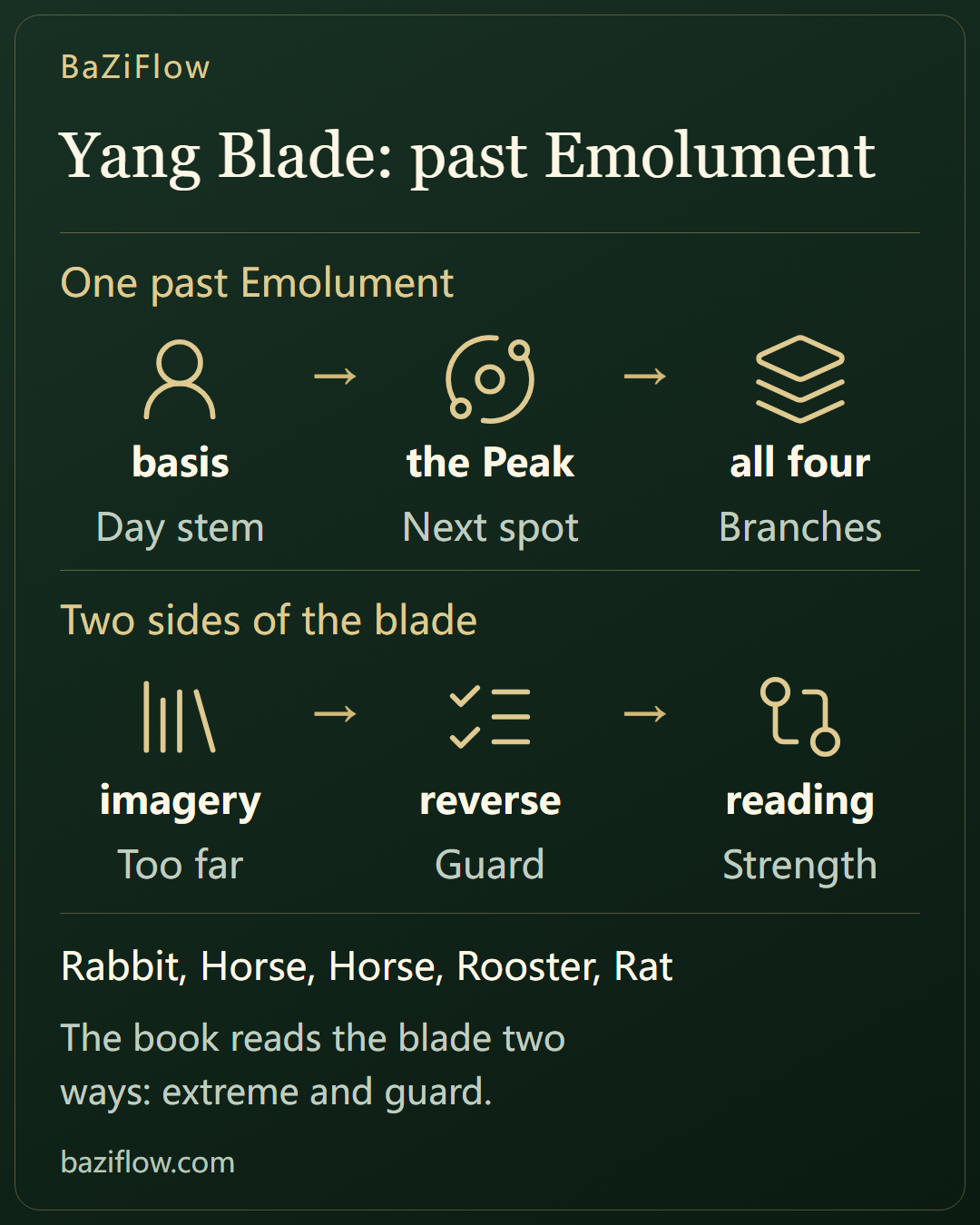
The Yang Blade starts from the day stem and exists only for the five Yang stems, on the branch right after Emolument. A table, two charts and the Sanming Tonghui on the blade, the Yin stems and the Day Blade.
The short version9 min read
The basis of the Yang Blade is the day stem: it gives one branch to each of the five Yang stems, one place after that stem's Emolument, and looks for it among the branches of all four pillars.
- Yang Wood gets Rabbit, Yang Fire and Yang Earth get Horse, Yang Metal gets Rooster, Yang Water gets Rat. Each blade is the next branch after the stem's Emolument and also its Peak; the five Yin stems are not looked up.
- All four branches are read, the day pillar's own branch included, so the day pillars Yang Fire Horse (丙午), Yang Earth Horse (戊午) and Yang Water Rat (壬子) carry the blade themselves, which matches the book's "only three Day Blade days".
- The Sanming Tonghui pictures the blade as Emolument pushed to its limit and also as its bodyguard, and reads it differently by the strength of the day master; the "cooling-off night" line is a modern tip of the site.
Read first
Symbolic Stars in BaZi: Check the Reference and Rule Before the Meaning ↗
Only five Yang stems have one, and it sits past Emolument
The Yang Blade (阳刃) gives a branch to five stems only: Yang Wood, Yang Fire, Yang Earth, Yang Metal and Yang Water get one each, and the five Yin stems are not looked up.
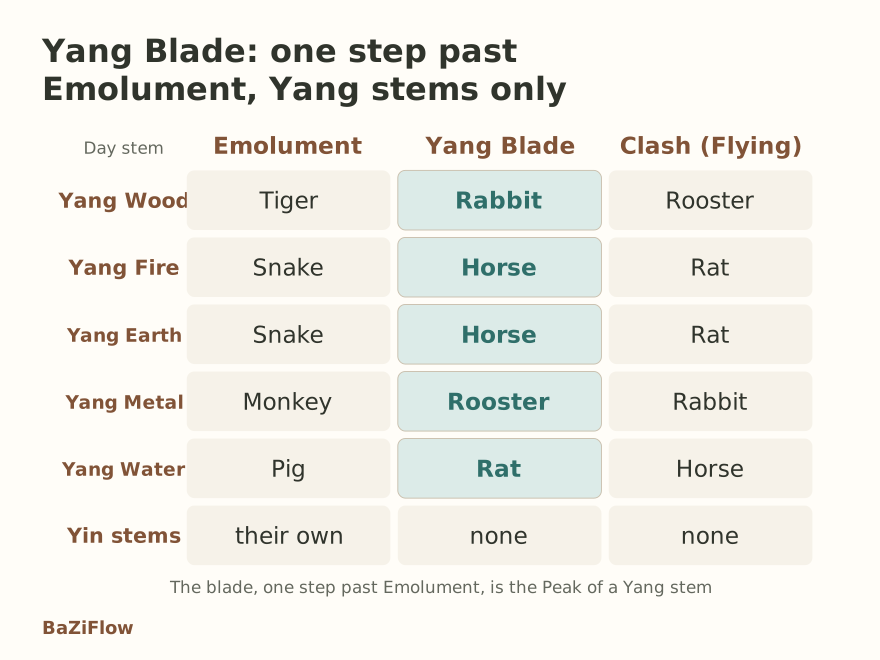
Sketch: the Emolument, Yang Blade and clash branch of each Yang stem, taken from the site engine and checked row by row against the twelve-stage table; the blade column is also each stem's Peak.
Each Yang stem has one row in the picture. On the left is its Emolument (禄), which is the Establishment stage of the twelve life stages; in the middle is the Yang Blade; on the right is the clash of the blade, which the book calls the Flying Blade (飞刃). The site's look-up does not use that last column, and it is shown here for comparison. The blade always stands one branch after Emolument: Yang Wood has Emolument on Tiger and its blade on Rabbit, Yang Fire and Yang Earth have Emolument on Snake and the blade on Horse, Yang Metal has Monkey and Rooster, Yang Water has Pig and Rat.
The search reads the branches of all four pillars, and the day pillar's own branch counts. The Traveling Horse, Peach Blossom, Canopy Star and General Star all start from the day branch and leave the day pillar out, which is where the blade differs from them.
The imagery: Emolument carried too far becomes a blade
Juan 3 of the Sanming Tonghui (三命通会) has a section headed "On the Yang Blade" (论羊刃), written there with the character for "sheep". It opens by quoting a text it calls Sanche (三车) to explain the name: "sheep" stands for hardness and "blade" for cutting. When Emolument is pushed to its end a blade is born, and the work that should now step back does not, so it overreaches, like a sheep standing on the cutting edge, where harm is implied. That is why the sheep blade sits one branch ahead of Emolument, and why the position across from it is called the Flying Blade.
The section then quotes Xi Yin, who makes the idea of an "extreme" very concrete:
In the way of yin and yang and all things, the fullest height is what they dislike. At the extreme, fire scorches out, water surges and runs dry, metal snaps, earth crumbles and wood is broken.
Xi Yin concludes that while strength has not yet peaked it is mild and comfortable, which is why the place behind the blade is Emolument; once it has reached the extreme it turns hard and ill-matched. The same section quotes Hu Zhong Zi, "everyone who has Emolument is given a blade to guard it", which sees the blade as the bodyguard of Emolument. Read together, the blade is both the extreme and the guard.
Enlarge diagram · scroll sideways to read
Why the Yin stems have none: two passages, juan 3 and juan 5
The same section calls the place of fullest strength the proper place of the ten stems, then lists those "proper positions", the extreme points, stem by stem: Rabbit belongs to Yang Wood, Horse to Yang Fire, Rooster to Yang Metal and Rat to Yang Water. On the Yin side it gives Dragon to Yin Wood, Goat to Yin Fire, Dog to Yin Metal and Ox to Yin Water, and says nothing separate about Yang Earth and Yin Earth. Push "the place after Emolument" onto the four Yin stems and you arrive at exactly these four branches.
Enlarge diagram · scroll sideways to read
The juan 3 section itself closes by citing the Ziping view that only the five Yang stems have a blade, and sends the reader ahead to the chapter on the Yang Blade. That chapter, in juan 5 (论阳刃), states the name and the range at its start:
"Yang" is the yang of yin and yang, "blade" is the blade of a knife; it is the place one ahead of Emolument, a strength that overreaches and so is perilous. ... Only the five Yang stems, Yang Wood, Yang Fire, Yang Earth, Yang Metal and Yang Water, have a blade; the five Yin stems have none, hence the name Yang Blade.
The "yang" in the name is the yang of yin and yang, and has nothing to do with the sheep, so only five stems qualify. The site uses exactly this name and this range. For Yin stems the book adds a line: meeting Hurting Officer brings the same trouble as a blade, and "Yin Wood meeting Yang Fire is also called a blade". That is a route through the stems, and the site does not have it.
Two charts looked up, then three day pillars counted
The look-up takes three steps: take the day stem, find its blade in the table, then see whether that branch appears among the four.
Enlarge diagram · scroll sideways to read
In chart one the day pillar is Yang Water Rat (壬子), and its day branch Rat is exactly the blade of Yang Water, so the year pillar and the day pillar each hold one. The Horse in the hour pillar is the clash of Rat, the Flying Blade of the book, and the site does not mark it. Chart two has only the month pillar's Rooster. In a chart with a Yin Wood day master, even three Rabbits among the year, month and hour would show no Yang Blade, because Yin Wood is not among the five Yang stems.
The book has ready-made numbers for the case where the day pillar carries the blade: "Day Blades are only three days: Yang Earth Horse (戊午), Yang Fire Horse (丙午) and Yang Water Rat (壬子)." Among the sixty pillars a Yang stem is only ever paired with a Yang branch, and the blade is the day branch itself on just these three. Yang Wood over Rabbit and Yang Metal over Rooster cannot exist, since the stem and branch differ in polarity. The site's look-up and the days counted by the book are the same set.
Three kinds of blade in the book, and a two-sided reading by strength
The book sorts the Yang Blade into three kinds, and the site looks up only one of them:
Three kinds of blade in the book
Yang Wood meets Yin Wood
The blade shows in the stems: a Yin stem of the same element shares the wealth. The book says it does not suit Wealth-Officer patterns.
Yang Wood meets Rabbit
The blade shows in the branches, which is the kind the site looks up. The book says it suits the return-to-Emolument pattern well.
Yin Wood and Yang Fire
The book gives Yin Wood and Yang Fire as its example, and an earlier line says Yin Wood meeting Yang Fire (Hurting Officer) also counts as a blade. The book says it suits "drop the Officer, keep the Killing" charts.
In reading a blade, the book first asks how strong the day master is. When the day stem has no strength, a Yang Blade is said to be "not bad", because it shares the wealth and props the self up; for a strong day master it is disliked as a plunderer. The book itself concludes "each has its own reasoning", so one blade has two readings. Position carries weight too: a blade in the year or hour pillar counts as heavier than one in the month or day pillar. For how strength is judged, see strong and weak day masters.
The next shensha that also starts from the day stem is the Red Charm.
Questions readers ask next
My day master is a Yin stem. Does that mean there is no "blade" question for me?
The site looks up the Yang Blade for the five Yang stems only, so a Yin day master never shows one. The book adds one line for Yin stems: meeting Hurting Officer brings the same trouble as a blade, so it is also called one. That is a stem-based route the site does not have, so nothing appears on the page.
My day pillar is Yang Fire Horse (丙午). Is the blade sitting on me?
Yes. The Yang Blade of Yang Fire is Horse and the day branch is Horse, so the site marks one blade on the day pillar, which is a fact about position. The book calls this a Day Blade (日刃) and counts three such days: Yang Fire Horse, Yang Earth Horse and Yang Water Rat. What it does in your chart depends on the whole chart.
The blade is "one place before Emolument" and also called Peak. Do the two readings clash?
No. In the twelve life stages the Establishment stage, which is Emolument, is followed at once by Peak, so "one place ahead of Emolument" and "the Peak spot" land on the same branch: Rabbit for Yang Wood, Horse for Yang Fire and Yang Earth, Rooster for Yang Metal, Rat for Yang Water.
Was this article helpful?
Sources & references
Continue reading
General Star: the Middle Branch of a Three Harmony Group ↗
Red Charm (红艳): Ten Day Stems on Eight Branches, and Two Cells That Differ From the Book ↗