

Sheng: from “allowed to rise” to “rising in darkness”
Content version · · Sources & references
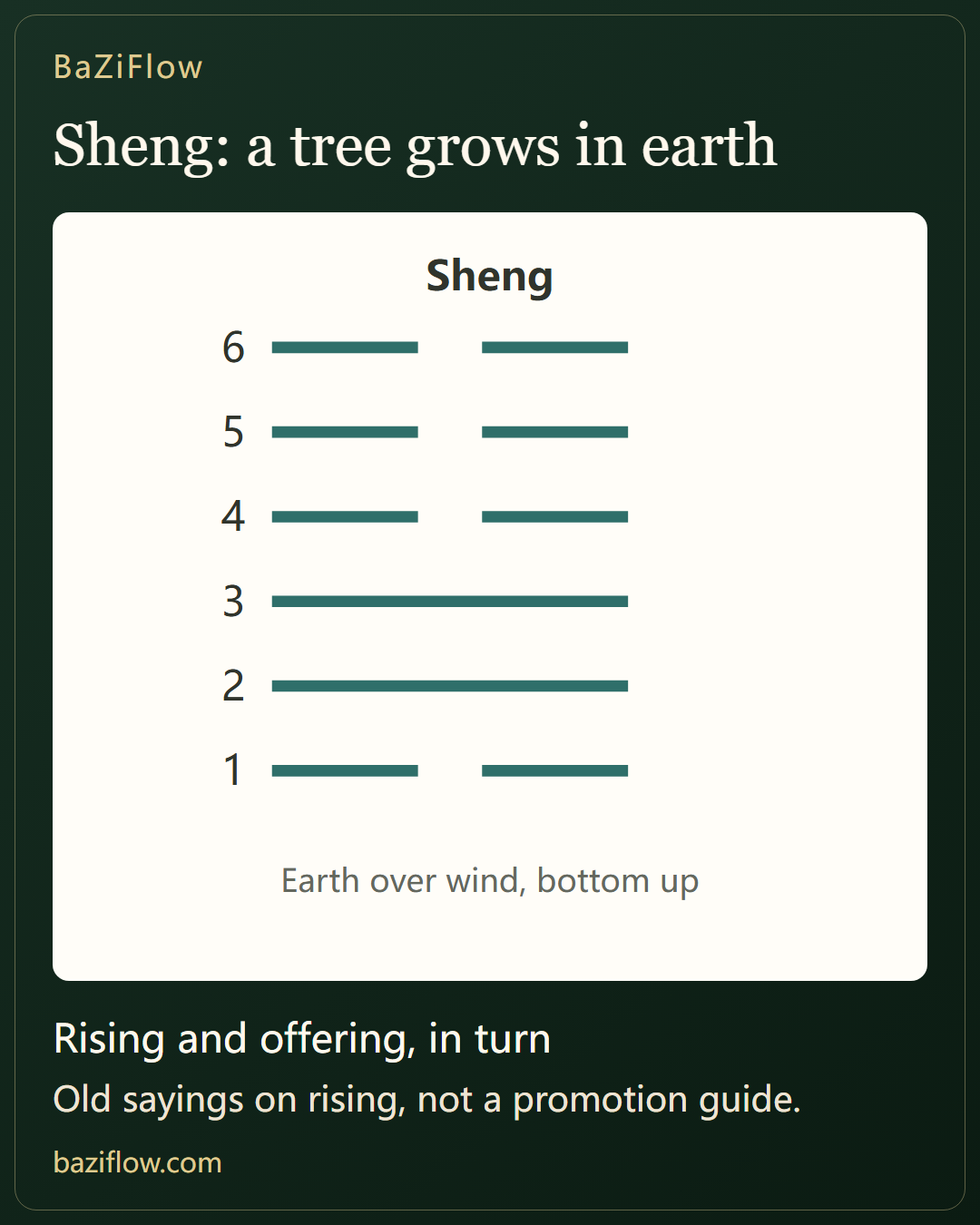
Sheng is the 46th hexagram: Kun (earth) above Xun (wind, wood). Read the Commentary’s soft words, the Image’s “pile up the small”, and six lines where rising and offering take turns up to “rising in darkness”.
The short version7 min read
In Sheng the word “rise” stands in lines 1, 3, 5 and 6, while lines 2 and 4 speak of offerings. One step up, one offering, and at the top it becomes “rising in darkness”, followed by “unceasing steadfastness”.
- Sheng puts Kun (earth) over Xun (wind, wood). In the Shuo Gua Xun stands for wood and for height, which is why the Great Image says a tree grows inside the earth.
- The Commentary describes rising almost entirely in soft words: the yielding rises with the time, entering and compliant; only “the firm at the center and answered” is hard. The Great Image adds the method: pile up the small to become high and great.
- Lines 1, 3, 5 and 6 speak of rising and lines 2 and 4 of offering. The Small Image on line 6 says “ebbing, not enriched”, and the Xu Gua says that rising without stopping must end in Kun (困), exhaustion.
Read first
The Sixty-Four Hexagrams: How Upper and Lower Trigrams Form One Figure ↗
Judgment and Line Statements: Whole Hexagram or Single Line? ↗
A tree inside the earth: Xun below, Kun above
Start with the figure: a yin line at the bottom, two yang lines over it, then three broken yin lines. The lower three are Xun, the upper three Kun. In the Shuo Gua the images of Xun include wood and also height, and Kun is the earth. This is Sheng (升). Wood inside the earth, growing upward: the figure matches the Great Image, “a tree grows inside the earth”, exactly.
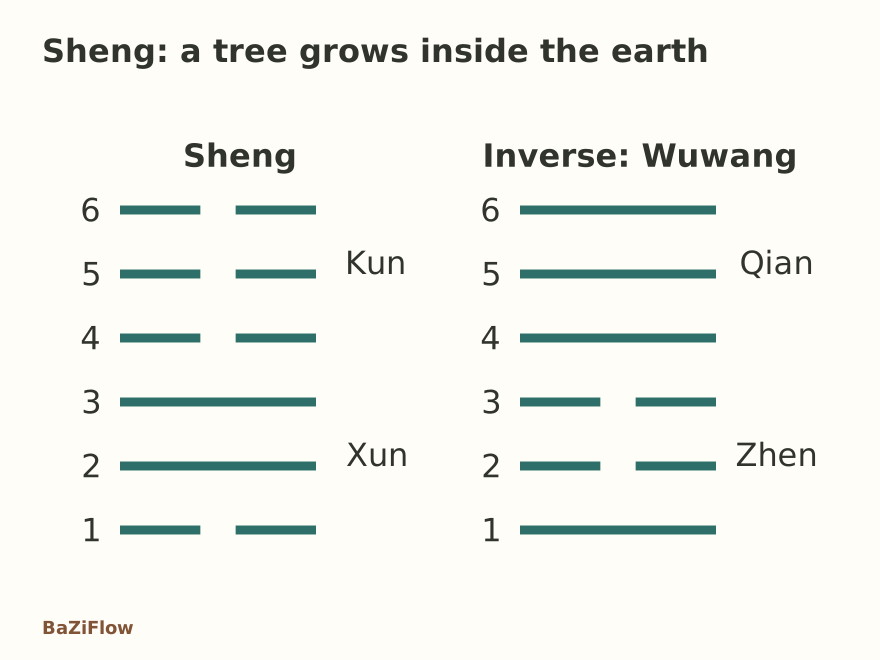
Sheng and its inverse Wuwang: the inverse changes every line to the opposite polarity, so the three yin lines of Sheng all become yang.
Enlarge diagram · scroll sideways to read
Three words in Sheng
- Sheng
- To climb, to go up to a high place. The Xu Gua puts it after gathering: what has gathered in one place and keeps going upward is Sheng.
- Campaign south
- The judgment ends “a southern campaign brings good fortune”. Literally it is a march or journey to the south; “south” is just a direction, and the text explains nothing more.
- Darkness
- In “rising in darkness” at the top line, the first word means dim: a rise made in the dark.
The judgment and the Commentary: rising told in soft words
The judgment of Sheng reads: primal success; fitting to meet a great person; do not worry; a southern campaign is fortunate. The Commentary on the Judgments splits this into conditions and results.
The yielding rises as the time allows. Entering and compliant, with the firm keeping to the center and finding an answer: this is why success is great. “Fitting to meet a great person; do not worry” means there is something to celebrate. “A southern campaign is fortunate” means the will gets carried out.
Enlarge diagram · scroll sideways to read
Of the three conditions, the yielding, entering and compliant ones are all soft words: the yielding is the yin line, entering is the word for Xun, and compliance is the image of Kun. Only the clause about the firm holding the center is hard, meaning that line 2 stands in the middle of the lower trigram and line 5 above answers it. The Commentary uses no word like “struggle” or “charge” for rising: it speaks of rising with the time.
The three results each answer one clause of the judgment: “great success” answers “primal success”, “celebration” answers “fitting to meet a great person; do not worry”, and “the will is carried out” answers the southern campaign.
The Great Image: a tree in the earth, piling up the small
The Great Image (大象) of Sheng reads: inside the earth a tree grows, Sheng; the noble person follows virtue and piles up the small to become high and great.
Enlarge diagram · scroll sideways to read
The word for “follows” in “follows virtue” is traditionally read as “complies with, goes along with”, and the sentence means acting in accord with virtue. The second phrase gives the method: pile up the small bit by bit until it becomes high and great. The Commentary says “the yielding rises with the time” and the Image says “pile up the small”: the two can be read together, one about following the time, the other about piling up little by little.
Six lines: rising and offering, by turns
Put the verbs of the six statements side by side and a neat rhythm shows. Line 1 speaks of rising, line 2 of an offering, line 3 of rising, line 4 of an offering, line 5 of rising, and line 6 again of rising.
Enlarge diagram · scroll sideways to read
Line 1: “allowed to rise: great good fortune”. The first word means trusted or agreed, so this line, at the bottom, rises with consent. The Small Image says “above, wills agree”, and one way to read it off the figure: the three lines above are yin as well, of the same kind, and their wills match.
Line 2: “where there is sincerity, a modest spring offering will serve; no blame”. Cui has this same clause in its line 2. The Small Image remarks: there is joy.
Line 3: “rising into an empty city”. One may read it off the figure: above line 3 are the three broken yin lines of Kun, like an empty town with nothing standing in the way. The Small Image says “nothing to doubt”.
Line 4: “the king offers at Mount Qi: good fortune, no blame”. Mount Qi is a place where the Zhou people were active early on. The Small Image says it is a matter of yielding: doing things as they come.
Line 5: “steadfastness brings good fortune; climb the steps”. Steps are taken one at a time, and for this line the Small Image calls it a will greatly met.
Line 6: “rising in darkness; fitting for unceasing steadfastness”. The Small Image comments: rising in darkness at the top, ebbing, not enriched. “Ebbing” is traditionally read as being used up, and “not enriched” as no longer gaining. At the end of the climb the next step is no further up; what carries the line is steadfastness that does not stop.
Cui, Wuwang and Guimei: what stands beside Sheng, and its place in the order
Turn Sheng upside down and you get Cui (萃), so Cui is its reversed hexagram (综卦), with the three yin lines back at the bottom. The inverse hexagram (错卦) is Wuwang (无妄), which swaps every line of Sheng. The nuclear hexagram (互卦) is Guimei (归妹): lines 2 to 4 of Sheng are yang, yang, yin, which make Dui; lines 3 to 5 are yang, yin, yin, which make Zhen; Dui under Zhen is Guimei.
Enlarge diagram · scroll sideways to read
Read the Great Images of Cui and Sheng together: one is “a lake above the earth”, water lying on the ground, and the other is “a tree grows inside the earth”. In each the three yin lines are the earth, one holding things up from below and the other covering them from above. The Xu Gua joins them: what has gathered then goes upward, and that is Sheng. After Sheng it says that rising without stopping must end in Kun (困), exhaustion. Yet line 6 of Sheng itself speaks of “unceasing steadfastness”: one text is about a steadfastness that does not stop, the other about a rise that does not stop. The two “not stopping” are worth reading side by side.
Questions readers ask next
Is Sheng about promotion and climbing the ladder?
In the text, “rising” is climbing to a place, and each of these rises is different: allowed to rise, into an empty city, up the steps, in the dark. The Commentary says “the yielding rises with the time” and the Great Image has a tree growing and the small piled high. Neither sounds like a scramble for position.
How should “rising in darkness; fitting for unceasing steadfastness” be read?
The first word means dim or dark, so literally it is a rise made in the dark; “unceasing steadfastness” is staying on course without stopping. Tradition usually takes it to mean that even at the top one has to hold on. The Small Image sets the tone for the line: at the end of the rise there is nothing more to gain.
How are Sheng and Cui related?
They are each other’s reversed hexagram: turn Cui over and you have Sheng. In Cui a lake sits above the earth, in Sheng a tree grows inside it. The Xu Gua says that what has gathered then goes upward. A single clause turns up in both: “where there is sincerity, a modest offering will serve”.
Was this article helpful?
Sources & references
Continue reading
Cui: a lake above the earth, from confusion to guarding against the unforeseen ↗
Kun (困): a lake with no water, from “stuck on a stump” to “stuck in vines” ↗
The Sixty-Four Hexagrams: How Upper and Lower Trigrams Form One Figure ↗
Judgment and Line Statements: Whole Hexagram or Single Line? ↗