

The Star: two ewers, water and land
Content version · · Sources & references
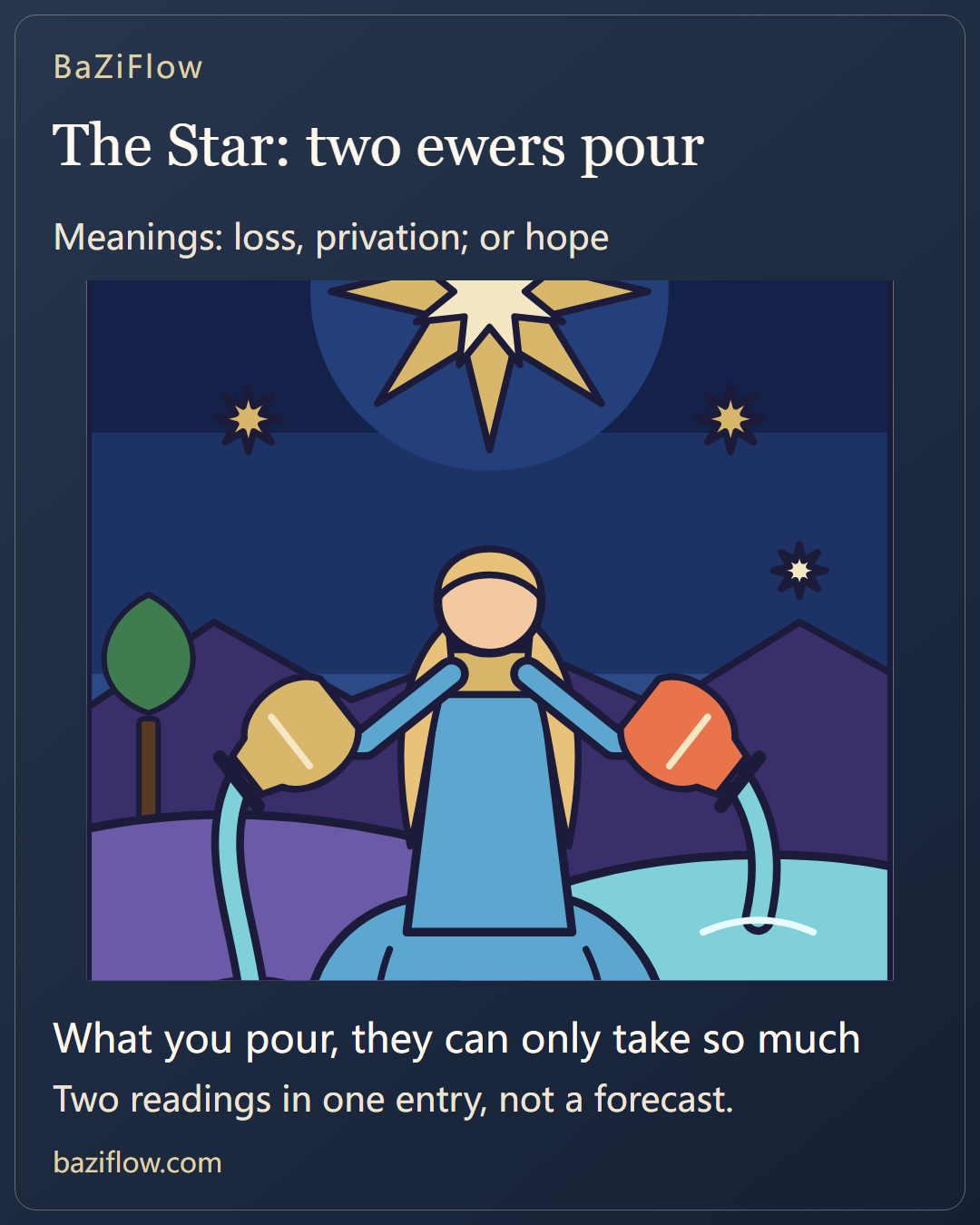
The Star shows a naked woman at the water’s edge pouring from two ewers under a great eight-rayed star. Separate the picture, the two readings in the list and Waite’s Kabalistic gloss, then plan a camp’s water.
The short version7 min read
The Star holds a great star, seven lesser ones and a woman pouring two ewers onto water and land. Waite’s list gives two directions in a single entry: loss, and hope.
- The picture: a star of eight rays ringed by seven lesser stars, also of eight rays; a naked woman with her left knee on land and right foot on water, pouring the Water of Life from two great ewers to irrigate sea and land.
- The list opens with loss, theft, privation, abandonment, then says “another reading”: hope and bright prospects. Reversed: arrogance, haughtiness, impotence.
- In Part II Waite calls “a card of hope” the summary of several tawdry explanations; his own gloss runs to Truth unveiled and, in the Kabalah, supernal Understanding.
Read first
One star, seven lesser stars, two ewers: the picture in three layers
Waite describes the Star in more detail than most cards. A great, radiant star of eight rays, surrounded by seven lesser stars, also of eight rays. The female figure in the foreground is entirely naked, her left knee on the land and her right foot upon the water, and she pours the Water of Life from two great ewers, irrigating sea and land. Behind her is rising ground, and on the right a shrub or tree on which a bird alights. He says the figure expresses eternal youth and beauty.
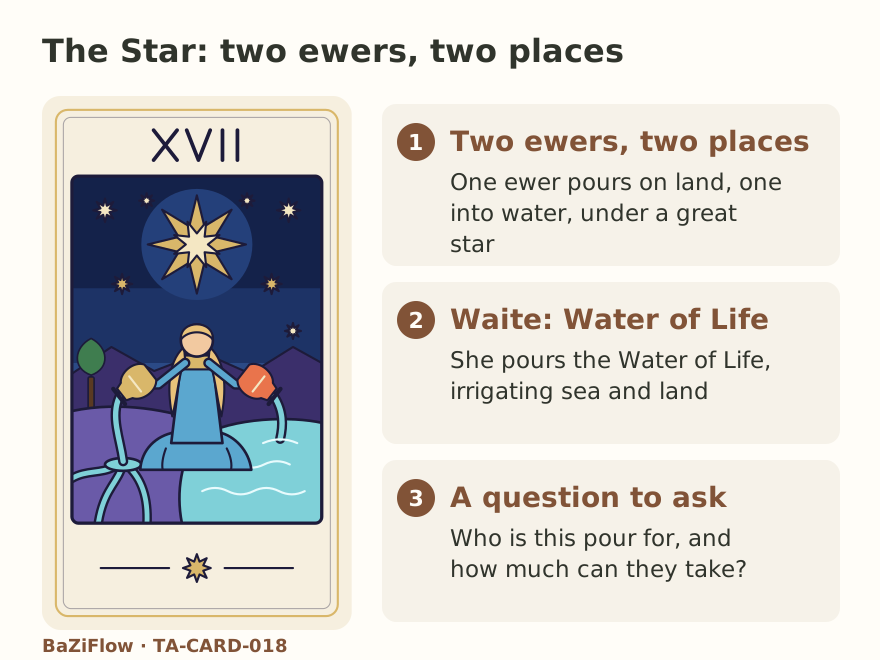
The Star as BaZiFlow drew it: two ewers pouring.
On the Rider-Waite-Smith card itself these are visible: XVII at the top; a yellow star slightly above center with seven white stars scattered around it; a blonde woman leaning forward, one ewer pouring into a pool and the other onto the ground; a red bird perched in the tree at the right; and a strip of purple hills in the distance.
Enlarge diagram · scroll sideways to read
A word list in two layers: loss and hope in one line
Waite’s divinatory meanings read: loss, theft, privation, abandonment; another reading says, hope and bright prospects. Reversed: arrogance, haughtiness, impotence. The main reading and the “other reading” sit in one entry and point in opposite directions; he does not say which to choose.
Loss, theft, privation, abandonment; another reading says: hope and bright prospects.
Enlarge diagram · scroll sideways to read
“Hope” turns up in three places in the book, in different tones. In Part III it is “another reading”. In Part II Waite says that several tawdry explanations boil down to calling this a card of hope, while on other planes the card has been certified as immortality and interior light. The same word carries a different weight in each position.
Star, water, woman: whom Waite hands each to
Of the star’s origin Waite says one thing: it is “l’étoile flamboyante”, the flaming star of Masonic symbolism, though confused there. What pours from the ewers he states plainly: what the figure communicates to the living scene is the substance of the heavens and the elements. The woman herself gets two readings.
Enlarge diagram · scroll sideways to read
For the majority of prepared minds, Waite says, she appears as the type of Truth unveiled, glorious in undying beauty, pouring on the waters of the soul some part and measure of her priceless possession. But in reality she is the Great Mother in the Kabalistic Sephira Binah, which is supernal Understanding, who communicates to the Sephiroth below “in the measure that they can receive her influx”.
She communicates to the Sephiroth that are below in the measure that they can receive her influx.
Three things, and what Waite gives for each
- Star and seven lesser stars
- Waite gives a count and a shape: a great star of eight rays and seven lesser stars, also of eight rays. The star is the flaming star confused in Masonic symbolism; what the seven stand for, he does not explain.
- Ewers and water
- What pours is the “Water of Life”, the substance of the heavens and the elements, irrigating sea and land. What is in the ewers the text states clearly; the disagreements begin with where the water goes.
- The naked woman
- She expresses eternal youth and beauty; most prepared minds see Truth unveiled, and Waite himself says she is “in reality” the Great Mother, Binah. That is his Kabalistic gloss.
The phrase “in the measure that they can receive” is the part the next section borrows: how much goes out depends on how much the receiving side can take. The borrowing takes only that idea of measure and leaves the Kabalistic gloss with Waite.
How to read it: a camp’s water, where it goes and how much each place can take
The picture itself has the shape of a measurement: water in the ewers, two places to pour, and the water going down in the measure each place can receive. Carry it to a camping trip. Three people stay two nights at a site with no tap, carrying 12 liters of drinking water.
Weigh what is in the ewer
Count only what is really carried: 12 liters, split over a few containers, with some chance of spills on the way. The number should come from weighing, not from impression.
Count the places it goes
The picture has two places, water and land. A camp’s water also splits into two kinds of use: what goes into the mouth (drinking, cooking) and what can be made do (washing up, dousing the embers).
Ask how much each place can take
Waite says she gives in the measure those below can receive. For each place, write the need first, then set it against the amount in the container, and the shortfall shows itself.
Enlarge diagram · scroll sideways to read
Before pouring, what was counted
Counted
- 12 liters carried
- Two nights, three people
Gone by impression
- “It should be enough”
- “The stream is always there”
Check first
- Is there a water point?
- Will it be hot these days?
Reversed and neighboring cards: arrogance, haughtiness, impotence, and other cards that pour
Waite’s reversed list has three words: arrogance, haughtiness, impotence. The first two speak of bearing and the third of capacity, and neither points the way the upright list does, toward what is lost or hoped for.
Arrogance, haughtiness, impotence.
Enlarge diagram · scroll sideways to read
Three cards that pour, and where each pours
From cup to cup
One foot on earth and one on water, as here, but Waite has the figure pour the essences of life from chalice to chalice. The list: economy, moderation, frugality, management, accommodation. It is about adjusting between two vessels.
Four streams from one cup
A hand from a cloud holds a cup from which four streams pour. Its words start from the house of the true heart and run through joy, nourishment and abundance, which describes the water once it is flowing.
The next card: night and water again
Its words begin with hidden enemies and run on to darkness, terror and error. The Star’s night has starlight and ewers; the Moon’s night is written as not seeing clearly.
Questions readers ask next
Is the Star simply the hope card?
In Waite hope is “another reading” in the divinatory list; what comes first there is loss, theft, privation, abandonment. He also calls “a card of hope” the summary of several tawdry explanations. Say which layer you are reading from.
What does the Star mean reversed?
Waite gives three words: arrogance, haughtiness, impotence. The first two describe a bearing and the last a capacity, which is a different axis from the upright list of what is lost or hoped for; they do not pair off one to one.
What is the point of the great star and the seven small ones?
Waite gives a count: one star of eight rays and seven lesser stars, also of eight rays. He says the star is the “l’étoile flamboyante” of Masonic symbolism, though confused there. What the seven stand for he does not explain.
Was this article helpful?
Sources & references
Continue reading
Temperance: a stream between two cups, thrift words, and a name with another origin ↗
The Tower: a bolt knocks the crown off, and Waite reads a House of Falsehood falling ↗