

Growth: the first of the twelve life stages
Content version · · Sources & references
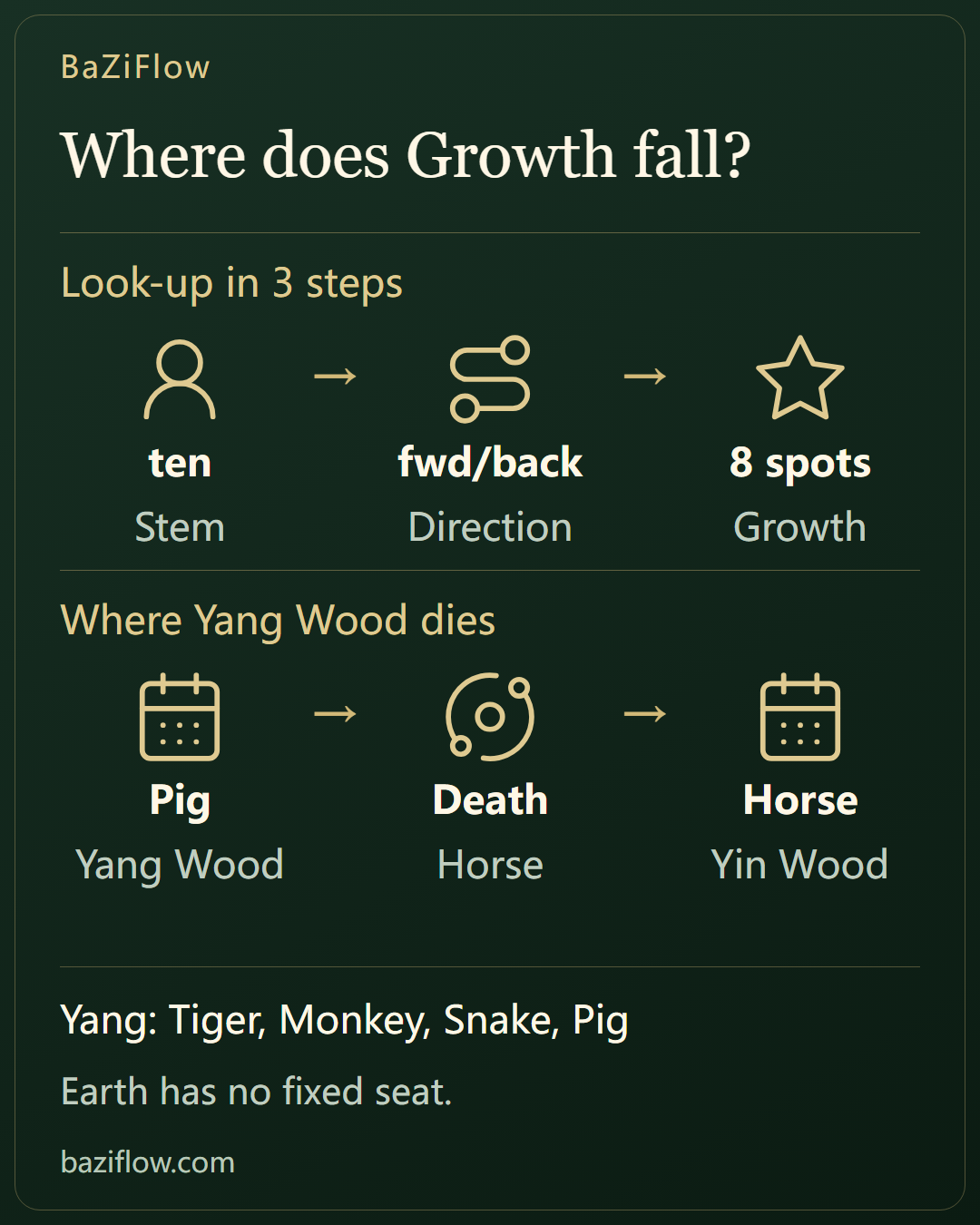
Growth is the first cell of the twelve life stages table. A map of the ten stems, the Yang-forward Yin-reverse rule, the Sanming Tonghui entries stem by stem and two ways to place Earth show where each Day Master lands.
The short version9 min read
Growth is the first cell of the twelve life stages table. You look it up by the Day Master stem: ten stems share eight positions, the Yang stems on Tiger, Monkey, Snake and Pig, the Yin stems on Rat, Rabbit, Horse and Rooster.
- Yang stems count forward along the branches and Yin stems count back, so their starting points differ; the Death position of a Yang stem is the Growth position of the Yin stem of the same element.
- Juan 2 of the Sanming Tonghui writes each stem as "born at one branch, dead at another", and every entry matches the site's engine table; Earth also has a second placing that the book records.
- Juan 3 of the same book calls the Growth position of the Day Stem the Academy Star (学堂), for "vital energy going to school"; the same passage also says one need not go by the Day Stem alone, and gives Na Yin and Tiger-Monkey-Snake-Pig readings.
Read first
Twelve Life Stages and Void Branches: Two Tables, Two References ↗
Strong and weak Day Masters: references, relationship directions and evidence ↗
Ten stems, eight positions
In plain words first: the twelve life stages are a look-up table. Give it a stem, and it tells you what stage that stem is in when it reaches a given branch. Growth (长生) is the first cell, followed by Bath (沐浴), Coming of Age (冠带), Establishment (临官), Peak (帝旺), Decline (衰), Weakening, Death, Storage, Severance, Conception and Nurture.
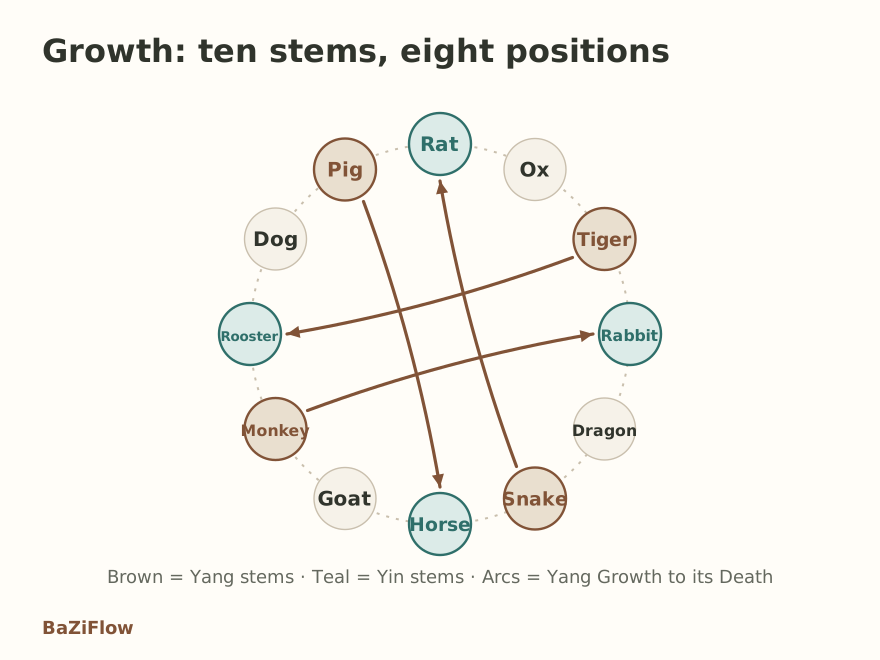
Position sketch: the positions come from the site engine's twelve-stage table; the arcs link each Yang Growth to its Death, which is the Growth of the Yin stem of the same element.
The ring shows where each Day Master has its Growth. The five Yang stems land on Pig (Yang Wood), Tiger (Yang Fire and Yang Earth), Snake (Yang Metal) and Monkey (Yang Water); the five Yin stems land on Horse (Yin Wood), Rooster (Yin Fire and Yin Earth), Rat (Yin Metal) and Rabbit (Yin Water). Tiger and Rooster each hold two stems, so ten stems use only eight branches.
The name "Growth" is the book's chosen image. Juan 2 of the Sanming Tonghui (三命通会), a Ming-dynasty compendium, quotes the Sanming Tiyao (三命提要), which pairs each of the twelve stages with a picture from nature and from a human life. The entry for Growth reads:
Everything is sprouting and heading for flourishing, like a person just born and growing upward.
Things have just sprouted and are leaning toward bloom, as a person grows after birth. So the image behind this cell is "just started, heading up", and that is all the name carries.
Yang runs forward, Yin runs back: one at Pig, one at Horse
Each element has two stems, one Yang and one Yin, and their Growth positions are not in the same place. The same chapter of the book sums the rule up with a line from a fu (rhapsody):
Yang is born where Yin dies, Yang dies where Yin is born; round and round they go, backward and forward, and the changes show.
The way to read it is simple. A Yang stem starts at its own Growth branch and counts forward along the branch order; a Yin stem starts at its own Growth branch and counts back. Put one Yang and one Yin stem from each element side by side and a tidy correspondence appears:
Enlarge diagram · scroll sideways to read
Take Yang Wood. Growth is the first cell at Pig; Rat is Bath, Ox is Coming of Age, Tiger is Establishment, Rabbit is Peak, Dragon is Decline, Snake is Weakening, and counting on to Horse gives the eighth cell, Death. Yin Wood has its Growth exactly on Horse. The other four pairs work the same way: from a Yang stem's Growth to its Death is always seven steps forward.
The book also says where this split came from. The ancients had only four "great Growths", and the examples given in the same passage are Wood at Pig, Fire at Tiger, Metal at Snake and Water at Monkey, which is the Yang column of the table above. Counting Yin and Yang separately adds the four Yin positions, and that is where the Yang-born-Yin-dead contrast comes from.
Juan 2, stem by stem: "born here, dead there"
The section on the Yin and Yang, birth and death of the Heavenly Stems takes them one at a time, giving each its Growth and Death positions and closing with an old saying. Yang Metal and Yin Metal show the offset best:
Enlarge diagram · scroll sideways to read
Read down the whole list and the birth positions agree with the site's table: Yang Wood at Pig, Yin Wood at Horse, Yang Fire at Tiger, Yin Fire at Rooster, Yin Earth at Rooster, Yang Metal at Snake, Yin Metal at Rat, Yang Water at Monkey, Yin Water at Rabbit, and Yang Earth at Tiger too. Each entry carries an image: Yang Wood is born at Pig, which the book likens to pond water; Yang Fire is born at Tiger, wood's territory, with the fire hidden inside the wood; Yang Metal is born at Snake, a furnace fire. These are traditional descriptions that help you remember the positions.
Earth: the book records two answers
Earth differs from the other four elements. Juan 2 first gives the placing the site uses: Yang Earth is born at Tiger, where there is fire inside; fire and earth are like mother and child, so Yang Earth follows Yang Fire and Yin Earth follows Yin Fire, one at Tiger and one at Rooster. The book next rejects a later verse that puts Yang Earth at Monkey, saying it leaves Yin and Yang "out of step"; then, under "some say", it gives the other school's case: Earth can follow Water, so both are born at Monkey, a view it calls "reasonable too". It sums up:
Earth has no fixed seat; it gives birth in many directions.
Enlarge diagram · scroll sideways to read
The site engine uses the Fire-and-Earth placing, so Yang Earth sits on Tiger and Yin Earth on Rooster. When you compare with another tool, first check whether its Yang Earth lands on Tiger or Monkey, and only then talk about the difference between the two tables.
The book's other name for the Growth position: the Academy Star
Juan 3 of the book, in its section on the Academy Star (学堂) and the Hall of Letters, gives the Growth position a second name. Quoting Ziping, it calls the Academy Star "the Growth spirit of the five elements", such as "Yang Wood meeting Pig, Yin Wood meeting Horse"; it is enough for one of the month branch or hour branch to show it, so the four pillars need not all agree, and "a Yin Fire day with a Rooster hour" is given as an Academy Star that carries the Heavenly Nobleman as well. An old verse puts it as "where the elements are born is the school".
Enlarge diagram · scroll sideways to read
Taken from the Day Stem, this is a name derived from the same Growth table, not a second table.
But the book's Academy Star has more than one reading. The section opens with a Na Yin example, "a Metal life meeting Yin Metal Snake (辛巳)": Metal has Growth at Snake, and the Na Yin of Yin Metal Snake is Metal too. The same passage says the name means "vital energy going to school" and that one "need not go by the Day Stem alone": any Tiger, Monkey, Snake or Pig in the pillars counts as learning, because those four gather the "purest qi", while Rat, Horse, Rabbit and Rooster are the "four decays" and Dragon, Dog, Ox and Goat the "four storehouses". So when another source speaks of the Academy Star, first ask whether it goes by the Day Stem, by Na Yin, or by those four branches alone.
The Academy Star is itself one of the Symbolic Stars (神煞), and how such stars sit in a chart is covered in where Symbolic Stars sit in a BaZi chart.
Look up two
The Day Master is Yin Metal. Which branch holds Growth?
Yin Metal is a Yin stem; in the reverse table Growth is on Rat. For Yang Wood that same Rat is Bath.
The Day Master is Yang Earth. Where is Growth, and where under the Water-and-Earth placing?
In the site table it is Tiger; in the Water-and-Earth placing it is Monkey. When the results differ, ask first which table was used.
The next cell is Bath; for how the whole table is read and how void branches differ from it, see the twelve life stages and void branches.
Questions readers ask next
My Day Master is Yin Metal. Is Growth on the Rat?
Yes. Yin Metal is a Yin stem, so the reverse table applies and Growth is on Rat. For Yang Wood the same Rat is the next cell, Bath, which is why you settle on the stem before looking at the branch.
Why do Yang Earth and Yin Earth share Growth with Fire?
The site engine treats Fire and Earth as sharing a palace: Yang Earth follows Yang Fire to Tiger and Yin Earth follows Yin Fire to Rooster. Another school places Yang Earth on Monkey, and the Sanming Tonghui records both, so say which table you use.
The book says the Academy Star "need not go by the Day Stem alone". So how is it taken?
Ziping's reading takes the Growth branch of the Day Stem, such as Yang Wood meeting Pig or Yin Wood meeting Horse, with one month or hour branch enough. The same passage says any Tiger, Monkey, Snake or Pig in the pillars counts as learning, and the section opens with a Na Yin example, a Metal life meeting Yin Metal Snake. The three readings give different results, so say which one you use.
Was this article helpful?
Sources & references
Continue reading
Bath (沐浴): One Step After Growth, and Why It Is Also Called Ruin and the Salt Pool ↗
What is Na Yin in BaZi? Why Jia-Zi Gold in the Sea does not replace Yang Wood ↗