

Heng: lasting is not standing still
Content version · · Sources & references
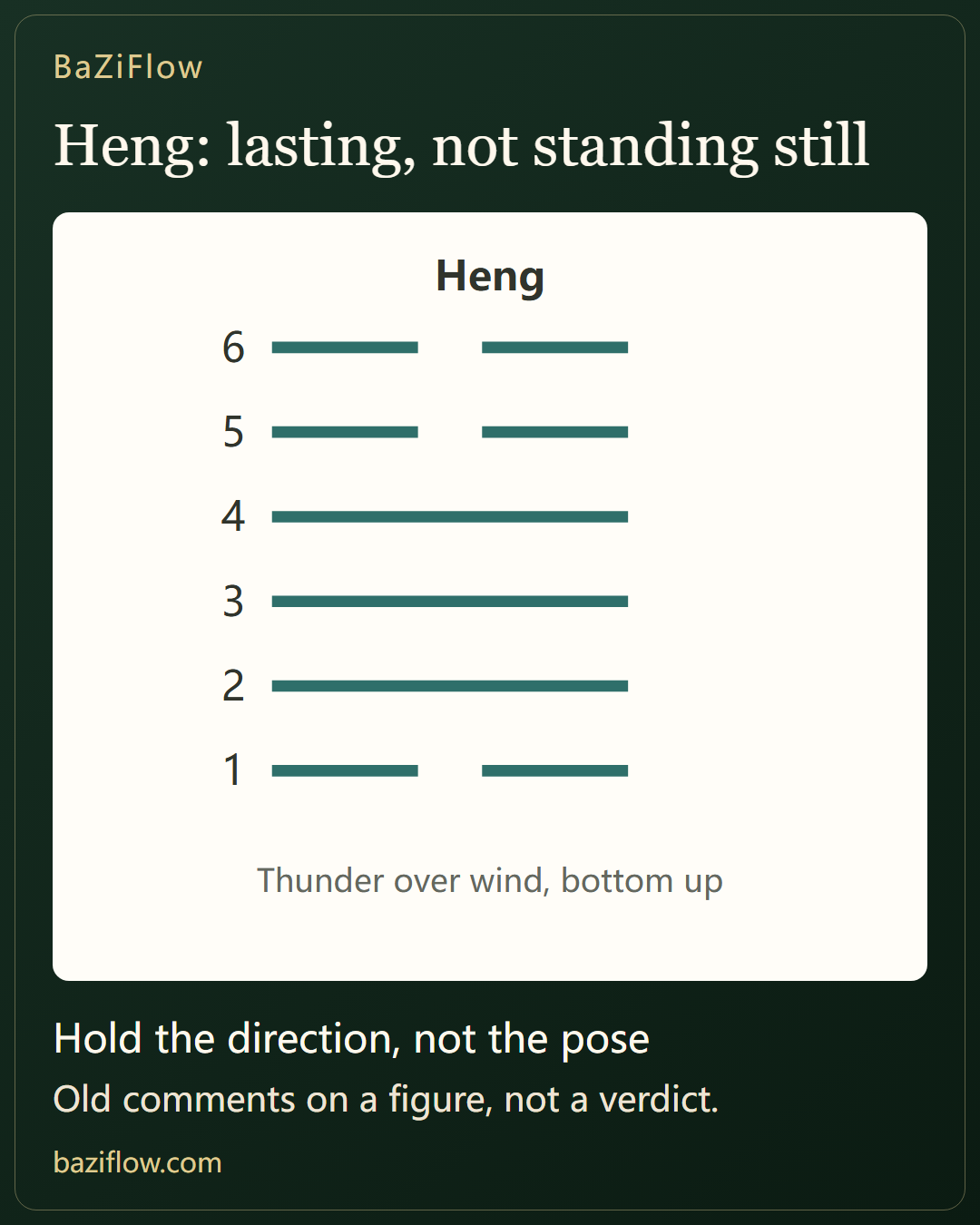
Heng is the 32nd hexagram: Zhen (thunder) above Xun (wind). Read how its Commentary ties lasting to change, how the Great Image fixes a direction rather than a posture, and how its six lines show lasting going wrong.
The short version7 min read
Heng means “lasting”, yet its image is the two most restless things among the trigrams. The text answers with “an end is followed by a beginning” and “stand and do not change direction”.
- Heng stacks Zhen (thunder) on Xun (wind). The Commentary on the Judgments names three features of the figure, and the third, firm and soft all answering, holds: all three line pairs are one yang and one yin.
- The Commentary points to sun and moon, the seasons and the sage to explain lasting; only the seasons are said outright to last through change. The last phrase of the judgment, fitting to have somewhere to go, is explained as an end followed by a beginning.
- The Great Image keeps the direction fixed, not the motion. In the lines, digging too deep, wavering, staying where one does not belong and stirring things up are four ways of seeking constancy badly.
Read first
The Sixty-Four Hexagrams: How Upper and Lower Trigrams Form One Figure ↗
Judgment and Line Statements: Whole Hexagram or Single Line? ↗
Thunder over wind: two restless things
Heng (恒) is Zhen (thunder) above and Xun (wind) below. The Shuo Gua gives each trigram a word: Zhen is moving, Xun is entering. It also says that nothing sets things in motion faster than thunder and nothing bends them faster than wind, and then adds a line of its own: thunder and wind do not oppose each other.
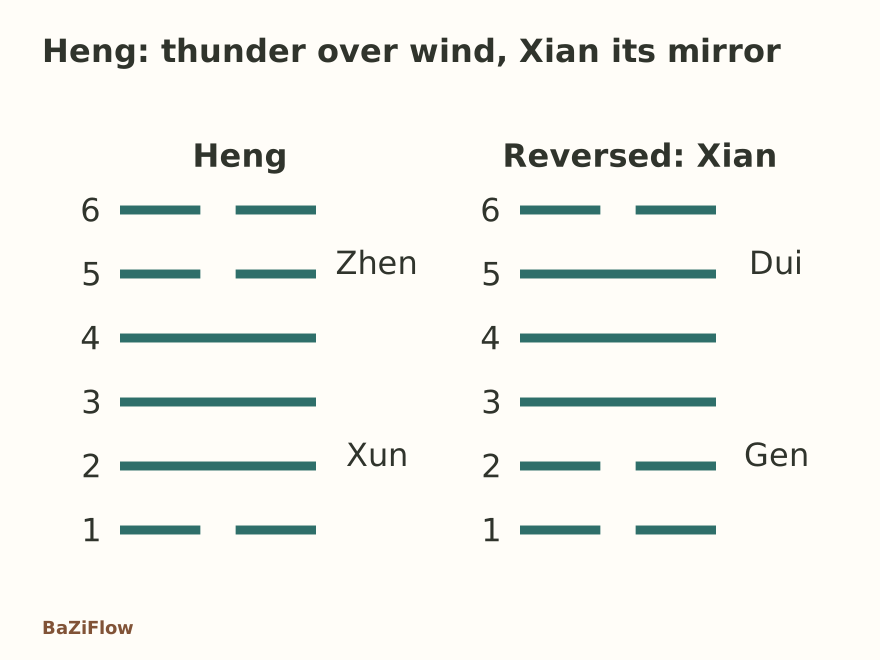
Heng and its reversed hexagram Xian: reversing turns the whole figure upside down, so Zhen turns into Gen and Xun into Dui, which gives Xian.
Choosing two of the most restless trigrams as the image of a word that means “lasting” is the first thing to notice. In this text Heng is not stillness; it is staying together between two kinds of ceaseless motion.
The Commentary on the Judgments (彖传) counts three features of the figure: “the firm above and the soft below”, “entering and moving”, and “firm and soft all answer”. The third can be checked directly: lines 1 and 4, 2 and 5, and 3 and 6 are each a yin and a yang.
Enlarge diagram · scroll sideways to read
Three phrases of the Commentary
- The firm above, the soft below
- Zhen has one yang line and Xun has one yin line, and tradition judges a trigram by that single odd line. So firm Zhen sits on top and soft Xun below.
- Entering and moving
- The lower trigram’s quality and the upper trigram’s quality are joined by one “and”: at once entering and moving.
- Firm and soft all answer
- Each of the three line pairs sets a yang against a yin, hence “all”.
The judgment and the Commentary: lasting by changing
The judgment of Heng reads: success, no blame; fitting to stay on the right course; fitting to have somewhere to go. The last clause is a small surprise, since a hexagram called “lasting” says outright that going somewhere is favorable. The Commentary first explains the name in three words, “Heng means lasting”, and then answers with a series of examples of how lasting is done.
The sun and moon keep to heaven and so can shine for long. The four seasons change and so can complete things for long. The sage stays long in his way, and so the world is transformed and completed.
Enlarge diagram · scroll sideways to read
The seasons never stop changing, yet they are said to “complete things for long”, because when one season ends the next picks up. That is the very sense in which the Commentary glosses the clause about having somewhere to go: when an end is reached, a beginning follows. Read this way, lasting in the text is continuation, not staying where you are.
The Commentary closes with a method: look at what a thing keeps up, and the character of heaven, earth and all things can be seen.
The Great Image: what stands is the direction
The Great Image (大象) of Heng is a single sentence.
Thunder and wind: Heng. The noble person stands and does not change direction.
To stand is to hold firm. The word translated “change” is the same one that gives the Yi in Zhouyi, and the word for “direction” can also mean a place or a way of doing things. Thunder and wind never stand still, yet the noble person is told to stand; and what must not change is neither motion nor stillness, but the direction.
Swap thunder and wind top for bottom and you get Yi (益), wind over thunder, which is also the inverse hexagram (错卦) of Heng. The Great Image of Yi falls the other way: when you see something good, move toward it, and when you have erred, correct it.
Enlarge diagram · scroll sideways to read
Read side by side, each has its own object: Yi’s moving and mending answer to particular goods and faults, while Heng’s refusal to change answers to a direction.
Six lines: mostly lasting gone wrong
Among the six line statements of Heng, only line 2, “regret vanishes”, and line 5, “constant in virtue”, speak of lasting working. The other four describe lasting sought in the wrong way.
Enlarge diagram · scroll sideways to read
Line 1 is at the bottom. The verb in “digging deep for constancy” is to dredge or dig, and the Small Image explains the ominous result: at the very start it asks for depth. Line 2 has only two words, “regret vanishes”, and the Small Image gives the reason: it can last by staying in the middle, at the center of the lower trigram.
Line 3, “not constant in his virtue”, is judged by the Small Image as having no place that can hold him. Line 4, “no game in the field”, is explained as staying long in a place that is not one’s own. Line 4 is a yang line sitting in the fourth place, a yin place, which fits that comment.
Line 5, “constant in his virtue”, is the one clearly positive statement about lasting, yet it goes on to sort fortune by role: good for a woman, ominous for a man. The Small Image explains that a woman who follows one course to its end is fortunate, while a man, who is the one to decide what is right, is in trouble if he simply follows. The same “following one” is judged differently depending on who does it.
Line 6, “stirring up constancy”, is written with the character for thunder in this text, with a variant reading that uses the character for shaking; the Small Image has the latter. The line sits at the very top of the upper trigram Zhen, and the Small Image comments that it achieves nothing great.
Xian, Yi and Guai: neighbors of Heng and its place in the sequence
Turn Heng upside down and you get Xian (咸), so Xian is the reversed hexagram (综卦) of Heng (see the figure above), and the two form a pair. The Xu Gua says that a marriage cannot do without lasting, and the next hexagram is therefore Heng. The Za Gua gives the pair one word each: Xian is quick, Heng is lasting.
The inverse hexagram is Yi, mentioned above. The nuclear hexagram (互卦) is Guai (夬): lines 2 to 4 of Heng are three yang lines (Qian), and lines 3 to 5 are yang, yang, yin (Dui), so they stack as Qian below and Dui above.
Enlarge diagram · scroll sideways to read
After Heng the Xu Gua moves on to Dun, giving as its reason that a thing cannot stay forever in the same place, and Dun means retreat. The step from lasting to retreating is exactly where the next article begins: Dun.
Questions readers ask next
Does Heng teach that nothing should ever change?
In the text, lasting means one stretch handing over to the next: the seasons keep changing and are still said to last, and the judgment itself says that having somewhere to go is fitting. What stays fixed is the “direction” named in the Great Image.
How are Heng and Xian related?
They are each other’s reversed hexagram: turn the six lines of Heng upside down and you have Xian. In the sequence of the sixty-four, Xian comes first and Heng follows it directly.
Is “good for a woman, ominous for a man” a prediction about the sexes?
It is the statement of one line, line 5. The Small Image explains it: a woman who keeps to one course and sees it through is fortunate, while a man who must decide what is right and merely follows is not. It is a comment on roles in an old text, to be read in that setting and not as a verdict on anyone today.
Was this article helpful?
Sources & references
Continue reading
Xian: a lake on a mountain, and feeling that climbs from the big toe to the tongue ↗
Dun: a mountain under heaven, from the tail of the retreat to the ample one ↗
The Sixty-Four Hexagrams: How Upper and Lower Trigrams Form One Figure ↗
Judgment and Line Statements: Whole Hexagram or Single Line? ↗