

Rooftop: one character, two roles
Content version · · Sources & references
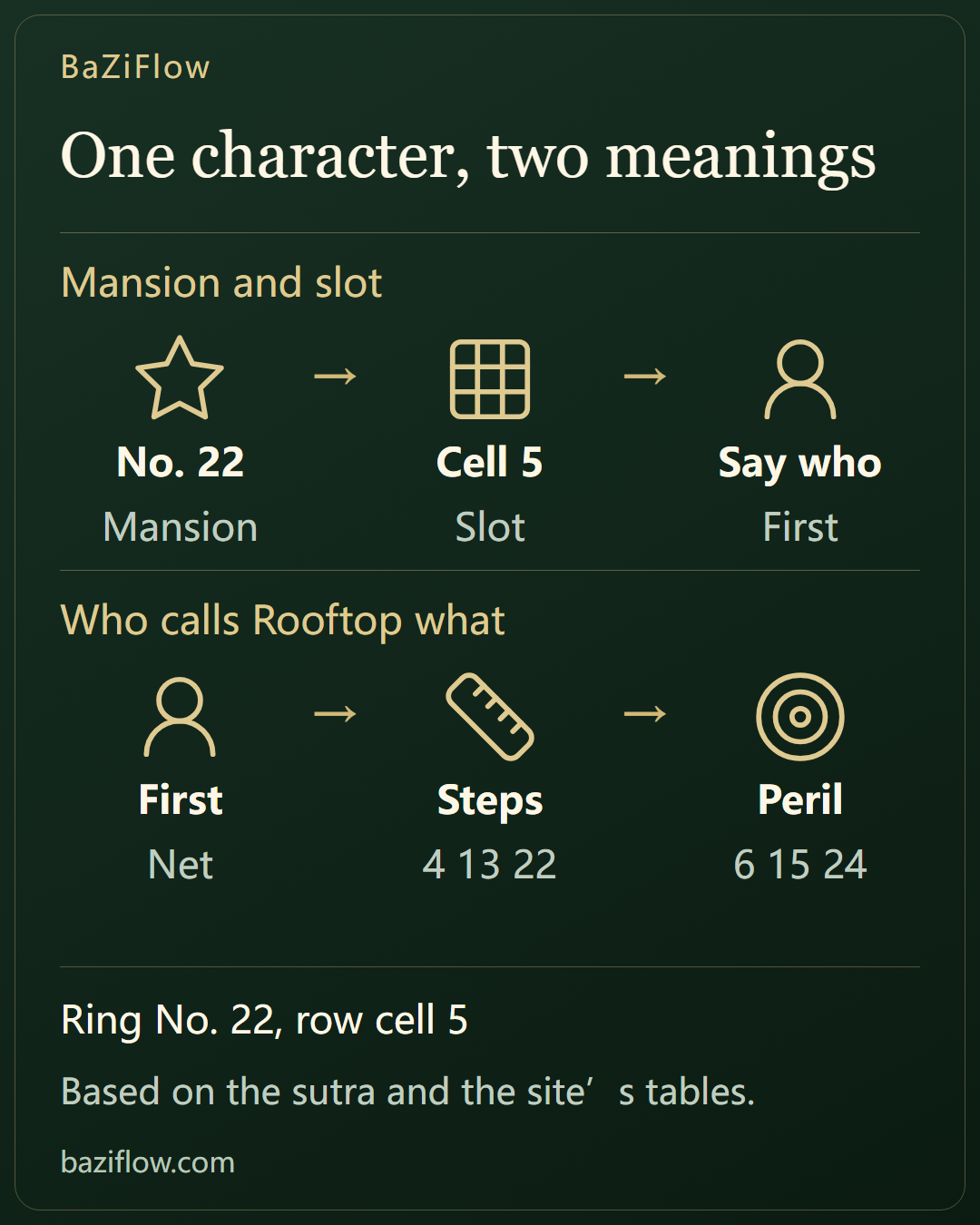
Rooftop (危) is position 22 on the 27-mansion ring, and the fifth slot of every three-nine row uses the same character. A ring, star counts, a class, dates and a lookup table keep the two apart.
The short version6 min read
Rooftop (危, Ki in Japanese) is position 22 on the site’s 27-mansion ring, between Emptiness and Encampment. The fifth slot of every row in the three-nine method is written with the same character, and that slot is a different thing.
- The mansion sits after Emptiness and before Encampment and never moves. The three-nine slot shifts with the starting mansion: in the sutra’s own example with Net first, it falls on Ghost, Room and Wall.
- The Rooftop picture says one star shaped like an ear of grain, while Yang Jingfeng’s note counts three stars in Chinese astronomy. Across the 27 mansions only ten have the same count in both layers, and Rooftop is not one of them.
- Turn the question around and the labels differ: Extended Net, Winnowing Basket and Stomach see Rooftop as Peril, Girl, Net and Chariot see it as Decline, and Rooftop sees itself as Fate.
Read first
What is Sukuyō astrology? How a birth mansion is found ↗
Sukuyō 27 mansions vs the 28 lunar mansions: what is the difference? ↗
One character, two places on the chart
Two different things in Sukuyō sources are written with one character (危). One is the mansion called Rooftop (危), position 22 on the ring, after Emptiness (虚) and before Encampment (室). The other is the fifth cell of each row in the three-nine method, which the site’s labels call Peril.
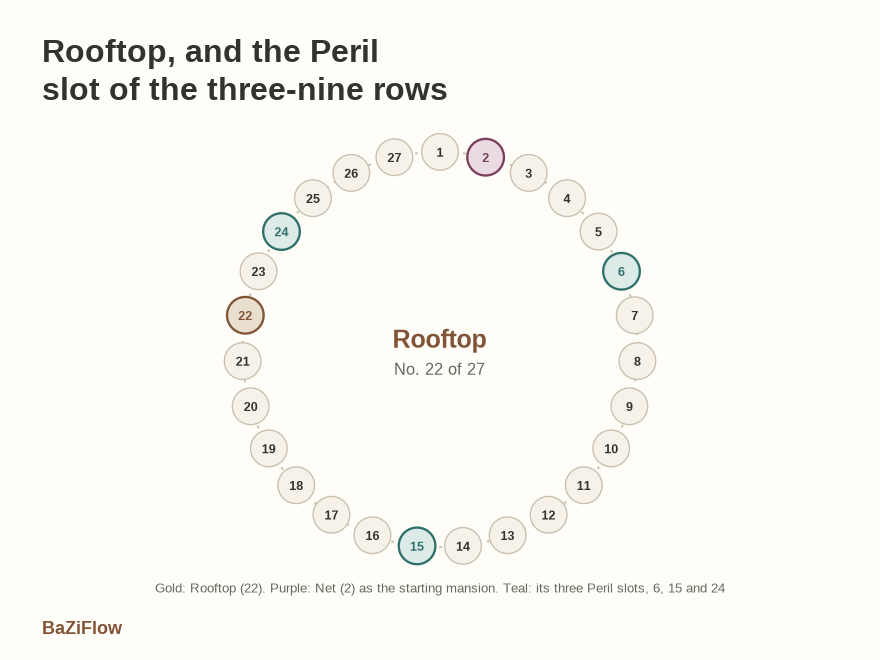
The ring lists the 27 mansions in the sutra’s order with even spacing, which says nothing about their widths in the sky; the purple and teal circles follow the sutra’s three-nine example.
In the picture the gold circle is Rooftop, and it stays where it is. The purple circle is Net (毕), the starting mansion in the sutra’s worked example. The three teal circles are the mansions that sit in the fifth cell of the three rows when Net comes first: Ghost (鬼), Room (房) and Wall (壁). Start from another mansion and those three shift together, while Rooftop remains in place.
Enlarge diagram · scroll sideways to read
The Rooftop picture: one star or three
The Rooftop entry sits in the second chapter of the Sukuyō Sutra and opens with:
Rooftop has one star, shaped like an ear of grain.
At the end of that entry the commentator Yang Jingfeng (杨景风) wrote the count used in Chinese astronomy:
In Chinese astronomy, Rooftop has three stars.
So one page holds two numbers: the text says one star and the note says three. Why Jingfeng sets two counts side by side is explained in his note on the Hairy Head picture, discussed in the article on Hairy Head (昴).
Enlarge diagram · scroll sideways to read
Jingfeng added a note like this for every mansion. Comparing the two layers across the 27 mansions, ten have the same count: Turtle Beak (觜), Horn (角), Root (氐), Room, Heart (心), Winnowing Basket (箕), Encampment, Wall, Bond (娄) and Stomach (胃). The other seventeen differ. Rooftop’s one against three is among them; Wings (翼) differs most, two against twenty-two, and Legs (奎) is out by exactly double, thirty-two against sixteen.
Well, Neck, Girl, Emptiness, Rooftop: the "light and restless" class
In the sutra’s own sorting of the 27 mansions into seven classes, Rooftop sits in the biggest class:
Well, Neck, Girl, Emptiness and Rooftop, these five stars are the light-and-restless mansions, and also the traveling mansions.
After the class name the sutra lists the activities suited to those days; here only the name and the members matter. The five sit unevenly on the ring: Girl, Emptiness and Rooftop follow one another directly, while Well (井), Neck (亢) and Girl (女) are seven or eight steps apart.
Enlarge diagram · scroll sideways to read
"Also the traveling mansions" is another name for the same class, in the same sentence. So the class name reads as a list of names and not as one continuous stretch of the ring.
The days that fall on Rooftop come earlier each month
The site reads the mansion of any day from a fixed first-day table on Japan’s old calendar (new moon taken at Tokyo time): each old-calendar month has its own opening mansion (the full table of twelve is in the article on Hairy Head (昴)), and every later day moves one place forward. With that table, Rooftop lands on these days:
Enlarge diagram · scroll sideways to read
The day-1 mansion of month 12 is Emptiness, so day 2 is Rooftop. A month runs 29 or 30 days while the cycle holds only 27 mansions, so the mansions that opened the month return before it closes, and day 29 of month 12 is Rooftop as well. Early 2026 shows the pair: old month 12, day 2 is 20 January and day 29 is 16 February, 27 days apart.
Turning it around: who calls Rooftop what
Three-nine names have a direction: A calls B one name and B calls A another. Put Rooftop on the receiving end and each of the other mansions gives it a name. The grid sorts them into three columns by how many steps they stand before Rooftop:
Enlarge diagram · scroll sideways to read
Net, the start of the sutra’s own example, calls Rooftop Decline, which matches the sutra’s three-nine line: with Net first, the third row opens at Girl (Womb), then Emptiness (Prosper) and Rooftop (Decline). The grid also shows that Ghost, Room and Wall all see Rooftop as a Friend.
Write the starting mansion
Name the mansion everything is counted from.
Write the steps
Record the steps from the start to the other mansion; the starting point itself is step zero.
Classify the word
Say whether this character (危) is the mansion or the slot, and whether it comes from the sutra text or from Jingfeng’s note.
Two exercises
Net is first. Which three mansions hold the Peril slot?
Net is position 2. Steps 4, 13 and 22 ahead give position 6 Ghost, position 15 Room and position 24 Wall, matching the sutra’s example.
Girl is first. What does Rooftop get called?
Girl is position 20 and Rooftop is position 22, two steps ahead, which is the third cell, Decline.
Just before it on the ring is Emptiness and just after it is Encampment; how the six relation names are derived is in the six relationship types.
Questions readers ask next
Is it correct to say "Rooftop is a Decline mansion"?
Only from a few starting points. In the sutra’s three-nine example Net is first, its third row opens at Girl (Womb), and Rooftop lands on the third cell of that row, Decline. Only Girl, Chariot and Net call Rooftop Decline; start from another mansion and Rooftop gets another name, so a label always travels with the words "counted from which mansion".
Does the mansion name Rooftop (危) mean danger?
The mansion name is inherited from the 28-mansion tradition, and the site renders it Rooftop; the everyday sense of the word does not carry over. The slot called Peril (危) in the three-nine rows belongs to the Peril–Attain pair. Quote them separately.
Why does the Peril slot (危) appear three times in the three-nine method?
The method has three rows, and the fifth cell of each is called Peril (危). For one starting mansion, three different mansions therefore sit in that slot, 9 steps apart. With Net first they are Ghost, Room and Wall.
Was this article helpful?
Sources & references
Continue reading
Emptiness (虚), Mansion No. 21: A Shared Month Start and a Mansion Cut in Half ↗
Encampment (室): Month-1 Opener, the Name of Month 7 and a Split House ↗