

Elements and modalities
Content version · · Sources & references
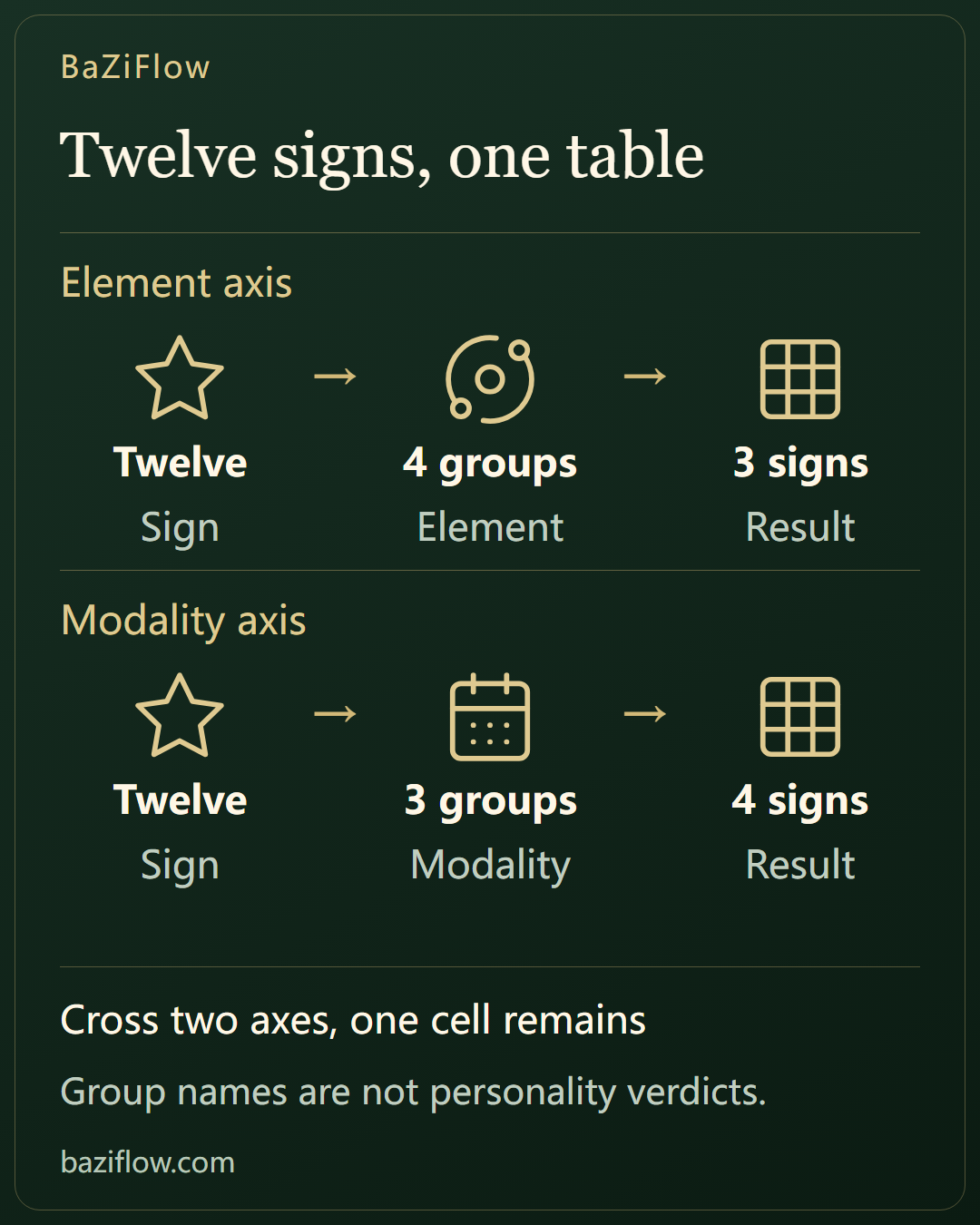
Elements sort the twelve signs into four groups and modalities into three. A four-by-three table, two find-the-sign exercises and one counting example separate classification, counting method and personality claims.
The short version4 min read
Every sign stands on two classification axes: four elements and three modalities. Put the two together and exactly one sign is left.
- Elements split the signs into Fire, Earth, Air and Water, three signs each; modalities split them into Cardinal, Fixed and Mutable, four signs each.
- In the four-by-three table each sign takes exactly one cell, so an element and a modality together identify the sign.
- "Fire is 50%" is only a count over one chosen list. Change the list, the weights or the denominator and the number changes; it is not a personality verdict.
Read first
Four Chart Components: Read the Object, Position and Relationship ↗
Two classification axes, twelve cells
The twelve signs can be grouped in two ways at once. By element there are four groups, Fire, Earth, Air and Water, with three signs each. By modality there are three groups, Cardinal, Fixed and Mutable, with four signs each. Every sign holds one position in each grouping.
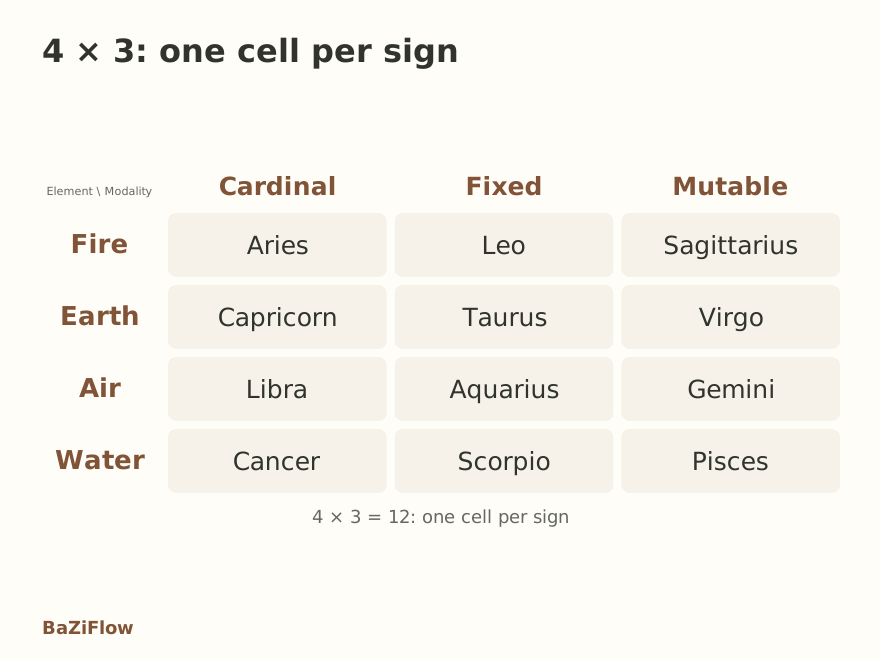
Classification sketch: 4 × 3 = 12, one cell per sign. Not a personality score and not a Five Phases diagram.
Read the table by row first, then by column: the row gives the element, the column gives the modality, and the cell where they cross is the sign. The table only answers "which cell does it belong to". It does not generate a personality description.
Elements: four groups, three signs each
Enlarge diagram · scroll sideways to read
The three signs of one element are spaced four signs apart on the zodiac, 120 degrees, which is why elements are also called the triplicities. Chapter 18 of book one of Ptolemy's Tetrabiblos discusses these triangles. Older translated names do not always match today's wording one for one, so a citation has to keep its original chapter context.
Modalities: where Cardinal, Fixed and Mutable sit in a season
Enlarge diagram · scroll sideways to read
Each of the four seasons holds three signs: a Cardinal sign opens it, a Fixed sign sits in the middle and a Mutable sign closes it. Ptolemy's Tetrabiblos I.11 ties these classes to the solstices, equinoxes and seasonal positions. Modern introductions often memorise the modalities as "begin, sustain, adjust", which is a mnemonic.
Find the one sign with two conditions
One condition leaves three or four candidates; two conditions leave one.
Enlarge diagram · scroll sideways to read
Two exercises
Knowing only "Water", then adding "Mutable"
Water leaves Cancer, Scorpio and Pisces; adding Mutable leaves only Pisces.
Knowing only "Fixed", then adding "Air"
Fixed leaves Taurus, Leo, Scorpio and Aquarius; adding Air leaves only Aquarius.
These questions have standard answers because they ask which cell a sign occupies, not what a person will do. Leo is the crossing of Fire and Fixed; it is not a blend made by taking half the adjectives of Aries and half of Taurus.
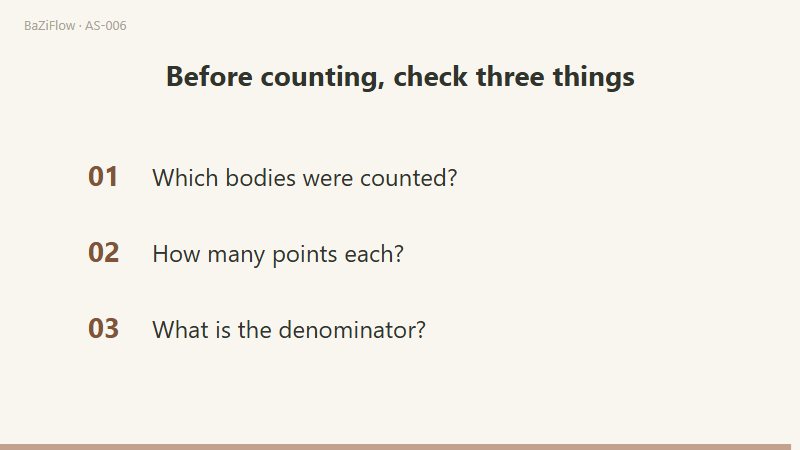
Before counting, check three things
Which bodies were counted?
The Sun and Moon are separate fields, and the Ascendant is not a planet, so it must not slip into a "ten planets" list.
How many points does each get?
Ten bodies at one point each and the Sun and Moon doubled give different percentages.
What is the denominator?
Two percentages whose denominators are not stated cannot be compared side by side.
Enlarge diagram · scroll sideways to read
So an element distribution must state which bodies were counted, how many points each received and what the denominator was before it can be compared with another. Keeping the raw positions beside the totals lets others recompute and see which bodies were left out.
Fixed does not prove stubborn, and Mutable does not prove unreliable. To read the classes back inside a whole chart, start with the Sun, Moon and Ascendant, then aspect angles and orbs and the order for reading a whole chart.
Questions readers ask next
Do signs of the same element share the same personality?
No. An element only says the signs belong to one group. The modality, the house and the aspects all change a particular reading. Classification organises the data; it does not pass a verdict on character.
Are Western Fire, Earth, Air and Water the same as the Chinese Five Phases?
No. They are separate systems that happen to share some words. The Western set is a four-way classification of signs; the Chinese set describes phases that generate and restrain one another. Borrowing one to explain the other mixes up two different sources.
Do modalities need rearranging for the southern hemisphere?
Do not rearrange them yourself. Introductions describe modalities as the start, middle and end of a season, which assumes the northern hemisphere and the tropical zodiac. Another seasonal scheme has to be defined separately.
Was this article helpful?
Sources & references
Continue reading
Sun, Moon and Rising: Two Luminaries and One Intersection ↗
Aspect Angles and Orbs: Calculate One Line from Two Positions ↗