

Timing an action
Content version · · Sources & references
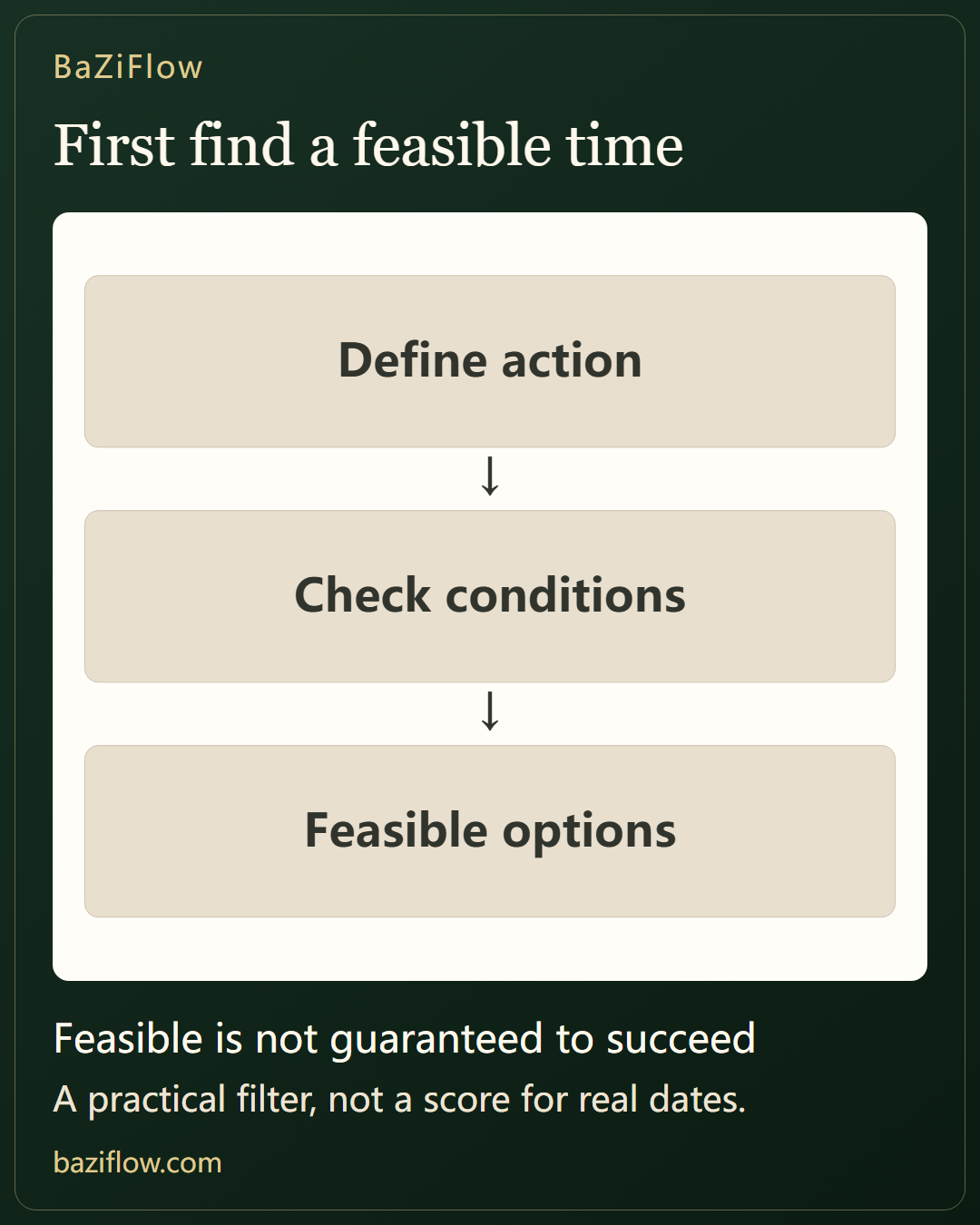
Distinguish asking a horary question from selecting an electional time, then connect practical constraints with Qimen timing and direction. A candidate window is not a success guarantee.
The short version6 min read
Sending an application, receiving confirmation and obtaining acceptance are different events. Define the action before asking which time to choose, and keep practical conditions visible.
- Sending, delivery and acceptance are separate observable events.
- A venue, participants and permissions determine which options are established rather than provisional.
- A question time, an intended start and a directional reference serve different roles.
What event would count as the start?
If you plan to submit an application, several moments may seem relevant: finishing the form, sending it, receiving a delivery confirmation or having it accepted. These are different events. Choosing whichever date later fits a reading would change the question after the result is known.
Define the action first. “Discuss one proposed arrangement with the other person” is more specific than “improve the relationship.” You can arrange to ask; you cannot elect another person's agreement into existence. A clear task makes it easier to see what a timing discussion can and cannot address.
Define the action, then check its conditions
- Start definition
- The event specified before comparison, such as sending rather than receiving a receipt.
- Feasible option
- An option that meets the stated practical conditions, not a promise of success.
Build the candidate set from real conditions
List the available dates, deadline, location, permissions, preparation and participants. If the venue is closed or a necessary participant has not agreed, that slot is not an established option. An encouraging symbolic description does not remove the missing condition.
| Item | Question to settle |
|---|---|
| Action | What exactly begins or finishes? |
| Window | Which dates are actually available? |
| Fixed constraint | What deadline or requirement cannot move? |
| Completion | What observation shows the action occurred? |
This is not a hidden electional algorithm. It is a way of keeping the learning question connected to the situation. Mark provisional arrangements as provisional instead of treating them as confirmed simply because you want a date to work.
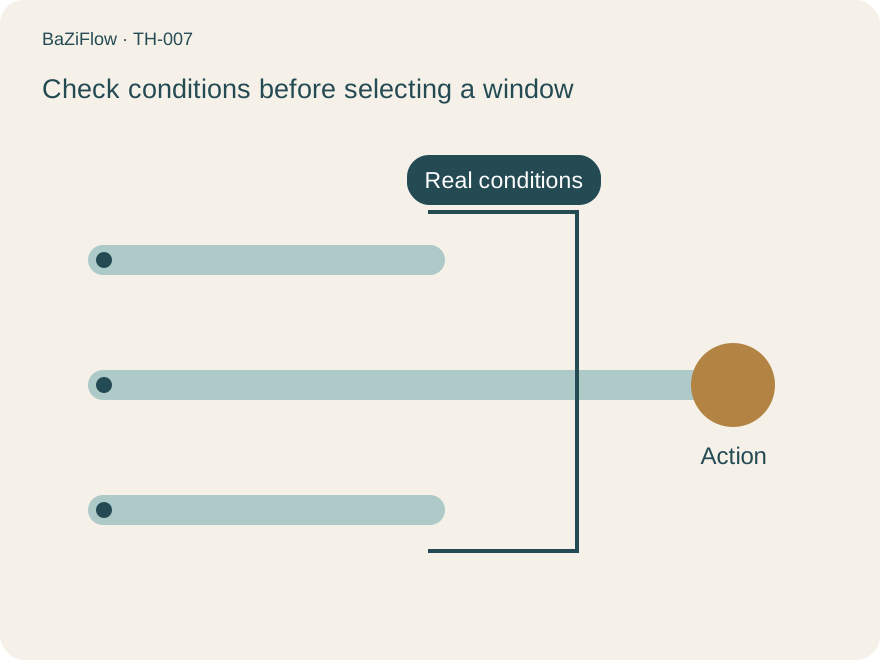
Original BaZiFlow candidate-window diagram. The example concerns feasibility and makes no judgment about actual dates.
The gate represents practical conditions. One of three illustrative bands continues to an action point; the others stop because the example has not established their feasibility. There is no calendar or favorable-time score in the drawing. It does not declare any real date unlucky.
Monday
- Practical condition
- Venue closed
- Status
- Not feasible
Tuesday
- Practical condition
- Venue and people confirmed
- Status
- Can proceed with planning
Wednesday
- Practical condition
- No reply yet
- Status
- Still provisional
The time of a question has a different role
Houlding's introduction describes horary astrology in terms of a clearly formed question submitted for astrological examination. Electional astrology, as discussed by Frawley, concerns choosing a moment for an intended action. These are descriptions of traditional methods, not demonstrations that a result is guaranteed.
Start with horary and electional astrology if those roles are unfamiliar. Asking about something now and selecting a future start are not interchangeable inputs. The time you ask is not automatically the time the event must occur.
Frawley's discussion also considers aims and practical limits. That point is relevant to defining the task, but it does not require adopting every historical, medical or causal assertion in the article. A source can establish how an author describes a method without establishing all of the author's claims as facts.
Question time
- When the clear question is submitted
Action time
- The intended future start
A direction needs an origin and a purpose
The route through Qimen timing and direction conditions raises another practical question: where is a direction measured from, and what action does it describe? Travel from a starting point, orientation in a room and another directional use should not be silently treated as the same instruction.
Keep the method attached to the explanation. Qimen and Western electional astrology do not form a shared scoring table just because both discuss action and time. Their chart structures and interpretive rules cannot be swapped by replacing one label with another.
For a question about a longer period, long phases versus present questions may be the better starting point. A broad theme does not automatically identify a minute in today's schedule. Narrowing the claim requires a stated method and appropriate information, not just more precise wording.
Travel direction
- Reference required
- Origin and destination
- Do not substitute
- Room orientation
Room orientation
- Reference required
- Which side defines the front
- Do not substitute
- A travel route
Preserve the reason for a change
Suppose a meeting date becomes unavailable. Record the actual reason, then work with the new candidate range. A participant's cancellation is new practical information; it need not be recast as proof that the original symbolism predicted the interruption.
Do not keep changing the question time to obtain a more reassuring result. If the task itself changes, make the change explicit and preserve the earlier record. That lets a later review distinguish a revised plan from a successful prediction about the original one.
After acting, keep the intended outcome, selected time, known conditions and actual result together. A smooth outcome alone cannot isolate timing as its cause. Preparation, cooperation, institutional requirements and chance remain part of the account. Nor does a difficult outcome establish that a particular symbol caused the difficulty.
Leave room for action rather than waiting for perfection
Necessary urgent action and fixed obligations should not be delayed while searching for an ideal symbolic moment. A timing discussion cannot replace professional requirements or practical responsibility. Where the available information only supports a broad choice, do not pretend to possess a precise guarantee.
The useful end product of this route is a well-defined task with feasible options and visible uncertainties. Sometimes the next step is simply to confirm permission or finish preparation. That step can be real and worthwhile even before you have interpreted any timing chart.
Venue cancels
- New information
- The old slot is unavailable
- Next action
- Check another place or date
No reply
- New information
- Participation remains unconfirmed
- Next action
- Contact or wait within the deadline
Goal changes
- New information
- It is a different task
- Next action
- Keep the old question and define the new one
Keep the specified event
If the question concerns sending, retain that timestamp and record acceptance separately. Do not select a different event after seeing the result.
Separate unavailable from unconfirmed
A closed Monday venue is unavailable. A missing Wednesday reply remains unknown rather than becoming either consent or refusal.
Revise only when information changes
If Tuesday’s venue cancels, preserve the reason and check a new set of options. Cancellation alone is not evidence that the symbolism predicted it.
Questions readers ask next
Which timestamp is the start?
Define it in the question. Sending, delivery and acceptance can all be recorded without choosing the most convenient one after the result.
Can a date with no reply be excluded?
It can remain outside the confirmed set, but no reply is not a refusal. Keep it provisional and act within the actual deadline.
Does a smooth result establish that timing worked?
One result cannot isolate the effect of timing. Preparation, cooperation, institutional conditions and chance remain relevant.
Was this article helpful?
Start reading
Choosing a Qimen time or direction starts with real constraints ↗ · Qimen Dunjia
A Ten-Year Theme Cannot Answer a One-Week Decision ↗ · Cross-system studies
Sources & references
Continue reading
Choosing a Qimen time or direction starts with real constraints ↗