

The Moon: four positions, sign and house
Content version · · Sources & references
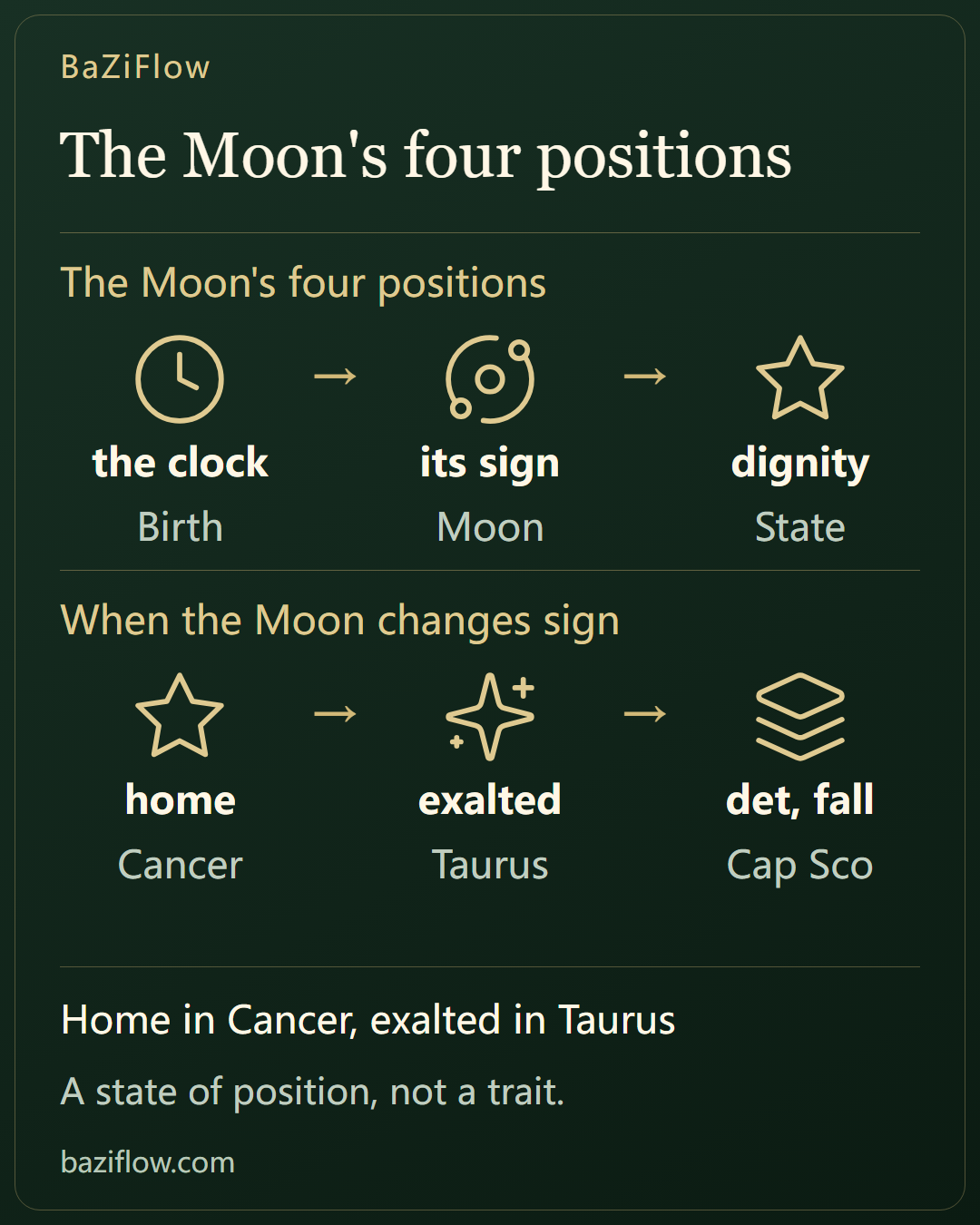
The Moon holds four positions: domicile in Cancer, exaltation in Taurus, detriment in Capricorn, fall in Scorpio. Four columns, Ptolemy's four phases, a 49-hour ingress calculation and a house table show the reading.
The short version6 min read
The Moon's home is Cancer and her exaltation is Taurus, with detriment and fall in the signs opposite them. The Sun takes a month per sign, the Moon a little over two days, so which sign she is in depends on the clock time of birth.
- The classical table in the engine records four entries for the Moon: domicile in Cancer, exaltation in Taurus, detriment in Capricorn and fall in Scorpio; Capricorn is Saturn's home and Scorpio is Mars's.
- Ptolemy ties the exaltation in Taurus to the phases: the Sun is in Aries at the new moon, and the Moon first shows and starts gaining light in Taurus. He also splits her month into moist, hot, dry and cold stages.
- At 00:00 UTC on 28 October 2026 the Moon is at 29°22′ Taurus, enters Gemini at 01:02 and Cancer at 02:06 on 30 October. One hour of difference turns exaltation into no entry at all.
Read first
Personal, Social and Outer Planets: Use Groups as a Directory ↗
Home in Cancer, exalted in Taurus: the Moon's four positions
In plain words first: in the site's classical table the Moon also holds four signs, and eight are blank: Aries, Gemini, Leo, Virgo, Libra, Sagittarius, Aquarius and Pisces.
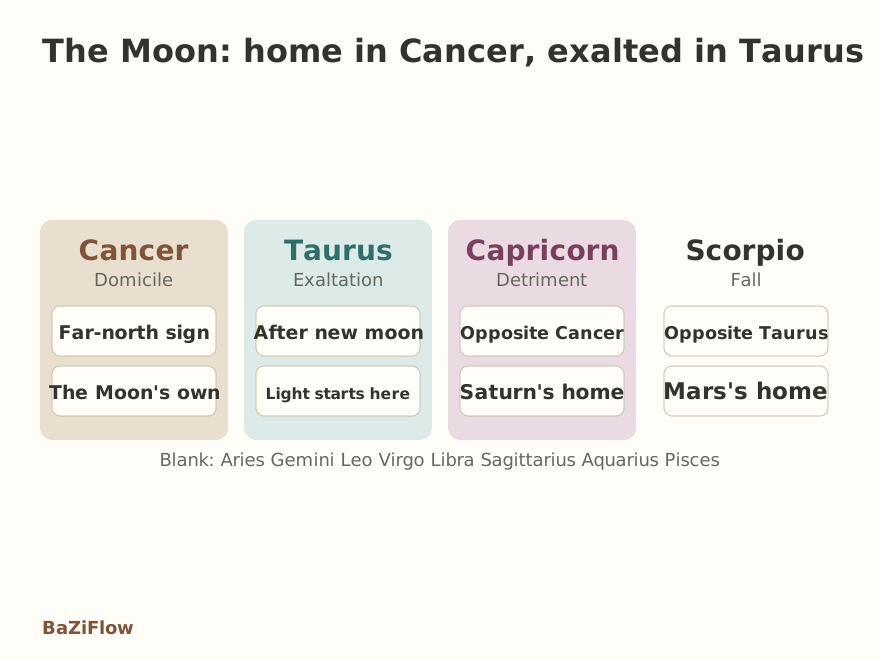
Comparison sketch: the four columns are the positions the site's classical table gives the Moon; detriment and fall are derived from the signs opposite domicile and exaltation.
Across the four columns, Cancer is the home and Taurus the exaltation; Capricorn lies opposite Cancer and is the detriment, and Scorpio lies opposite Taurus and is the fall. The two opposite signs happen to be other planets' homes as well: Capricorn belongs to Saturn and Scorpio to Mars.
Ptolemy's Moon: near, moist and changing with her phase
Ptolemy first gives the Moon's nature:
The Moon chiefly makes moisture. Of all the bodies she is the nearest to the earth, so she is best placed to stir up damp vapors and to loosen and spoil living bodies; because she takes her light from the Sun she also has a modest share of heat.
The other three labels are short. Warm and moist, the Moon is counted benefic together with Jupiter and Venus (I.5); moisture is feminine, so she is listed as feminine with Venus (I.6) and as nocturnal like her (I.7).
Her nature also changes over the month. Chapter 8 divides it by phase:
Enlarge diagram · scroll sideways to read
So one and the same Moon passes through moist, hot, dry and cold within a single month. The site's position table records only the sign layer; the phase layer is not in it.
Taurus is exalted because of a first thin crescent
Why Cancer belongs to the Moon follows the same reasoning as for the Sun, laid out in the Sun in sign and house. Detriment follows from it: Capricorn lies directly across from Cancer and is also Saturn's home, so the Moon is in detriment in Capricorn. The Sun is in detriment in Aquarius, which is Saturn's home too; the signs where both lights lose standing belong to Saturn.
The exaltation, though, has a reason that belongs to the Moon alone:
After her conjunction with the Sun in Aries, where he is exalted, the Moon first appears and begins to gain light in Taurus. Taurus is the first sign of her own triplicity, so it is set as her exaltation, and Scorpio, directly opposite, as her fall.
Enlarge diagram · scroll sideways to read
This hangs the Moon's exaltation behind the Sun's: the Sun is exalted in Aries, the Moon is invisible there, and one sign on she lights up. To look at that sign itself, read Taurus.
Which sign the Moon is in depends on the clock
The Sun takes a month per sign and the Moon is far quicker. Here is a stretch computed by the engine: the Moon enters Taurus at 23:35 UTC on 25 October 2026, stands at 29°22′ Taurus by 00:00 on the 28th, and then changes sign in turn.
Enlarge diagram · scroll sideways to read
In this stretch she spends 49 to 50 hours in each of Taurus, Gemini and Cancer, yet each boundary is a single minute wide. Between 00:00 and 01:30 UTC on the 28th, less than two hours, her state goes from exaltation to no entry at all.
Two exercises
Born at 00:40 UTC on 28 October 2026: which sign is the Moon in?
She enters Gemini at 01:02, so at this instant she is still in Taurus, in exaltation.
And at 01:30 UTC the same day?
It is past 01:02, so she is in Gemini, one of the eight blank signs, with no entry in the table.
Anyone who knows the birthday but not the hour, on a day with a sign change, has two candidate Moon signs and has to keep both.
The same Moon sign can land several houses apart
Count houses the whole-sign way (the Sun article shows how) and the Moon's sign stays put while the Ascendant moves the house number around it:
Enlarge diagram · scroll sideways to read
In Lilly's survey of the twelve houses the third is written up as the Moon's joy, one entry in the traditional list of planetary joys. The highlighted cell has Taurus rising and the Moon in Cancer: in the sign table she is at home, in the house table she stands in her joy house. The two records come from two tables and neither lends strength to the other. Give the chart another Ascendant and the same Moon sign sits in a different house. What the third house covers is in the third house.
Two more exercises
Capricorn rising, Moon in Cancer: which house?
The seventh. Capricorn is the first house and Cancer lies directly across, the seventh sign.
Taurus rising, Moon in Scorpio: which house, and what state?
The seventh; Scorpio is "fall" for the Moon. Sign and house are each recorded on their own.
After the Moon comes the planet that never strays far from the Sun, in Mercury in sign and house.
Questions readers ask next
The Moon is exalted in Taurus. Are people born with the Moon there emotionally steadier?
Exaltation describes the state of the Moon as a body standing in Taurus. Ptolemy's reason is only about her phases: after the new moon her light starts to grow in Taurus. The book draws no conclusion about the character of anyone born.
I know my birthday but not the hour. Which sign is the Moon in?
First check whether the Moon changes sign that day. If she does not, there is one candidate; if she does, keep both candidates. Do not pick the one that seems more fitting, and do not go on to compute a house.
Is "the Moon falls in Scorpio" the same as "the Moon is in fall in Scorpio"?
In the first, "falls" is a verb meaning the Moon's sign is Scorpio. In the second, "fall" is a dignity state name. The Moon stands in Scorpio, so the table records that position as "fall"; the two words just happen to coincide.
Was this article helpful?
Sources & references
- Ptolemy, Tetrabiblos Book I (F. E. Robbins text on LacusCurtius): planetary natures, houses, exaltations ↗
- Deborah Houlding, Traditional Sign Rulerships (2003) ↗
- William Lilly, Christian Astrology (1647), Of the Twelve Houses, pp. 50–56 ↗
- William Lilly, Christian Astrology (1647), Book I, Of the Planets (Saturn pp. 57–61, Jupiter pp. 61–65, Mars pp. 65–68, Sun pp. 69–71, Venus pp. 72–75, Mercury pp. 76–79, Moon p. 80ff; Cazimi p. 113) ↗
Continue reading
The Sun: Home in Leo, Exalted in Aries, and How to Read Its Sign and House ↗
Mercury: Two Homes, Two Detriments, and the Rule That He Never Strays a Sign from the Sun ↗