

Storage: who lives in each storehouse
Content version · · Sources & references
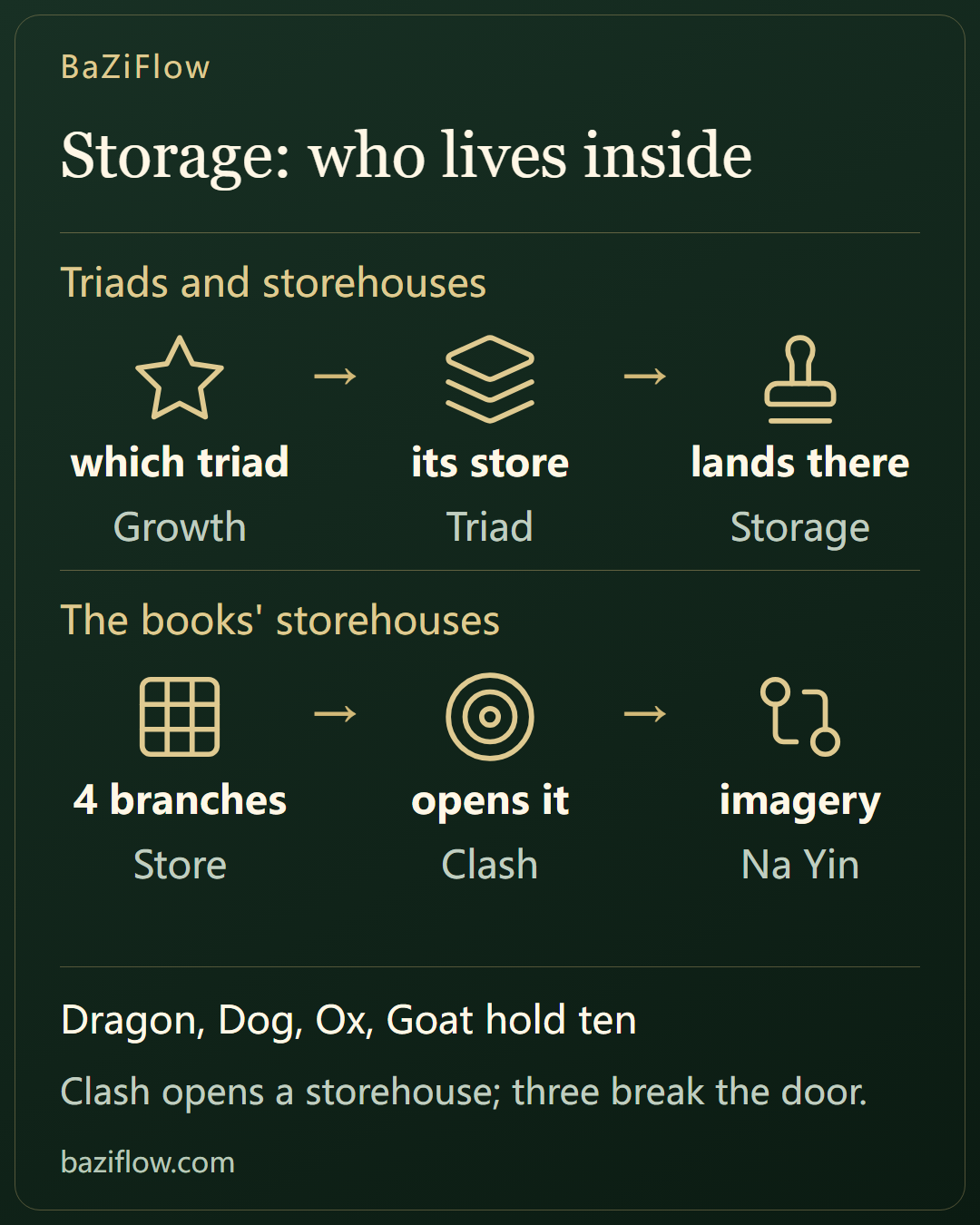
Storage is also called the storehouse, and all ten Day Masters land on Dragon, Dog, Ox and Goat. Three-harmony triads, the Sanming Tonghui on each storehouse, a Di Tian Sui line and Na Yin names explain the cell.
The short version8 min read
Storage is the ninth cell of the twelve life stages and is also called the storehouse: all ten Day Masters land on Dragon, Dog, Ox and Goat, and the Storage of each is the storehouse of the three-harmony triad that holds its Growth.
- All ten Day Masters together occupy only four branches, two or three to a storehouse, and the old books call those four branches storehouses.
- The rule: Storage is the last branch of the triad that contains the stem's Growth. Yang Water is born on Monkey, the Monkey-Rat-Dragon triad ends on Dragon, so Yang Water's Storage is Dragon.
- The books say a storehouse "should be opened": the Di Tian Sui says so briefly, and the Sanming Tonghui calls Dog "the key" to Dragon, while keeping a limit in the line about three Dogs breaking the door.
Read first
Twelve Life Stages and Void Branches: Two Tables, Two References ↗
Strong and weak Day Masters: references, relationship directions and evidence ↗
Storage, also the storehouse: putting finished things away
Storage (墓) comes ninth in the sequence, right after Death. The Sanming Tiyao (三命提要), preserved in the Sanming Tonghui (三命通会), gives it two names:
Storage, also called the storehouse: it is where all things that have succeeded are stored away, as a person at the end of life returns to the grave. Having returned to the grave, one again receives qi, is conceived and is born.
"Storehouse" says that things are finished and put in the barn; "Storage" says that a cycle ends here. The last sentence already hooks up the next cell: after the grave, the cycle begins again with receiving qi and conception.
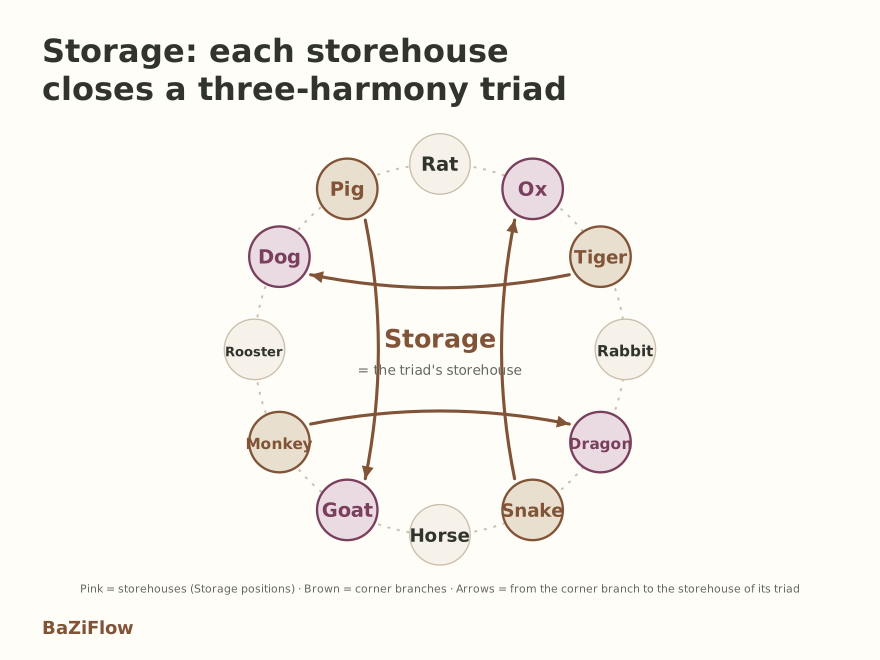
Position sketch: the positions come from the site engine's twelve-stage table; Yin Wood, Yang Fire and Yang Earth share Dog, Yin Fire, Yin Earth and Yang Metal share Ox; the arrows run inside each triad from its corner branch to the storehouse.
Four storehouses, four triads
Why these four branches, and why these stems? The answer is in the three-harmony triads. Taking every fourth branch around the circle gives groups of three: Monkey, Rat and Dragon belong to Water; Pig, Rabbit and Goat to Wood; Tiger, Horse and Dog to Fire; Snake, Rooster and Ox to Metal (see six harmony, three harmony and directional). The last branch of each triad is the storehouse of that element.
Enlarge diagram · scroll sideways to read
The rule is that a Day Master's Storage is the storehouse of the triad that holds its Growth. Yang Water is born on Monkey, Monkey is in the Water triad, and the storehouse of the Water triad is Dragon, so its Storage is Dragon. Yin Wood is born on Horse, Horse is in the Fire triad, and the storehouse of the Fire triad is Dog, so its Storage is Dog. The reason is that Growth to Storage is eight steps, two thirds of a circle, and neighboring branches of a triad are exactly four steps apart, so eight steps leave you inside the same triad.
Dragon, Dog, Ox, Goat: what the book says of each
In its notes on the twelve branches, the Sanming Tonghui (juan 2) spends a line or two on each storehouse. Start with Dragon:
Dragon governs late spring, the muddy wetness in which the roots of all things are nourished. Yang Wood arriving here is in decline, yet there is the leftover qi of Yin Wood; Yang Water arriving here is in storage, yet there is the returning soul of Yin Water.
Yang Wood reaches Dragon at Decline, Yang Water reaches it at Storage, and the book says Dragon still holds the leftover qi of Yin Wood and the returning soul of Yin Water, so Storage is not an empty room. The four storehouses side by side:
Enlarge diagram · scroll sideways to read
The Dog entry says that for a Fire life, meeting Dog counts as "entering the grave". That line speaks of the element: Fire is stored on Dog. The site engine counts by stem, Yang forward and Yin backward, so the stems whose Storage is Dog are Yang Fire, Yang Earth and Yin Wood, while Yin Fire's Storage is Ox; when a book says Fire enters the grave, first check whether it means the element or one stem. The four entries stress different things, but none treats a storehouse as an empty barn: Dragon has Yin Water, Dog has a furnace, Ox has a Metal triad, and Goat has Yin Wood and Yin Fire inside.
A storehouse should be opened
Several books bring up the clash when they talk about storehouses. The Di Tian Sui (滴天髓), in its chapter on the branches, has one line:
On a birth branch beware of agitation, a storehouse should be opened; on a ruin branch that meets a clash, weigh it carefully.
The commentary sorts the branches into three groups: Tiger, Monkey, Snake and Pig are the "four births" and fear agitation; Dragon, Dog, Ox and Goat are the "four storehouses" and should be clashed open; Rat, Horse, Rabbit and Rooster are the "four ruins" and depend on the case. It adds that a ruin branch may welcome a clash when it meets a combination, or welcome a combination when it meets a clash, but neither is as fixed as a birth branch that "must not be clashed" or a storehouse that "must not be shut". The Sanming Tonghui is more specific about Dragon: "Dog is the key and can open what is in the storehouse; if three Dogs clash it, the door is broken, which is not auspicious." The four storehouses clash in pairs, Dragon with Dog and Ox with Goat (the clash rules are in clash, punishment, harm and destruction):
Enlarge diagram · scroll sideways to read
"Should be clashed open" is how these books read a storehouse, and opening has limits: three clashes break the door, and the book puts that boundary in the same place.
How Storage got into Na Yin names
Storage shows up not only in look-up tables. When it names the Na Yin, juan 1 of the Sanming Tonghui uses it directly. Ren Wu (壬午) and Gui Wei (癸未) are called Willow Wood because Wood dies on Horse and is stored on Goat, the leaves fall in high summer and the branches are slight, which the book takes as the softness of wood; Jia Zi and Yi Chou are called Gold in the Sea, and the reasoning includes Metal dying on Rat and being stored on Ox.
Enlarge diagram · scroll sideways to read
What is looked up here is the Na Yin element: Wood reaches Goat and Metal reaches Ox, each falling into its own element's storehouse. The full reasoning for the name is in Gold in the Sea.
Who lives in which storehouse
DragonWater
DogFire
OxMetal
GoatWood
After the storehouse a cycle closes and Severance follows; to see where the four storehouses sit on the whole circle, compare the twelve life stages and void branches.
Questions readers ask next
Are Storage and the storehouse the same cell?
Yes. The Sanming Tiyao says "Storage, also called the storehouse". Calling it the storehouse looks at things finished and put away; calling it Storage looks at the end of a cycle, when a life returns to the grave.
Why does Storage appear only on Dragon, Dog, Ox and Goat?
From Growth to Storage is eight steps, two thirds of a circle. Branches in a three-harmony triad are four steps apart, so eight steps keep you inside the triad that holds the Growth branch, and the last branch of that triad is the storehouse.
When the book says Dog is "the key", does Dragon need Dog to be opened?
That is the Sanming Tonghui's picture of the Dragon storehouse: Dog clashes with Dragon, and the clash is imagined as the force that opens the door. The same passage goes on to say three Dogs clashing at once "break the door, which is not auspicious", so the book's "opening" has limits.
Was this article helpful?
Sources & references
Continue reading
What is Na Yin in BaZi? Why Jia-Zi Gold in the Sea does not replace Yang Wood ↗