

Judgement: trumpet and the risen
Content version · · Sources & references
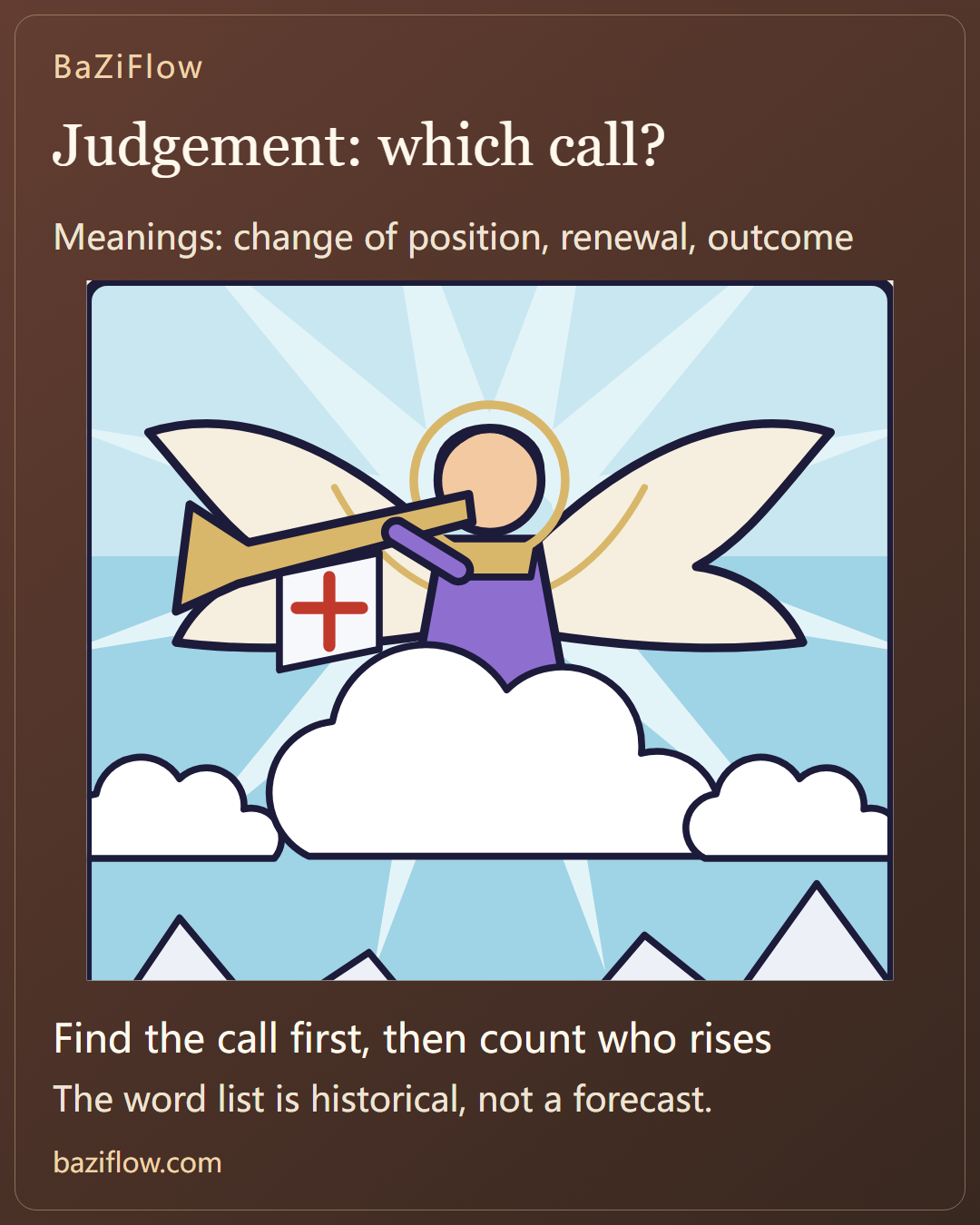
Judgement, which Waite calls The Last Judgment, shows an angel blowing a trumpet and figures rising from coffins with raised arms. Separate the picture, the list and Waite’s inner-summons reading, then re-plan a route.
The short version6 min read
Judgement shows an angel on a cloud blowing a trumpet and people rising from coffins with raised arms. Waite says the summons is heard within the person.
- The picture: an angel among clouds blows a bannered trumpet with the cross on the banner; a man, a woman and a child with its back turned rise from the tombs, and Waite deliberately restores more than these three.
- The list: change of position, renewal, outcome; another account says total loss through lawsuit. Reversed: weakness, pusillanimity, simplicity; also deliberation, decision, sentence.
- Waite reads it as an answer to the summons of the Supernal, heard from within; for those who see no further the card may still show the Last Judgment and a resurrection in the natural body.
Read first
Trumpet, banner, coffins: an angel sounds the horn and those below rise
Waite says this symbol is essentially invariable in all Tarot sets. The great angel is encompassed by clouds, but he blows his bannered trumpet, and the cross as usual is displayed on the banner. The dead are rising from their tombs: a woman on the right, a man on the left hand, and between them their child, whose back is turned.
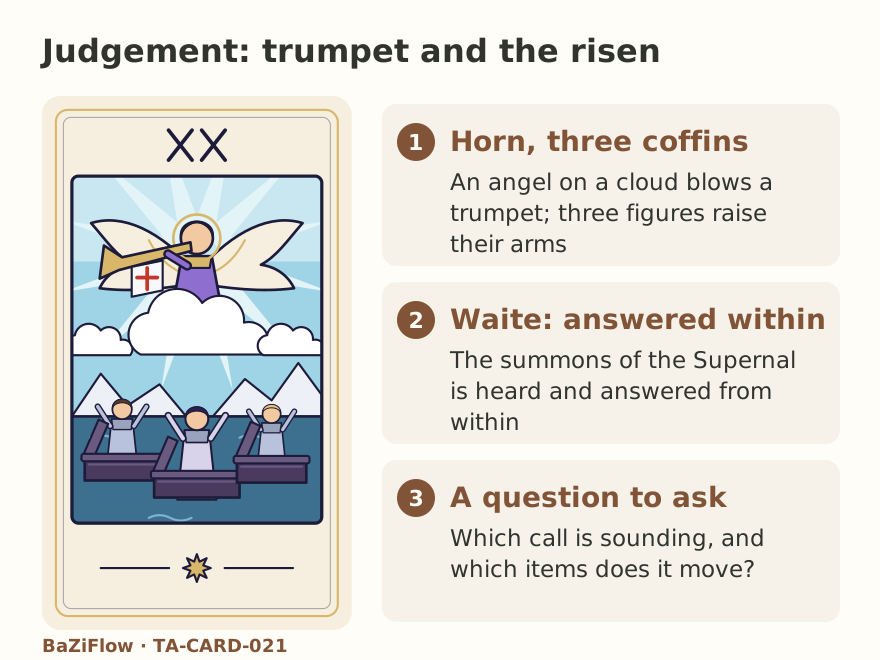
Judgement as BaZiFlow drew it: trumpet and the risen.
But in this card more than three are restored, a variation he thought worth making as illustrating the insufficiency of current explanations. He adds that all the figures are as one in the wonder, adoration and ecstasy expressed by their attitudes.
In the Rider-Waite-Smith original: XX at the top; the angel has curly golden hair and red-edged wings, and blows a golden trumpet hung with a white banner bearing a red cross; clouds gather around him; below on the water float several grey rectangular coffins, and bare grey figures raise their arms, a man at the left, a long-haired woman at the right, a child in the middle with its back turned, and a few more raising their arms in the distance; snowy peaks behind.
Enlarge diagram · scroll sideways to read
The list: change of position, renewal, outcome, and another account of lawsuit
Waite’s divinatory meanings are: change of position, renewal, outcome. Then he brings in another account, which specifies total loss through lawsuit. The three main words all point to a state after change; the other account points the opposite way.
Change of position, renewal, outcome. Another account specifies total loss though lawsuit.
Enlarge diagram · scroll sideways to read
Trumpet, risen, inner call: Waite reads a transformation
In the second half of Part II, Waite moves the picture from outside to inside. He says the card registers the accomplishment of the great work of transformation in answer to the summons of the Supernal, and that this summons is heard and answered from within.
Enlarge diagram · scroll sideways to read
His question is the plainest sentence in the passage:
What is that within us which does sound a trumpet and all that is lower in our nature rises in response, almost in a moment?
Then he leaves room for two ways of seeing it: for those who can see no further, the card continues to depict the Last Judgment and the resurrection in the natural body, and those who have inward eyes may discover more. He adds that it has truly been called in the past a card of eternal life, and so may be compared with Temperance.
Trumpet, risen, inner call: what Waite says of each
- Angel and trumpet
- A great angel encompassed by clouds blows a bannered trumpet, with the cross as usual on the banner. Waite says the summons comes from the Supernal.
- The risen
- The dead rise from their tombs, a man at the left, a woman at the right, a child between with its back turned; here more than three. All the figures are as one in wonder, adoration and ecstasy.
- The inner call
- The summons is “heard and answered from within”. He reads it as the accomplishment of a transformation while keeping the surface picture of the Last Judgment and the resurrection in the natural body.
How to read it: changing a travel route, first find which call sounded
Take the shape of “one call, several figures rise” and apply it to one concrete matter. Four people planned a week along the coast, and one of them proposes switching to a mountain route from the third day.
Find the call
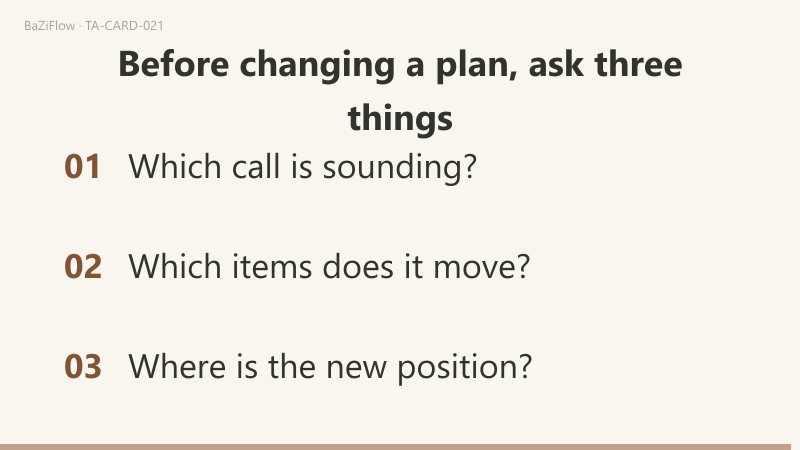
Write in one sentence what set off the change, and mark whether it came from outside (a weather forecast, a companion’s proposal) or from a thought of your own. Waite asks what within us sounds the trumpet.
Count who rises in answer
Go through the booked rooms, the tickets and your companions’ leave one by one, marking each “moved” or “not moved at all”. More than one rises, but not everything does.
Write the new position
After the change, where are you on the morning of day three, and which bookings must be cancelled or remade? This matches “change of position” in the list.
Enlarge diagram · scroll sideways to read
What the call actually moved
Confirmed to move
- Rooms must be rebooked
- Bus tickets need changing
Only assumed to change
- “The whole trip is void”
- “Everything booked is wasted”
To confirm
- Can it be rebooked free?
- Is the pass open this season?
Reversed and neighboring cards: weakness, pusillanimity, simplicity, and “deliberation, decision, sentence”
Waite’s reversed line is: weakness, pusillanimity, simplicity; also deliberation, decision, sentence. The first half describes a person’s condition and the second half the steps of handling a matter, two kinds of words side by side in one line.
Weakness, pusillanimity, simplicity; also deliberation, decision, sentence.
Enlarge diagram · scroll sideways to read
Three neighboring cards and how each writes about change
The comparison Waite names himself
He says Judgement has been called a card of eternal life and so may be compared with Temperance. That card pours from chalice to chalice and its list centers on thrift, moderation and management: it writes about blending, not about rising.
Another card that writes about law
Its list leans toward fairness and the legal side, and its reversed line speaks of severity and bias. In Judgement the words “lawsuit” and “sentence” appear only in the other account and the reversed line, not in the main entry.
The next card: another kind of change of place
The World’s list has “change of place”, close in wording to Judgement’s “change of position”; one stands last in the sequence of major cards, the other is still on the way up at the trumpet’s call, so the contexts differ.
Questions readers ask next
Does Judgement simply mean being judged or sentenced?
Waite’s title for the card is the Last Judgment and its picture is a trumpet and a rising. The main list has no word about being assessed: it says change of position, renewal, outcome. “Deliberation, decision, sentence” sit in the reversed line.
Is Judgement about lawsuits?
The list holds one other account, total loss through lawsuit, and the reversed line has “sentence”. These are old wording and make no judgement on any real case; with an actual case on your hands, the person to ask is a lawyer, not the card.
Why do so many people rise from the coffins?
Waite says the usual picture shows three: a man, a woman and their child. Here more than three are restored, a variation he thought worth making to show that current explanations fall short, and he notes that all the figures are as one in wonder, adoration and ecstasy.
Was this article helpful?
Sources & references
Continue reading
Justice: a sword held up, a scale hung low, and one measure for both sides ↗