

Five of Cups
Content version · · Sources & references
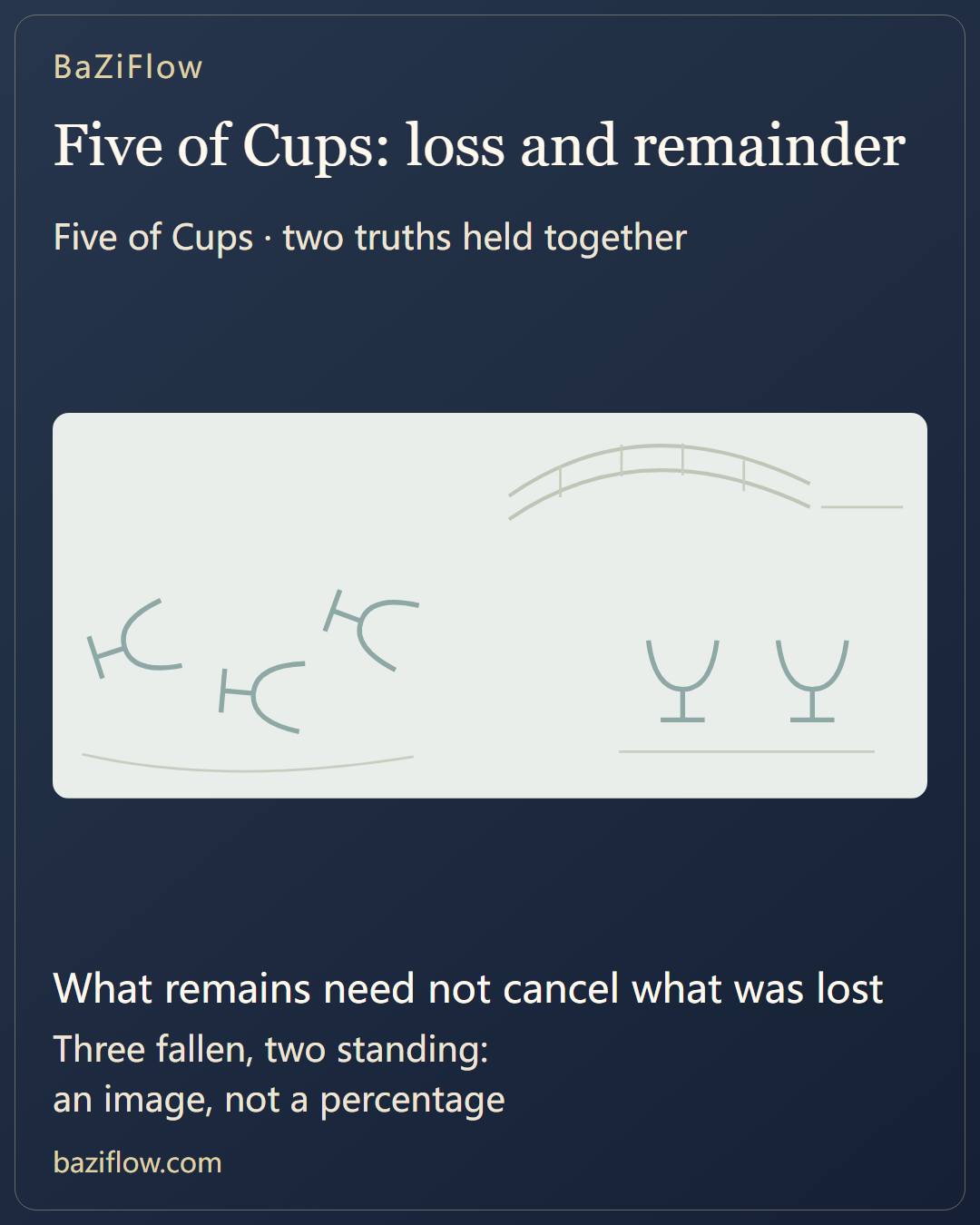
Read the RWS Five of Cups through three fallen cups, two standing cups and a distant bridge, without calculating loss percentages or predicting someone’s return.
The short version6 min read
Three cups have fallen, two remain upright, and a bridge stands in the distance. Waite explicitly places loss beside remainder. The Five need not use what survives to cancel disappointment: loss, available resources and possible next steps can each retain their place.
- Three fallen and two standing cups form a pictorial relation, not a formula for sixty percent lost and forty percent retained.
- Rehearsal recordings do not replace a canceled live occasion; the remaining resource and the missed experience can both be real.
- The bridge shows a route, not a completed crossing; keeping, using and publishing what remains are separate decisions too.
Read first
The source explicitly holds loss and remainder together
On the RWS card, a figure in a black cloak stands with head bowed, turned toward three cups lying on their sides, their contents spilled on the ground; two cups stand upright on the right. Behind the figure a river runs through the landscape, with a bridge in the distance and a small keep on the far bank.
Waite describes a cloaked figure looking toward three overturned cups, with two upright behind and a bridge in the background. His interpretation says that something has been lost while something remains. Other historical assignments concern expectations around inheritance and marriage, which this article does not treat as predictions of actual legal, financial or relationship events.
The count is pictorial, not quantitative evidence about life. Three and two do not mean sixty percent lost and forty percent saved. They do not identify a fixed number of people or opportunities.
Nor does the figure’s attention license a judgment that the reader is deliberately ignoring good things. The picture is not a clinical observation of a person. A useful application can notice both sides without turning the standing cups into a rebuke.
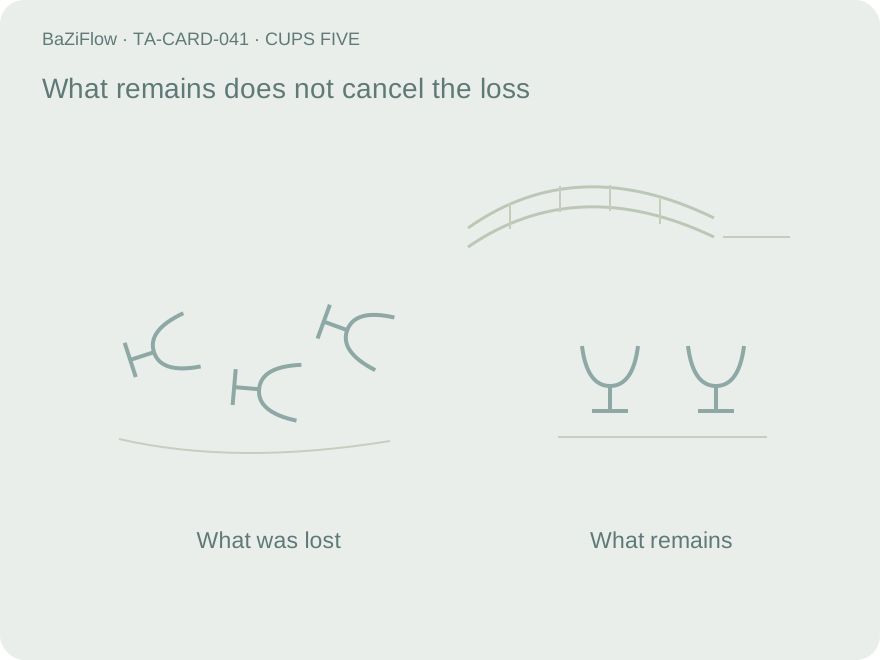
An original BaZiFlow loss-and-remainder diagram for the Five of Cups; the count is not a percentage and the bridge does not guarantee recovery or return.
Three fallen
- Loss is pictured
Two standing
- Something remains
Distant bridge
- A route exists, not a completed crossing
Two remaining cups are not an argument against disappointment
A choir’s long-prepared performance is canceled. Rehearsal recordings remain, the singers have learned the music and their coordination has developed. The anticipated occasion of singing together before an audience nevertheless did not happen.
Those statements do not need to cancel each other. The Five of Cups can prompt a record that preserves both a real disappointment and real remaining material. It does not require a person to feel better immediately because something can still be named on the positive side.
This is a modern teaching example, not a diagnosis of grief or a forecast of misfortune. The card cannot determine how much an event matters to someone or when they should be ready to use what remains.
For the canceled performance, the distinction might look like this:
| What did not happen | What remains, without replacing it |
|---|---|
| This public performance | Rehearsal recordings and learned music |
| The planned exchange with an audience | Coordination developed among singers |
| The shared occasion on that date | A future choice about whether to work together again |
The columns need not have equal value. A recording does not automatically substitute for a live event. At the same time, canceling the event does not make every hour of learning nonexistent.
Someone may want to keep the recordings but not listen for now. Another member may want to explore another venue. Those are different responses to the same available material. They should be heard rather than merged into a compulsory new plan intended to make the loss worthwhile.
Keep
- Locate recordings and backup
Use
- Whether to replay or edit
Share publicly
- Seek the participants’ agreement
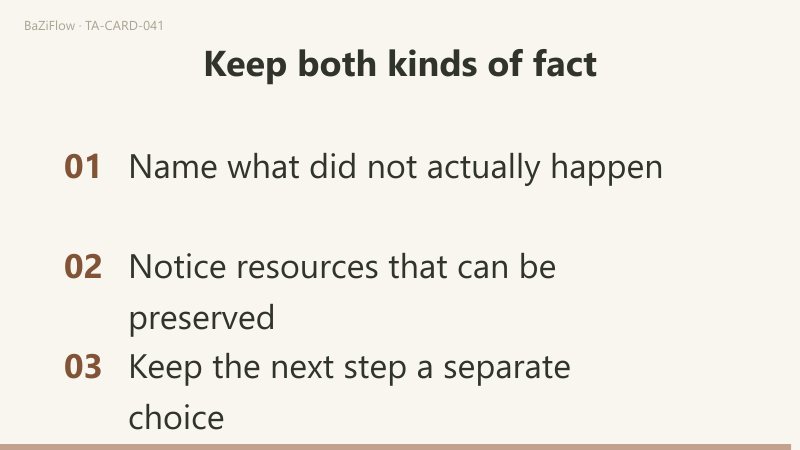
These are three decisions, not a compulsory sequence after storage.
A bridge is not a deadline to move on
The diagram leaves distance among the fallen cups, the standing cups and the background route. It adds no arrow insisting that the viewer cross immediately. Waite’s description identifies a bridge; it does not say that the figure has already crossed it.
Using the route as a question about possible next steps is therefore a modern extension. It cannot promise a timetable for recovery. A new performance would need new agreement, available space and preparation, not simply the symbolic existence of a bridge.
There may be practical actions that preserve options without committing everyone. Confirm where the recordings are stored and which cancellation arrangements need closing. Publishing recordings or restarting rehearsals, however, should remain separate decisions with the people concerned.
A backup can be made without playing it immediately. Later, an editing proposal can be discussed without pretending that storage already constituted agreement to public release. Remaining resources expand possibilities; they do not select one on everyone’s behalf.
Locate what can be kept
Locate recordings and scores without requiring immediate listening.
Close the cancellation tasks
Identify any notices or venue matters still open.
Ask separately about the future
Editing, release and another performance each need terms and agreement.
Reversal does not identify who will return
Waite’s main reversed list includes news, connections and return but also false projects. The supplementary chapter adds further favorable and family-related predictions. Selecting only a return term does not justify telling someone that a particular former partner will contact them.
These assignments also cannot settle a family or property matter. The additional-meanings chapter acknowledges inconsistencies and limited pictorial links, so the source itself should not be presented as one seamless, certain forecast.
An upright and reversed method might ask whether the reader wants to revisit a remaining resource. State that as a present-day question, not as knowledge of when a person will recover or someone else will reappear.
Compare the Four of Cups, where the example concerned whether a new offer fits a current need. Here there is a specific occasion that has been lost. Calling both situations negativity would obscure their different facts.
End with three distinct records: the arrangement that cannot now occur as planned, the material still available and the follow-up not yet decided. What remains can be acknowledged without making it an excuse for what did not happen.
Original event
- Canceled; expectation unmet
Possible new event
- Needs dates, willingness and venue
Questions readers ask next
Does the Five of Cups tell someone to look on the bright side immediately?
Waite recognizes both loss and remainder without saying that one erases the other. A modern reading can notice resources while allowing disappointment. The two standing cups need not become a demand that someone recover their mood at once.
Can three fallen cups be counted as a sixty percent loss?
No. The count belongs to the picture. Opportunities, experiences and relationships do not have a shared unit that permits that calculation. Preserve the visible number and orientation without turning them into a score or a fixed count of people.
Do the bridge and reversed return mean someone from the past will reappear?
They do not establish that. The bridge is a background route, and the reversed list contains several meanings, including false projects. Future contact or renewed cooperation needs actual messages and willingness, not a person and date inferred from the image.
Was this article helpful?