

What are oracle lots?
Content version · · Sources & references
Learn to identify a lot within its source, distinguish verse from story headings and commentary, and avoid treating a number as a universal fortune ranking.
The short version6 min read
A lot number is a way to find an entry, not a complete reading. The place, collection and actual wording identify the material; a poem, an allusion and a modern explanation perform different jobs.
- A number locates an entry within a source rather than rating a future outcome.
- Keep the slip’s wording separate from interpretations added later.
- A shared name or number does not establish identical entries.
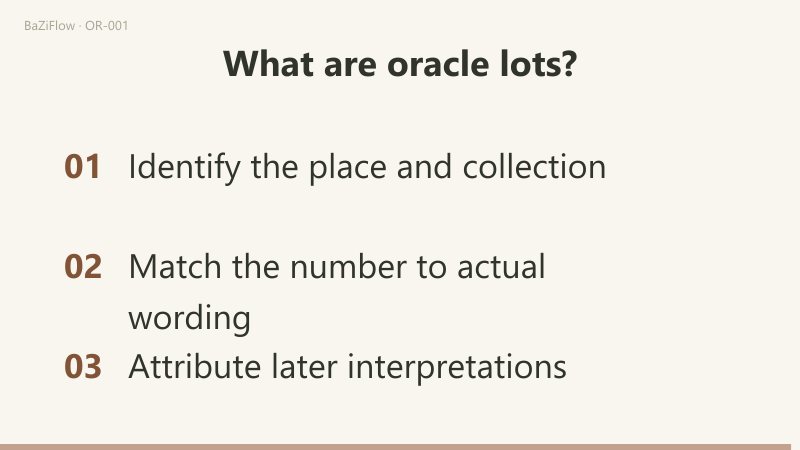
A lot number identifies an entry; it does not rank your future
“I drew number eight. What does it mean?” This question leaves out the collection to which that eight belongs. An oracle-lot number helps locate an entry within a particular source. It is not a universal score, a ranking of good fortune, or automatically a count of days before something happens.
Here, “oracle lots” refers to a religious and cultural practice in which a drawn lot is connected with written material and interpreted in relation to an inquiry. The physical stick, its identifier, the text, and the explanation are related components. Treating them as interchangeable makes it easy to attach the wrong words to a number.
Number alone
- Lot eight
Located material
- Place, collection, entry
Locate the entry, then distinguish its layers
- Lot number
- An identifier used to locate an entry within a specified collection.
- Commentary
- An attributed interpretation of a text or story, rather than automatically part of the original verse.
Read the object before reading a prediction
A slip may contain a number, a poem, a story heading, a grade, topical notes, or later explanatory prose. Not every collection has the same fields. Record what the particular object actually contains rather than filling absent sections with a story found elsewhere.
Hsing Tian Kong's official FAQ distinguishes confirming a lot number from obtaining its corresponding poem slip. That supplies a concrete example of the link between an identifier and a text. The identifier alone is not the text, and receiving the text is not yet an explanation of it.
For an online image, retain enough of the page to identify the source and edition. A cropped number can be ambiguous; a cropped poem can lose its collection label. If someone introduces additional numerological rules, those need their own evidence. They do not follow merely from the fact that the slip has a number.
A source-bound example with four fields
An article by Huang Yun-hsi in Lungshan Temple's January 2019 magazine, issue 43, associates its eighth lot with a Fan Wengong story heading and a poem beginning with an image of long-cultivated pines and cypresses. The relevant printed page is 33. We use this bibliographic pairing, not the modern author's full commentary.
| Field | What is recorded in this example | What the field does |
|---|---|---|
| Source | Lungshan magazine, issue 43, 2019, printed page 33 | Bounds the material being checked |
| Entry | Lot 8 | Locates the item |
| Text cue | Opening phrase about pines and cypresses | Helps match the wording |
| Story heading | Fan Wengong cutting pickles and dividing porridge | Points to a narrative reference |
Matching these fields confirms a location in a particular publication. It does not demonstrate that a present-day reader will reproduce the historical person's life, and it does not turn the story's dates into dates for a modern event. Locating an item and validating a prediction are different tasks.
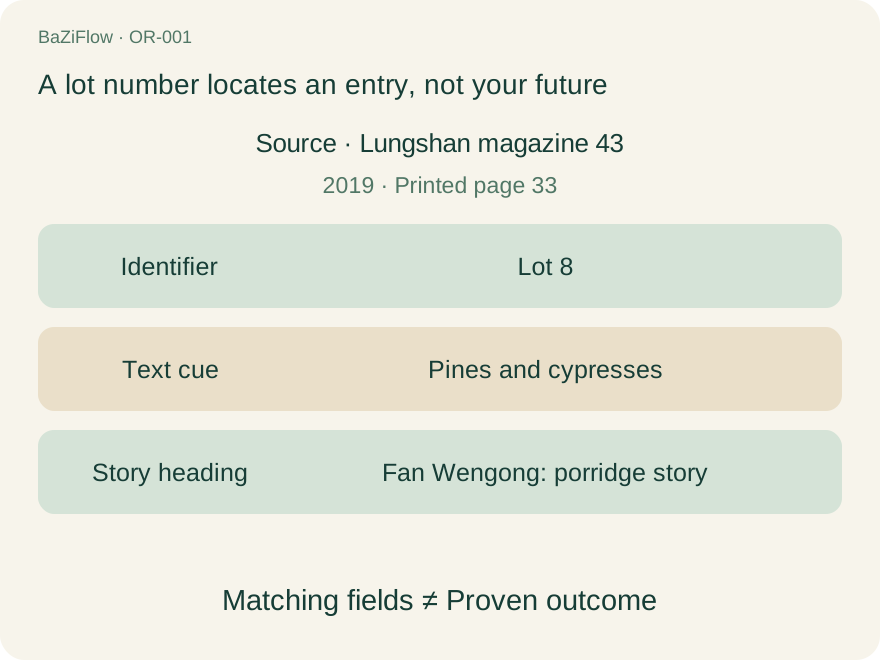
Original BaZiFlow field diagram, redrawn to explain the relationship of the data without reproducing the magazine's artwork or layout.
Issue 43 / page 33
- Field function
- Bound the publication
Entry eight
- Field function
- Locate the item
Pine-and-cypress opening
- Field function
- Match the wording
Fan Wengong heading
- Field function
- Identify a narrative layer
A story heading is not a script for the questioner's identity
A poem can use landscape, movement, or seasonal imagery. An attached narrative may offer a way of reflecting on that imagery, but it is not necessarily a word-for-word translation of the verse. A later interpreter adds another layer when relating either one to a contemporary situation.
Ask which details are present on the page and which connections the interpreter has supplied. Reading an image as a prompt to consider long preparation is an analogy. Identifying a particular colleague as the person who will intervene adds a factual claim about someone. The vividness of the analogy does not establish that claim.
A familiar story title also does not establish the historical status of every detail in its popular retelling. A chronicle, a later anecdote, and a modern explanation need separate attribution. The article on poem, allusion, and commentary develops these distinctions.
Textual image
- Pines and cypresses
Modern analogy
- Long preparation
Additional claim
- A colleague will intervene
Similar collection names do not establish identical entries
Senso-ji's official FAQ calls its omikuji Kannon Hyakusen, a hundred-lot Kannon collection. A shared devotional name is not sufficient evidence that its numbers and wording can be exchanged with every Chinese-language Guanyin collection. That requires comparison of the actual entries.
If all that survives is “Guanyin lot eight,” begin with the temple, booklet, or page from which it came. If the original cannot be recovered, retain the edition uncertainty. The first search result bearing the same number is not automatically the missing slip. See why the same number can have different versions.
Local procedures should be kept local as well. A site's explanation of how to obtain or handle a lot is evidence for that site's practice, not a universal ritual manual. Identifying the text remains a separate task that can continue after the visit.
Similar devotional name
- Established
- A naming connection
- Still to compare
- Entry numbers and wording
A remembered number
- Established
- One identifier
- Still to compare
- Its place and collection
Keep enough information for another reader to check
A practical record preserves the place, collection name, number, complete wording, and date obtained. For a publication, add its issue and page; for a web entry, preserve its address. Store a later explanation with its own author and date so it cannot be mistaken for part of the original poem.
These are reading and documentation suggestions, not extra ritual requirements. Sharing the edition does not require publishing the questioner's name, address, or private question. The article on recording version and source explains how to retain useful provenance.
An initial reading is stronger when it can answer three modest questions: which entry is this, what does the source actually say, and what has been added in interpretation? Those answers give the number an appropriate role without asking it to guarantee an outcome that the record has not established.
Source
Place, issue, page or address
Entry
Number and complete wording
Later explanation
Author, date and assumptions
Recover the original source
If only “lot eight” remains, look for the place, photograph or page. Do not substitute the first search result.
Compare two different fields
Check both the number and the wording in that source. Identical numbers with different text remain a version difference.
Attribute an interpretation
Separate printed words, a story heading and a modern workplace analogy. Identify who supplied the analogy and when.
Questions readers ask next
Can a number alone supply a reading?
It supplies a search clue. The place, collection and wording remain necessary to identify what is being read.
Does every lot have an allusion?
Collections differ. Record the fields present on the actual slip or source page instead of supplying a missing heading from elsewhere.
Can similarly named collections exchange their numbers?
Their shared name is insufficient. Compare the actual versions and entries before identifying a correspondence.
Was this article helpful?
Part of a learning path
Oracle lots: from versions to real-world thinking · Step 1 of 1 available