

Symbols, claims and evidence
Content version · · Sources & references
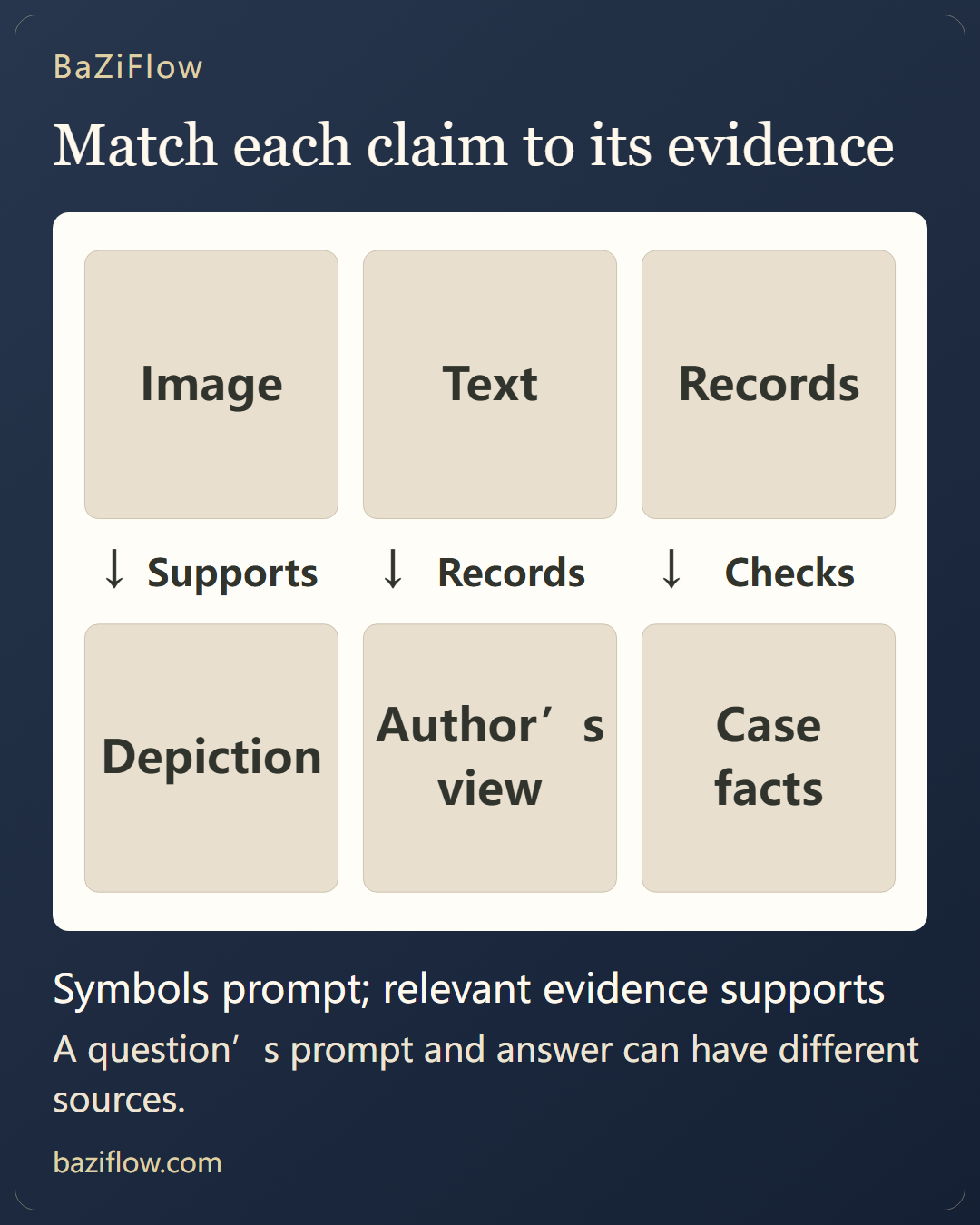
Use the Tower to distinguish a recorded card, an author’s interpretation and a claim about a real project. A prototype-review example shows how an association can become a check without becoming a prediction.
The short version6 min read
Drawing the Tower, reading its author’s interpretation and finding conflicting labels are different claims. An image may prompt a check, a text documents a view, and actual records establish a specific condition. Keep each contribution and its scope clear.
- Depictions, authorial views and real-world claims need different sources. The word therefore cannot supply a missing evidential connection.
- An image can prompt a useful inspection while documents establish the finding. Preserve both contributions without assigning the finding to prediction.
- Two conflicting labels establish a mismatch, not which label is correct. Resolve that through the intended design rather than expanding the claim.
Read first
Ask what the evidence is evidence of
A record can establish that the Tower was drawn. Waite's text can establish how he discussed its symbolism. Neither, by itself, establishes that a particular project will fail. These are three different claims, even when they appear in consecutive sentences.
The error often sits inside a small connecting word: “The Tower appeared, so the plan is doomed.” The first clause concerns a card selection; the second concerns an external outcome. Proximity does not supply the missing evidence. An image may provoke a strong reaction without acquiring the ability to settle the project's condition.
This distinction allows symbolic reflection to remain available. It simply asks the writer to say when a description has become an association, and when an association is being promoted into a factual claim.
Draw record
- Tower drawn
- Identifies the card
Project claim
- Project will fail
- Needs project evidence
The subject and claim change; therefore cannot replace an investigation
Read the author in the right context
In his symbolic discussion of the Tower, Waite compares different explanations and favours language about a house of doctrine or falsehood being broken. He is not merely identifying a literal building destined to fall. His separate divinatory list includes more direct language of calamity and difficulty. The section and purpose matter when reporting his position.
The historical text is primary evidence for the author's ideas. It is not a contemporary inspection report for the reader's life. Its religious metaphors should remain attributed to that context rather than quietly becoming universal psychological facts. Preserving different interpretations is also preferable to selecting whichever line matches an expected outcome and calling that confirmation.
The National Archives artwork-analysis resource asks for evidence in the work or the maker's context and for additional material. That educational distinction is relevant to studying an image. The resource is not a study validating tarot predictions, and citing it does not transfer institutional authority to a divinatory claim.
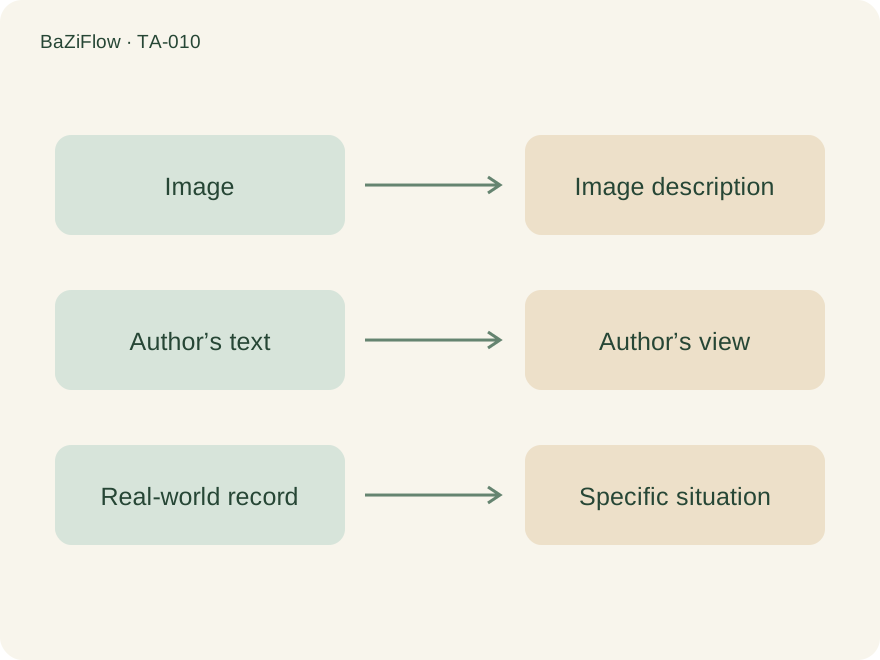
Original BaZiFlow evidence map. The links pair sources with the statements they can support, not with claims of predictive validation.
Follow an association into a check, not a verdict
Suppose the Tower prompts you to inspect the structure of a website prototype. This is an original practice example. A useful question might be whether the navigation labels agree across screens. The answer comes from comparing those screens, not from the card's title.
If two screens use conflicting labels for the same destination, record the exact discrepancy. That supports a narrow statement about the prototype. It does not support a retrospective claim that the Tower foretold the entire project's collapse. If no discrepancy is found, the association may simply have produced no new finding.
| Statement | Appropriate evidence | Scope of the conclusion |
|---|---|---|
| The Tower was drawn | The draw record | Identity of the selected card |
| Waite proposed a particular symbolic reading | The specified passage | An author's historical view |
| Two navigation labels conflict | The actual screens | A concrete inconsistency to resolve |
The source of a question and the source of its answer can differ. A symbol may have prompted the inspection, while a document or direct comparison supplies the finding. There is no need to erase the first contribution, but the second should not be reassigned to the card as predictive credit.
Do not broaden the initial idea until every minor imperfection counts as structural collapse. If the claim can always change its object and scale after inspection, it becomes difficult to say what was actually proposed.
Teaching example
Same destination
- First place
- Screen A: Resources
- Second place
- Screen B: Library
- Established difference
- Two different labels
Constructed example; the mismatch alone does not decide which label should remain
“Possibly” does not replace a missing reason
Changing “the project will fail” to “the project may fail” reduces certainty without adding project-specific evidence. A more accountable sentence is “This image makes me want to check this feature; I do not yet know whether it has a problem.” That reports an association and identifies an investigation.
The same distinction applies to claims about other people. A figure looking away does not establish that someone refuses communication, and a cup does not disclose a person's emotional state. If a participant supplies a relevant account, label that as the source. Do not retroactively describe the information as something the image independently revealed.
Subject and time matter too. A description of a painted figure, an author's historical belief and a friend's present circumstances refer to different subjects and contexts. Gentle wording does not repair a silent substitution between them. Sometimes the only supported outcome is a feeling or an unanswered question, which can be recorded without converting it into a fact about someone else.
A prompt and a finding have different sources; there may be no new finding
Edit a claim before softening its tone
Take a draft that says, “The Tower means the prototype launch will fail.” Before changing its tone, underline what could be checked: which prototype, what failure, and by when? No such details are supplied by selecting the Tower. Editing should expose this missing step rather than surround it with reassuring language.
Instead of checking only whether the whole reading sounds cautious, find its specific claims about people, dates, causes or outcomes. Ask which source supports each one. If the answer is only a card name or a symbolic keyword, narrow the statement to an association or a question still requiring evidence.
Preserve the original wording, the revision and the information needed. For a website prototype, replacing a prediction of failure with a check of two navigation labels changes the kind of claim. Once the mismatch is verified, state it separately and accurately. The result need not be dramatic to be useful.
Single-card practice offers a way to retain impressions and corrections. Relationship questions considers the additional problem of speaking about other people's choices. Symbolic reflection can help generate questions, while conclusions about a particular situation should remain answerable to evidence from that situation.
Identify the specific claim
Mark the person, time, object and causal connection.
Find matching material
A card name cannot replace a screen, nor an author’s view a participant’s account.
Write the inspected result
Report a label mismatch when found, or no new finding when none appears.
Questions readers ask next
Why can a primary text not establish the project’s real outcome?
Its evidential role depends on the question. Waite’s text establishes what he wrote, but it is not a current inspection of a prototype. Actual screens and the intended design are needed to establish and resolve a labelling discrepancy.
Can I say an image helped me discover a problem?
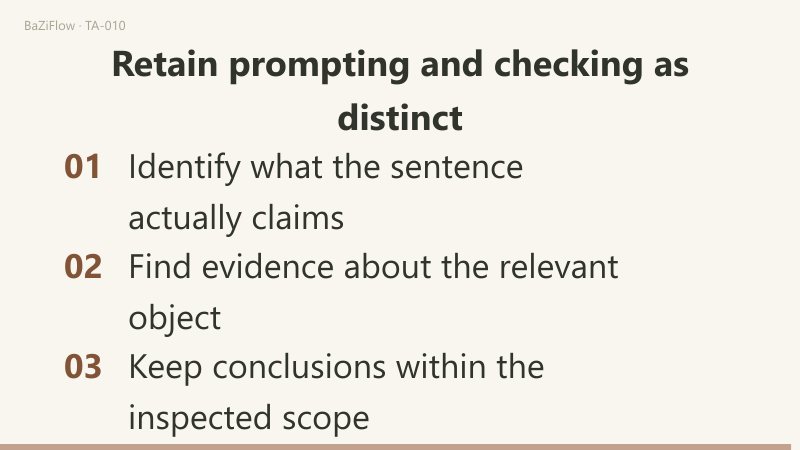
Yes, if the help is described as prompting an inspection. The existence, location and correction of the problem come from later information. Retain the distinct contributions of prompting and checking instead of merging them into prediction.
Does adding possibly make a claim evidence-based?
It lowers certainty without adding a reason. Identify the association, the specific object to inspect and what has actually been found. If no check has occurred, retain the proposed interpretation as a question.
Was this article helpful?