

Temperance: water between two cups
Content version · · Sources & references
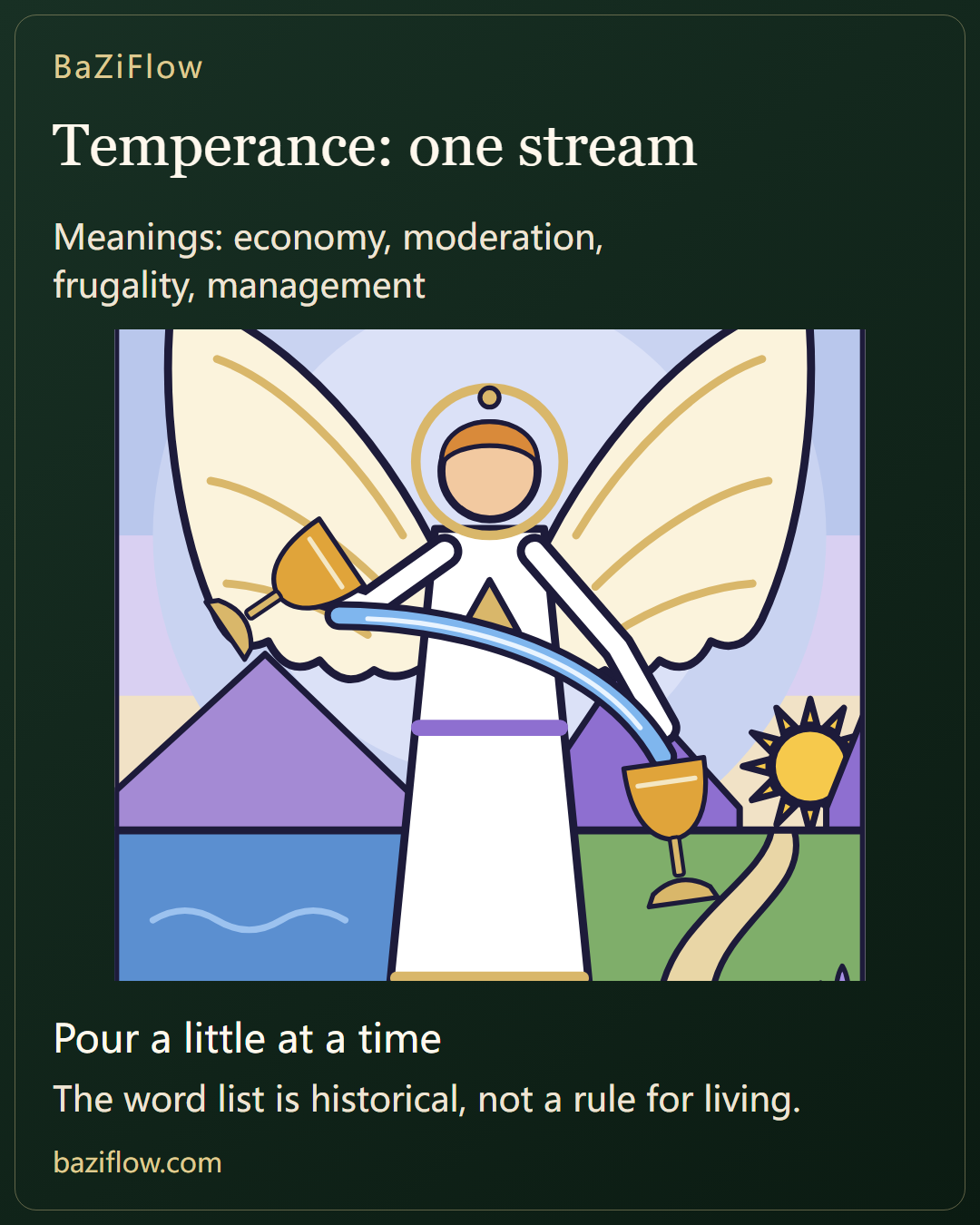
Temperance shows a winged figure pouring water between two cups, yet its list is economy, moderation, frugality, management. Separate picture, list and the readings Waite set aside, then practice relaying a complaint.
The short version8 min read
Temperance is water running between two cups. Waite's list is made of household words while his description speaks of the essences of life, so the two layers have to be laid side by side.
- Waite writes a winged figure pouring the essences of life from chalice to chalice, one foot on earth and one on waters, a direct path rising toward a great light; he says the figure is neither male nor female.
- The divinatory list is economy, moderation, frugality, management, accommodation. Part II renounces the conventional emblems and meanings and explains the name as tempering, combining and harmonising the psychic and material natures.
- The reversed list runs in two strings: churches, religions, sects, the priesthood, and disunion, unfortunate combinations, competing interests. The practice takes the stream between the cups: part land from water, pour a little at a time.
Read first
The picture: a stream from cup to cup, one foot on land, one on water
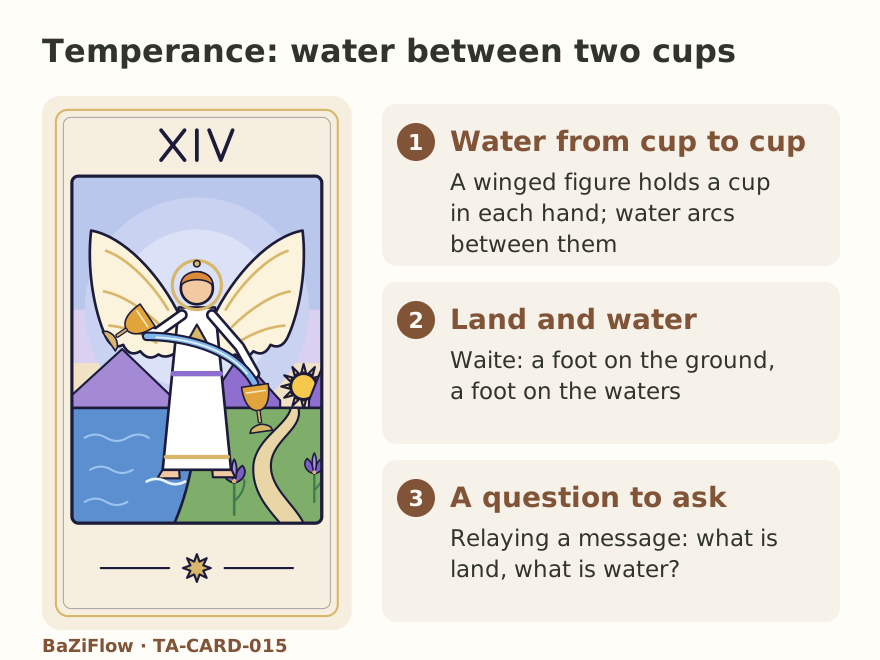
Waite begins with a winged figure: the sign of the sun is on its forehead and on its breast are the square and triangle of the septenary. He says he speaks of it in the masculine sense, but that the figure is neither male nor female. The figure is supposed to be decanting the essences of life, one chalice into the next.
One foot stands upon the earth and one upon waters, which is said to illustrate the nature of the essences. A direct path goes up to certain heights on the verge of the horizon, and above there is a great light, through which a crown is seen vaguely.
BaZiFlow's original Temperance with three ways to read it
On the RWS card: a golden-haired figure with a gold disc on the forehead and, on a white robe, a triangle inside a square; great wings behind with rays of light above; two gold cups with a stream running from one to the other; one foot in the water and the other on a stone at the bank; yellow irises at the right and, at the left, a path winding toward distant hills with a burst of light at the pass.
Read it from the top down: the cups, the feet, the path.
Enlarge diagram · scroll sideways to read
What Waite lists: economy, moderation, frugality, management, accommodation
Waite's divinatory meaning is five words:
Economy, moderation, frugality, management, accommodation.
The five fall into three small groups: economy and frugality are about how much is spent, moderation about where to stop, management and accommodation about how things are arranged. They are all words of everyday household life, while Part II describes a winged figure and the essences of life, and the tone of the two places is far apart.
Enlarge diagram · scroll sideways to read
Cups, feet, path and light: what he wrote, and the old readings he set aside
The symbols Waite writes down gather in three places: the cups and water, the feet, the path and light. For each he gives the look, and for only one he adds a purpose.
What Waite wrote about each of the three
- Two cups, the water
- Waite: the figure is supposed to decant the essences of life, one chalice into the next. He writes an act and does not say what each cup stands for.
- Foot on land, foot on water
- Waite: one foot on the earth and one on waters, "thus illustrating the nature of the essences". It is the one place he adds a purpose, and he does not go on to say what that nature is.
- Path and light
- Waite: a direct path goes up to heights on the verge of the horizon, with a great light above through which a crown is seen vaguely. What the crown is, he does not say.
Enlarge diagram · scroll sideways to read
Then Waite sets some older readings aside. All the conventional emblems are renounced here, he says, and so are the conventional meanings: changes in the seasons, the perpetual movement of life, even the combination of ideas. It is also untrue, he adds, to say that the figure symbolizes the genius of the sun, though it is the analogy of solar light, realized in the third part of our human triplicity.
The name too is given "fantastically": it is called Temperance because, when the rule of it obtains in our consciousness, it tempers, combines and harmonises the psychic and material natures. Under that rule we know in our rational part something of whence we came and whither we are going.
How to read it: pour one complaint from one cup into another
The act in the picture is pouring: water runs from one cup to another, one foot is on earth and one on water, and a path lies ahead. Put onto a message passed along at work, it becomes three moves. The picture is borrowed, the steps are ours, and nothing like them appears in Waite.
One foot on land, one on water: part them first
Split what you are about to relay into two kinds: what can be checked (which day, what failed, what the log shows) and what shifts (tone, feeling, your own guess). The first is the land under your feet; the second is water.
Cup to cup: a little at a time
Do not tip the whole cup over at once. Relay one point, wait until the other person has taken it, then pour the next. Pour the checkable cup first.
The path ahead: end on a next step
After each small pour, say who does what next and when you will report back. Wherever the water runs, a next step has to catch it.
Say a client sends a heated email on Friday complaining that exports keep failing, and you must pass it on to a developer. The water between the two cups can be sorted like this:
Enlarge diagram · scroll sideways to read
What one cup can hold
Poured in
- Facts you can check
- The one step you need
Left outside
- Guesses about their tone
- Conclusions not yet found
After pouring
- Ask what was received
- Agree who replies, and when
Reversed and neighboring cards: churches, disunion, competing interests, and three cards beside it
Waite's reversed list runs in two strings:
Things connected with churches, religions, sects, the priesthood, sometimes even the priest who will marry the Querent; also disunion, unfortunate combinations, competing interests.
The first string points to religious matters and the text does not say why; the second, disunion, unfortunate combinations and competing interests, looks just like tempering, combining and harmonising when it has not succeeded. Calling the second string 'harmony that failed' is the reader's sorting of the list; the text does not put it that way.
Enlarge diagram · scroll sideways to read
Three cards beside it
Also pouring, a very different list
On the Star card, the pouring is done from two great ewers over sea and land; its list is loss, theft, privation, abandonment, and by another reading hope and bright prospects.
Two cups in two pairs of hands
In the Two of Cups each cup belongs to one person and the cups meet in the middle; in Temperance both cups are in one pair of hands and the water runs between them. One asks what each side said, the other how to pour.
Also named for a virtue
In Part II Waite calls Strength "Fortitude"; its list is power, energy, action, courage, magnanimity. One leans toward effort, the other toward proportion.
Enlarge diagram · scroll sideways to read
Questions readers ask next
Does Temperance simply mean "balance"?
The list has moderation and management, but "balance" is not in it. Waite also says that the conventional meanings, changes in the seasons, the perpetual movement of life and the combination of ideas, are renounced here. "Balance" is a later teaching reading, so say so when you use it.
What does one foot on land and one on water mean?
Waite says only that it illustrates "the nature of the essences", and he does not go on to say what that nature is. Reading water as feeling and land as reality is a later teaching borrowing.
What does Temperance mean reversed?
Waite's reversed list has two strings: one about churches, religions, sects and the priesthood, even "the priest who will marry the Querent", and another of disunion, unfortunate combinations and competing interests. The first string he does not explain.
Was this article helpful?
Sources & references
Continue reading
The Lovers: two unveiled people, a light above, a tree behind each ↗