

Four of Cups
Content version · · Sources & references
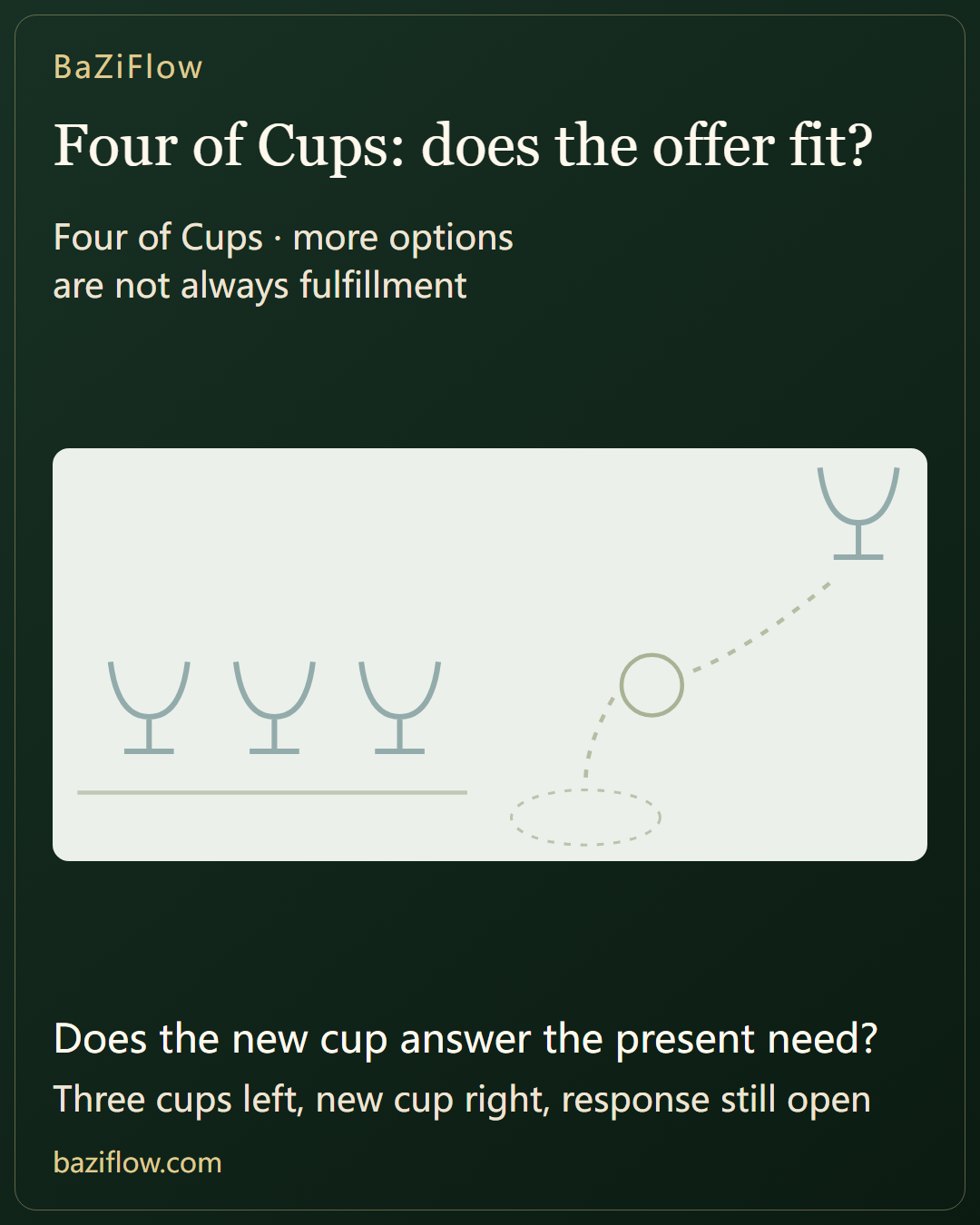
Read the RWS Four of Cups through dissatisfaction and an offered cup, distinguishing fit, available information and choice without moralizing refusal or diagnosing a mood.
The short version6 min read
Three cups stand before the figure and another is offered from a cloud, yet consolation does not arrive. The Four’s tension is that more options and a met need are not the same thing. A modern reading can turn dissatisfaction into a specific question of fit.
- The source sets three present cups, another offer and an unconsoled figure together; the fourth is not automatically the right answer.
- Similar reluctance can arise from repeated content, conflicting dates or missing information, each calling for a different response.
- Reversed new instruction and new relations are historical meanings; actual new information may change a judgment without erasing other limits.
Read first
What the original description does and does not settle
On the RWS card, the young man sits on the grass against a large tree, legs crossed and arms folded. Three cups stand in a row in front of him, and a hand coming out of a cloud on the left offers a fourth.
Waite describes the young person beneath a tree, looking at three cups on the grass, while an arm from cloud offers another. His interpretation emphasizes dissatisfaction and lack of consolation from the additional offering. That is the source’s account of the scene.
It does not assign the first three cups to three previous opportunities in your life or the fourth to a destined benefactor. Nor does it establish that accepting something new will improve the reader’s situation. Matching needs and options is our contemporary application, not a hidden factual mapping in the number of cups.
Keeping those limits also avoids a reverse assumption: the card does not prove that the workshop is unsuitable. The point is to examine its actual content instead of letting either the novelty or the reluctance decide the facts in advance.
Waite’s RWS Four of Cups places three cups before a seated figure and another offered from a cloud. It is tempting to narrate the new cup as the obvious answer that the figure foolishly refuses. But a pictured offer does not tell us whether a particular real-world opportunity suits the reader.
The original interpretation does use judgmental language for dissatisfaction and weariness. This article reports that historical characterization without adopting it as a diagnosis or reproach toward someone who is not interested. A refusal need not be ungrateful, and a quiet posture does not establish a mental-health condition.
The teaching question is more limited: what need remains unmet, and what does the new proposal actually provide?
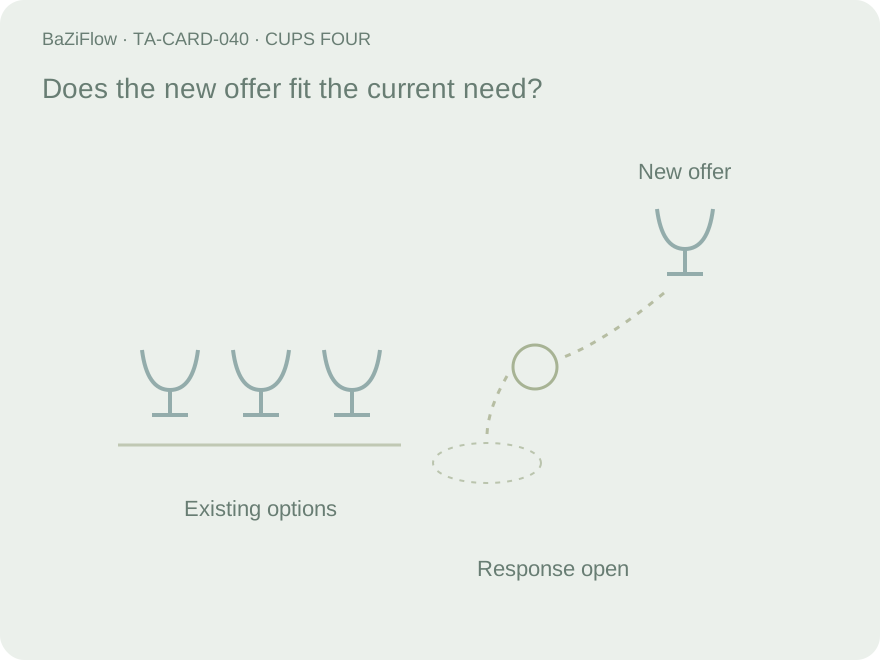
An original BaZiFlow fit diagram for the Four of Cups, separating existing options, a new proposal and response without making refusal an error.
Three present
- What is present does not console
One offered
- Another offer, not automatic fit
Response
- Still unconsoled in the text
A workshop after several similar talks
You have attended several lectures on much the same topic. Another invitation arrives, this time labeled a workshop, but you do not feel drawn to it. The label alone cannot distinguish repetitive content from a useful practical session.
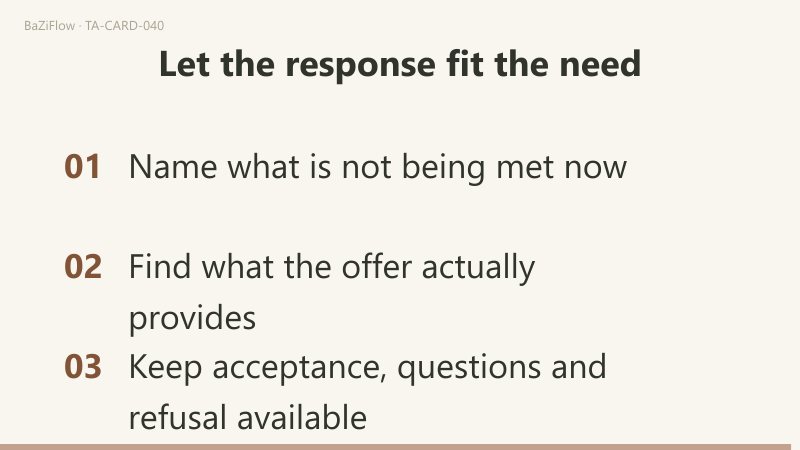
Rather than asking why you are not sufficiently open-minded, identify the relevant condition:
| Current concern | Information that could clarify it |
|---|---|
| The topic looks repetitive | Does the session include a different exercise or feedback? |
| The time conflicts with another commitment | Is there another date, or is declining this one appropriate? |
| The description is vague | What will participants actually do, for how long and at what level? |
Clarification is not a technique for forcing a yes. You may learn enough to decline with confidence. You may discover a useful feature and still decide that the time does not work. Different conditions can remain true together.
If what you want is an uncommitted period of rest, that need not be disguised as another productive plan. You can decline briefly. If you had already accepted, tell the organizer about the change so that their arrangements are not left relying on an outdated response.
Tutor feedback
- Tutor responds to each person’s work
Peer exchange
- Participants discuss one another’s work
Both may help, but they are not the same experience.
Leave the response area open
The diagram separates the three existing cups from the additional offer. A dashed route passes a small point of comparison before reaching an empty response area. Acceptance, a question or a refusal can occupy that space; the drawing does not mark one as inevitable.
Novelty and fit are different properties. A new title may cover familiar material, while a modest description may contain the particular feedback you have been seeking. A useful comparison names that feedback rather than relying on the general impression that new is better.
Compare the Ace of Cups, whose lesson concerns an opening of feeling and room to receive it. The Four sets existing options, a further offer and dissatisfaction beside one another. Receptivity does not require taking every cup offered.
Name the need
Here the need is feedback on personal work, not only a new topic.
Ask about the format
Will the tutor respond individually, or will peers discuss?
Include timing in the answer
If content fits but the date conflicts, ask about another session.
A reversed novelty term is still not an outcome
Waite’s reversed entry includes new instruction and new relations. The supplementary list supplies different short assignments. These are historical meanings, not evidence that the next event will introduce a specific person or change the reader’s life.
The additional-meanings chapter also acknowledges inconsistencies and limited pictorial connections. If an upright and reversed approach asks whether some new information has been overlooked, identify that as a modern inquiry. The information still needs to be found and assessed.
Suppose the organizer replies that the workshop includes individual feedback, which the earlier talks lacked. That is a concrete reason to reconsider. If the schedule remains impossible, the useful feature does not erase that constraint. The final choice can reflect both rather than becoming a verdict on whether you are positive enough.
Record the current need, the offer’s actual conditions and your response or remaining question. Lack of interest can be made more specific without being forced into a story of ingratitude or a missed destined chance.
Fits and works
- May accept
Details missing
- Ask what happens
Does not fit
- Decline or seek another date
Questions readers ask next
Is the Four of Cups a rebuke for failing to value opportunities?
Waite does use judgmental language for weariness and discontent, but that is not a reason to reproach a reader. The scene leaves a gap between an offer and its reception. Its usefulness depends on which actual need it answers.
Should the fourth cup always be accepted?
No. It is another offer, not a description of a real event’s content, timing and intended participants. Clarification may support acceptance or refusal. If the activity genuinely fits and is feasible, an initially uninterested person may also reconsider.
How can tiredness and unsuitable content be distinguished?
Ask separately whether rest is wanted and whether the event offers repeated instruction, tutor feedback or peer practice. More than one answer may apply. The event’s details and the person’s wishes are more useful than labeling all reluctance closed-mindedness.
Was this article helpful?
Sources & references
Continue reading
Ace of Cups: an opening of feeling is not a promised relationship ↗